




- Food Ingredients & Additives
- Fruit Flavors Market
Fruit Flavors Market Size, Share, Growth, and Regional Forecast, 2026 to 2033
Fruit Flavors Market by Flavor Type (Citrus, Berries, Tropical, Stone Fruits, Apple & Pear, and Melons), by Form (Powder, Liquid, Syrup, and Paste), by Application (Food & Beverages, Pharmaceuticals, Nutraceuticals, Personal Care & Cosmetics, and Pet Food) by Distribution Channel (Supermarkets/Hypermarkets, Specialty Stores, Online Retail, and Convenience Store), and Regional Analysis from 2026 to 2033

Fruit Flavors Market Share and Trend Analysis
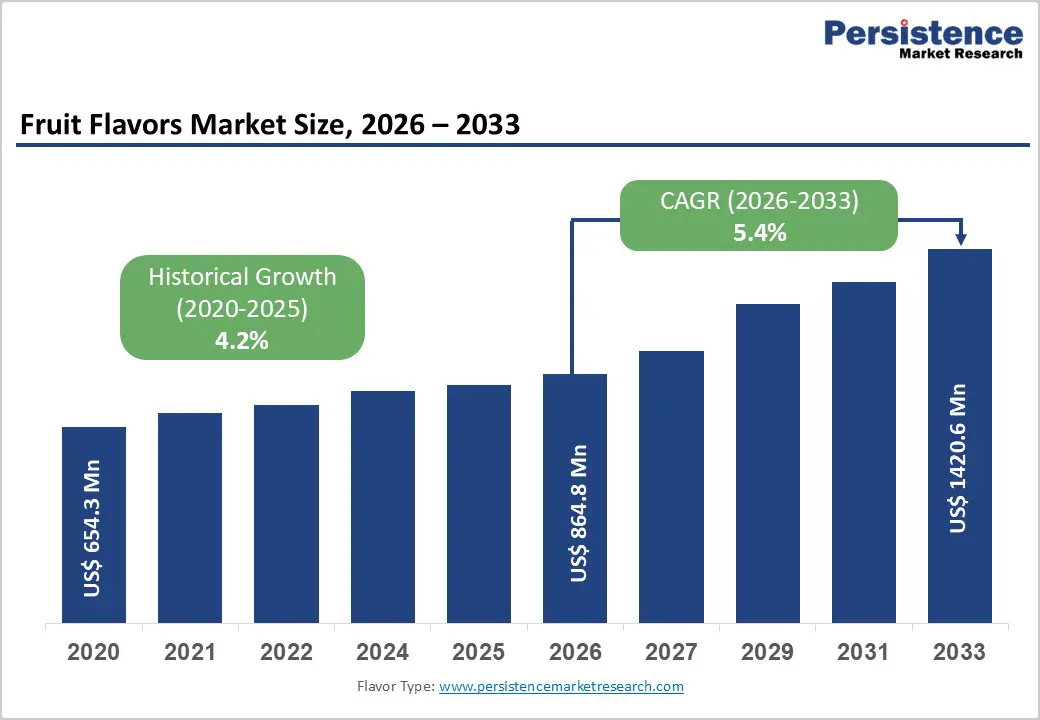
The global fruit flavors market size is estimated to grow from US$ 864.8 million in 2026 to US$ 1420.6 million by 2033. The market is projected to record a CAGR of 5.4% during the forecast period from 2026 to 2033.
Shifting consumer inclination toward natural and fruit-derived taste enhancers is significantly boosting the adoption of fruit flavors across the food, beverage, and nutraceutical industries. As demand for clean-label and minimally processed products rises, fruit flavors are increasingly used to replace synthetic additives while maintaining sensory appeal. Their versatility across carbonated beverages, flavored water, dairy, confectionery, and functional foods makes them essential in modern product development.
Additionally, growing interest in health-oriented consumption is encouraging the use of fruit flavors in dietary supplements and wellness products. Continuous progress in extraction methods, encapsulation, and flavor stabilization technologies has enhanced authenticity, shelf life, and application performance. Alongside expanding global supply chains and strategic partnerships, fruit flavors are becoming central to innovation in premium, natural, and functional product formulations.
Key Industry Highlights:
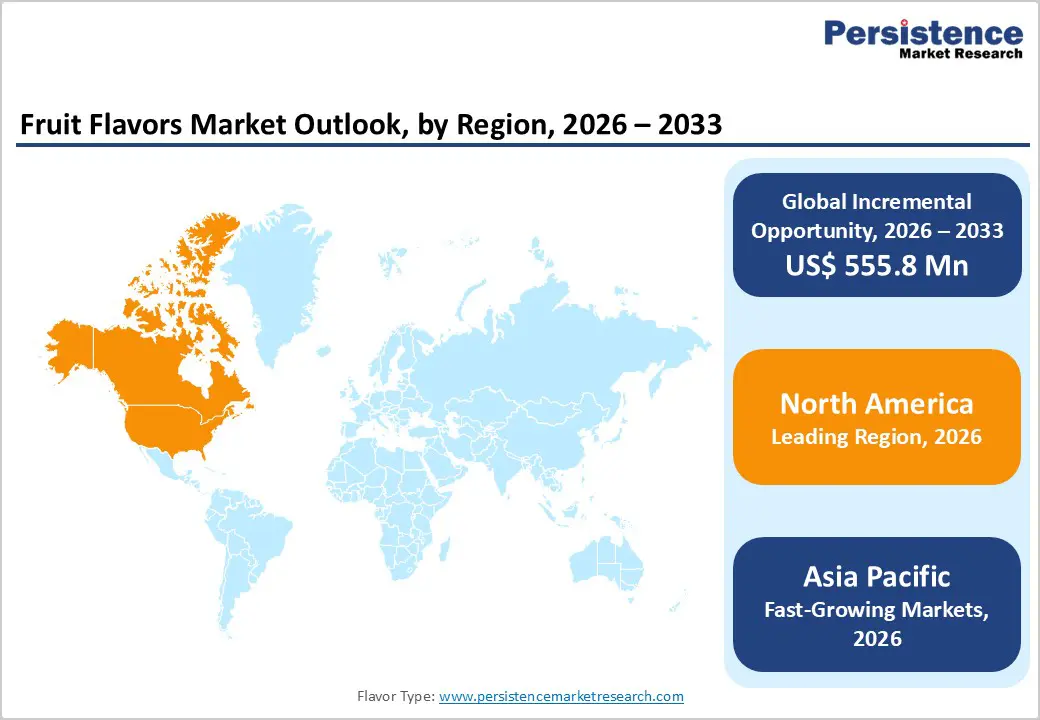
- Leading Region: North America accounts for 46.7% of the market, supported by a mature food and beverage sector, strong innovation in flavor technologies, and high consumer inclination toward natural ingredient-based products.
- Fastest-Growing Region: Asia Pacific is expanding rapidly, driven by urbanization, rising disposable incomes, and increasing demand for flavored beverages and processed foods across emerging economies.
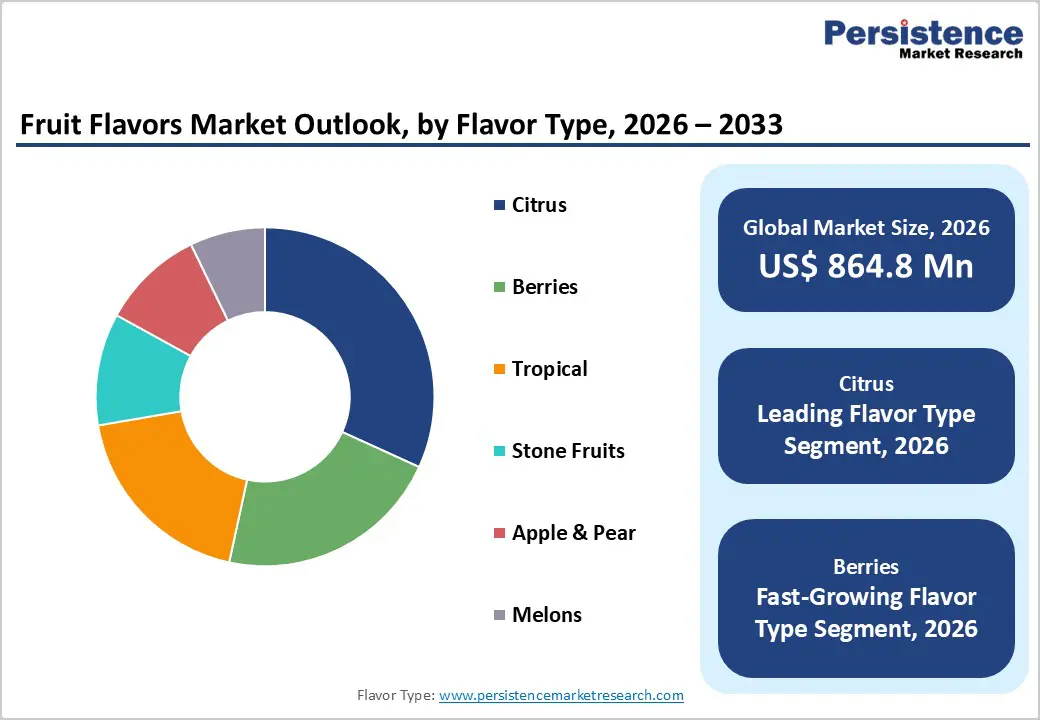
- Leading Flavor Type Segment: Citrus holds a 31.8% share, owing to its widespread acceptance, refreshing taste profile, and extensive application across beverages, dairy, and confectionery products.
- Fastest-Growing Flavor Type Segment: Berries are gaining strong momentum as consumers shift toward premium, antioxidant-rich, and naturally appealing flavor profiles in health-focused applications.
- Leading Application Segment: Food & Beverages lead with a 62.7% share, supported by large-scale usage in soft drinks, ready-to-drink beverages, dairy, and bakery products.
- Fastest-Growing Application Segment: Pharmaceuticals is witnessing notable growth, with increasing incorporation of fruit flavors in syrups, chewables, and nutraceutical formulations to improve taste and patient compliance.
| Key Insights | Details |
|---|---|
| Fruit Flavors Market Size (2026E) | US$ 864.8 Mn |
| Market Value Forecast (2033F) | US$ 1420.6 Mn |
| Projected Growth (CAGR 2026 to 2033) | 5.4% |
| Historical Market Growth (CAGR 2020 to 2025) | 4.2 % |
DRO Analysis
Driver - Growing Demand for Natural, Clean-Label Ingredients in Food and Beverage Formulations
A pronounced shift in consumer preference toward natural and recognizable ingredients is significantly accelerating the adoption of fruit flavors across global industries. Increasing awareness around the health implications of synthetic additives, coupled with rising demand for clean-label products, is encouraging manufacturers to replace artificial flavoring agents with fruit-derived alternatives. Consumers today actively seek transparency in ingredient sourcing, favoring products formulated with natural extracts, concentrates, and essences. This trend is particularly evident in beverages, dairy, confectionery, and functional foods, where fruit flavors enhance taste while aligning with health-conscious positioning.
Additionally, rapid product innovation within ready-to-drink beverages, flavored water, plant-based dairy, and fortified snacks is creating sustained demand for diverse fruit flavor profiles. Manufacturers are leveraging advanced extraction, encapsulation, and stabilization technologies to improve flavor authenticity, shelf stability, and heat resistance during processing. The rise of premiumization in food and beverages has further strengthened the use of exotic and region-specific fruit flavors to differentiate products. Simultaneously, regulatory frameworks promoting natural ingredient usage are supporting market expansion. As global consumption patterns continue to evolve toward healthier and minimally processed foods, fruit flavors are becoming integral to formulation strategies, driving consistent growth across multiple application segments.
Restraints - Stability Constraints, Cost Pressures, and Variability in Natural Raw Material Supply
Despite strong demand momentum, several structural challenges continue to limit the large-scale adoption of fruit flavors. One of the primary concerns is the stability of natural flavor compounds, which are often sensitive to heat, light, and oxidation during processing and storage. Maintaining consistent flavor intensity and sensory performance across different product formulations requires sophisticated technologies, increasing production complexity. Additionally, natural fruit flavors typically involve higher costs compared to synthetic alternatives due to extraction processes, raw material sourcing, and quality control requirements. This creates pricing challenges, particularly in cost-sensitive markets and mass-produced food categories.
Supply chain variability also presents a significant constraint. Fruit flavor production depends heavily on agricultural outputs, which are subject to seasonal fluctuations, climatic conditions, and regional availability. Any disruption in crop yield or quality can directly impact pricing and supply continuity. Furthermore, ensuring uniformity in flavor profiles across batches is challenging due to natural variations in raw materials. Regulatory compliance related to labeling, authenticity, and permissible usage levels varies across regions, adding another layer of complexity. To address these issues, manufacturers often invest in blending techniques and stabilization solutions, which can extend development timelines and increase overall formulation costs.
Opportunity - Rising Demand for Functional Foods, Exotic Flavors, and Technological Advancements in Flavor Delivery
Expanding applications in functional and health-oriented food categories are creating significant growth opportunities for fruit flavors globally. As consumers increasingly gravitate toward fortified foods, nutraceuticals, and wellness beverages, fruit flavors play a critical role in enhancing palatability while supporting product positioning. They are widely incorporated into protein drinks, dietary supplements, probiotic products, and plant-based formulations, where taste optimization is essential for consumer acceptance. The growing popularity of personalized nutrition and health-focused consumption patterns further strengthens demand for customized flavor solutions.
Moreover, there is a notable shift toward exotic and regionally inspired fruit flavors such as dragon fruit, passion fruit, guava, and yuzu, particularly among younger consumer demographics seeking novel taste experiences. This trend is encouraging manufacturers to diversify their flavor portfolios and invest in innovation. Technological advancements, including microencapsulation, controlled-release systems, and fermentation-based flavor production, are improving stability, scalability, and cost efficiency. Emerging markets across Asia Pacific and Latin America present untapped potential due to changing dietary habits and increasing disposable incomes. Collectively, these factors are enabling companies to expand their offerings and capture new revenue streams in an increasingly dynamic global flavor landscape.
Category-wise Analysis
By Flavor Type Insights
Citrus flavors are projected to remain the dominant segment in the global fruit flavors market in 2026, accounting for 31.8% of total revenue. Their leadership is driven by widespread consumer acceptance, refreshing taste profile, and strong compatibility across beverages, dairy, and confectionery products. Orange, lemon, and lime flavors are extensively used in carbonated drinks, juices, flavored water, and functional beverages due to their ability to deliver a balanced sweet-tangy profile. Additionally, citrus flavors play a key role in masking bitterness in nutraceutical and pharmaceutical formulations. Advancements in flavor extraction and encapsulation technologies have enhanced stability, shelf life, and sensory consistency. Growing demand for clean-label and natural ingredients has further accelerated the adoption of citrus-derived flavors. With continuous product innovation and expansion into wellness-oriented applications, citrus remains the most commercially significant flavor category.
By Application Insights
The food & beverages segment is expected to hold the largest share in 2026, contributing 62.7% of total revenue. Its dominance is attributed to the extensive incorporation of fruit flavors in beverages, dairy products, bakery items, and confectionery. Beverage manufacturers represent the largest consumers, utilizing fruit flavors in carbonated drinks, ready-to-drink beverages, energy drinks, and flavored water to enhance taste appeal and product differentiation. In addition, dairy applications such as yogurts, flavored milk, and desserts rely heavily on fruit-based flavor systems. The segment also benefits from rising demand for functional and fortified foods, where flavors improve palatability. Technological advancements in flavor delivery systems have improved heat stability and consistency during large-scale processing. As consumers increasingly prefer natural and recognizable ingredients, fruit flavors continue to play a critical role in product innovation and reformulation across the global food and beverage industry.
By Distribution Channel Insights
Supermarkets and hypermarkets are anticipated to account for 34.6% of total market revenue in 2026, making them the leading distribution channel. Their dominance is supported by extensive product availability, strong supply chain networks, and the ability to offer a wide variety of flavored food and beverage products under one roof. These retail formats enable consumers to compare brands, explore new flavor variants, and make informed purchasing decisions. In addition, organized retail chains frequently introduce private-label products incorporating fruit flavors, further expanding market reach. Promotional activities, in-store sampling, and strategic shelf placements enhance visibility and drive impulse purchases. The segment also benefits from increasing urbanization and changing consumer lifestyles, which favor convenient shopping experiences. While online retail is expanding rapidly, supermarkets and hypermarkets continue to lead due to their scale, accessibility, and ability to support high-volume sales.
Region-wise Insights
North America Fruit Flavors Market Trends
North America is projected to account for 46.7% of the global fruit flavors market value in 2026, with the United States serving as the primary contributor. The region benefits from a highly advanced food and beverage sector that continuously introduces new flavored products to meet evolving consumer preferences. Strong demand for clean-label, natural, and functional ingredients has encouraged manufacturers to incorporate fruit-based flavors across beverages, dairy, and packaged foods. Innovation remains a key differentiator, with companies investing heavily in advanced extraction, formulation, and encapsulation technologies to enhance flavor authenticity and stability.
Consumer awareness regarding health and wellness has also influenced purchasing behavior, driving demand for products with recognizable and natural ingredients. Additionally, the presence of major global flavor houses and a well-established distribution infrastructure supports consistent product availability. Regulatory frameworks ensure product quality and safety, facilitating faster commercialization of new flavor formulations. The region’s strong retail ecosystem, combined with high disposable income levels, enables rapid adoption of premium and innovative fruit flavor solutions, reinforcing North America’s leadership position.
Europe Fruit Flavors Market Trends
Europe represents a mature yet innovation-driven market, supported by stringent regulatory standards and a strong emphasis on ingredient transparency. Key countries such as Germany, France, the United Kingdom, Italy, and Spain play a significant role in shaping regional demand. Consumers in Europe increasingly prefer products formulated with natural and sustainably sourced ingredients, encouraging manufacturers to shift toward fruit-derived flavor systems.
Beverage innovation remains a core growth area, particularly in low-sugar and functional drinks, where fruit flavors enhance taste without compromising health positioning. The region also demonstrates strong demand in bakery, dairy, and confectionery applications. Sustainability initiatives, including responsible sourcing and eco-friendly processing methods, are gaining importance among manufacturers. Furthermore, well-defined regulatory policies ensure consistent quality standards, strengthening consumer confidence. The presence of advanced R&D capabilities and a focus on premium product development continue to position Europe as a technologically sophisticated and stable market for fruit flavors.
Asia Pacific Fruit Flavors Market Trends
Asia Pacific is expected to be the fastest-growing region, expanding at a CAGR of approximately 7.3% between 2026 and 2033. Rapid urbanization, rising disposable incomes, and evolving dietary habits are key factors driving demand across countries such as China, India, Japan, and South Korea. Consumers are increasingly shifting toward packaged foods and beverages with enhanced taste profiles, boosting the adoption of fruit flavors across multiple applications.
The beverage industry remains a major growth engine, with manufacturers introducing region-specific and tropical flavor variants to cater to local preferences. In addition, expanding dairy and confectionery sectors are incorporating fruit flavors to diversify product offerings. China plays a crucial role as both a producer and consumer, supported by large-scale processing capabilities. Meanwhile, India and Southeast Asia are witnessing growing demand for flavored functional foods and beverages. Government initiatives supporting food processing industries and agricultural development further strengthen market expansion. With a large consumer base and dynamic consumption patterns, Asia Pacific continues to offer significant growth potential for fruit flavor manufacturers.
Competitive Landscape
The global fruit flavors market is highly competitive, with strong participation from Archer Daniels Midland Company, Givaudan, DÖHLER, MANE, FONA International, Inc., and Flavaroma. These companies leverage advanced extraction technologies, encapsulation techniques, and fermentation-based processes, along with global distribution networks, to enhance flavor authenticity, stability, and application versatility across food, beverages, nutraceuticals, and personal care. Rising demand for natural and clean-label ingredients is accelerating innovation. Manufacturers are expanding production capabilities, strengthening sourcing networks, ensuring regulatory compliance, and increasing R&D investments to develop next-generation fruit flavor solutions.
Key Developments:
- In March 2026, Kagome introduced an orange-flavored juice developed without using actual oranges. The product leverages advanced flavor formulation techniques to replicate the sensory profile of real orange juice. This innovation highlights the company’s focus on sustainable sourcing and alternative ingredient solutions, while addressing supply chain constraints and evolving consumer preferences for novel beverage concepts.
- In October 2025, I.T.S Taste introduced a new range of crossbreed fruit flavors aimed at enhancing product differentiation and sparking consumer curiosity. The portfolio blends unique fruit profiles to deliver novel taste experiences tailored for beverages, confectionery, and dairy applications. This launch reflects the company’s focus on innovation and evolving consumer demand for exotic and hybrid flavor combinations.
- In March 2025, Rasna launched its “Rasna Rich” powder concentrate range in multiple flavors. Mango, widely known as the king of fruits, was positioned as the flagship variant due to its strong consumer preference and consistent sales performance. The launch aims to strengthen the brand’s presence in the premium beverage concentrate segment while catering to evolving taste preferences.
Companies Covered in Fruit Flavors Market
- Archer Daniels Midland Company
- Givaudan
- DÖHLER
- MANE
- FONA International, Inc.
- Flavaroma
- Kerry Group
- Sensient Technologies Corporation
- Takasago International Corporation
- Flavor Producers, LLC
- Citromax Flavors
- International Flavors & Fragrances Inc. (IFF)
- Symrise AG
- DSM-Firmenich AG
- Robertet Group
- Others
Frequently Asked Questions
The global fruit flavors market is projected to be valued at US$ 864.8 Mn in 2026.
Rising demand for natural, clean-label ingredients and increasing consumption of flavored products across food, beverages, and nutraceuticals drive market growth.
The global fruit flavors market is poised to witness a CAGR of 5.4% between 2026 and 2033.
Expansion in functional foods, plant-based products, and emerging markets, along with innovation in exotic and customized fruit flavors, creates strong growth opportunities.
Archer Daniels Midland Company, Givaudan, DÖHLER, MANE, FONA International, Inc., and Flavaroma are some key players in the fruit flavors market.


