




- Healthcare
- Microsurgery Market
Microsurgery Market Size, Share, Trends, Growth, and Regional Forecast, 2026 to 2033
Microsurgery Market by Product Type (Operating Microscopes, Micro forceps, Micro scissors, Micro needle holders, Robotic Assisted Systems), Procedure Type (Free Tissue Transfer, Transplantation Procedures, Infertility Related Microsurgeries, Suture and Grafting Procedures, Others), Application (Neurology, Ophthalmic , Plastic & Reconstructive , ENT (Otolaryngology), Orthopedic, Oncology-related ,Others), End-user, and Regional Analysis from 2026 to 2033

Microsurgery Market Share and Trends Analysis
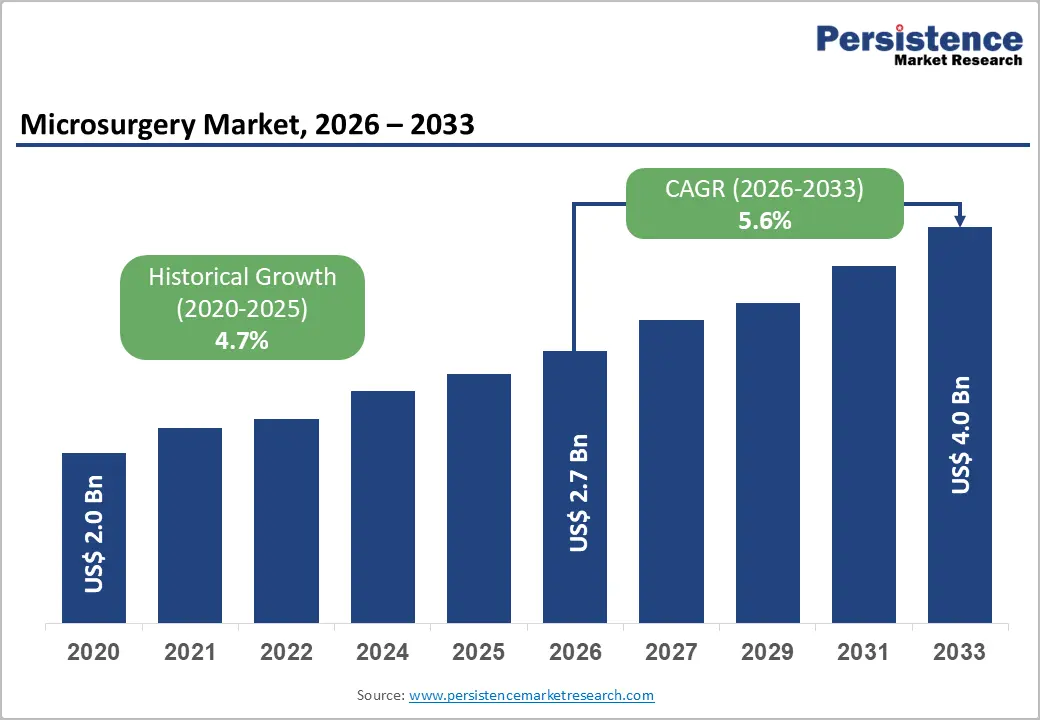
The global microsurgery market size is estimated to grow from US$ 2.7 billion in 2026 to US$ 4.0 billion by 2033, growing at a CAGR of 5.6% during the forecast period from 2026 to 2033.
The global microsurgery market is expanding steadily, driven by aging populations, increasing healthcare demands, and advanced surgical needs. North America leads owing to robust infrastructure and high levels of technology adoption. Asia-Pacific is the fastest-growing region, driven by improved healthcare access, supportive government initiatives, rising medical device manufacturing, and increased investment in innovative microsurgical technologies.
Key Industry Highlights:
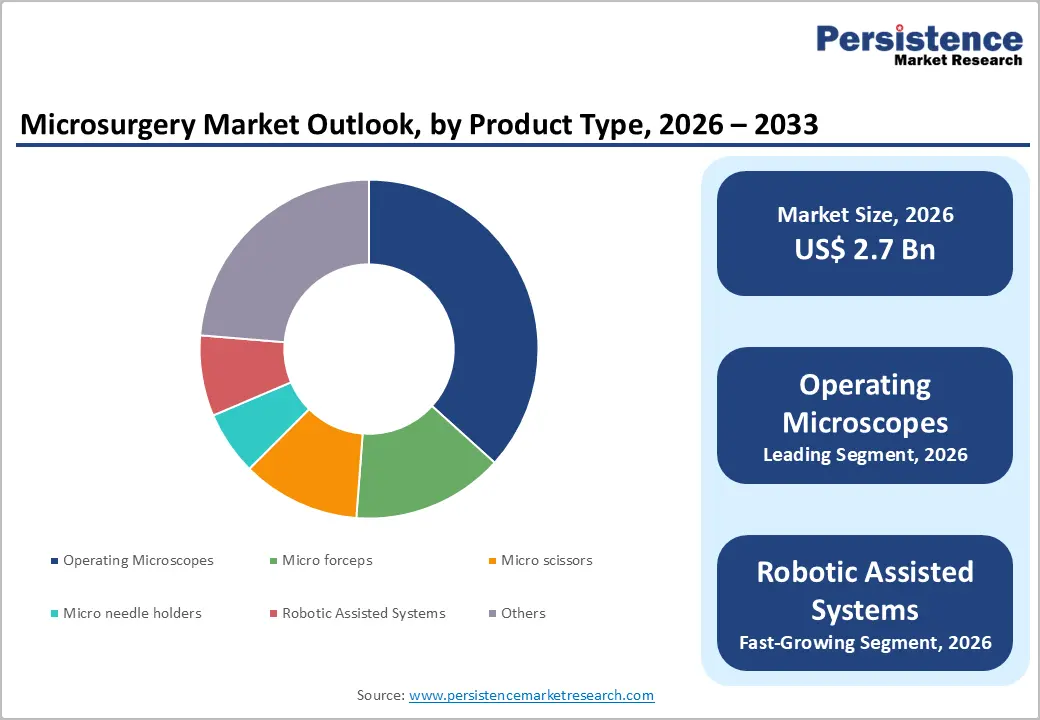
- Dominant Segment: Operating microscopes hold 36.7% share in 2025, driven by essential use in reconstructive, neurological, and ophthalmic procedures, precision requirements, and integration with advanced imaging and navigation systems.
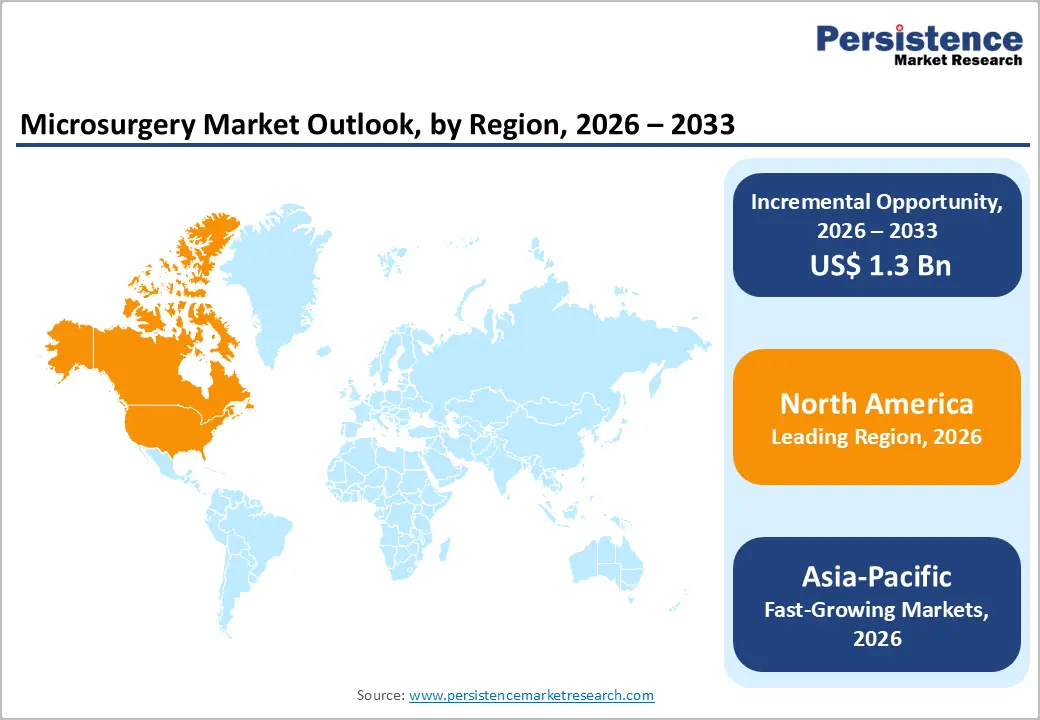
- Dominant Region: North America leads in 2025, with a 39.3% share, supported by advanced healthcare infrastructure, high adoption of microsurgical techniques, and stringent regulatory standards. Asia-Pacific is the fastest-growing region, driven by expanding healthcare access, government initiatives, rising patient awareness, and increasing investment in medical technologies.
- Market Drivers: Growth is driven by rising demand for complex reconstructive procedures, technological advances in microsurgical instruments, the increasing prevalence of chronic diseases, and the expansion of surgical infrastructure.
- Market Opportunity: Key opportunities include the adoption of robotic-assisted microsurgery, expansion of reconstructive and transplantation procedures, growth in emerging economies, integration with digital imaging and navigation systems, and the development of multifunctional instruments that improve precision, efficiency, and patient outcomes.
| Global Market Attributes | Key Insights |
|---|---|
| Microsurgery Market Size (2026E) | US$ 2.7 Bn |
| Market Value Forecast (2033F) | US$ 4.0 Bn |
| Projected Growth (CAGR 2026 to 2033) | 5.6% |
| Historical Market Growth (CAGR 2020 to 2025) | 4.7% |
Market Dynamics
Driver: Increasing Demand for Advanced Visualization Technologies
Advanced visualization technologies, such as high-definition optical microscopes, 3D imaging, augmented reality overlays, and robotic-assisted platforms, are central to modern microsurgery because they significantly enhance surgical precision and outcomes. Surgical microscopes with integrated digital imaging enable magnification beyond 40× and enhanced depth perception, allowing surgeons to visualize tiny blood vessels, nerves, and tissue planes that are otherwise extremely difficult to see with the naked eye. This capability is particularly important in neurosurgical, ophthalmic, and reconstructive microsurgeries where structures smaller than 1 mm must be manipulated accurately without trauma.
Adoption of these technologies has been rising sharply; global microsurgical procedures have increased alongside growth in minimally invasive surgery volumes, with traditional microscope use expanding in areas like ENT, ophthalmology, and neurovascular procedures.
Data from the surgical microscopes sector shows that high-definition, AI-assisted systems, and robotic-mounted visualization tools comprise a growing portion of surgical hardware installations globally, with approximately 12,000 advanced systems deployed worldwide that support ergonomic, heads-up displays and advanced imaging functions. These technologies not only improve surgical accuracy but also reduce operative time and surgeon fatigue, directly addressing clinical demand for precision and efficiency.
The rising volume of complex microsurgeries, including trauma repair and tumor resections, reinforces this trend, making advanced visualization one of the strongest drivers of microsurgery market expansion.
Restraints: High Cost of Advanced Microsurgical Equipment
The high cost of advanced microsurgical equipment remains one of the most significant restraints on the widespread adoption and growth of the microsurgery market. Microsurgical tools, such as operating microscopes, robotic arms, and digital imaging systems, incorporate precision optics, AI modules, and robotic mechanics, all of which substantially increase unit prices relative to conventional surgical instruments. For example, high-end robotic surgical systems used in microsurgery can cost around US$2 million per unit in the U.S., representing a major capital expenditure for hospitals and surgical centers, particularly in cost-sensitive settings.
Beyond initial procurement costs, ongoing maintenance, regular calibration of high-precision optics, software upgrades, and specialized consumables further increase the financial burden on facilities. India’s medical device landscape even as it expands, continues to rely heavily on imports for high-technology devices (MRI, CT, robotic systems), indicating that imported surgical equipment still dominates and often commands a high price premium. The government’s renewed focus on local manufacturing underscores how import dependence and equipment cost remain barriers.
Imported high-end devices not only entail higher acquisition costs but also incur additional costs, such as import duties and foreign exchange effects, thereby compounding affordability challenges for hospitals and clinics.
Opportunity: Growth of Local Manufacturing under Make-in-India Initiatives
Local manufacturing initiatives under Make in India and associated medical device policies present a significant opportunity to make the microsurgery market more affordable and self-sustaining. India’s medical devices industry, officially recognized as a sunrise sector, was valued at approximately INR 1,02,660. crore (US$12 billion) in FY24 and is projected to reach INR4,27,750 crore (US$ 50 billion) by 2025, representing strong structural growth and increased domestic production capacity.
Government schemes such as the Production Linked Incentive (PLI) for medical devices provide financial incentives (5% on incremental sales) for domestic manufacturing of high-value equipment, directly addressing import dependence in advanced medical tech.
As of 2024, under the PLI scheme, 19 greenfield projects had been commissioned to manufacture 44 products, including high-end devices previously imported, such as imaging and diagnostic systems. The government’s focus on creating medical device parks and clusters (21 clusters across major states) further builds infrastructure support, lowering production costs and creating shared testing and development facilities that are critical for sophisticated microsurgical tools.
Category-wise Analysis
By Product Type Insights
Operating microscopes are leading with 36.7% share in 2025, essential in virtually all microsurgical specialties because they provide high magnification, bright illumination, and enhanced visualization of fine anatomical structures, enabling surgeons to safely work on blood vessels and nerves that are often 1 mm or less in diameter, which the naked eye cannot reliably see. Microsurgery is defined as surgery that requires microscopes; without them, procedures such as microvascular anastomosis and nerve repair are not feasible.
Advanced versions now integrate imaging modalities such as fluorescence and optical coherence tomography, further improving surgical precision across neurosurgery, ophthalmology, ENT, and plastic reconstruction. Because they are used in the majority of complex procedures requiring magnification and precision, operating microscopes form the foundation of microsurgical practice and thus command the largest share of equipment utilization.
By Procedure Type Insights
Free tissue transfer (free flap) procedures dominate the microsurgery procedure segment because they address large and complex defects that cannot be repaired by local tissue movement or simple grafts. In free tissue transfer, tissue with its own blood supply is completely detached and re-attached at the defect site, requiring extremely precise microvascular anastomosis under a microscope. This technique is widely used for trauma reconstruction, oncologic defect repair, and functional restoration, making it indispensable in high-complexity reconstructive cases.
Clinical literature reports high success rates, with many centers achieving survival rates of 88–100% for free flaps, underscoring its efficacy and broad adoption in surgical practice. Its ability to restore form and function in significant tissue loss makes free tissue transfer the most frequently performed and clinically impactful microsurgical procedure type worldwide.
Regional Insights
North America Microsurgery Market Trends
North America leads the global microsurgery market because of its advanced healthcare infrastructure, high procedural volumes, and strong technology adoption. The region accounts for approximately 39.3% of the global microsurgery market share, owing to the extensive use of microsurgical techniques in reconstructive, neurological, and ophthalmic surgeries, supported by well-equipped hospitals and specialty centers. The United States has one of the highest healthcare expenditures globally, at around 17–18% of GDP, significantly above OECD averages, enabling investment in advanced surgical equipment and training.
Additionally, North America has a large, aging population with a growing burden of chronic conditions requiring microsurgical intervention, coupled with strong insurance reimbursement systems that support complex procedures. These factors collectively sustain the region’s leadership in both market revenue and procedural adoption.
Europe Microsurgery Market Trends
Europe is a key regional market for microsurgery due to its robust healthcare systems, high surgical standards, and significant population of older adults requiring intricate surgical care. The region accounts for roughly 26.4% of the global microsurgery market, making it the second-largest market worldwide. European countries such as Germany, France, and the UK perform a high volume of reconstructive, vascular, and nerve surgeries owing to well-established hospitals and specialist training programs that emphasize precision care.
Europe’s aging demographic, where a high proportion of individuals over 60 contributes to increased demand for surgical interventions, further reinforces microsurgical utilization. Additionally, integrated healthcare systems and coordinated surgical training across EU member states support consistent adoption of advanced microsurgical procedures, strengthening the region’s presence in the global market.
Asia Pacific Microsurgery Market Trends
Asia-Pacific is the fastest-growing regional market for microsurgery, driven by rapid healthcare expansion, rising surgical demand, and increasing investments in medical infrastructure. Population trends indicate that the Asia-Pacific population is aging rapidly, with projections indicating dramatic growth in older age groups, thereby increasing the need for complex surgeries, including reconstructive and nerve repair procedures.
Government initiatives to improve healthcare access and infrastructure, alongside rising patient awareness and urbanization, are driving increased volumes of microsurgery procedures. Growing medical tourism and expanding specialist training capacity also contribute, making the Asia-Pacific region the leading region in near-term growth rates for microsurgical technologies and services.
Competitive Landscape
The global microsurgery market is highly competitive, with key players including Carl Zeiss Meditec, Leica Microsystems, Stryker, Intuitive Surgical, and Olympus. Companies compete through advanced product innovation, robotic-assisted systems, strategic partnerships, and regional expansion. Focus on high-precision instruments and digital integration drives differentiation and market share growth.
Key Industry Developments:
- In December 2025, Medtronic received FDA clearance for its Hugo™ robotic-assisted surgery system for urologic procedures. The approval allows the Hugo system to be used in hospitals and surgical centers across the U.S. for procedures such as prostatectomies and kidney surgeries.
- In September 2025, Meril launched the Mizzo Endo 4000, a next-generation robotic surgery system, setting a new benchmark in minimally invasive procedures. The system was designed to enhance surgical precision, provide 3D visualization, and improve ergonomics for surgeons, particularly in complex procedures.
Companies Covered in Microsurgery Market
- Medtronic
- Meril Life Sciences
- Scanlan International
- KLS Martin Group
- Integra LifeSciences Corporation.
- B. Braun SE
- Leica Microsystems
- Medical Microinstruments, Inc.
- Terumo Corporation
- Stryker
- Microtrack Surgicals
- TOPMOST INSTRUMENTS CORPORATION OF INDIA
- SHREEJI MICRO SYSTEMS INC.
- Western Surgical
- Appasamy Associates
- Trivitron Healthcare
- Others


