




- Medical Devices
- Microdermabrasion Devices Market
Microdermabrasion Devices Market Size, Share, Growth, and Regional Forecast, 2026 to 2033
Microdermabrasion Devices Market by Product Type (Crystal, Diamond), Application (Acne and Scars, Photo Damage, Anti-aging, Hyperpigmentation, Stretch Marks, Others), End-user, and Regional Analysis from 2026 to 2033

Microdermabrasion Devices Market Share and Trends Analysis
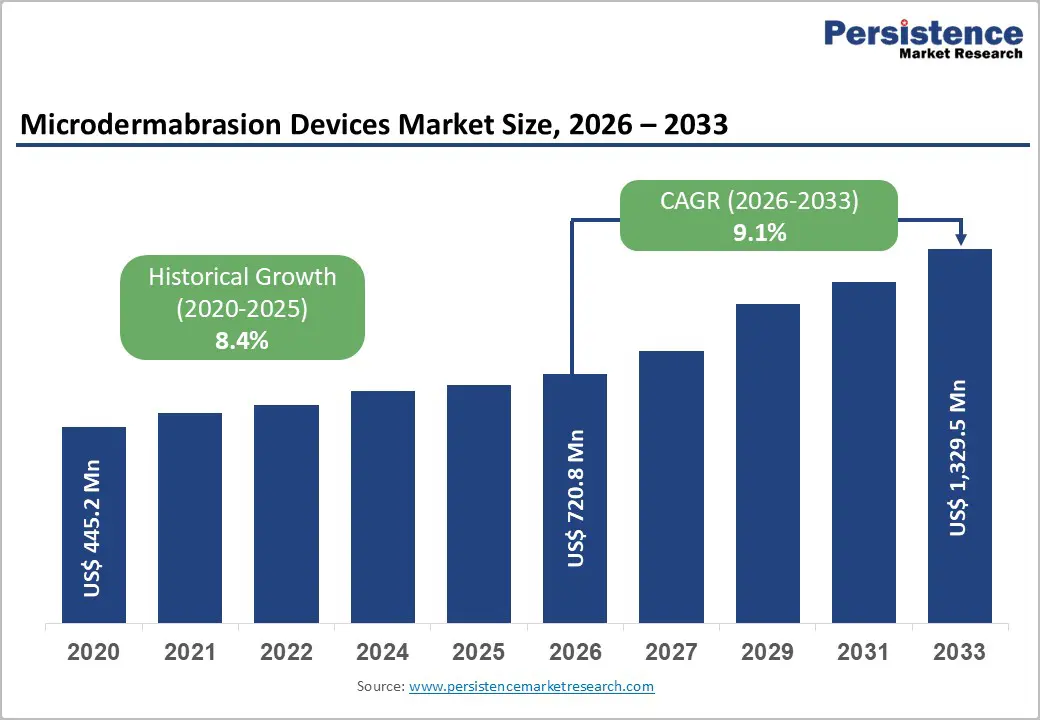
The global microdermabrasion devices market size is expected to be valued at US$ 720.8 million in 2026 and projected to reach US$ 1,329.5 million by 2033, growing at a CAGR of 9.1% between 2026 and 2033. Rising incidence of skin-related disorders and high demand for such devices worldwide are driving sales of microdermabrasion equipment. Skin-related conditions are influenced by climate and lifestyle.
According to online studies, North America has a high prevalence of psoriasis and eczema, with 25-30 cases per 100,000 people, reflecting increased awareness and diagnostic resources. Western Europe experiences 19 to 20 cases due to fair-skinned populations and sun exposure. The demand for skincare devices is estimated to boost in these regions. The home skincare device industry is surging due to its low cost and ease of use. Professional treatments may be performed at home with devices such as LED therapy and microdermabrasion. Accessibility and efficacy have improved due to technological advancements and greater consumer awareness.
Key Industry Highlights
- Demand for microdermabrasion devices is increasing rapidly due to the growing emphasis on achieving flawless skin, particularly among women.
- The increasing prevalence of skin conditions such as acne, scars, and aging is driving demand for effective treatments.
- The popularity of social media and the desire for a flawless appearance have significantly increased demand for cosmetic devices.
- In 2025, crystal devices are expected to capture 59.3% due to their ability to efficiently remove dead skin cells.
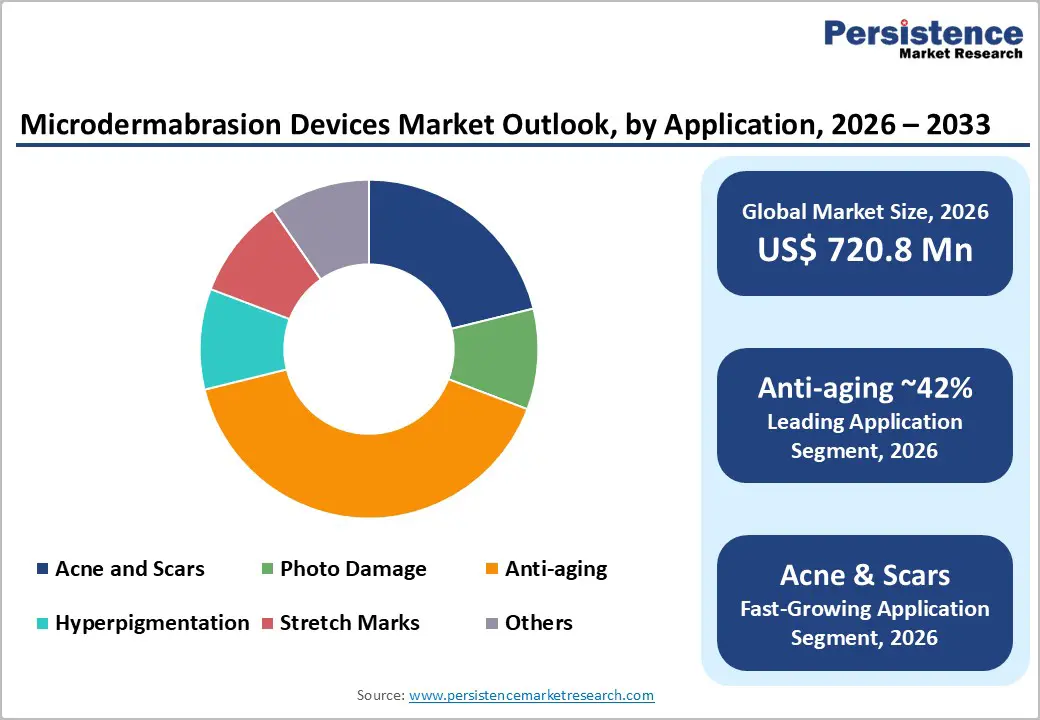
- Based on applications, the anti-aging segment is projected to account for 36.5% in 2025, driven by rising demand from the growing geriatric population.
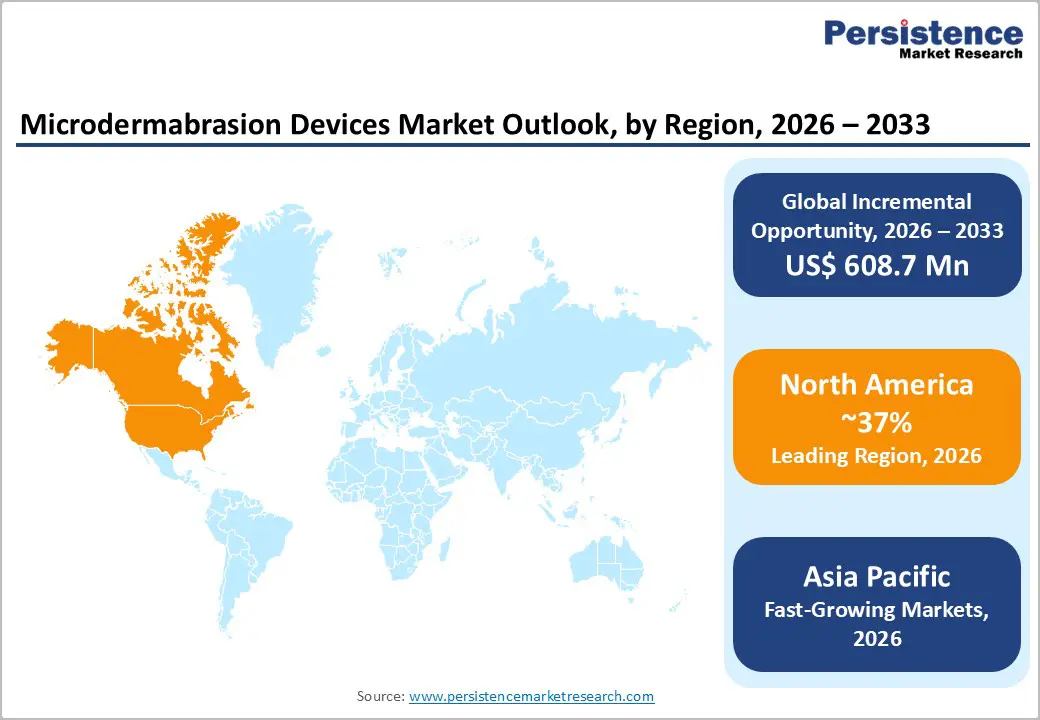
- Owing to advances in skincare technology, North America is projected to account for 41.3% in 2025.
| Key Insights | Details |
|---|---|
| Microdermabrasion Devices Market Size (2026E) | US$ 720.8 Mn |
| Market Value Forecast (2033F) | US$ 1329.5 Mn |
| Projected Growth (CAGR 2026 to 2033) | 9.1% |
| Historical Market Growth (CAGR 2020 to 2024) | 8.4% |
Market Dynamics
Driver - Rising Prevalence of Skin Conditions like Acne Supports Market Expansion
The global microdermabrasion devices market is anticipated to surge due to the rise in skin-related conditions, which are among the leading causes of human illness. For instance, among the more than 900 million people affected by skin diseases, five common conditions account for over 80% of these cases, boosting demand for non-invasive treatments such as microdermabrasion.
Developments in device technology, increased patient awareness, and rising skin care applications, including acne and anti-aging treatments, are supporting market growth. The rising prevalence of skin conditions is expected to drive demand for skincare devices. For instance, according to studies, eczema affects around 15-30% of children and 2-10% of adults worldwide. Acne, on the other hand, often persists in adulthood, affecting nearly 12 to 14% of adults. Among adolescents, the condition’s prevalence rate is around 85%.
Trend of Non-invasive Cosmetic Procedures to Foster Demand
The increased demand for non-invasive cosmetic procedures and growing self-consciousness about one's appearance are expected to drive demand for microdermabrasion machines. To satisfy these desires, dermatologists are providing highly lucrative cosmetic procedures.
Microdermabrasion devices are set to be adopted by practice management companies that use technology to attract, retain, and engage patients. The market for microdermabrasion equipment is likely to grow over the next 10 years. This is because such treatments can address surface concerns, including fine lines, dull skin, mild to severe acne, and dark spots. For example, according to several sources, between 25 and 35% of adults report having dark spots or hyperpigmentation on their faces. Because of their high melanin synthesis, those with darker skin tones (Fitzpatrick skin types III-VI) are more likely to have it. In some groups, prevalence rates can reach 40-50%.
Restraints - High Risk of Swelling and Skin Infections to Limit Adoption
The demand for microdermabrasion appliances is likely to decrease due to potential infections, redness, and swelling resulting from insufficient vacuum and inadequate applicator sanitization. Social stigma and concerns about aesthetic treatments may also hinder access to these services.
Cosmetic surgery complications have increased by 44% in the U.K. In countries with high medical tourism, such as Türkiye, accredited professionals and transparent follow-up care are crucial for mitigating risks.
Ethical transgressions in plastic surgery have further restricted the use of these devices, potentially limiting market expansion. Hence, the success of skincare equipment depends on its proper use and sanitization.
Opportunity - Surging Popularity of At-home Treatments to Forge Fresh Prospects
Demand for affordable, user-friendly skincare devices is on the rise amid surging cases of skin conditions such as acne, scars, and aging. Social media and beauty influencers are driving this trend, while the aging population is increasingly interested in anti-aging treatments. It is mainly driven by technological advances in microdermabrasion.
Diamond-free technology, which is easy to clean and reduces the risk of contamination, has emerged from recent developments in microdermabrasion. Simple and efficient home-use devices are also becoming immensely popular.
Hydrodermabrasion machines combine traditional microdermabrasion with water-based solutions, offering gentle exfoliation and hydration for sensitive skin types. Modern microdermabrasion machines often incorporate features like vacuum suction to stimulate circulation and promote lymphatic drainage. These often allow for tailored procedures to meet individual skincare needs.
Increasing Focus on Skin Rejuvenation Presents Lucrative Opportunities
The rising popularity of skin rejuvenation options, particularly microdermabrasion, is driven by the need for safe and efficient treatments. For example, the launch of unique products such as Trufacial's triple-dual-function plate technology in October 2023 and the partnership between Hydrafacial and Dior Beauty in May 2023 have increased demand for non-invasive cosmetic procedures.
The availability of home-use microdermabrasion equipment, which often includes vacuum suction for lymphatic drainage and circulation, has also increased. Companies and brands are raising demand for microdermabrasion treatments by launching educational initiatives. They are mainly highlighting the significant impact of surging awareness of market innovation and demand for cosmetic treatments.
Category-wise Analysis
By Product Type Insights
Crystal microdermabrasion remained the leading product type in 2025, accounting for approximately 59.3% of the market share, primarily due to its established clinical use and consistent treatment outcomes. The procedure employs fine aluminum oxide crystals, widely recognized for their hardness, chemical stability, and non-toxicity, making them suitable for controlled exfoliation. The integrated vacuum mechanism effectively removes dead skin cells while stimulating circulation, contributing to smoother and more even skin texture. Clinical observations indicate that nearly 85% of regular users experience visible improvements in skin tone and surface smoothness after repeated sessions. The technique is widely used across professional dermatology clinics and medical spas because it can be adjusted for different skin types and treatment intensities. Its cost-effectiveness and ease of operation further support adoption. While generally considered safe, individuals with highly sensitive skin, rosacea, or active acne lesions often require professional assessment to minimize irritation, supporting continued reliance on trained practitioners.
By Application Insights
The anti-aging application segment showed strong performance, capturing around 36.5% of total market revenue in 2025, driven by growing preference for non-surgical aesthetic solutions. Growing concerns about fine lines, wrinkles, uneven texture, and age spots have prompted consumers to adopt regular exfoliation-based treatments. Women represent the largest consumer group, accounting for nearly 60% of demand, with average annual spending of about US$ 250 per person on anti-aging products and procedures. At the same time, participation from men and non-binary individuals continues to rise, with annual expenditure ranging between US$ 150 and US$ 200. The expanding geriatric population plays a central role in sustaining demand, particularly in mature markets such as North America and Europe, where awareness and accessibility are high. Product innovation is increasingly focused on gentle formulations, multifunctional benefits, and environmentally responsible practices, reshaping purchasing decisions within this segment.
Regional Insights
North America Microdermabrasion Devices Market Trends
North America continues to lead the global microdermabrasion devices market, supported by well-established healthcare and aesthetic infrastructure and high consumer awareness around skincare and cosmetic wellness. In 2025, the region is expected to account for approximately 37% of the global market, reflecting strong adoption of non-invasive aesthetic technologies. The U.S. remains the dominant contributor, generating nearly 75% of North America’s total sales in 2023, driven by high disposable incomes, a mature med-spa ecosystem, and frequent product innovation. Canada followed with an estimated 18% share, while Mexico contributed around 7%, supported by expanding urban beauty clinics and rising interest in advanced skincare solutions. Continuous technological advancements, including device miniaturization and enhanced exfoliation precision, are improving treatment outcomes and user experience.
In addition, sales of skincare products, estimated at 7,500 units in the U.S., 1,800 in Canada, and 700 in Mexico during 2023, underscore strong consumer engagement. Growing preference for non-surgical procedures, AI-enabled personalization, and environmentally conscious devices is further accelerating regional market growth.
Europe Microdermabrasion Devices Market Trends
Europe accounts for a significant share of the global microdermabrasion devices market, driven by strong demand for non-invasive aesthetic treatments and the increasing emphasis on personal appearance. In 2025, the region contributed around 23.1% of the overall non-invasive aesthetics industry, reflecting steady adoption across both developed and emerging European economies. Rising awareness of skin health and aging concerns, along with a preference for treatments with minimal downtime, are key factors driving market expansion. Skin rejuvenation procedures, including microdermabrasion and related therapies, are gaining popularity due to their effectiveness and rapid recovery. Germany, the UK, and France lead the regional market in revenue, benefiting from advanced dermatology clinics and high patient volumes. Market participants in these countries are actively investing in research and development to enhance device performance and introduce innovative treatment options. Recent focus areas include a combination of aesthetic solutions, laser-assisted procedures, and non-surgical body contouring. Supportive regulatory frameworks, growing medical tourism, and expanding professional skincare networks are expected to sustain Europe’s market growth trajectory.
Asia Pacific Microdermabrasion Devices Market Trends
The Asia Pacific is emerging as the fastest-growing market for microdermabrasion devices, driven by increasing disposable incomes, rising urbanization, and heightened awareness of skincare and cosmetic procedures. Countries such as China, India, Japan, and South Korea are witnessing strong adoption of non-invasive aesthetic treatments, supported by the expansion of beauty clinics, med-spas, and dermatology centers. Consumers are increasingly seeking solutions for skin rejuvenation, pigmentation, and anti-aging, favoring treatments that offer visible results with minimal downtime. The growth is also fueled by increasing e-commerce penetration, which makes home-use microdermabrasion devices more accessible to younger consumers.
Additionally, innovations in device design, including portability, multifunctionality, and compatibility with different skin types, are boosting consumer interest. Sustainability and eco-friendly practices are becoming key differentiators, as environmentally conscious consumers prefer devices with reusable components and reduced chemical usage. Government initiatives that promote the healthcare and personal grooming industries further support market expansion, positioning the Asia-Pacific region as a high-growth region in the coming years.
Competitive Landscape
The microdermabrasion device market is characterized by intense rivalry from large corporations that use state-of-the-art technology, robust distribution systems, and extensive research and development resources. To set themselves apart, key companies prioritize product development, quality enhancement, and strategic partnerships.
Competitive pricing, robust customer connections, regulatory compliance, and effective marketing strategies all have an impact on the microdermabrasion device market dynamics. These factors support the market positions of important businesses, propelling growth and expansion of the industry.
Key Industry Developments:
- In May 2024, Bio-Therapeutic, based in Seattle, launched the bt-sculpt facial toning unit, powered by Suzuki Sequencing, offering professional-grade lifting, toning, sculpting, and firming. The device improves wrinkle appearance, skin texture, and reduces perceived TruSkin Age.
- In May 2024, Dr. Ava Shamban, based in the U.S., launched Althaea Skin, a line of health and beauty products. These align with the skin's circadian rhythm to enhance efficacy and promote environmental awareness.
- In February 2024, Lumenis Be Ltd., a leading Israeli medical equipment supplier, signed a distribution agreement with Aesthetics Solutions to market its medical aesthetic portfolio across the U.K.
Companies Covered in Microdermabrasion Devices Market
- DeRoyal Industries, Inc.
- BREG, Inc.
- Bauerfeind
- Frank Stubbs Company Inc.
- DJO, LLC (Enovis)
- McDavid
- Ottobock
- ÖssurFillauer LLC
- Weber Orthopedic LP
- Others
Frequently Asked Questions
The global microdermabrasion devices market is projected to be valued at US$ 720.8 Mn in 2026.
Rising demand for non-invasive skin treatments, growing skincare awareness, ageing population, and continuous technological advancements.
The global market is expected to witness a CAGR of 9.1% between 2026 and 2033.
Expansion of home-use devices, growth in emerging markets, multifunctional systems, and expansion of clinics/med-spa channels.
North America is the leading region in the global microdermabrasion devices market.


