




- Medical Devices
- Medication Dispenser Market
Medication Dispenser Market Size, Share, Growth, and Regional Forecast, 2025 to 2033
Medication Dispenser Market by Product Type (Pharmacy-Based ADS, Ward-Based ADS, Automated Unit Dose Dispenser), End-user (Hospital Pharmacies, Ambulatory Surgical Centers, Nursing Facilities), by Regional Analysis, from 2026 to 2033

Medication Dispenser Market Share and Trends Analysis
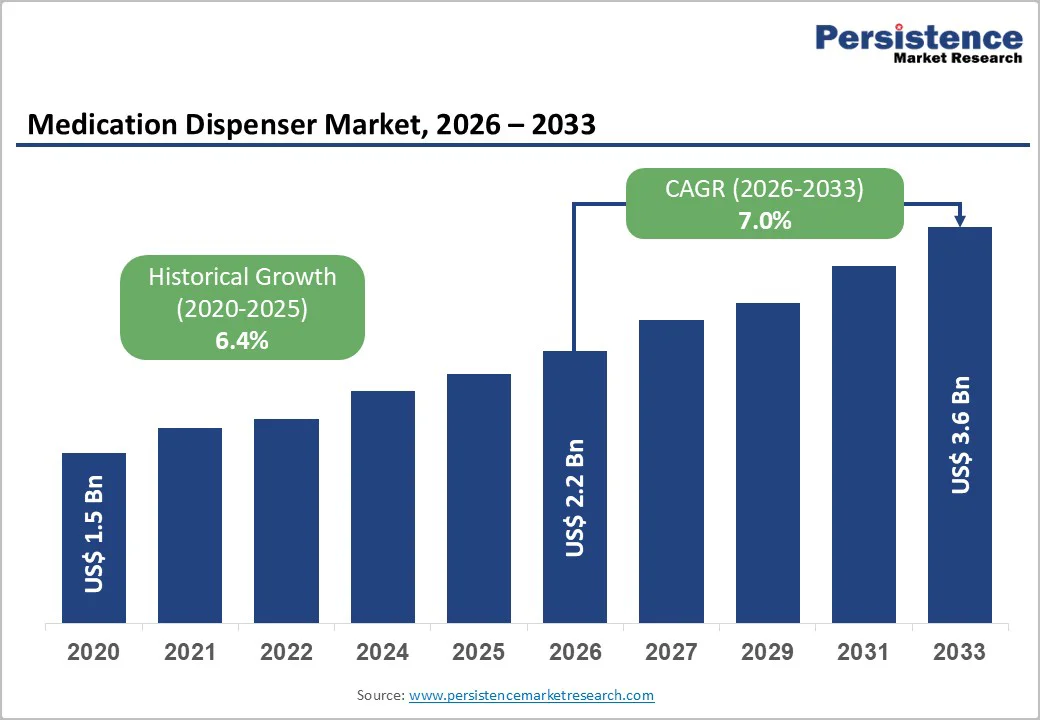
The global medication dispenser market size is estimated to grow from US$ 2.2 billion in 2026 to US$ 3.6 billion by 2033, growing at a CAGR of 7.0% during the forecast period from 2026 to 2033. The global market is expanding steadily as healthcare systems adopt technologies that improve safety, adherence, and patient convenience.
Rising cases of chronic illnesses, aging populations, and growing concerns about medication non-compliance are increasing demand for automated solutions that simplify daily drug management. These devices, designed to organize and dispense medicines accurately at scheduled times, are becoming essential for individuals with cognitive limitations, memory disorders, or complex treatment regimens. Hospitals and long-term care facilities are also integrating automated dispensers to reduce errors and improve workflow efficiency. With growing digital integration and smart features, the market is shifting rapidly toward connected, patient-centric dispensing solutions.
Key Industry Highlights:
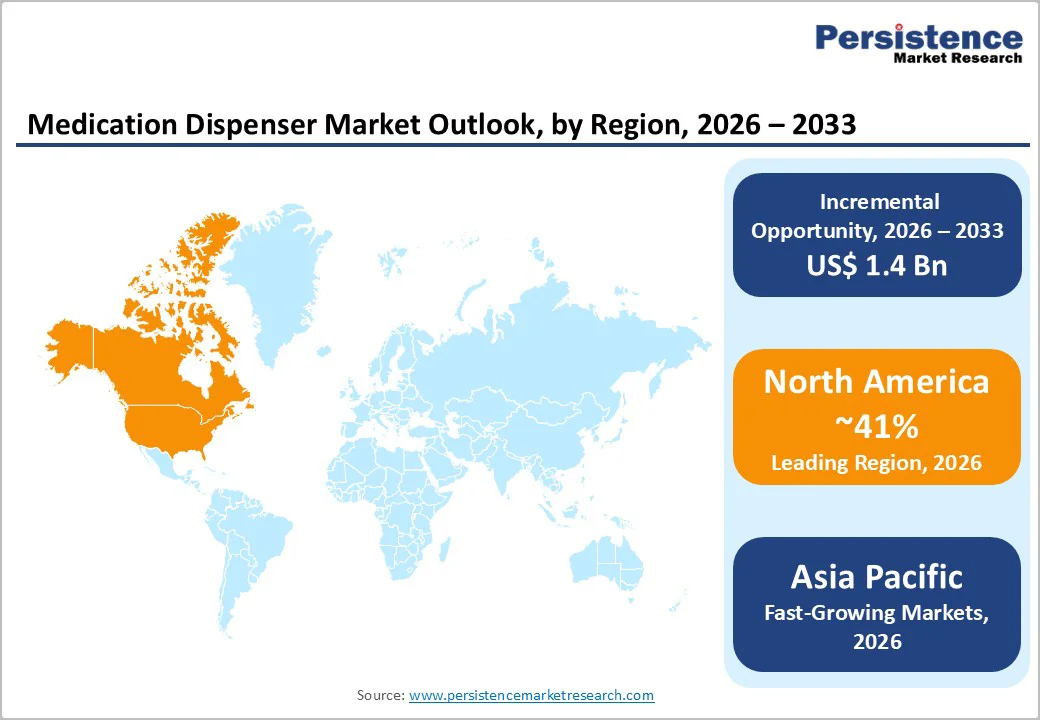
- Leading Region: North America leads the global market with approximately 41% share in 2025, driven by U.S. regulatory frameworks and high hospital adoption of automated systems.
- Fastest Growing Region: Asia Pacific is the fastest-growing region, fueled by manufacturing hubs in China and India, plus rising healthcare investments in ASEAN.
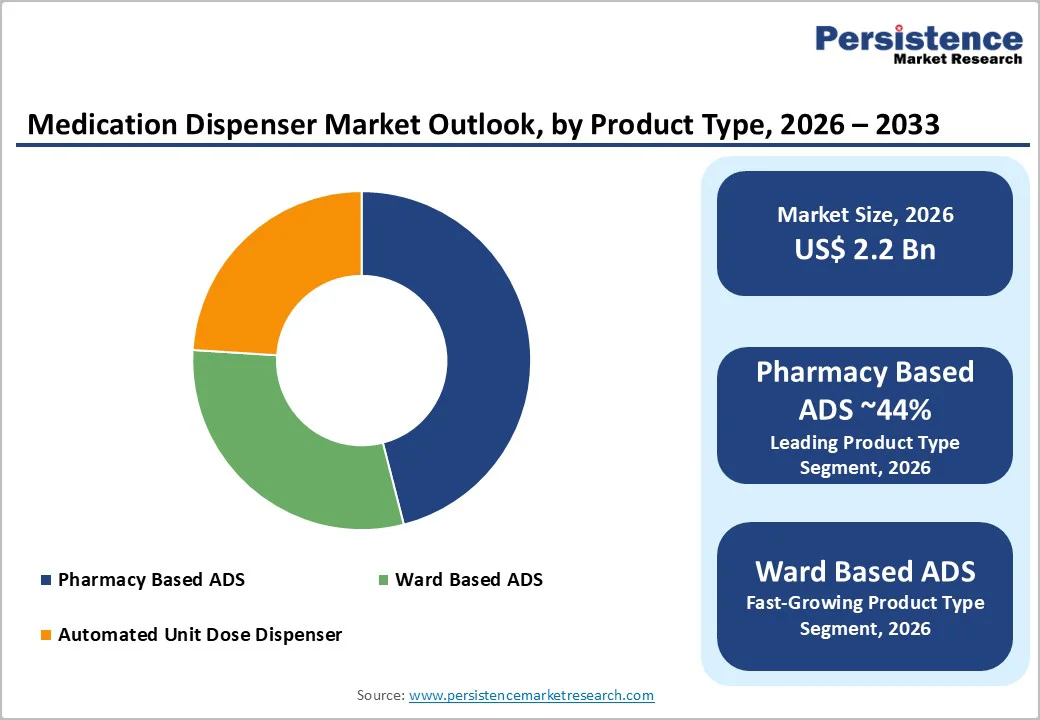
- Dominant Segment: Pharmacy-Based ADS remains the dominant segment due to its excelling in centralized efficiency and error reduction for high-volume pharmacies.
- Fastest Growing Segment: Ward-Based ADS grow fastest, driven by bedside medication access, error reduction, workflow efficiency, and growing hospital adoption globally.
| Key Insights | Details |
|---|---|
| Medication Dispenser Market Size (2026E) | US$ 2.2 Bn |
| Market Value Forecast (2033F) | US$ 3.6 Bn |
| Projected Growth (CAGR 2026 to 2033) | 7.0% |
| Historical Market Growth (CAGR 2020 to 2025) | 6.4% |
Market Dynamics
Driver - Rising Medication Errors and Patient Safety Imperatives
Growing concerns around medication errors have become a major force pushing the adoption of advanced medication dispensers across healthcare settings. Errors during prescribing, dispensing, and administration contribute to patient harm, extended hospital stays, and significant financial losses for health systems. With hospitals managing increasing patient volumes and complex drug regimens, traditional manual processes are no longer adequate to ensure safe and accurate dispensing. Automated medication dispensers help reduce these risks by combining barcode verification, controlled drug access, electronic tracking, and integration with clinical decision-support systems. These features ensure that every step from storage to dispensing follows a standardized and traceable workflow, minimizing human mistakes. Healthcare facilities adopting these systems report substantial drops in dispensing and administration errors, more consistent documentation, and better adherence to regulatory standards. In addition, automated systems improve inventory control, reduce medication waste, and help ensure the timely delivery of drugs during peak hours, easing pressure on pharmacy and nursing staff. As hospitals strive to enhance patient safety and comply with accreditation requirements, the shift toward automated dispensing is accelerating, making safety-focused technologies a central driver of market expansion.
Restraints - High Initial Capital and Integration Costs
Despite clear benefits, the high upfront cost of implementing automated medication dispensers remains a major barrier, especially for small hospitals, clinics, and long-term care facilities. Installing a modern dispensing system often requires a substantial investment that goes beyond the hardware itself. Facilities must also budget for software licenses, IT upgrades, and integration with existing electronic health record platforms, all of which add to the financial burden. Many providers operate on constrained budgets, making it difficult to justify such a large capital outlay, even when long-term savings are anticipated. Ongoing costs further complicate adoption, as routine maintenance, technical support, staff training, and periodic software updates require continuous spending. Facilities lacking dedicated IT teams often face additional challenges in managing these systems. For organizations in emerging markets or rural settings, limited funding and infrastructure gaps make adoption even more difficult. As a result, many institutions continue relying on manual or semi-automated processes, slowing the wider deployment of advanced dispensing technologies despite their recognized value.
Opportunity - Expanding Global Demand for Smart, Automated Medication Management Solutions
The global medication dispenser market is poised for substantial opportunity as healthcare systems worldwide pursue safer, more efficient medication management. Ageing population, rising chronic disease cases, and increasing dependence on long-term therapies are creating strong demand for automated solutions that can support adherence and reduce preventable errors. Hospitals and home-care settings are shifting toward connected dispensers that sync with electronic health records, send refill alerts, and track dosing behavior, making them valuable in managing complex regimens.
Growing adoption of telehealth and remote monitoring also boosts the need for smart dispensing tools that help clinicians oversee patient compliance from a distance. In emerging markets, government investment in digital health infrastructure and pharmacy automation offers a large untapped customer base. Manufacturers benefit from opportunities to innovate with AI-driven systems, compact home-care units, and cloud-based analytics. The shift toward decentralized care models further positions medication dispensers as essential tools in improving outcomes while reducing system-level burdens.
Category-wise Analysis
By Product Type Insights
Pharmacy-based automated dispensing systems (ADS) lead the global medication dispenser market with nearly 42% share in 2025, primarily because they are designed for high-volume, centralized pharmacy operations. These systems automate bulk storage, picking, packaging, and dispensing, enabling pharmacies to handle thousands of SKUs with minimal manual intervention. Their seamless integration with pharmacy information systems ensures real-time visibility into inventory, drug shortages, and expiration alerts, significantly reducing wastage and diversion risks. FDA-cleared robotic central-fill technologies further enhance efficiency by reducing manual picking errors by nearly 50% and supporting strict regulatory requirements around drug handling.
The scalability of pharmacy-based ADS makes them ideal for large hospital networks, retail pharmacy chains, and mail-order pharmacies, where consistent accuracy and throughput are critical. Their ability to support multi-dose and unit-dose formats, automate formulary updates, and streamline medication reconciliation workflows keeps them at the center of global digital pharmacy transformation.
By End-user Insights
Hospital pharmacies dominate the end-user segment with approximately 46% share in 2025, driven by the complexity, urgency, and high patient load associated with inpatient medication management. Hospitals operate in high-risk environments where dosing errors, drug mix-ups, and delays can significantly impact patient safety. Automated Dispensing Systems (ADS) help mitigate these risks by providing secure, round-the-clock access to medications through biometric authentication, barcode verification, automated logs, and real-time tracking of transactions. These systems reduce wrong-drug errors by up to 40% and support compliance with Joint Commission and WHO medication safety standards.
Large hospitals over 80% in developed regions have integrated pharmacy-based ADS, point-of-care dispensing cabinets, and unit-dose dispensing to align with multidisciplinary care pathways and emergency response needs. With growing adoption of closed-loop medication administration, hospitals increasingly prefer ADS that interface with EHRs, MAR systems, and smart pumps. Their operational need for accuracy, accountability, and faster medication solidifies hospital pharmacies as the leading end-user category.
Region-wise Insights
North America Medication Dispenser Market Trends
North America leads the global medication dispenser market, driven by a mature healthcare ecosystem, strong regulatory oversight, and rapid technology adoption. In the U.S., the FDA’s clearance of next-generation robotic systems such as BD’s 2024 central-fill automation has accelerated deployment across hospital and outpatient settings. Hospitals increasingly implement Automated Dispensing Systems (ADS) to address labor shortages and reduce medication errors, with studies showing a 39-78% decline in dispensing mistakes after adoption.
Reimbursement incentives tied to medication safety and workflow optimization further reinforce uptake. Ward-based ADS units enhance bedside access, supporting nurses in high-acuity environments. Integrated care networks, including large health systems like Barnes Healthcare, are adopting ADS for tasks such as IV compounding, perioperative medication workflow management, and controlled substance monitoring. Additionally, the region’s focus on closed-loop medication administration, EHR interoperability, and infection-control automation positions ADS as a core component of digital transformation strategies across hospitals, retail pharmacies, and long-term care facilities.
Asia and Pacific Medication Dispenser Market Trends
Asia Pacific is emerging as the fastest-growing region in the medication dispenser market, fueled by demographic shifts, healthcare digitalization, and strong regional manufacturing capabilities. China, Japan, India, and ASEAN countries are at the forefront, each contributing distinct growth drivers. China’s expanding medical device industry boosts the availability of cost-effective automated dispensing units for both domestic and export markets, accelerating adoption across public hospitals. India is witnessing rapid integration of pharmacy-based ADS as hospital chains expand capacity to manage rising chronic diseases and medication volumes.
Japan leads in advanced applications, integrating AI-enabled dispensing and monitoring systems within elderly-care and nursing facilities to reduce manual workload and minimize errors in an aging population. Governments across the region are investing in healthcare automation, with incentives supporting smart hospitals and digital pharmacies. The shift from manual dispensing to semi- and fully automated systems is further supported by urbanization, improved reimbursement models, and growing private hospital investment, positioning the Asia Pacific for sustained, high-velocity growth.
Competitive Landscape
The medication dispenser market features a competitive landscape dominated by global players such as BD, Omnicell, Swisslog, Yuyama, and ScriptPro, alongside emerging innovators offering AI-enabled and home-care focused systems. Companies compete on automation efficiency, integration with hospital IT systems, and accuracy in dispensing. Strategic partnerships, FDA-cleared product launches, and expansion into remote-monitoring ecosystems strengthen market positions. Growing demand for pharmacy automation and smart home dispensers continues to intensify competition.
Key Industry Developments:
- In November 2025, iZafe Group have signed a distribution agreement with Skand for the launch of Dosell, a medication-dispensing robot, in Iceland.
- In May 2025, Omnicell launched RFID-enabled MedTrack products for perioperative settings, boosting medication visibility and accuracy.
Companies Covered in Medication Dispenser Market
- Becton, Dickinson and Company
- Omnicell Inc.
- Cerner Corporation
- Capsa Solution LLC
- InstyMeds Corporation
- PARATA SYSTEMS, LLC
- TriaTech Medical Systems Inc.
- ARxIUM Inc.
- ScriptPro LLC
- YUYAMA Co.,Ltd
- Howard Industries, Inc.
- Swisslog Holding AG
- Talyst
- Robotik Technology
- Others
Frequently Asked Questions
The global medication dispenser market is projected to be valued at US$ 2.2 Bn in 2026.
Rising medication errors, growing chronic disease burden, and increasing demand for automated, time-saving dispensing solutions drive market growth.
The global medication dispenser market is poised to witness a CAGR of 7.0% between 2026 and 2033.
Expansion of smart connected dispensers, AI-enabled adherence tools, and pharmacy automation in hospitals and eldercare facilities offers strong opportunities.
Key companies include Becton, Dickinson and Company, Omnicell Inc., Cerner Corporation Capsa Solution LLC, and InstyMeds Corporation.


