




- Advanced Materials
- Marine Composites Market
Marine Composites Market Size, Share, and Growth Forecast, 2026 - 2033
Marine Composites Market by Composite Type (Polymer Matrix Composite, Metal Matrix Composite, Others), Fiber Type (Glass Fiber, Carbon Fiber, Others), Resin Type, Vessel Type, and Regional Analysis for 2026 - 2033

Marine Composites Market Size and Trends Analysis
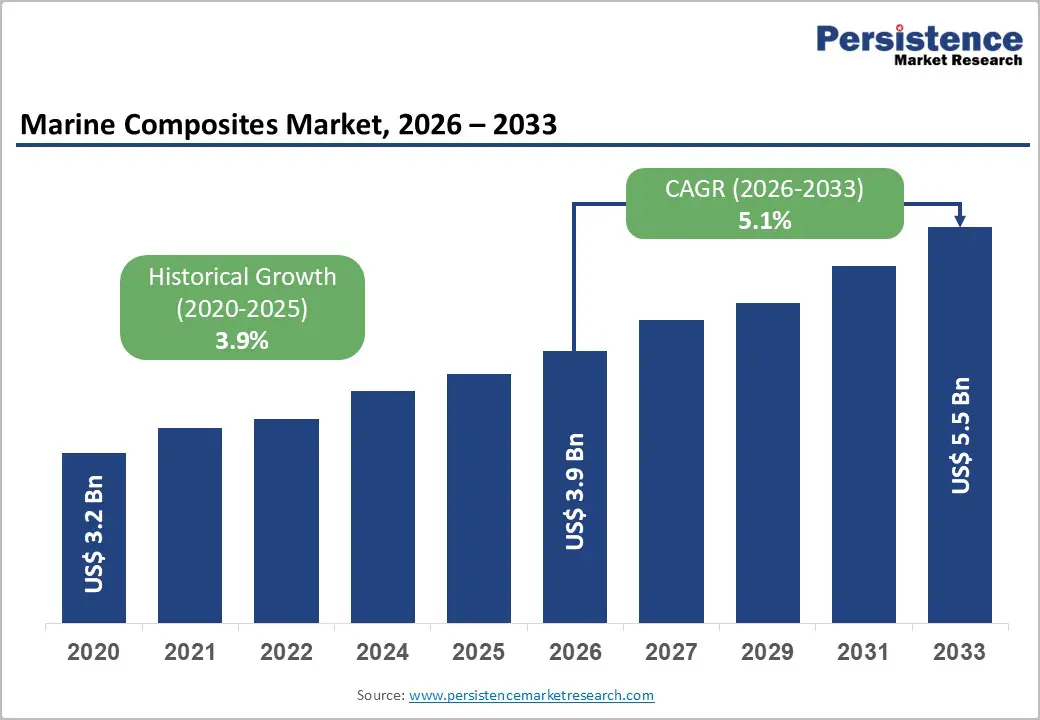
The global marine composites market size is likely to be valued at US$3.9 billion in 2026 and is expected to reach US$5.5 billion by 2033, growing at a CAGR of 5.1% between 2026 and 2033, driven by the increasing adoption of lightweight materials to improve fuel efficiency and reduce emissions in marine vessels.
Regulatory frameworks targeting decarbonization, particularly in developed regions, are accelerating the shift toward advanced composite materials. Expansion in recreational boating and rising demand for high-performance vessels are also supporting sustained material consumption. The market is also evolving with the emergence of recyclable composite technologies and advanced resin systems.
Key Industry Highlights:
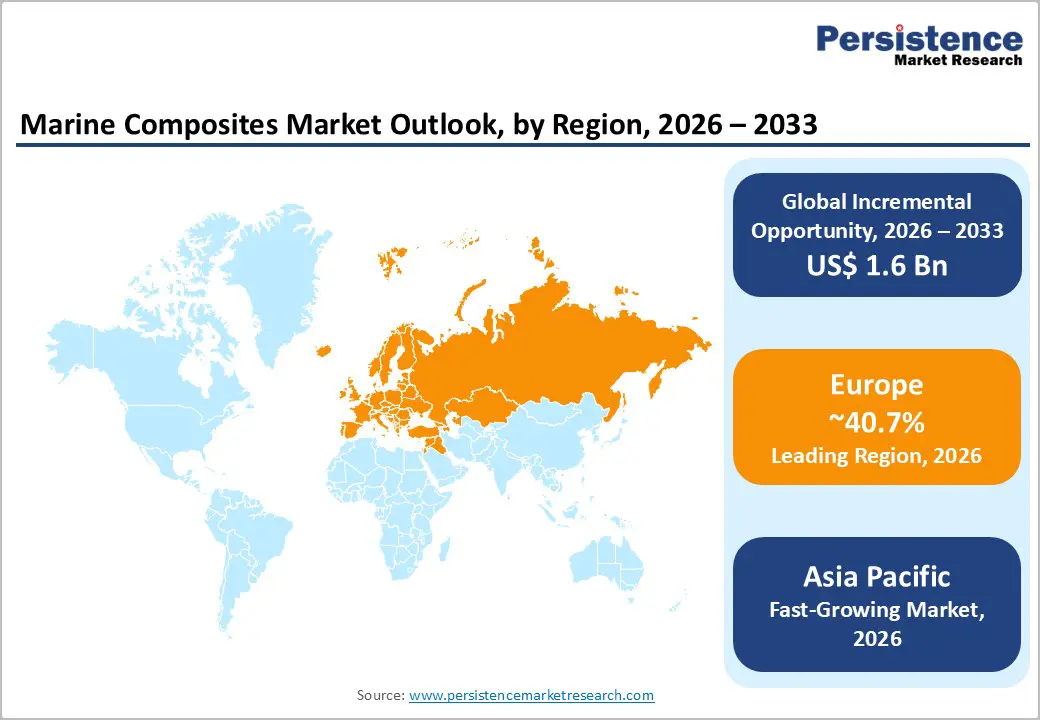
- Leading Region: Europe is projected to dominate the market, accounting for 40.7% of the market share, driven by strong regulatory frameworks, advanced shipbuilding capabilities, and the presence of premium yacht manufacturers.
- Fastest-growing Region: Asia Pacific is expected to be the fastest-growing region, supported by expanding shipbuilding activities and government-backed maritime investments.
- Investment Plans: Significant investments are being directed toward sustainable and recyclable composite technologies, as well as shipbuilding infrastructure expansion, particularly in Asia Pacific and Europe, strengthening long-term market growth potential.
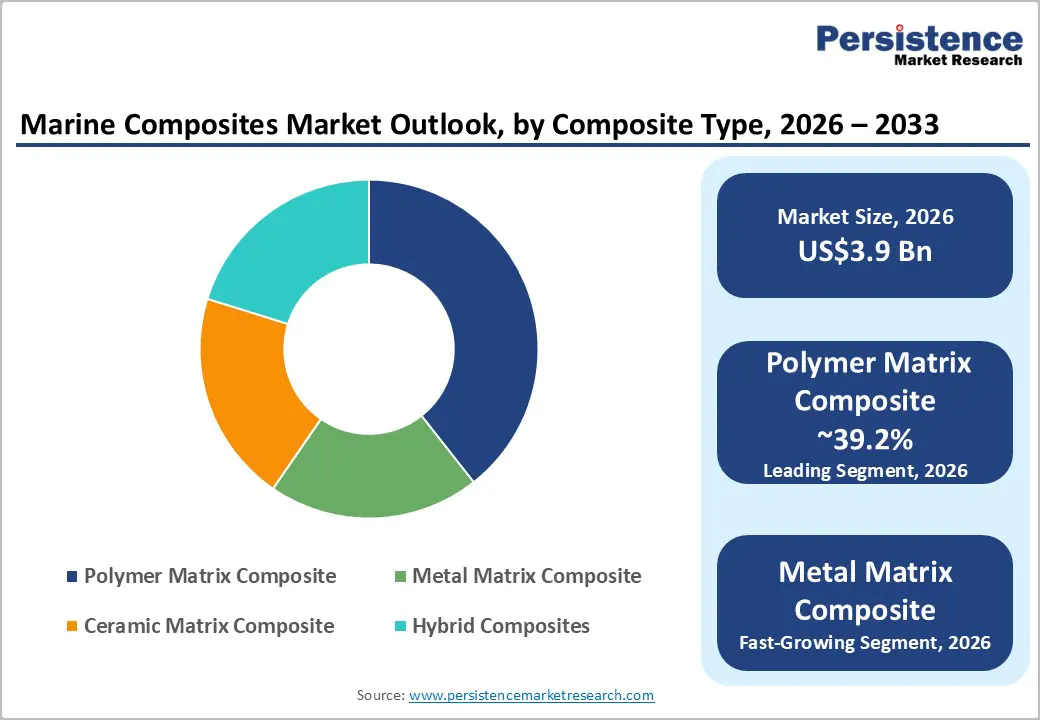
- Dominant Composite Type: Polymer matrix composites lead the market with an anticipated share of 39.2%, owing to their lightweight properties, corrosion resistance, and widespread use in hulls and structural components.
- Leading Fiber Type: Glass fiber remains the leading fiber type, holding an anticipated 44.8% market share, supported by its cost-effectiveness and extensive application in mass-produced marine vessels.
| Key Insights | Details |
|---|---|
|
Marine Composites Market Size (2026E) |
US$3.9 Bn |
|
Market Value Forecast (2033F) |
US$5.5 Bn |
|
Projected Growth (CAGR 2026 to 2033) |
5.1% |
|
Historical Market Growth (CAGR 2020 to 2025) |
3.9% |
DRO Analysis
Driver Analysis - Rising Demand for Lightweight and Fuel-Efficient Vessels
The marine industry is undergoing a structural shift toward lightweight materials to improve operational efficiency and reduce emissions. Composite materials offer high strength-to-weight ratios, enabling vessel manufacturers to reduce overall mass without compromising durability. This directly contributes to lower fuel consumption and improved vessel speed and range. Global maritime emissions have exceeded 1 billion tonnes annually, reinforcing the need for energy-efficient vessel design. Regulatory frameworks in key markets are increasingly linking vessel performance to emissions reduction targets. As a result, composites are becoming a preferred material in hulls, decks, and structural components, driving consistent demand across both commercial and recreational vessel segments.
Expansion of Recreational Boating and Premium Vessel Demand
The recreational boating sector represents a significant demand base for marine composites, particularly in North America and Europe. The industry contributes hundreds of billions of dollars in economic activity and supports a large network of manufacturers and service providers. Powerboats, especially fiberglass-based models, continue to dominate new unit sales. Consumer preference is shifting toward premium, high-performance vessels that offer improved durability, design flexibility, and aesthetics. Composite materials enable manufacturers to meet these requirements efficiently through moldability and corrosion resistance. This trend is reinforcing steady demand for glass fiber-reinforced plastics and advanced resin systems.
Growing Focus on Sustainability and Circular Material Solutions
Sustainability is increasingly influencing material selection in the marine industry. Shipbuilders and boat manufacturers are adopting recyclable composite solutions to address environmental concerns related to end-of-life disposal. The development of thermoplastic resins and recyclable composite platforms is gaining traction, supported by industry collaborations and pilot-scale commercialization. Some manufacturers have already demonstrated significant reductions in carbon emissions through the use of recyclable materials compared to conventional polyester systems. This shift is encouraging the adoption of environmentally responsible production methods and creating new opportunities for material innovation.
Restraint Analysis - High Production and Material Costs
Marine composites require specialized manufacturing processes, including controlled curing, precision molding, and skilled labor. These factors contribute to higher production costs compared to traditional materials such as steel or aluminum. The cost burden becomes more pronounced during periods of economic uncertainty, when discretionary spending on recreational boats declines. Fluctuations in raw material prices, including resins and fibers, further add to cost pressures. For manufacturers, maintaining profitability while absorbing these costs presents a significant challenge, particularly in price-sensitive market segments.
Challenges in Recycling and Regulatory Compliance
Despite advancements in recyclable composites, the majority of existing marine composite materials remain difficult to recycle. End-of-life disposal of composite vessels poses environmental and logistical challenges, particularly in regions with strict waste management regulations. Compliance with evolving environmental policies requires investment in new materials, processes, and certification systems. Smaller manufacturers often lack the resources to adapt quickly, which can limit adoption of advanced composite technologies. These factors contribute to slower market penetration in cost-sensitive applications.
Opportunity Analysis - Adoption of Recyclable Thermoplastic Composites
The development of recyclable thermoplastic resins presents a significant growth opportunity in the marine composites market. These materials allow for easier reprocessing and reuse compared to traditional thermoset resins. Manufacturers are increasingly investing in recyclable composite solutions to meet sustainability targets and regulatory requirements. The ability to reduce lifecycle costs and environmental impact enhances the value proposition of these materials. This trend is particularly relevant in premium and performance vessel segments, where innovation and sustainability are key differentiators.
Expansion of Shipbuilding Activities in Asia Pacific
Asia Pacific is witnessing substantial growth in shipbuilding and maritime infrastructure development. Government initiatives aimed at strengthening domestic shipbuilding capabilities are driving investment in new vessels and modernization programs. Countries such as India, China, and Japan are prioritizing maritime development through funding programs, industrial clusters, and international collaborations. This expansion is increasing demand for advanced materials, including composites, across hull construction, interiors, and structural components. The region’s cost advantages and manufacturing capabilities further support market growth.
Increasing Demand from Defense and Offshore Sectors
Defense and offshore marine applications require high-performance materials capable of withstanding extreme conditions. Composite materials offer superior resistance to corrosion, fatigue, and impact, making them suitable for naval vessels, submarines, and offshore platforms. These applications typically prioritize performance over cost, allowing suppliers to offer advanced and higher-margin products. Growth in subsea exploration and naval modernization programs is expected to drive demand for specialized composite materials, creating opportunities for market expansion beyond recreational boating.
Category-wise Analysis
Composite Type Insights
Polymer matrix composite is expected to lead the market with an anticipated share of approximately 39.2% in 2026. These composites are widely used due to their excellent corrosion resistance, lightweight properties, and compatibility with established manufacturing processes such as hand lay-up and vacuum infusion. They are extensively applied in hulls, decks, bulkheads, and superstructures across recreational boats, ferries, and small commercial vessels. For instance, fiberglass-reinforced polymer (FRP) is commonly used in powerboats and sailboats due to its durability and low maintenance requirements. Their adaptability with glass and carbon fibers, along with cost efficiency, continues to reinforce their dominance in high-volume marine production.
Metal matrix composite is expected to be the fastest-growing segment, particularly in high-stress naval and offshore applications where superior mechanical strength and thermal resistance are critical. These materials are increasingly used in components exposed to extreme loads, such as propeller shafts, engine components, and structural reinforcements in naval vessels. Ceramic Matrix Composites are gaining attention for their high-temperature stability and are anticipated to account for a notable share in specialized applications such as exhaust systems and thermal shielding in advanced marine systems. Hybrid composites, which combine different fiber and matrix systems, are also witnessing increased adoption, enabling manufacturers to optimize performance, cost, and durability for specific vessel requirements.
Fiber Type Insights
Glass fiber is expected to dominate the market with an anticipated share of 44.8% in 2026. Its widespread adoption is driven by its cost-effectiveness, corrosion resistance, and ease of processing, making it ideal for large-scale production. Glass fiber composites are extensively used in recreational boats, fishing vessels, and small commercial crafts. For example, fiberglass hulls are standard in outboard powerboats and personal watercraft due to their strength and resistance to marine environments. The material also integrates well with polyester and vinyl ester resins, supporting consistent manufacturing and reducing production complexity.
Carbon fiber is likely to be the fastest-growing segment, supported by rising demand for high-performance and lightweight vessels. Its superior strength-to-weight ratio makes it particularly suitable for racing yachts, luxury boats, and high-speed naval crafts. For instance, carbon fiber is increasingly used in America’s Cup racing yachts and premium leisure boats to enhance speed and fuel efficiency. Natural fibers such as flax and jute are emerging in niche applications focused on sustainability, especially in eco-friendly boat designs. Meanwhile, aramid fibers are used in specialized applications requiring high impact resistance, such as military vessels and reinforcement zones in high-performance hulls.
Regional Insights
North America Marine Composites Market Trends - High-Performance Marine Composites Driven by Innovation and Premium Vessels
North America represents a significant market for marine composites, driven by a well-established recreational boating industry and strong consumer demand. The U.S. leads the region, supported by a large base of boat manufacturers, suppliers, and service providers. Composite materials are widely used in fiberglass boat production, particularly in powerboats and fishing vessels. Leading manufacturers such as Brunswick Corporation and Boston Whaler continue to expand their fiberglass and composite-based product portfolios, reinforcing demand for glass fiber and polyester resin systems. The scale of production in outboard-powered boats and personal watercraft further supports steady consumption of marine composites across standard vessel categories.
Innovation plays a critical role in the regional market, with manufacturers focusing on advanced materials and sustainable solutions. Companies such as Hexcel Corporation are actively developing lightweight carbon fiber solutions for high-performance marine applications, while Owens Corning continues to enhance glass reinforcement technologies for durability and cost efficiency. The regulatory environment is evolving, with increasing emphasis on environmental performance and emissions reduction, particularly in coastal states. While growth in unit sales may fluctuate due to economic conditions, demand for high-performance and premium vessels, including offshore fishing boats and luxury cruisers, continues to support the adoption of advanced composite materials across the region.
Europe Marine Composites Market Trends - Luxury Yacht Production and Regulation-Led Sustainable Composites Adoption
Europe is projected to lead the market with a regional share of 40.7% in 2026. The region benefits from a strong shipbuilding tradition, advanced manufacturing capabilities, and a high concentration of premium yacht producers. Countries such as Germany, the U.K., France, and Spain play a key role in driving regional demand. Leading boat manufacturers such as Groupe Beneteau and Ferretti Group are continuously investing in composite-intensive yacht production, particularly in the luxury and semi-custom segments. These vessels rely heavily on carbon fiber and advanced resin systems to improve performance, fuel efficiency, and onboard comfort.
Strict environmental regulations are a major growth driver, encouraging the adoption of lightweight and energy-efficient materials. Policies aimed at maritime decarbonization are accelerating the transition toward advanced composites, particularly in ferries, leisure craft, and hybrid vessels. Europe is also at the forefront of recyclable composite innovation. For example, Arkema has collaborated with boatbuilders to introduce recyclable thermoplastic resin systems, while Groupe Beneteau has implemented these materials in select production models. This shift is influencing supplier strategies and pushing manufacturers toward circular production methods. Investment in sustainable marine solutions, including electric and hybrid boats, continues to reinforce demand for next-generation composite materials across the region.
Asia Pacific Marine Composites Market Trends - Shipbuilding Expansion and Cost-Driven Marine Composites Growth
Asia Pacific is expected to be the fastest-growing region in the marine composites market, driven by rapid expansion in shipbuilding and maritime infrastructure. Countries such as China, Japan, and India are investing heavily in shipyard capacity, modernization programs, and marine technology development. China remains a global leader in shipbuilding output, while Japan continues to focus on high-performance and technologically advanced vessels. In India, initiatives under maritime development programs are encouraging domestic shipbuilding and repair capabilities, which is increasing demand for cost-effective composite materials in smaller vessels and coastal applications.
The region also benefits from significant cost advantages in manufacturing, supported by access to raw materials and large-scale production capabilities. Companies such as Toray Industries and Teijin Limited are expanding their carbon fiber and composite production capacities in Asia to meet growing regional demand. At the same time, local shipbuilders are increasingly incorporating composites into ferries, patrol boats, and offshore support vessels to improve fuel efficiency and durability. Government initiatives aimed at boosting maritime trade, port infrastructure, and naval capabilities are further supporting market growth. The rising adoption of advanced materials in both commercial and defense applications positions Asia Pacific as a key growth engine, with strong long-term demand for marine composites.
Competitive Landscape
The global marine composites market is moderately fragmented, with a mix of global material suppliers and regional manufacturers. Large companies dominate the supply of fibers, resins, and core materials, while vessel manufacturing remains decentralized. Competitive positioning is influenced by product innovation, material performance, and supply chain capabilities.
Key players are focusing on innovation, sustainability, and regional expansion. Investments in recyclable materials, advanced resin systems, and high-performance fibers are central to competitive differentiation. Companies are also strengthening partnerships with shipbuilders to improve product integration and enhance long-term customer relationships.
Key Industry Developments:
- In March 2026, Hexcel Corporation showcased its latest lightweight composite technologies at JEC World 2026, focusing on high-performance applications, including marine structures, aimed at improving fuel efficiency and structural performance.
Companies Covered in Marine Composites Market
- Gurit
- Hexcel Corporation
- Toray Industries
- Teijin Limited
- Owens Corning
- Arkema
- Sika AG
- Solvay
- Polynt Group
- Scott Bader
- Chomarat
- BASF
- Mitsubishi Chemical Group
- AOC Resins
- 3A Composites
- Saertex
Frequently Asked Questions
The marine composites market is estimated to be valued at US$3.9 billion in 2026.
The marine composites market is expected to reach US$5.5 billion by 2033.
Key trends include rising adoption of lightweight and fuel-efficient materials, growing focus on recyclable and sustainable composites, and increasing use of carbon fiber in high-performance vessels.
Polymer matrix composites lead the market with an anticipated share of 39.2%, due to their versatility, corrosion resistance, and widespread use in marine structures.
The marine composites market is projected to grow at a CAGR of 5.1% from 2026 to 2033.
Some of the major market players include Gurit, Hexcel Corporation, Toray Industries, Owens Corning, and Arkema.


