




- Advanced Materials
- Advanced Structural Ceramics Market
Advanced Structural Ceramics Market Size, Share, and Growth Forecast, 2026 - 2033
Advanced Structural Ceramics Market by Material Type (Alumina, Zirconate, Others), End-use Industry (Industrial, Semiconductors, Others), Ceramics Type, and Regional Analysis for 2026 - 2033

Advanced Structural Ceramics Market Size and Trends Analysis
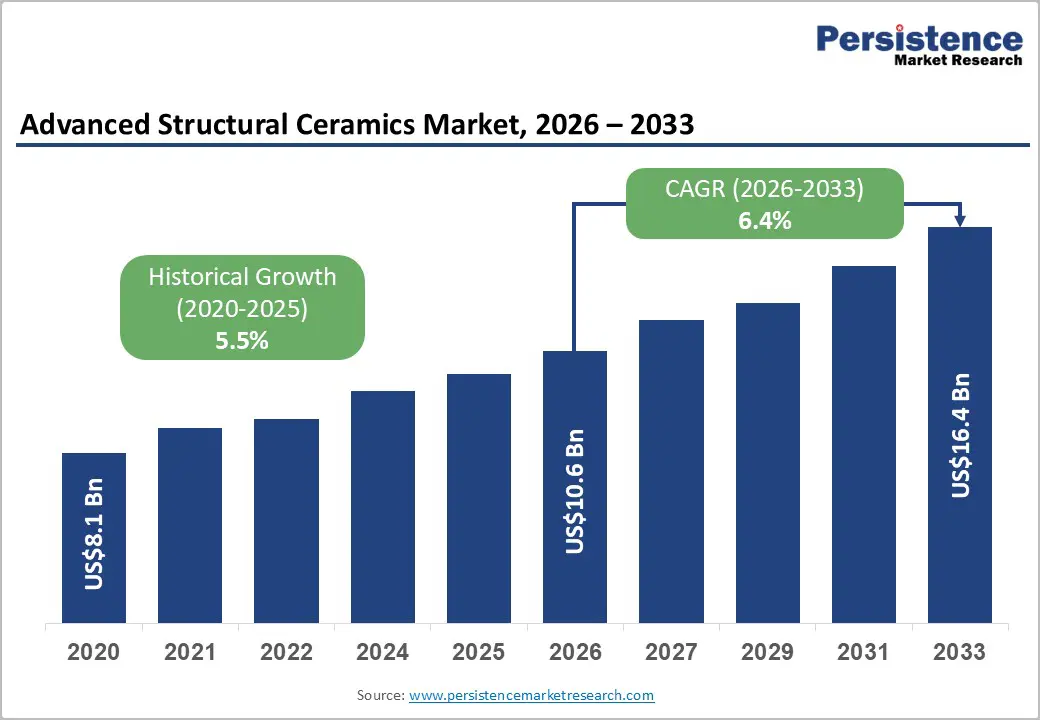
The global advanced structural ceramics market size is likely to be valued at US$10.6 billion in 2026 and is expected to reach US$16.4 billion by 2033, growing at a CAGR of 6.4% between 2026 and 2033, driven by rising demand for high-performance materials capable of operating under extreme thermal, mechanical, and chemical conditions.
Growth is strongly supported by semiconductor manufacturing expansion, electrification trends, and increasing adoption in aerospace and medical applications. These materials are becoming critical in enabling precision engineering, durability, and miniaturization, which are essential across advanced industrial ecosystems.
Key Industry Highlights:
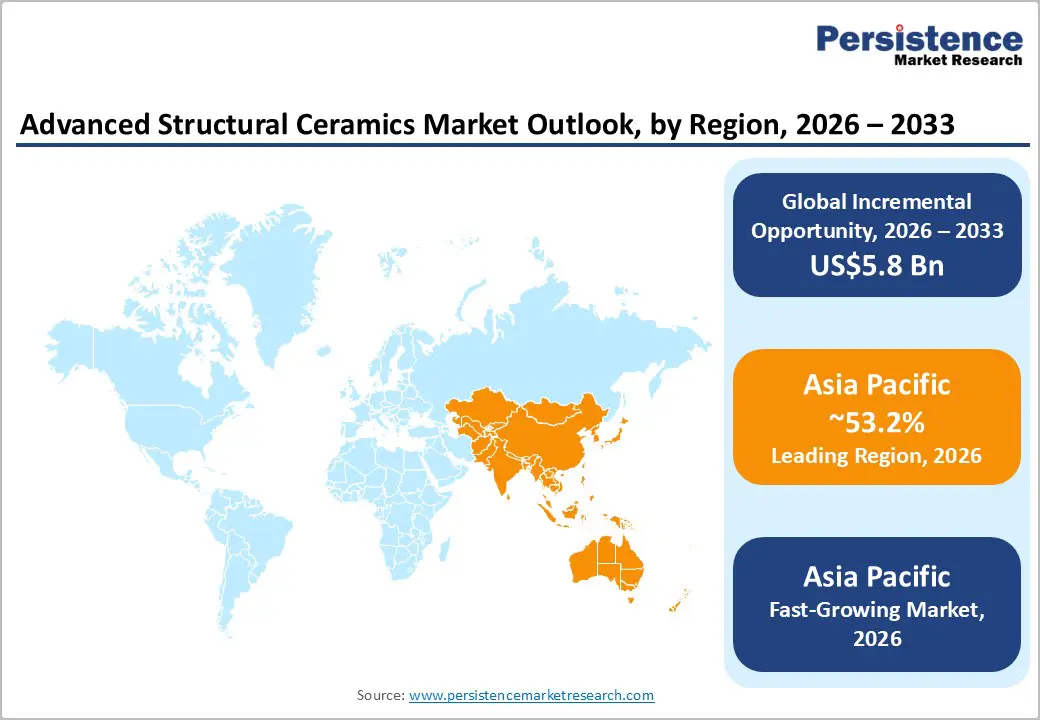
- Leading Region: Asia Pacific is projected to account for 53.2% of the market share in 2026, driven by strong manufacturing capabilities and high demand from the electronics and automotive sectors.
- Fastest-growing Region: Asia Pacific is projected to grow at a 7% CAGR, supported by expanding semiconductor and electric vehicle production in China, Japan, and India.
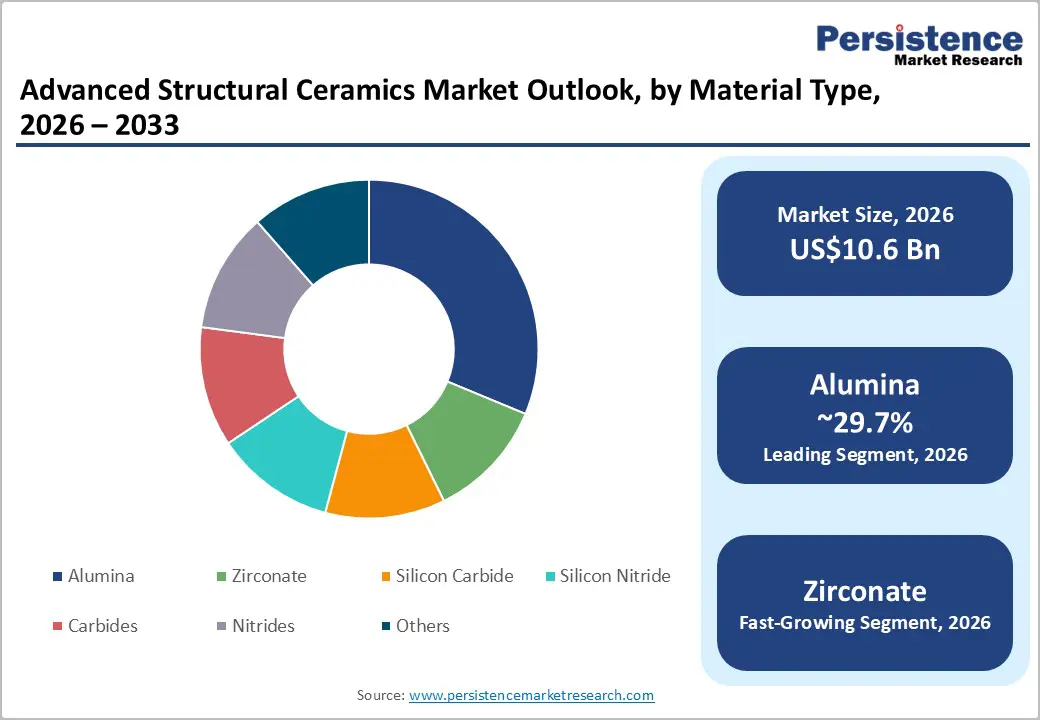
- Dominant Material Type: Alumina is anticipated to hold 29.7% market share in 2026, due to its cost-efficiency, durability, and wide applicability across the industrial, electronics, and medical sectors.
- Leading End-use Industry: The industrial segment is estimated to account for 24.3% revenue share in 2026, driven by demand for wear-resistant and high-temperature components in manufacturing and process industries.
DRO Analysis
Driver - Rising Semiconductor Manufacturing and Advanced Electronics Demand
The global semiconductor industry continues to expand rapidly, driven by artificial intelligence, data centers, and advanced computing requirements. Advanced structural ceramics play a critical role in semiconductor fabrication equipment, including wafer-handling systems, electrostatic chucks, insulation components, and plasma-resistant chambers. These materials provide high purity, dimensional stability, and resistance to extreme processing environments, making them indispensable in fabrication facilities.
As chip manufacturers increase investments in leading-edge nodes and advanced packaging technologies, the demand for ceramic components grows proportionally. The shift toward localized semiconductor manufacturing in key economies further strengthens this demand. From a market perspective, this results in higher value per fabrication unit, increased qualification requirements, and long-term supply agreements, positioning ceramics suppliers as strategic partners within the semiconductor value chain.
Electrification and Energy Transition across Industries
The global transition toward electrification, particularly in transportation and energy systems, is significantly accelerating demand for advanced structural ceramics. Electric vehicles, renewable energy systems, and power electronics require materials that provide thermal stability, electrical insulation, and wear resistance.
Advanced ceramics are widely used in battery systems, inverters, sensors, and charging infrastructure. As electrification intensifies, the complexity and voltage requirements of these systems increase, which raises the need for materials capable of maintaining performance under high thermal and electrical stress. This trend also extends to renewable energy applications, where ceramics support components in wind turbines, solar systems, and grid infrastructure.
The business impact is substantial, as manufacturers prioritize longer lifecycle performance, reduced maintenance, and enhanced energy efficiency, all of which favor the adoption of advanced ceramic materials.
Restraint - High Production Costs and Complex Manufacturing Processes
The production of advanced structural ceramics involves energy-intensive processes, including high-temperature sintering, precision machining, and controlled atmosphere fabrication. These processes require significant capital investment and technical expertise, which increases overall production costs. In addition, stringent qualification requirements in industries such as aerospace, medical, and semiconductors extend product development cycles and delay commercialization. Manufacturers must meet rigorous standards for reliability, safety, and performance, often requiring multiple testing and validation phases.
This combination of high upfront investment and extended time-to-market creates barriers for new entrants and limits rapid capacity expansion. It also contributes to supply concentration among established players with the resources and technical capabilities to meet these demands.
Opportunity - Expansion of Medical and Bioceramic Applications
The healthcare sector presents a significant growth opportunity for advanced structural ceramics. Aging populations and increasing demand for medical implants are driving the adoption of materials such as alumina and zirconia in orthopedic and dental applications. These ceramics offer biocompatibility, high wear resistance, and long service life, making them ideal for implantable devices.
The opportunity extends beyond volume growth. Medical applications require strict regulatory compliance, traceability, and precision manufacturing, which enables manufacturers to command premium pricing and long-term contracts. Companies that invest in medical-grade production capabilities and regulatory certifications can strengthen their market position while accessing high-margin segments.
Growth in Aerospace and Extreme-Environment Applications
Advanced structural ceramics are increasingly used in aerospace and defense applications, particularly in components exposed to extreme temperatures and mechanical stress. These include turbine engines, thermal protection systems, and high-speed aerospace structures. The demand is driven by the need for lightweight materials that can withstand harsh operating conditions while improving fuel efficiency and performance. Ceramics such as silicon carbide and silicon nitride are particularly well-suited for these applications due to their thermal resistance and mechanical strength.
As investments in aerospace innovation, defense systems, and space exploration increase, the demand for high-performance ceramic materials is expected to grow. This creates opportunities for manufacturers capable of delivering consistent quality and scalable production for mission-critical applications.
Category-wise Analysis
Material Type Insights
Alumina is expected to dominate, accounting for over 29.7% of the market share by 2026. Its widespread adoption is attributed to its balanced combination of mechanical strength, electrical insulation, corrosion resistance, and cost-effectiveness. Alumina is extensively used in industrial components such as pump seals and wear plates, electronic substrates in power modules, and medical devices, including hip joint heads and dental implants, demonstrating its versatility across multiple industries.
Its compatibility with established manufacturing processes further supports its leadership position. Companies prefer alumina for high-volume applications due to its reliability and ease of integration into existing production systems. For instance, alumina substrates are widely used in power electronics for electric vehicles and consumer electronics, while industrial manufacturers rely on alumina linings in high-wear environments such as mining and chemical processing.
Zirconate is projected to be the fastest-growing material type. This growth is driven by its superior performance in high-temperature and extreme-environment applications. Zirconate materials exhibit low thermal conductivity, high thermal stability, and strong resistance to thermal shock, making them suitable for advanced electronics, thermal barrier coatings, and energy systems.
The increasing demand for materials that can operate under severe conditions is accelerating the adoption of zirconate. For example, rare-earth zirconates are increasingly used in thermal barrier coatings for gas turbines and aerospace engines, as well as in solid oxide fuel cells and advanced nuclear applications. As industries prioritize performance over cost in critical applications, zirconate is expected to gain a stronger foothold in the market, particularly in high-value, high-temperature environments.
End-use Industry Insights
The industrial segment is expected to lead, accounting for over 24.3% of market revenue in 2026. Advanced structural ceramics are widely used in industrial equipment such as pumps, valves, cutting tools, bearings, and wear-resistant linings. Their ability to withstand abrasion, high temperatures, and corrosive environments makes them essential in manufacturing processes across sectors such as chemicals, mining, and heavy machinery.
Industrial demand is also supported by the need for operational efficiency and reduced downtime, as ceramic components often outperform traditional materials in durability and lifespan. For example, silicon carbide seals are used in chemical processing plants to improve corrosion resistance, while ceramic cutting tools enhance machining efficiency in automotive manufacturing. This results in consistent demand across various industrial applications, reinforcing the segment’s leadership.
The semiconductor segment is set to be the fastest-growing end-use industry. The increasing complexity of semiconductor manufacturing processes requires materials that can maintain precision, purity, and stability under extreme conditions. Advanced ceramics are critical in ensuring contamination-free processing and thermal stability.
For instance, electrostatic chucks, wafer carriers, and chamber liners made from alumina and silicon carbide are widely used in wafer fabrication facilities. These components must meet stringent requirements for cleanliness and dimensional accuracy. As semiconductor production expands globally, particularly in advanced nodes and packaging technologies, the demand for specialized ceramic components is expected to rise significantly, driving strong growth in this segment.
Regional Insights
North America Advanced Structural Ceramics Market Trends
North America is a key market for advanced structural ceramics, supported by strong demand from the semiconductor, aerospace, and defense industries.
U.S. Advanced Structural Ceramics Market Trends
The U.S. leads the region, driven by large-scale investments in semiconductor manufacturing and advanced engineering applications. Programs such as the U.S. CHIPS and Science Act have accelerated domestic fabrication capacity, directly increasing demand for high-purity ceramic components used in wafer processing equipment. Companies such as CoorsTek and 3M continue to expand advanced materials capabilities, particularly in semiconductor and industrial applications, strengthening regional supply chains.
The region benefits from a well-developed innovation ecosystem, supported by collaborations between institutions such as NASA and private manufacturers working on high-temperature ceramic materials for aerospace and defense. For example, ceramic matrix composites are increasingly used in turbine engines and thermal protection systems, improving fuel efficiency and durability. Regulatory standards in the aerospace and medical sectors further reinforce the use of high-performance ceramics, as compliance requirements prioritize reliability and safety.
Investment opportunities remain strong in semiconductor components, medical-grade ceramics, and aerospace applications. The expansion of EV manufacturing and defense modernization programs continues to drive demand for precision-engineered ceramic components, positioning North America as a high-value innovation-driven market.
Europe Advanced Structural Ceramics Market Trends
Europe’s advanced structural ceramics market is driven by strong industrial bases in Germany, the U.K., France, and Spain.
Germany Advanced Structural Ceramics Market Trends
Germany serves as the manufacturing and engineering hub of the region, supported by its automotive and industrial machinery sectors. Companies such as CeramTec are expanding production of high-performance ceramics for medical implants and industrial applications. The country’s focus on Industry 4.0 and precision engineering continues to increase demand for wear-resistant and high-temperature ceramic components in automated manufacturing systems.
U.K. and France Advanced Structural Ceramics Market Trends
The U.K. and France contribute significantly through aerospace and defense innovation. Morgan Advanced Materials has strengthened its portfolio in thermal management and electrical ceramics, supporting applications in energy and aerospace systems. France’s aerospace ecosystem, anchored by companies such as Safran, increasingly incorporates advanced ceramics in propulsion systems to improve efficiency and reduce emissions.
Despite challenges related to energy costs and raw material availability, Europe maintains a strong position in high-value, specialized applications, particularly in aerospace, healthcare, and power electronics. The region’s focus on sustainability and innovation supports long-term demand for advanced structural ceramics.
Asia Pacific Advanced Structural Ceramics Market Trends
Asia Pacific is expected to be the leading region, accounting for 53.2% of the market share in 2026, and is also the fastest-growing region with a CAGR of 7%. The region’s dominance is driven by strong manufacturing capabilities, rapid industrialization, and high demand from electronics and automotive sectors.
China Advanced Structural Ceramics Market Trends
China is the largest market within the region, supported by its extensive manufacturing base and large-scale investments in advanced technologies. Companies such as Chaozhou Three-Circle Group are expanding production of ceramic components used in smartphones, automotive electronics, and data centers. The company’s recent international expansion efforts reflect a broader trend of Chinese manufacturers scaling globally. China’s leadership in EV production and electronics manufacturing significantly increases demand for ceramic substrates, insulators, and thermal management components.
Japan Advanced Structural Ceramics Market Trends
Japan remains a global leader in advanced ceramics innovation, with companies such as Kyocera Corporation and Murata Manufacturing focusing on high-precision ceramic components for semiconductors and electronic devices. Japan’s strength lies in material science expertise and high-quality manufacturing, which support applications in semiconductor equipment, sensors, and automotive electronics.
The region benefits from cost advantages, large-scale production, and increasing investments in semiconductor and electric vehicle manufacturing. These factors position Asia Pacific as both a major consumer and a global production hub for advanced structural ceramics, with strong forward integration into electronics, automotive, and energy value chains.
Competitive Landscape
The global advanced structural ceramics market is moderately fragmented, with a mix of global leaders and regional players. Leading companies hold a significant share in high-performance applications, while smaller players focus on niche markets and specialized products.
Competition is based on technical expertise, product quality, and application-specific solutions, with established companies maintaining strong relationships with key customers across industries. Key strategies include product innovation, capacity expansion, and geographic diversification. Companies are investing in advanced manufacturing technologies and forming strategic partnerships to strengthen their market position. The focus remains on delivering high-performance materials while optimizing production efficiency and meeting evolving customer requirements.
Key Industry Developments:
- In March 2026, Kyocera Corporation announced the development of a pluggable optoelectronic module supporting PCIe 6.0, aimed at enabling high-speed, power-efficient AI data centers. This development strengthens Kyocera’s position in advanced electronic ceramics and highlights the growing role of ceramics in next-generation data infrastructure.
Companies Covered in Advanced Structural Ceramics Market
- Kyocera Corporation
- Saint-Gobain
- CoorsTek
- CeramTec
- Morgan Advanced Materials
- 3M
- NGK Insulators Ltd.
- Murata Manufacturing Co., Ltd.
- SCHOTT AG
- Ferrotec Holdings Corporation
- Rauschert GmbH
- Ortech Advanced Ceramics
- Blasch Precision Ceramics
- Superior Technical Ceramics
- Ceradyne Inc.
- McDanel Advanced Ceramic Technologies
Frequently Asked Questions
The global advanced structural ceramics market is valued at US$10.6 billion in 2026.
The market is expected to reach US$16.4 billion by 2033.
Key trends include the rapid expansion of semiconductor manufacturing, rising adoption in electric vehicles and power electronics, and increasing use in medical implants and aerospace systems.
The alumina material segment leads the market, accounting for 29.7% share, due to its strong balance of performance, cost efficiency, and widespread industrial applicability.
The market is projected to grow at a CAGR of 6.4% from 2026 to 2033.
Some of the major players include Kyocera Corporation, Saint-Gobain, CoorsTek, CeramTec, and Morgan Advanced Materials.


