




- Advanced Materials
- Technical Textiles Market
Technical Textiles Market Size, Share, and Growth Forecast 2026 - 2033
Technical Textiles Market by Product Type (Agro Textiles, Buildtech Textiles, Indutech Textiles), by Manufacturing (Thermo-forming, 3D Weaving, 3D Knitting), by Fiber Type (Natural, Synthetic), and Regional Analysis, 2026 - 2033

Technical Textiles Market Size and Trends Analysis
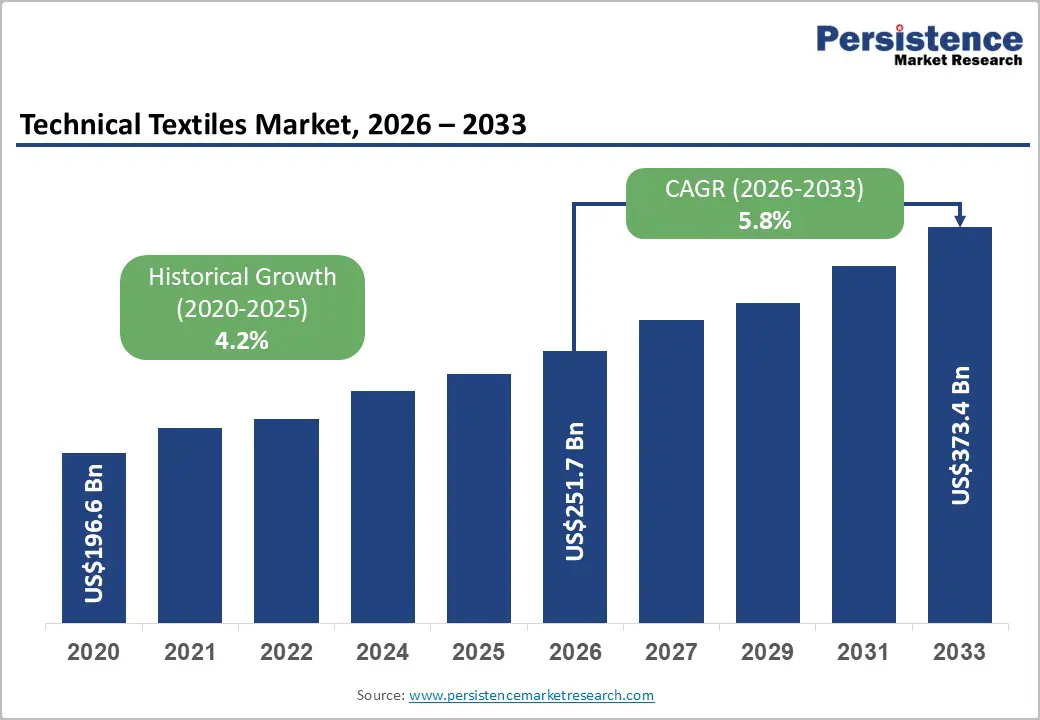
The global technical textiles market size is likely to be valued at US$251.7 billion in 2026 and is expected to reach US$373.4 billion by 2033, growing at a CAGR of 5.8% during the forecast period from 2026 to 2033, driven by ongoing infrastructure development, where geotextiles are used in roads, railways, and erosion control projects to improve lifespan and reduce maintenance.
Healthcare is another key driver, with rising use of nonwoven medical textiles, antimicrobial fabrics, and disposable protective products.
Key Industry Highlights:
- Government Initiative: India’s Ministry of Textiles recently approved 52 new applications under the third round of the Production Linked Incentive (PLI) Scheme, including 18 projects focused on technical textiles to strengthen domestic manufacturing and innovation capabilities.
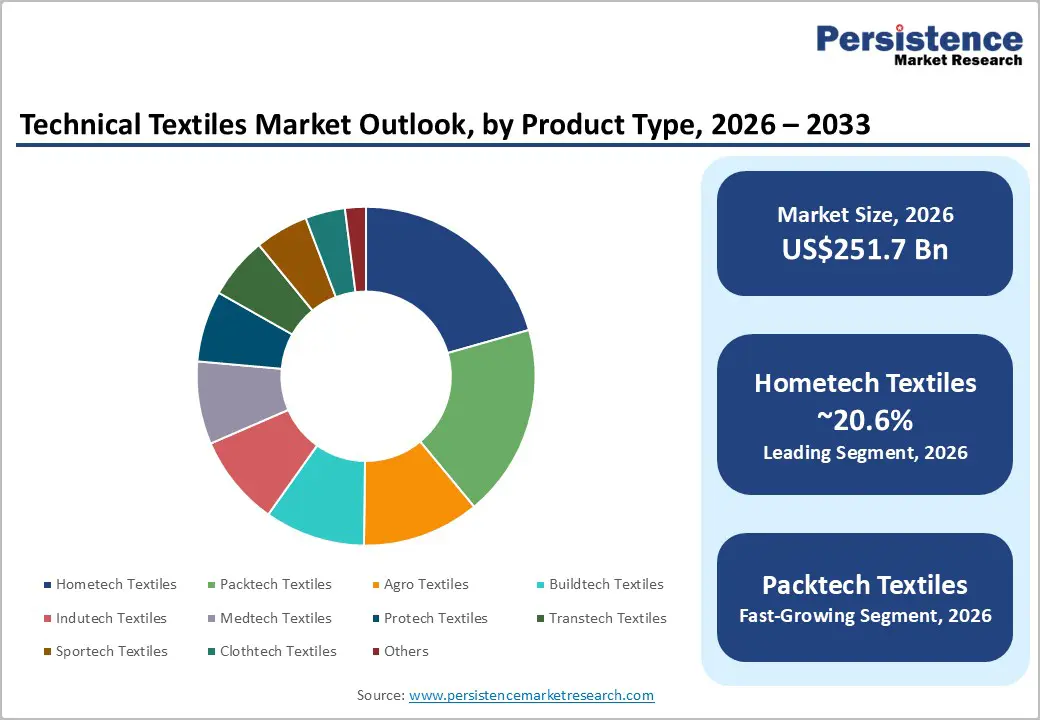
- Leading Product Type: Hometech textiles, approximately 20.6% share in 2026, as they are used in everyday applications, including mattresses, blinds, and HVAC filters.
- Dominant Manufacturing: 3D weaving, nearly 24.3% in 2026, as it enables the production of smooth, multilayer composite structures with high strength and impact resistance.
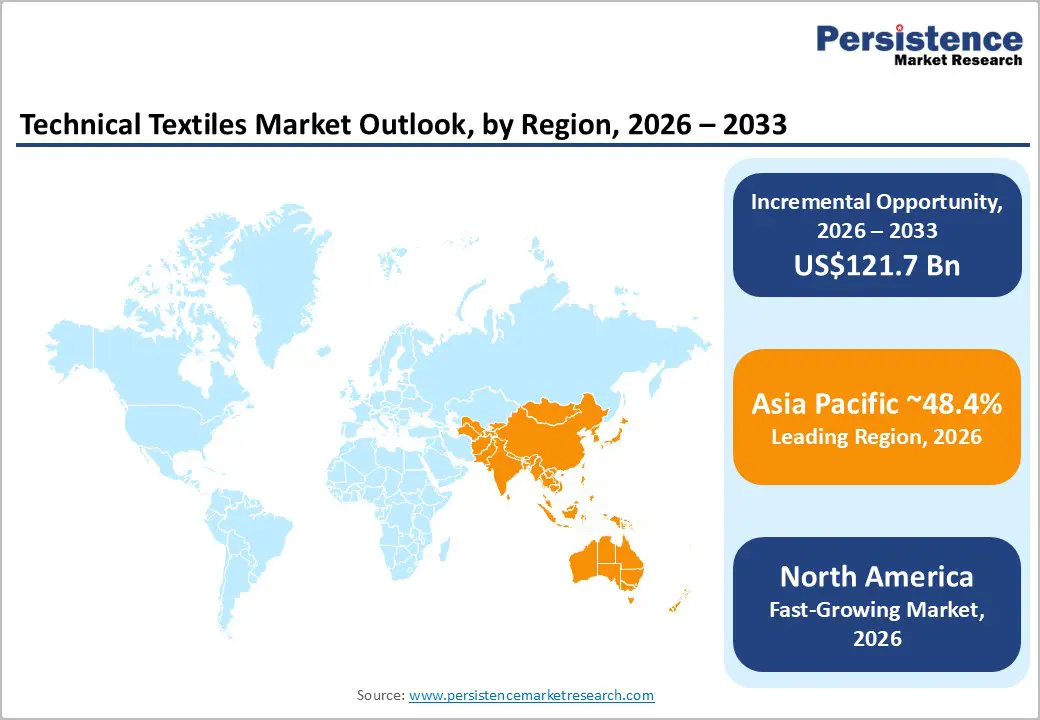
- Leading Region: Asia Pacific, with about 48.4% share in 2026, backed by its integrated fiber-to-fabric supply chains and government-backed programs.
- Fast-growing Region: North America, due to increasing investments in high-performance applications such as aerospace composites and medical textiles.
DRO Analysis
Driver- Superior Protective Performance to Support Demand
The increasing requirement for high-strength and heat-resistant materials in defense, industrial safety, and aerospace applications is accelerating demand for technical textiles. Advanced fibers such as aramid, carbon fiber, and Ultra-High Molecular Weight Polyethylene (UHMWPE) are being used in ballistic protection, firefighter suits, and aerospace insulation as they can withstand extreme temperatures, chemical exposure, and mechanical stress while remaining flexible.
In 2026, India’s Ministry of Textiles stated that several projects under the National Technical Textiles Mission (NTTM) are focused on high-performance fibers and protective, smart textiles for defense and industrial applications. The mission has already approved multiple research & development projects involving aramid fibers, smart protective clothing, and advanced composites. The U.K.’s Defense Science and Technology Laboratory also highlighted ceramic matrix composites that remain stable above 1,000°C while being lighter than conventional metals, propelling the shift toward unique technical textile materials in key industries.
Surging Preference for Lightweight Materials in Mobility and Infrastructure Sectors
Technical textiles are witnessing surging adoption as automotive, aerospace, and infrastructure companies prioritize lightweight materials that improve fuel efficiency and operational performance. Textile-based composites deliver high strength with reduced weight, helping manufacturers lower fuel consumption and simplify transportation logistics. The Ministry of Textiles in India reported in 2026 that government-backed projects are supporting geotextiles, geogrids, and composite systems for highways, railways, and industrial infrastructure, while aerospace-focused projects are developing indigenous carbon-fiber materials.
Research studies are also advancing woven textile composites for aircraft lightning-strike protection and damage-resistant aerospace structures. These materials reduce structural weight while maintaining durability under extreme operating conditions. In electric mobility, lightweight composites are becoming increasingly important, as reducing vehicle weight directly improves battery efficiency and driving range, creating additional demand for technical textile solutions across the transport industry.
Restraint - Limited Access to Advanced Manufacturing Infrastructure
The market for technical textiles faces a key challenge because several small and mid-sized manufacturers still lack access to novel machinery, automation systems, and precision testing technologies required for high-performance textile production. Technical textiles used in aerospace, medical, defense, and industrial applications demand strict quality consistency. However, small-scale units often struggle with outdated equipment and limited technical expertise.
India’s textile industry bodies have repeatedly pointed out that several MSMEs are unable to meet global performance standards for specialized products due to high capital investment requirements for modern weaving, coating, and composite-processing technologies.
Opportunity - Expansion of Intelligent Wearable Textiles
The integration of sensors, conductive fibers, and wireless electronics into textiles is opening new opportunities in healthcare monitoring, sports performance tracking, and defense applications. Smart garments can now monitor body temperature, respiration, muscle movement, hydration levels, and cardiac activity in real time without bulky wearable devices. In 2026, India’s Ministry of Textiles announced new projects under the National Technical Textiles Mission focused on smart and functional textiles, including sensor-enabled fabrics and advanced wearable systems for industrial and healthcare use.
Researchers are also developing battery-free textile sensing systems and self-powered fabrics that generate energy from body heat, movement, or friction, reducing dependence on traditional electronics. Recent studies by wearable technology researchers demonstrated textile-based motion-tracking systems with nearly 5-degree accuracy for monitoring arm and joint movement. It shows the increasing commercial potential of smart technical apparel in rehabilitation and remote healthcare monitoring.
Development of Sustainable Bio-Based Textile
The shift toward environmentally sustainable materials is creating new opportunities for biodegradable and bioengineered technical textiles. Mycelium-based leather alternatives, agricultural waste-derived composites, and recyclable biofabric materials are gaining impetus as industries seek alternatives to petroleum-based synthetic textiles. Recent studies demonstrate that engineered mycelium fabrics have achieved improved tear resistance, water resistance, and thermal stability, making them suitable for fashion, packaging, and industrial applications.
Researchers have also developed bio-composites using cotton waste, polyester residues, and fungal mycelium to create flame-resistant and low-impact materials, supporting textile waste reduction initiatives. Luxury and fashion companies continue to explore commercial mycelium applications, as these materials can be produced from agricultural waste with lower chemical processing requirements than conventional leather production. Government-backed technical textile innovation programs globally are also encouraging start-ups and research institutions to commercialize sustainable fiber technologies and eco-friendly textile manufacturing systems.
Category-wise Analysis
Product Type Insights
Hometech textiles are anticipated to lead with a share of nearly 20.6% in 2026, as they are widely used in everyday residential and commercial applications, creating steady and large-scale consumption. Products such as mattress components, carpet backing, blinds, mosquito nets, HVAC filters, nonwoven wipes, and fire-resistant furnishing fabrics are increasingly demanded due to urbanization, modern housing projects, and rising consumer focus on hygiene and comfort.
Packtech textiles are predicted to remain in the second position, as industries are shifting toward lightweight, durable, reusable, and moisture-resistant packaging materials. Technical textile-based packaging solutions are used in agriculture, chemicals, pharmaceuticals, logistics, and food transportation due to their high strength and protective performance. India’s Technotex initiative notes that products such as FIBCs (Flexible Intermediate Bulk Containers), woven sacks, leno bags, and food-grade jute packaging are witnessing rising demand as they provide better handling efficiency and protection against moisture, UV exposure, and contamination.
Manufacturing Insights
The 3D weaving segment is expected to dominate with around 24.3% of the share in 2026. It is attributed to the ability of this manufacturing technique to produce smooth and multilayer textile structures with superior strength, impact resistance, and durability. Unlike conventional weaving, 3D weaving creates integrated structures that reduce weak points between layers, making these materials highly suitable for aerospace, automotive, defense, and medical applications.
Finishing treatments are expected to be the fastest-growing segment over the forecast period, as industries constantly demand textiles with additional functional properties beyond basic fabric performance.
Unique finishing technologies such as plasma coating, lamination, antimicrobial treatment, flame retardancy, UV protection, and water repellency are transforming standard textiles into high-performance industrial materials. Technical textiles used in healthcare, automotive interiors, industrial filtration, military clothing, and protective wear now require improved durability and specialized surface properties to meet strict safety and operational standards.
Regional Insights
Asia Pacific Technical Textiles Market Trends
Asia Pacific is estimated to dominate with approximately 48.4% of the share in 2026, as the region houses large-scale manufacturing capacity, low-cost production ecosystems, and superior export infrastructure. China, India, Japan, and South Korea have heavily invested in industrial textiles, nonwovens, smart fabrics, and automotive composites over the last decade.
The region also benefits from constant government support through subsidy programs, production-linked incentives, and export-oriented policies. India’s National Technical Textiles Mission and China’s industrial modernization policies are accelerating domestic manufacturing of high-value textile materials.
India Technical Textiles Market Trends
India has become a critical market as the government is positioning the country as a global manufacturing and export center for technical textiles. The National Technical Textiles Mission (NTTM), Production Linked Incentive (PLI) scheme, and infrastructure investments are encouraging domestic production of meditech, mobiltech, agrotech, and geotech products. India is also benefiting from the global China Plus One sourcing strategy, where international buyers are diversifying textile sourcing beyond China.
Technical textile demand is mainly rising from the healthcare, highways, railways, defense, agriculture, and water management sectors. The country’s government stated in 2025 that technical textiles remain a priority sector, due to the rising export opportunities and industrial applications. India is also seeing increasing demand for geotextiles in road construction and smart textiles in healthcare monitoring systems. The country’s relatively lower labor costs and expanding synthetic fiber capacity are improving its competitiveness in high-value textile manufacturing.
China Technical Textiles Market Trends
China continues to see stable growth as it has one of the world’s most integrated textile manufacturing hubs, covering raw materials, fiber production, machinery, coating technologies, and finished technical textile products. It remains a dominant supplier of industrial nonwovens, automotive textiles, filtration media, and protective fabrics used across global manufacturing industries. The country’s ongoing infrastructure projects, renewable energy expansion, electric vehicle production, and industrial automation programs are boosting domestic demand for technical textiles.
Local manufacturers are also upgrading from low-cost commodity textiles toward unique composites, carbon-fiber materials, and high-performance industrial fabrics. Despite global sourcing diversification, various international textile supply chains still depend heavily on China’s raw materials and intermediate textile products owing to the country’s large-scale production efficiency and integrated logistics network. Rising investments in smart manufacturing and sustainable textile recycling technologies are further helping domestic companies maintain competitiveness in the global market.
North America Technical Textiles Market Trends
North America is expected to be the fastest-growing market over the forecast period, driven by the growing focus on high-performance and specialized technical textile applications rather than mass-volume textile manufacturing. Demand is rising from the aerospace, defense, medical technology, industrial filtration, electric vehicles, and advanced protective equipment sectors. The region has become a key innovation center for smart textiles, antimicrobial fabrics, wearable healthcare systems, and lightweight composite materials. Companies in the U.S. and Canada are investing heavily in automation, sustainable textile manufacturing, and advanced fiber engineering to reduce dependence on overseas supply chains.
U.S. Technical Textiles Market Trends
The U.S. is expected to remain one of the most innovation-driven markets globally, supported by superior research capabilities and strong demand from the aerospace, defense, healthcare, and industrial sectors. The country has a mature hub for advanced fibers, nonwoven technologies, medical textiles, and military-grade protective materials. U.S.-based companies are actively developing smart fabrics integrated with sensors for remote patient monitoring, soldier safety, and industrial performance tracking. The healthcare sector remains a prominent growth engine as hospitals and medical device manufacturers increasingly use disposable nonwoven products, implantable textiles, and antimicrobial fabrics.
Europe Technical Textiles Market Trends
Europe is experiencing steady growth driven by rising demand for sustainable textiles, automotive composites, industrial filtration products, and advanced medical fabrics. Local manufacturers are mainly focusing on recyclable materials, bio-based fibers, and circular textile systems because of stringent environmental regulations under the European Green Deal. Germany, France, Italy, and the U.K. are the key centers for automotive textiles, aerospace composites, and industrial engineering fabrics. Europe also has a superior research base supporting smart textiles, nanofiber materials, and sustainable manufacturing technologies.
U.K. Technical Textiles Market Trends
The U.K. is seeing gradual growth through advanced manufacturing, aerospace applications, defense technologies, and medical innovation. The country has a strong research base in smart fabrics, wearable technologies, and protective materials for industrial and military applications. U.K.-based companies and universities are now developing antimicrobial textiles, conductive fabrics, and sustainable fiber technologies for healthcare and industrial applications. Demand is also rising from automotive lightweighting projects and filtration technologies associated with clean energy initiatives.
France Technical Textiles Market Trends
France is strengthening its technical textiles sector through aerospace engineering, luxury-performance textiles, defense applications, and sustainable material innovation. The country has a well-established industrial base for high-performance composites used in aviation, rail transport, and protective clothing. Domestic textile companies are investing in recyclable fibers, bio-based textile materials, and novel nonwoven technologies to comply with Europe’s sustainability goals.
Competitive Landscape
The global technical textiles market is moderately consolidated, with competition centered around material development, specialized applications, and sustainability capabilities. Leading players, including DuPont, Freudenberg Performance Materials, Asahi Kasei Corporation, Toray Industries, and Berry Global Group, are heavily investing in advanced fibers, smart textiles, recyclable materials, and lightweight composites to strengthen their positions.
Competition is further intensifying through acquisitions, partnerships, and regional expansion strategies. Sustainability has become another important competitive differentiator, with companies focusing on recyclable fibers, bio-based materials, and circular textile systems. Industry events such as Techtextil 2026 showcased increasing competition around natural fibers, low-impact production technologies, and textile recycling innovations.
Key Industry Developments:
- In March 2026, the Union Minister of Textiles, Shri Giriraj Singh, launched India’s flagship global textile event, Bharat Tex 2026. It aims to bring together the entire textile value chain, ranging from yarn and fiber to technical textiles, garments, fabrics, and sustainable developments.
- In February 2026, Mafatlal Industries Limited introduced a dedicated digital platform for medical apparel called Mafatlal MedFits to enter the e-commerce space. This launch would help the company broaden its presence in the medical textiles segment.
- In January 2026, Messe Frankfurt Trade Fairs India Pvt Ltd. signed a Memorandum of Understanding with the Department of Textiles and Guidance, Tamil Nadu, Government of Tamil Nadu. This MoU enables the launch of Techtextil India Summit scheduled from 26 to 27 November 2026 at CODISSIA, Coimbatore.
Companies Covered in Technical Textiles Market
- Low & Bonar PLC
- Freudenberg Group
- Berry Global Group, Inc.
- Ahlstrom-Munksjo
- Asahi Kasei Advance Corp.
- Kimberly-Clark Corp.
- Mitsui Chemicals, Inc.
- Huntsman International LLC
Frequently Asked Questions
The global technical textiles market is projected to be valued at US$251.7 billion in 2026.
The technical textiles market is expected to reach US$373.4 billion by 2033.
Key market trends include the rise of smart textiles with embedded sensors and the increasing adoption of recyclable fibers.
Hometech textiles are expected to lead with around 20.6% share in 2026, spurred by rising demand for antimicrobial bedding, nonwoven wipes, and dust-resistant furnishings.
The technical textiles market is expected to grow at a CAGR of 5.8% from 2026 to 2033.
Low & Bonar PLC, Freudenberg Group, Berry Global Group, Inc., and Ahlstrom-Munksjo are a few key market players.


