




- Pharmaceuticals
- Inhalation Formulation Market
Inhalation Formulation Market Size, Share, and Growth Forecast, 2026 - 2033
Inhalation Formulation Market by Drug Class (Short-acting Beta2 Agonist (SABAs), Others), Disease Indication (Asthma, Chronic Obstructive Pulmonary Disease (COPD), Others), Sales Channel (Hospitals, Others), and Regional Analysis for 2026 – 2033
Inhalation Formulation Market Size and Trends Analysis
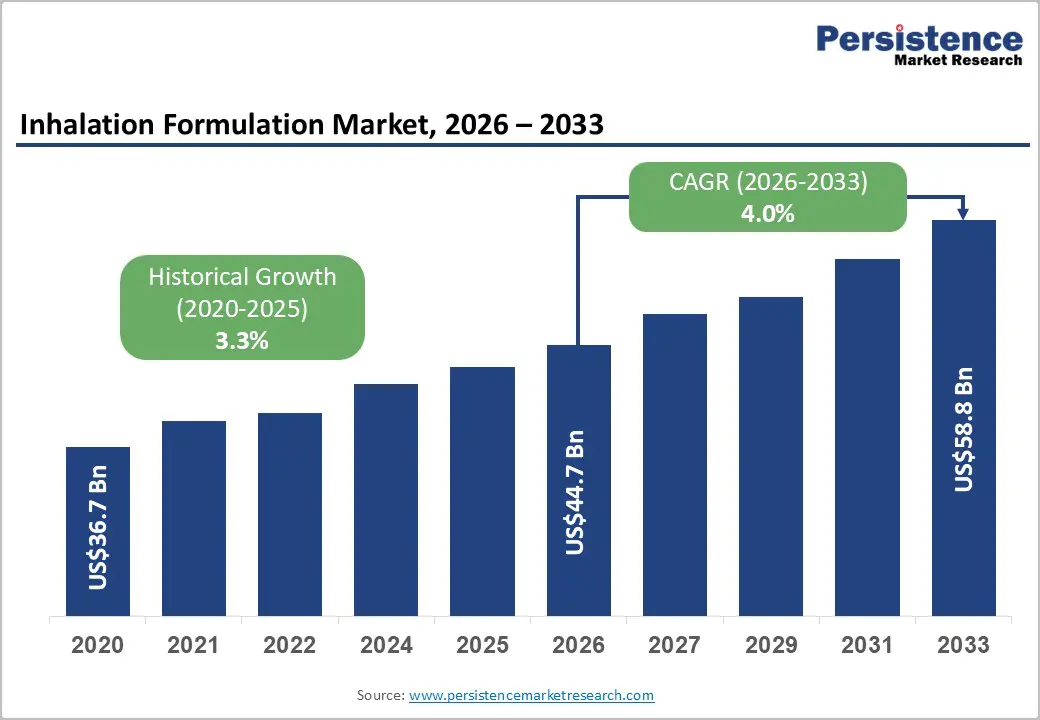
The global inhalation formulation market size is likely to be valued at US$44.7 billion in 2026, and is expected to reach US$58.8 billion by 2033, growing at a CAGR of 4.0% during the forecast period from 2026 to 2033, driven by the increasing prevalence of respiratory diseases such as asthma and COPD, rising demand for convenient, non-invasive drug delivery, growing adoption of combination inhalers for better disease control, and expanding patient preference for maintenance therapy in chronic respiratory conditions.
Increasing recognition of inhalation formulations as critical for targeted pulmonary delivery, reduced systemic side effects, and better quality of life in chronic respiratory disease management remains a major driver of market growth.
Key Industry Highlights:
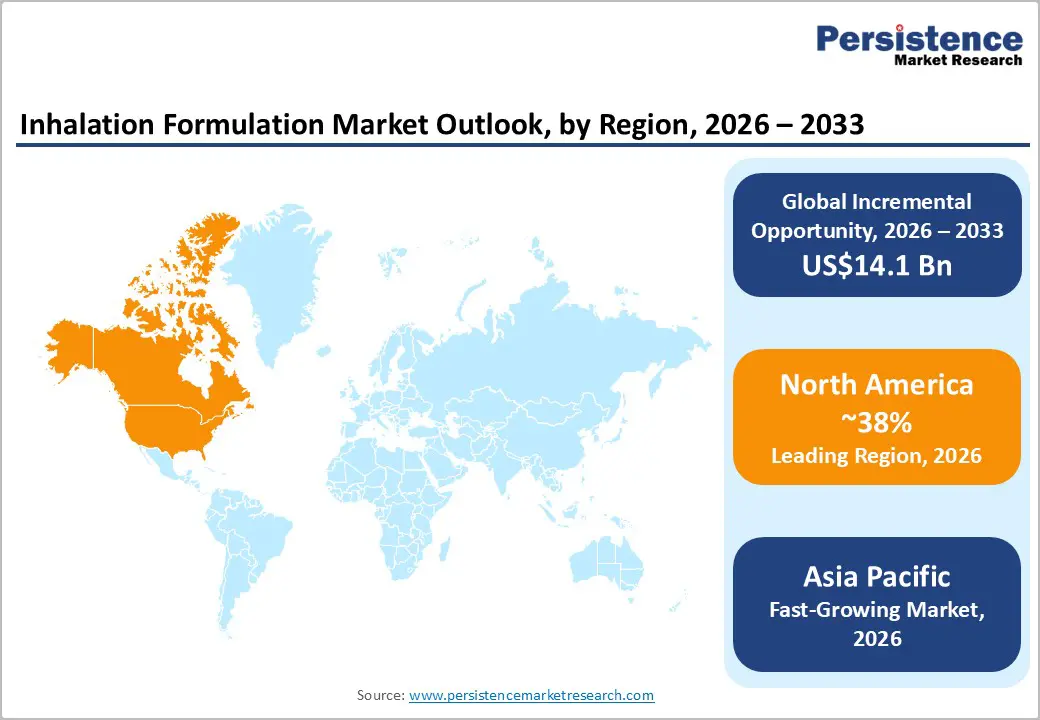
- Leading Region: North America, anticipated to account for a 38% market share in 2026, driven by high asthma/COPD prevalence, advanced inhaler adoption, and strong demand in the U.S.
- Fastest-growing Region: Asia Pacific, fueled by rising respiratory disease burden, increasing healthcare access, and growing generic inhaler penetration in China and India.
- Dominant Drug Class: Combination ICS/LABA, to hold approximately 45% of the market share, as it remains the preferred maintenance therapy for asthma and COPD.
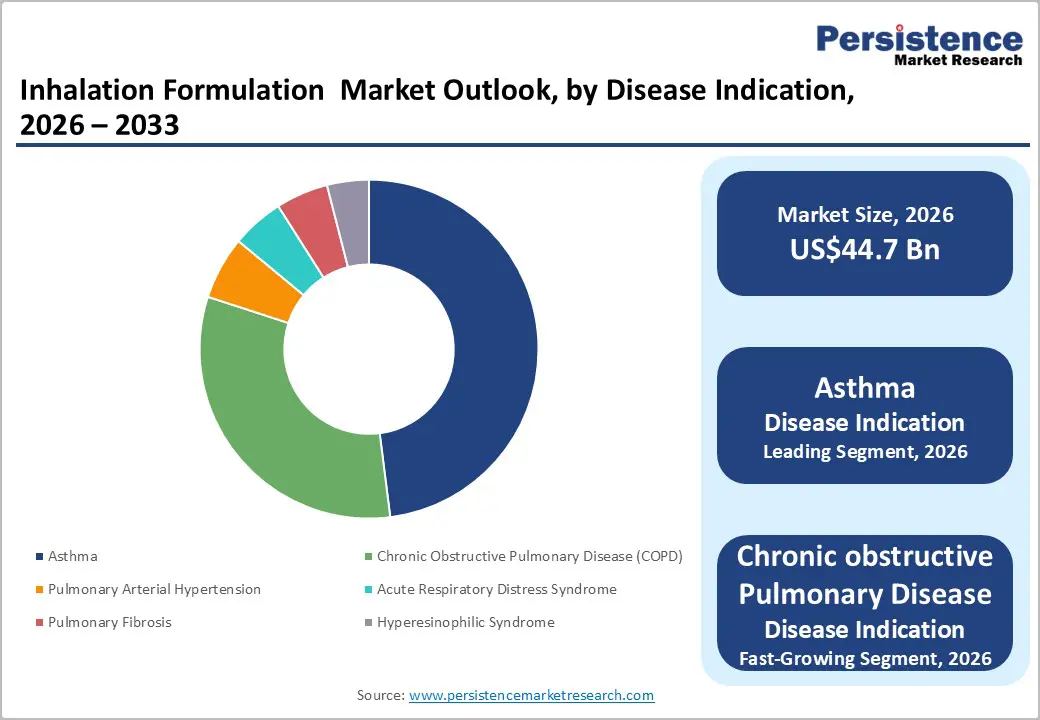
- Leading Disease Indication: The asthma segment is expected to contribute nearly 48% of the market revenue, due to the highest patient pool and chronic therapy demand.
| Key Insights | Details |
|---|---|
| Inhalation Formulation Market Size (2026E) | US$44.7 Bn |
| Market Value Forecast (2033F) | US$58.8 Bn |
| Projected Growth CAGR (2026-2033) | 4.0% |
| Historical Market Growth (2020-2025) | 3.3% |
Market Factors – Growth, Barriers, and Opportunity Analysis
Growth Analysis – Rising Respiratory Disease Burden and Combination Therapy Preference
The growing incidence of chronic respiratory disorders is creating sustained demand for inhalation-based drug formulations. Asthma and chronic obstructive pulmonary disease (COPD) require long-term management using inhaled medications that deliver drugs directly to the lungs with faster therapeutic action and reduced systemic side effects. Healthcare systems increasingly prioritize inhalation therapy as the primary treatment modality for airway inflammation and bronchoconstriction.
According to the World Health Organization (WHO), approximately 262 million people globally were living with asthma, demonstrating the substantial patient population requiring continuous respiratory medication and inhalation delivery systems. This expanding disease burden drives consistent prescription volumes for inhalers and nebulized therapies across hospitals, clinics, and home-care settings, strengthening demand for inhalation formulations in pharmaceutical manufacturing and distribution.
Clinical practice increasingly favors combination therapy to address multiple disease mechanisms in respiratory disorders. Physicians frequently prescribe formulations that combine bronchodilators and anti-inflammatory agents within a single inhaler to improve symptom control, reduce exacerbation risk, and simplify treatment regimens. The complexity of respiratory diseases often requires multi-drug therapy rather than single-agent treatment. According to a study of COPD patients' surveys, 26.5% of asthma patients and 29.6% of COPD patients exhibit asthma-COPD overlap, highlighting the need for integrated treatment approaches that manage multiple pathological pathways simultaneously.
Smart Inhaler Adoption and Adherence Improvement
Integration of digital technology in respiratory care is enhancing treatment outcomes and driving demand for inhalation formulations. Smart inhalers equipped with sensors and Bluetooth connectivity enable real-time monitoring of patient usage, allowing healthcare providers to track adherence and adjust therapy as needed. Non-adherence to prescribed inhaled medications has historically limited the effectiveness of respiratory treatments. Smart inhaler adoption addresses these challenges by reminding patients of doses, recording inhalation technique, and providing actionable data to clinicians. This integration enhances patient engagement and encourages consistent use of inhalation therapy, driving sustained market demand for advanced inhalation formulations.
Digital adherence support is particularly valuable in chronic respiratory conditions such as COPD and severe asthma, where treatment complexity can lead to missed doses. Pharmaceutical companies and healthcare providers recognize that coupling inhalation formulations with smart delivery systems enhances therapeutic efficiency and patient compliance. This trend incentivizes investment in both device innovation and formulation development, reinforcing the growth trajectory of the inhalation formula market as patient-centric, technology-enabled solutions become standard in respiratory care.
Barrier Analysis – High Development Costs and Generic Competition
Developing inhalation formulations involves significant investment in research, clinical trials, and regulatory approvals, which increases the overall cost of bringing new products to market. Advanced delivery technologies, such as pressurized metered-dose inhalers, dry powder inhalers, and smart inhaler integration, require specialized engineering and testing to ensure consistent dosing and patient safety. These high development costs can limit the number of companies able to enter the market, creating barriers for smaller players.
Generic competition exerts downward pressure on pricing and profit margins. Once patents expire, generic manufacturers can produce equivalent inhalation products at lower costs, increasing market accessibility but intensifying competition for branded formulations. Balancing investment in innovation with the threat of generics challenges pharmaceutical companies to optimize production efficiency and focus on differentiating products through advanced delivery mechanisms, combination therapies, or digital adherence technologies to maintain market share and profitability.
Patient Technique Challenges and Device Complexity
Incorrect inhaler usage and complex device designs remain key obstacles in effective respiratory therapy, influencing the demand for advanced inhalation formulations. Many patients struggle with coordinating inhalation timing, device activation, and dose measurement, which can significantly reduce drug delivery efficiency to the lungs. The CDC reports that up to 70% of asthma patients use their inhalers incorrectly, leading to poor symptom control and higher rates of emergency visits. These challenges create a market need for user-friendly devices and optimized formulations that ensure consistent dosing even when the technique is suboptimal.
Pharmaceutical companies are responding by developing inhalers with simplified mechanisms, integrated dose counters, and breath-actuated systems, minimizing errors and improving adherence. Device complexity also drives demand for patient education programs and combination therapies that reduce the number of devices required.
Opportunity Analysis – Growth in Smart Inhalers and Biologic Respiratory Therapies
Advancements in digital health technology are transforming respiratory care, driving the adoption of smart inhalers, and boosting demand for inhalation formulations. Smart inhalers equipped with sensors, mobile connectivity, and dose tracking features allow patients and clinicians to monitor adherence and optimize therapy in real time.
Smart inhalers address these challenges by improving medication compliance, providing feedback on inhalation technique, and reducing missed doses. This drives consistent demand for innovative inhalation formulations capable of integration with digital delivery devices. Pharmaceutical companies are investing in these solutions to enhance patient outcomes and differentiate their products in a competitive respiratory market.
Biologic therapies targeting severe asthma and other complex respiratory conditions are also influencing inhalation formula growth. Biologics, such as monoclonal antibodies, are increasingly administered via inhalation to provide targeted delivery to the lungs, enhancing efficacy while minimizing systemic exposure. According to the National Institutes of Health (NIH), biologic treatments have reduced severe exacerbation rates by up to 50% in eligible asthma patients. The combination of smart device technology and advanced biologic formulations supports patient-centric care, encouraging adoption of fixed-dose inhalers and specialized formulations.
Expansion in Online Pharmacy Channels
The growing adoption of online pharmacy platforms is reshaping access to respiratory therapies, boosting the demand for inhalation formulations. Patients increasingly prefer digital channels for convenience, home delivery, and discreet medication management, particularly for chronic conditions requiring regular refills. Streamlined ordering, automated reminders, and doorstep delivery increase adherence rates, which directly drive prescription volumes and strengthen market growth for inhalation formulations.
Online pharmacies also facilitate the distribution of advanced inhaler technologies and combination therapies by simplifying logistics and reducing barriers to entry for new products. nhanced adherence and improved accessibility create a favorable environment for inhalation formula adoption. Pharmaceutical companies leverage these digital channels to optimize supply chains, target patient education programs, and expand market penetration, driving overall growth in the inhalation formula segment.
Category-wise Analysis
Drug Class Insights
Combination ICS/LABA is anticipated to dominate the market, accounting for 45% of the market share in 2026. Its dominance is driven by its dual mechanism of action. ICS reduces airway inflammation, while LABA provides sustained bronchodilation, improving symptom control and reducing exacerbations in asthma and COPD patients. Clinicians favor these fixed-dose combinations for simplifying treatment regimens, enhancing adherence, and reducing the need for multiple devices.
The ability to address both inflammation and airway constriction in a single inhaler drives strong prescription demand. The ICS/LABA combination inhaler is Symbicort, developed by AstraZeneca. Symbicort combines budesonide (ICS) and formoterol (LABA) in a single inhaler, targeting both airway inflammation and bronchoconstriction in asthma and COPD patients. Clinical data and real-world usage show improved symptom control, reduced exacerbation frequency, and better adherence compared to separate inhalers.
Long-acting beta2 agonist inhalers (LABAs) represent the fastest-growing drug class, due to their ability to provide sustained bronchodilation, improving lung function and reducing symptoms in patients with asthma and COPD. LABAs maintain airway openness for up to 12–24 hours, allowing once- or twice-daily dosing, which enhances patient adherence and convenience. Their use is particularly valuable in combination with inhaled corticosteroids (ICS), offering both anti-inflammatory and bronchodilator benefits.
LABA inhaler is Serevent Diskus, developed by GlaxoSmithKline (GSK). Serevent contains salmeterol, a long-acting beta2 agonist, which provides up to 12 hours of bronchodilation, improving breathing and reducing nighttime symptoms in asthma and COPD patients.
Disease Indication Insights
Asthma is expected to dominate the market, contributing nearly 48% of revenue in 2026, propelled by its high prevalence and the need for long-term management. Patients require daily use of inhaled medications to control airway inflammation, prevent exacerbations, and maintain lung function. Inhalation therapies provide targeted delivery to the lungs, offering faster relief and minimizing systemic side effects, which makes them the preferred treatment option. Flovent HFA, developed by GlaxoSmithKline (GSK).
Flovent HFA contains fluticasone propionate, an inhaled corticosteroid used for long-term management of asthma. It helps reduce airway inflammation, prevent asthma attacks, and improve overall lung function in patients requiring daily therapy.
Chronic obstructive pulmonary disease (COPD) represents the fastest-growing disease indication, fueled by its rising prevalence and long-term treatment requirements. COPD patients often require multiple inhaled medications, including bronchodilators and corticosteroids, to manage symptoms, reduce exacerbations, and improve quality of life. Aging populations, increased exposure to air pollution, and smoking-related lung damage contribute to the expanding patient base. Inhalation therapies offer targeted delivery to the lungs, providing faster relief and minimizing systemic side effects.
Breo Ellipta, developed by GlaxoSmithKline (GSK). Breo Ellipta combines fluticasone furoate (ICS) and vilanterol (LABA) in a single inhaler, providing once-daily maintenance therapy for COPD patients. It helps reduce exacerbations, improve lung function, and simplify treatment regimens for long-term disease management.
Regional Insights
North America Inhalation Formulation Market Trends
North America is expected to dominate, accounting for 38% revenue share in 2026, driven by the high prevalence of chronic respiratory diseases such as asthma and COPD. Advanced healthcare infrastructure, widespread insurance coverage, and increasing patient awareness of disease management support consistent demand for inhalation therapies. Patients and clinicians in the region prefer inhalers and nebulizers for targeted drug delivery, which ensures faster symptom relief and reduces systemic side effects compared to oral medications.
Adoption of combination therapies, including ICS/LABA inhalers, is rising, driven by clinical evidence supporting improved adherence, reduced exacerbations, and simplified dosing regimens. Technological innovations, such as smart inhalers, digital monitoring, and breath-actuated devices, further enhance patient compliance and engagement, providing real-time feedback on inhalation technique. Telehealth integration and the growth of online pharmacy channels make these therapies more accessible, particularly in remote or underserved areas.
Europe Inhalation Formulation Market Trends
Market growth in Europe is supported by the rising burden of chronic respiratory diseases and increasing demand for patient-friendly therapies. Aging populations, coupled with high smoking prevalence in some countries, have led to a growing incidence of asthma and COPD, driving consistent need for inhaled medications. Inhalation therapies are preferred for their ability to deliver drugs directly to the lungs, providing rapid relief and minimizing systemic side effects.
Clinicians in Europe increasingly favor combination therapies, such as ICS/LABA inhalers, which improve adherence by reducing the number of devices needed and addressing multiple disease mechanisms simultaneously. Innovation in inhaler devices, including breath-actuated systems, dose counters, and smart inhalers, enhances ease of use and supports correct technique, improving clinical outcomes. Growth of e-pharmacy platforms and telehealth services in the region further increases access to inhalation therapies, particularly in remote or underserved areas.
Asia Pacific Inhalation Formulation Market Trends
Asia Pacific is likely to be the fastest-growing in 2026, fueled by rising prevalence of chronic respiratory diseases, increasing urbanization, and higher exposure to air pollution. Countries such as China and India report a growing burden of asthma and COPD, driven by industrialization, tobacco use, and poor air quality, which amplifies demand for effective inhalation therapies. Inhalers and nebulizers are preferred as they deliver drugs directly to the lungs, providing fast relief and minimizing systemic side effects.
The adoption of combination therapies, including ICS/LABA and LABA/LAMA inhalers, is increasing as clinicians aim to simplify treatment regimens and improve adherence. Technological advancements such as smart inhalers, dose counters, and breath-actuated devices are being introduced to address patient technique challenges, supporting better clinical outcomes. Expansion of online pharmacy platforms and home delivery services is improving accessibility, particularly in rural and semi-urban regions.
Competitive Landscape
The global inhalation formulation market is shaped by competition between established pharmaceutical leaders and emerging generic manufacturers. In North America and Europe, companies such as GSK plc and AstraZeneca dominate through extensive branded portfolios, integration of digital health tools, and strong relationships with hospitals and clinics. Their focus on innovative therapies, including ICS/LABA combinations and smart inhaler programs, enhances patient adherence, improves clinical outcomes, and reinforces brand loyalty.
In Asia Pacific market sees rapid growth of local generic players offering cost-competitive inhalation therapies, improving accessibility for large patient populations, and addressing affordability challenges. Combination ICS/LABA inhalers are particularly valued for reducing exacerbation risks, simplifying treatment regimens, and delivering targeted therapy, driving widespread adoption across diverse patient groups.
Key Industry Developments:
- In October 2025, GSK plc announced positive Phase III results from its clinical program for a next-generation version of its metered-dose inhaler (MDI), Ventolin (salbutamol). The study confirmed that the salbutamol MDI formulated with the innovative low-carbon propellant HFA-152a demonstrated therapeutic equivalence and comparable safety to the existing salbutamol MDI using HFA-134a.
- In March 2024, AstraZeneca announced the U.S. FDA approval of its new fixed-dose combination inhaler, Breztri Aerosphere, for the maintenance treatment of COPD.
Companies Covered in Inhalation Formulation Market
- Boehringer Ingelheim International GmbH
- Lupin Ltd.
- Recipharm AB
- Perrigo Company plc.
- Teva Respiratory, LLC
- AstraZeneca
- Organon Group of Companies
- Novartis AG
- GSK plc.
- Viatris Inc. (Mylan N.V)
- Cipla Ltd.
- Merck & Co., Inc.
Frequently Asked Questions
The global inhalation formulation market is projected to reach US$44.7 billion in 2026.
Growing cases of asthma, COPD, and other respiratory disorders are increasing demand for inhalation formulations due to their fast and targeted drug delivery to the lungs.
The inhalation formulation market is poised to witness a CAGR of 4% from 2026 to 2033.
Development of biologics, gene therapies, and nanoparticle-based inhalation drugs is creating new opportunities for targeted pulmonary drug delivery.
GSK plc, AstraZeneca, Boehringer Ingelheim, Novartis AG, and Teva Respiratory are the key players.


