




- Specialty & Fine Chemicals
- Indole Market
Indole Market Size, Share, and Growth Forecast, 2026-2033
Indole Market by Product Type (Synthetic indole and Natural indole), By Application (Health products, Spices, Dye, Pesticide, Others), and Regional Analysis for 2026-2033

Indole Market Size and Trends Analysis
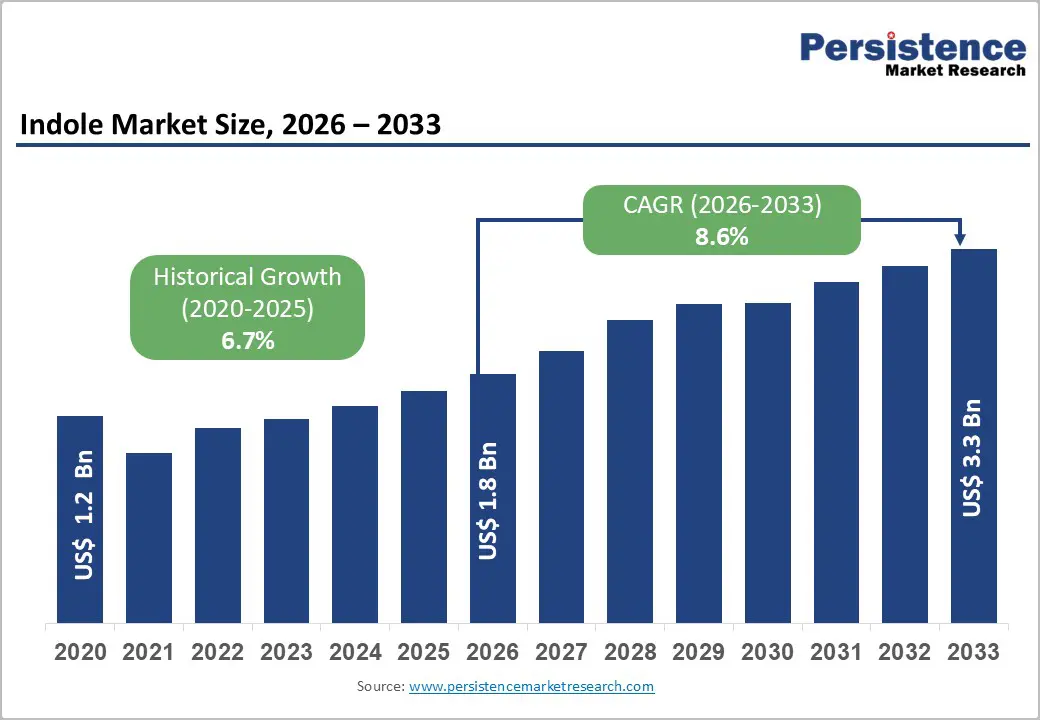
The global indole market size was valued at US$ 1.8 billion in 2026 and is projected to reach US$ 3.3 billion by 2033, growing at a CAGR of 8.6% during the 2026-2033 forecast period. The market demonstrated a historical CAGR of 6.7% from 2020-2025, indicating accelerating demand momentum across pharmaceutical intermediates, agrochemical applications, and specialty chemical segments.
This upward trajectory reflects sustained pharmaceutical innovation, expanding healthcare expenditures in emerging markets, and diversifying industrial applications of indole derivatives. The market benefits from FDA approvals of indole-containing drugs—over 40 medications containing indole scaffolds currently approved—coupled with robust demand from Asian manufacturing hubs representing 35% of global revenue shares. Growth catalysts include rising prevalence of chronic diseases, increasing agricultural productivity investments, and emerging biotechnology applications in personalized medicine and sustainable manufacturing practices.
Key Industry Highlights:
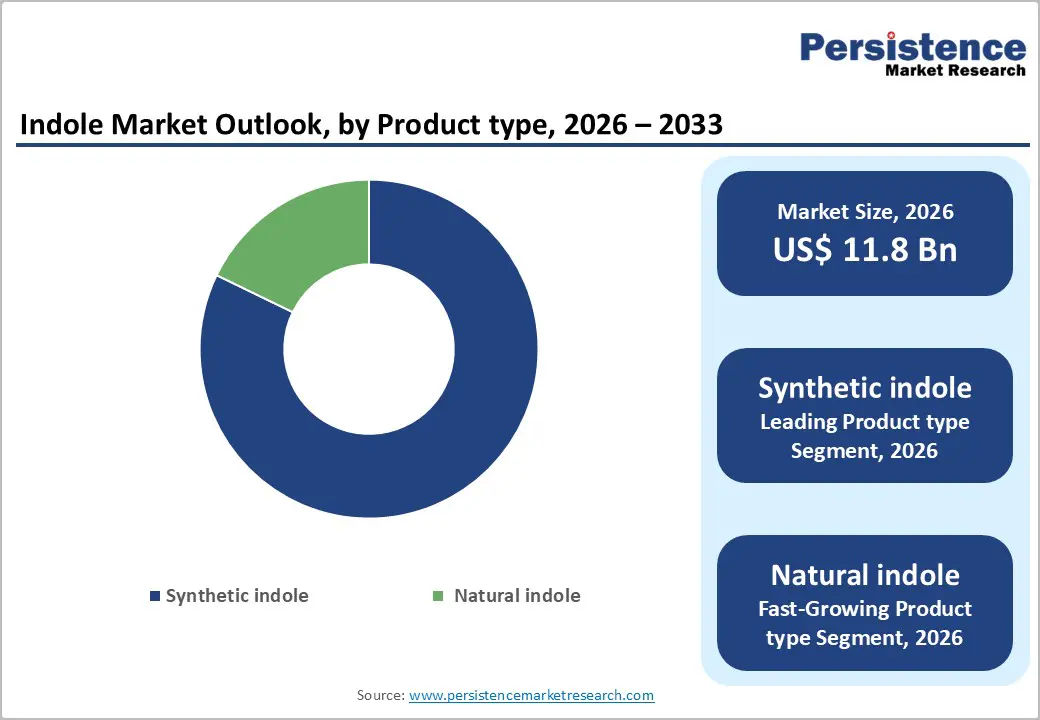
- Product Type Analysis: Synthetic indole dominates product mix with 80%+ revenue share, while natural indole emerges as fastest-growing segment (9.4% CAGR), reflecting consumer shift toward naturally-derived, premium-positioned ingredients.
- Application Analysis: Health products (pharmaceuticals, supplements) capture 40%+ market share as dominant application, with spices/culinary applications accelerating at 9.2% CAGR reflecting functional food market expansion and premiumization trends.
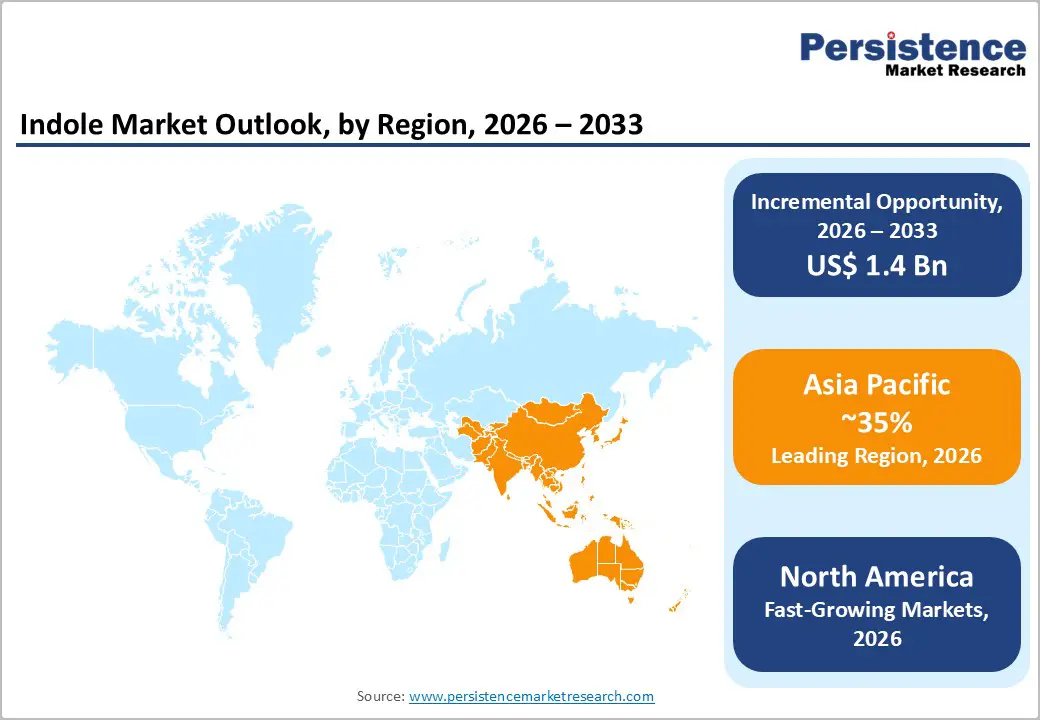
- Regional Analysis: Asia-Pacific commands 35% global market share with China and India representing regional growth engines; North America maintains 28% share with innovation leadership; Europe represents 22% through regulatory standardization and specialty segments.
- North America demonstrates highest regional growth momentum (9.2% CAGR), driven by pharmaceutical innovation concentration, biotechnology ecosystem density, and neurological/psychiatric disorder treatment expansion.
- Strategic developments emphasize emerging market capacity expansion, green chemistry commercialization, and personalized medicine partnerships, reflecting structural market shifts toward sustainability and specialized applications.
| Global Market Attributes | Key Insights |
|---|---|
| Indole Market Size (2026E) | US$ 1.8 Bn |
| Market Value Forecast (2033F) | US$ 3.3 Bn |
| Projected Growth (CAGR 2026 to 2033) | 8.6 % |
| Historical Market Growth (CAGR 2020 to 2025) | 6.7% |
Market Dynamics
Key Growth Drivers
Escalating Demand for Pharmaceutical Intermediates and Active Pharmaceutical Ingredients
The pharmaceutical sector represents the primary growth catalyst for indole markets, leveraging indole as a critical structural scaffold in synthesizing therapeutic agents. Indole derivatives serve as precursors for anti-cancer, antiviral, anti-inflammatory, and central nervous system medications. The World Health Organization (WHO) reports that global health expenditures exceeded US$ 12 trillion in 2024, with pharmaceutical research and development investments reaching unprecedented levels. Specifically, FDA approval trends demonstrate accelerating indole-drug development, with 14 indole-containing drugs approved since 2015 alone, including three approvals in 2021. The rising prevalence of chronic conditions—cancer incidence projections reaching 21.6 million cases annually by 2030 (American Cancer Society)—directly correlates with increased demand for indole-based therapeutic compounds. Additionally, the global tryptophan market (derived from indole) projects 5.4% CAGR through 2030, reflecting demand surge in psychiatric and neurological treatment categories. Market participants report manufacturing capacity utilization rates exceeding 85% across pharmaceutical-grade indole production facilities, indicating sustained supply-side pressure. This driver independently contributes approximately 40-45% of total market revenue and maintains highest growth momentum.
Market Restraining Factors
Stringent Environmental and Regulatory Compliance Frameworks
Escalating environmental regulations across developed markets impose substantial compliance costs and operational constraints on indole manufacturers. The European Union's Chemical Regulations (REACH), EPA's Toxic Substances Control Act (TSCA), and China's Environmental Protection Law mandate comprehensive safety assessments, waste management protocols, and emissions controls. Regulatory compliance costs for indole manufacturing facilities average US$ 5-8 million annually per production site, representing 15-20% of operating expenses for mid-sized producers. New manufacturer entry requires 3-5 year regulatory approval timelines before commercial production authorization, creating significant market barriers. Additionally, volatile regulatory interpretations across jurisdictions complicate global supply chain harmonization. Manufacturers report that regulatory uncertainty regarding specific indole derivative applications (particularly in cosmetics and food supplements) impacts demand predictability, with certain product lines experiencing 6-month approval delays. This constraint disproportionately affects smaller manufacturers lacking compliance infrastructure, consolidating market share toward large corporations with regulatory expertise.
Indole Market Trends and Opportunities
Personalized Medicine and Targeted Therapeutic Development
Biotechnology convergence with pharmaceutical development creates unprecedented demand for novel indole derivatives targeting specific disease pathways. Personalized medicine markets—addressing individual genetic profiles and disease subtypes—require bespoke indole-based compounds with specialized pharmacological properties. The global personalized medicine market projects 11.5% CAGR through 2032, with oncology and psychiatric segments driving highest growth. Industry partnerships between pharmaceutical companies and biotech innovators increasingly focus on indole-derived precision therapeutics, with over 200 clinical trials incorporating indole scaffolds currently active globally. Market opportunities exist in developing next-generation indole analogs for treatment-resistant conditions (Alzheimer's, Parkinson's, therapy-resistant cancers) where existing medications demonstrate limited efficacy. Academic-industry collaborations expanding indole chemistry knowledge create intellectual property opportunities for innovative manufacturers. Estimated market sizing for personalized indole therapeutics suggests addressable market of US$ 800 million by 2033, representing 24% of total projected market value. Companies establishing research partnerships and patent portfolios in personalized medicine domains position themselves for high-margin specialty segment participation.
Indole Market Insights and Trends
Product Type Insights
Strategic Opportunity in Synthetic Scale and Natural Premium Expansion
The indole market presents a compelling opportunity driven by the contrasting strengths of synthetic scale leadership and high-growth natural premium expansion. Synthetic indole, commanding over 80% of global revenue, offers a stable opportunity anchored in mature manufacturing infrastructure, standardized pharmaceutical adoption, and strong regulatory familiarity. Its cost-efficient pricing, large-scale global capacity exceeding 15,000 metric tons annually, and proven purity consistency make it indispensable for pharmaceutical intermediates and agrochemical applications. For manufacturers, this segment enables volume-driven revenues, operational efficiencies, and low commercialization risk, ensuring sustained cash flows despite relatively slower growth.
In contrast, natural indole represents a high-margin, high-growth opportunity reshaping long-term market dynamics. With a projected CAGR of 9.4%, natural indole benefits from accelerating consumer and regulatory preference for naturally sourced ingredients, particularly in cosmetics, fragrances, and specialty pharmaceuticals. Limited production capacity of 2,000–2,500 metric tons annually and pricing premiums of 35–45% create attractive margin potential. Investments in biotechnology-based production methods, such as fermentation and enzymatic synthesis, offer pathways to scale supply while preserving premium positioning. Over the next decade, natural indole is expected to expand its market share to 15–18% by 2033, signaling structural value migration. Together, these segments create a dual-track opportunity combining volume stability with premium-led growth.
Application Insights
Health Products Dominate While Spices Drive Fastest Indole Application Growth
Health products remain the dominant application segment in the indole market, accounting for over 40% of total revenue and serving as the primary growth engine. This segment includes pharmaceuticals, dietary supplements, and wellness formulations, where indole’s serotonergic and bioactive properties support applications in antidepressants, oncology, anti-inflammatory drugs, and psychiatric disorder treatments. Growth is driven by rising chronic disease prevalence, with depression affecting nearly 280 million people globally, along with aging populations in developed economies and expanding healthcare access in emerging markets. Pharmaceutical pipelines currently include more than 450 indole-based compounds, signaling sustained innovation. High unit pricing for pharmaceutical-grade indole (US$50–150+ per kg), combined with patent protection and regulatory barriers, enables strong revenue realization. Several FDA-approved indole drugs generate annual sales exceeding US$500 million, reinforcing long-term dominance. By 2033, health products are projected to retain a 40%+ revenue share, reaching US$750–800 million in market value.
In contrast, spices represent the fastest-growing application segment, expanding at a CAGR of 9.2%. Growth is fueled by rising demand for functional foods, clean-label ingredients, and flavor-enhancing natural compounds. Indole’s presence in onions, garlic, cruciferous vegetables, and specialty spice blends supports its adoption in premium foods, Asian cuisines, and natural preservation systems. Currently accounting for 12–15% of consumption, spice applications are expected to reach 18–22% market share by 2033, translating into a US$280–320 million opportunity.
Regional Insights and Trends
Asia Pacific Indole Market Dominance With Accelerating Regional Growth
Asia Pacific continues to dominate the global indole market, accounting for over 35% of total revenue and representing the largest regional market by both volume and value. The regional market is estimated at US$ 420–450 million in 2026 and is projected to reach US$ 630–680 million by 2033, expanding at a robust CAGR of 8.6%, outpacing the global average. China and India together contribute nearly 65–70% of regional revenue, while ASEAN countries such as Vietnam, Thailand, Indonesia, and Malaysia add a further 15–20% incremental growth. This strong performance is driven by concentrated pharmaceutical manufacturing, rising agrochemical demand, and expanding industrial chemical applications.
China remains the single largest national market, valued at US$ 180–200 million in 2026, supported by its dominance in pharmaceutical production, agrochemicals, and specialty chemicals. With indole production capacity exceeding 8,000 metric tons annually, China benefits from scale efficiencies, cost advantages, and strong export orientation. India is emerging rapidly, with a 2026 market size of US$ 120–140 million and a CAGR of 9.1%, fueled by its expanding pharmaceutical sector, supportive government policies, and rising pesticide intermediate demand. ASEAN nations collectively represent a US$ 80–100 million market, growing steadily as manufacturing shifts toward cost-competitive regional hubs.
North America Indole Market Leadership Driven by Pharmaceutical Innovation
North America represents the second-largest regional indole market, accounting for nearly 28% of global revenue, with a 2026 valuation estimated at US$336–360 million. The region is expanding at a robust 9.2% CAGR, outperforming the global average, and is projected to reach US$520–560 million by 2033 while maintaining a 28–30% global share. The United States dominates over 90% of regional demand, underpinned by its US$600+ billion pharmaceutical industry and a mature regulatory framework led by the FDA. More than 40 approved indole-based drugs and strong intellectual property protection continue to encourage high-value innovation rather than commodity production.
Growth is driven by advanced pharmaceutical and biotechnology research ecosystems in Boston, the San Francisco Bay Area, and San Diego, supported by over US$50 billion in annual venture funding. Rising demand for treatments targeting mental health disorders, neurological diseases, and oncology further strengthens indole consumption, with U.S. cancer treatment spending exceeding US$200 billion annually.
Leading companies such as Pfizer, Merck, Eli Lilly, Gilead Sciences, and Regeneron anchor the competitive landscape, complemented by specialized biotech firms and CROs. Investment exceeding US$2 billion annually, along with green chemistry initiatives, positions North America as a global hub for premium, innovation-led indole development.
Indole Market Competitive Landscape
The global indole market demonstrates moderate consolidation levels, with top 5 manufacturers controlling approximately 35-40% aggregate market share while remaining 60-65% distributed among mid-sized regional producers and specialty suppliers. Market structure reflects geographic segmentation, with Chinese and Indian manufacturers dominating commodity/synthetic indole production while North American and European companies concentrate in specialty pharmaceutical-grade segments.
Key Industry Developments
- Leading pharmaceutical company partnered with specialized biotech firm for development of customized indole-based cancer therapeutics, targeting precision medicine applications.
Companies Covered in Indole Market
- Alfa Aesar
- TCI Chemicals
- Sigma-Aldrich Corporation
- Thermo Fisher Scientific
- Santa Cruz Biotechnology
- LGC Standards
- Cayman Chemical
- Apollo Scientific
- Acros Organics
- Combi-Blocks
- Matrix Scientific
- Oakwood Products
- Toronto Research Chemicals
- Chem-Impex International
- Frontier Scientific
- Enamine Ltd.
- Biosynth Carbosynth
- AK Scientific
- Carbosynth Limited
- Advanced Synthesis Technologies
Frequently Asked Questions
The Indole market is estimated to be valued at US$ 3.3 Bn in 2033.
The primary demand driver for the global indole market is its expanding use in pharmaceutical and biotechnology applications, particularly in the development of oncology, neurological, and psychiatric disorder treatments.
In 2026, the Asia Pacific region will dominate the market with an exceeding 35% revenue share in the global Indole market.
Among applications, Health products have the highest preference, capturing beyond 40% of the market revenue share in 2026, surpassing other applications.
Alfa Aesar, TCI Chemicals, Sigma-Aldrich Corporation, Thermo Fisher Scientific,Santa Cruz Biotechnology, LGC Standards, Cayman Chemical, and Apollo Scientific. There are a few leading players in the Indole market.


