




- Biotechnology
- ICP-MS System Market
ICP-MS System Market Size, Share, and Growth Forecast, 2025 - 2032
ICP-MS System Market By Product Type (Single Quadrupole, Triple Quadrupole, Others), Application (Environmental Testing, Pharmaceutical Analysis, Others), End-use, and Regional Analysis for 2025 – 2032

ICP-MS System Market Size and Trends Analysis
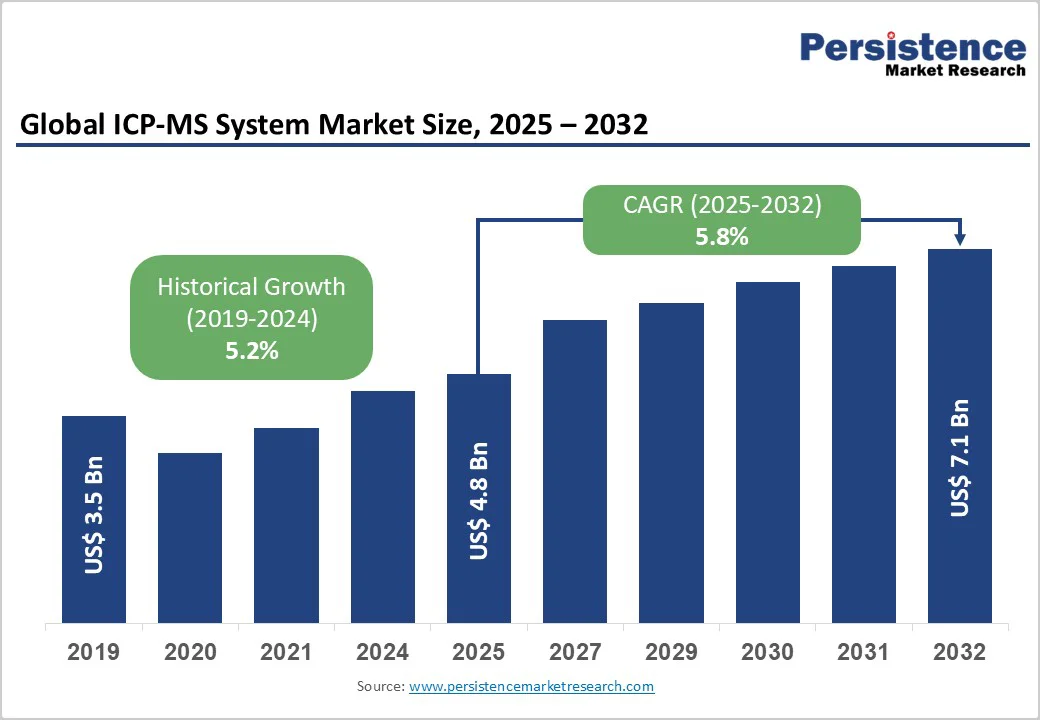
The global ICP-MS system market size is likely to be valued US$4.8 Billion in 2025, growing to US$7.1 Billion by 2032 at a CAGR of 5.8% during the forecast period from 2025 to 2032 driven by the increasing demand for precise trace element analysis, rising regulatory requirements in environmental and pharmaceutical sectors, and advancements in high-resolution and triple quadrupole technologies.
The need for accurate detection of trace metals at parts-per-trillion (ppt) levels to comply with stringent standards has significantly boosted the adoption of ICP-MS platforms across industries, particularly in developed regions. The growing acceptance of ICP-MS systems as superior alternatives to atomic absorption spectroscopy, especially for multi-element analysis, is a key growth factor.
Key Industry Highlights:
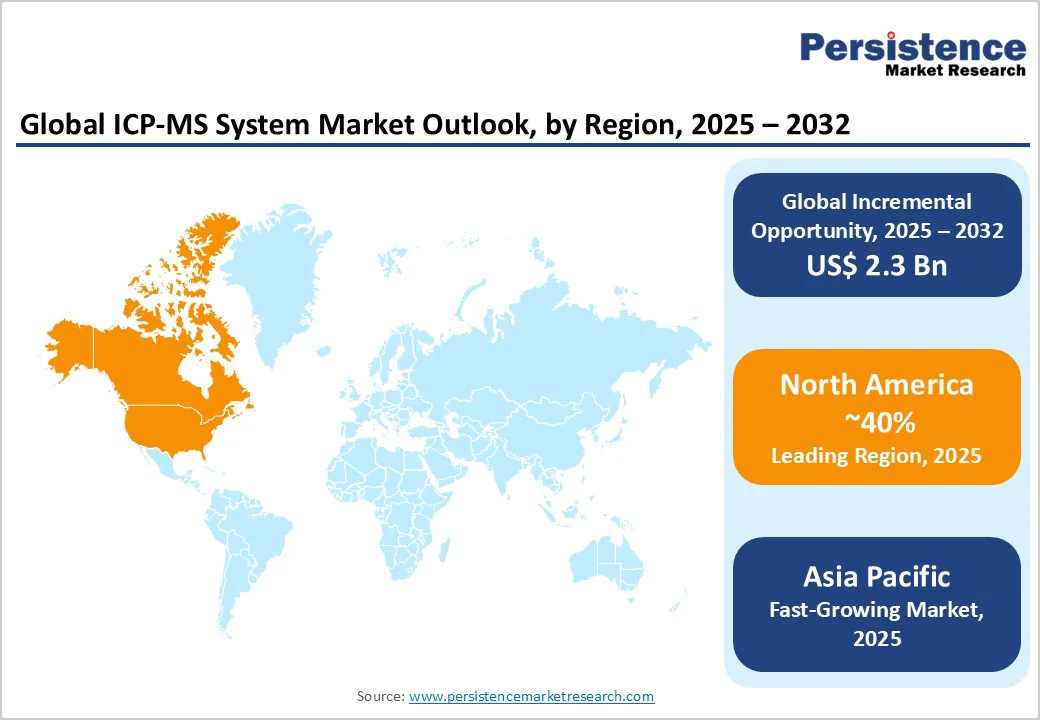
- Leading Region: North America, commanding a 40% market share in 2025, driven by advanced R&D infrastructure and stringent EPA regulations in the U.S.
- Fastest-growing Region: Asia Pacific, fueled by rapid industrialization and growing pharmaceutical exports in China and India.
- Dominant Product Type: Single Quadrupole, holding approximately 50% of the market share, due to its affordability and reliability in routine testing.
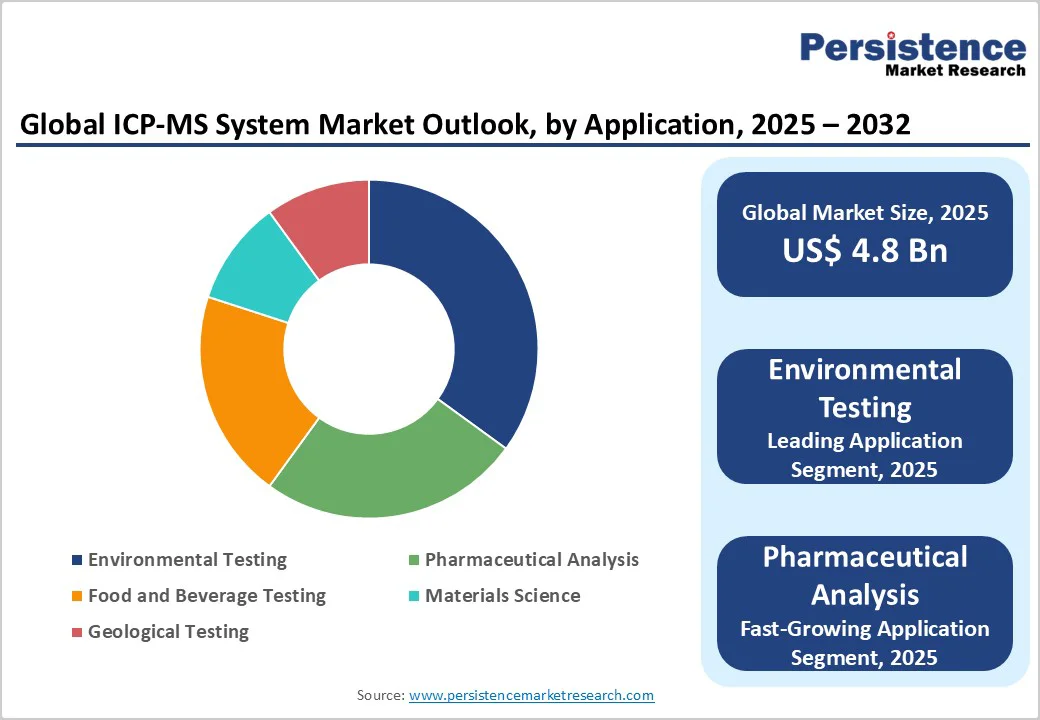
- Leading Application: Environmental Testing, accounting for over 35% of market revenue, driven by demand for heavy metal detection in water and soil.
- Leading End-use: Pharmaceutical Industry, contributing nearly 30% of market revenue, due to critical roles in drug safety and impurity profiling.
- Growth Opportunity: Portable systems and AI integration, enhancing field analysis and automation for emerging markets.
| Global Market Attribute | Key Insights |
|---|---|
|
ICP-MS System Market Size (2025E) |
US$4.8 Bn |
|
Market Value Forecast (2032F) |
US$7.1 Bn |
|
Projected Growth (CAGR 2025 to 2032) |
5.8% |
|
Historical Market Growth (CAGR 2019 to 2024) |
5.2% |
Market Factors – Growth, Barriers, and Opportunity Analysis
Rising Demand for Trace Element Analysis and Regulatory Compliance
The growing need for precise trace element analysis is a key driver of the ICP-MS system market. Increasing regulatory and safety requirements across industries are creating strong demand for highly accurate, multi-element detection. In environmental monitoring, the need to regularly assess water and soil for heavy metals has intensified, prompting laboratories to adopt ICP-MS platforms for reliable and rapid analysis. In the pharmaceutical sector, the rise of global drug production has increased the demand for impurity and trace metal testing to ensure product safety and regulatory compliance. ICP-MS platforms provide ultra-trace detection with high accuracy, significantly reducing analysis time compared to traditional techniques, which enhances laboratory efficiency and lowers the risk of costly errors.
Additional drivers include growth in semiconductor manufacturing and mining, where precise elemental characterization is critical for quality control and process optimization. Regulatory frameworks such as REACH, FDA’s ICH Q3D guidelines, and WHO food safety standards further reinforce the need for advanced analytical systems. Leading companies, such as Thermo Fisher Scientific, have demonstrated the effectiveness of ICP-MS in preventing recalls and ensuring compliance, making the technology indispensable in North America, Europe, and other key regions.
High Costs and Specialized Skill Requirements
The high initial investment and operational costs of ICP-MS systems, combined with the need for skilled operators, present significant challenges for market growth. Advanced instruments, particularly high-resolution and triple quadrupole models, require substantial capital outlay, while ongoing expenses for maintenance, gases, and specialized components add to the financial burden. Operating these systems demands trained personnel, and insufficient staffing can result in delays, reduced productivity, and increased downtime in laboratories. In addition, regulatory compliance, including validation for good manufacturing practices (GMP) and other quality standards, further increases operational complexity and costs.
Calibration, maintenance, and documentation procedures can be time-consuming and require highly skilled expertise, creating barriers for smaller or budget-constrained laboratories. These factors often favour large, well-funded institutions and established global players, limiting adoption among smaller labs and emerging markets. Challenges are particularly evident in regions where resources and trained personnel are limited, making it difficult for smaller facilities to compete with dominant industry players. While ICP-MS analyzers offer high precision and advanced capabilities, their high costs, operational complexity, and regulatory requirements continue to constrain widespread adoption.
Advancements in Portable Systems and AI Integration
Advancements in portable ICP-MS systems and AI-driven analytics are driving significant growth in the ICP-MS market. Compact systems enable on-site testing, reducing dependence on centralized laboratories and improving workflow efficiency, which is especially valuable in environmental monitoring, geological surveys, and industrial inspections. AI integration enhances data interpretation, corrects interferences, and enables more reliable multi-element analysis, increasing precision and operational efficiency. Leading companies are developing portable prototypes and modular designs that simplify upgrades and reduce long-term costs, while cloud-based platforms support remote collaboration and seamless data sharing. These innovations facilitate faster decision-making, improve laboratory productivity, and expand accessibility to advanced elemental analysis.
With rising demand for high-resolution, flexible, and cost-efficient ICP-MS solutions, technological developments are fostering adoption in high-growth regions such as Asia Pacific and North America. The combination of portability, AI-driven analytics, modular designs, and connected platforms is reshaping the ICP-MS market, driving innovation, and enabling broader application across research, environmental, and industrial sectors.
Category-wise Analysis
Product Type Insights
Single quadrupole dominates the market, account 50% of the share in 2025. due to its cost-effectiveness and reliability. It is widely used for routine environmental and food testing, offering accurate trace element analysis with lower operational costs. Its simplicity, durability, and consistent performance make it the preferred choice for laboratories conducting standard, high-throughput analyses.
Triple Quadrupole is the fastest-growing segment, driven by increasing demand for ultra-low detection limits in pharmaceutical testing and analysis of complex matrices. Its superior sensitivity and selectivity enable accurate quantification of trace elements in challenging samples, supporting regulatory compliance, high-precision research, and quality control, making it a preferred choice for advanced analytical laboratories.
Application Insights
Environmental testing leads with over 35% share in 2025, driven by global regulations on water and soil quality. The increasing need for accurate monitoring of pollutants and heavy metals has led to widespread adoption, with more than 80% of laboratories using ICP-MS analyzers to ensure compliance, maintain environmental safety, and support sustainable practices.
Pharmaceutical analysis is the fastest-growing, driven by stringent drug safety regulations and the increasing production of biologics. The need for precise detection of trace metals and impurities in complex drug formulations ensures compliance with regulatory standards, supports high-quality biologic development, and enhances patient safety, making ICP-MS an indispensable tool in modern pharmaceutical laboratories.
End-use Insights
Pharmaceutical industry holds nearly 30% share, driven by the critical need for trace metal analysis in drug development, formulation, and quality control. ICP-MS analyzer ensure compliance with strict regulatory standards, detect impurities at ultra-trace levels, and support accurate, reliable testing, making them essential tools for pharmaceutical laboratories focused on safety, efficacy, and regulatory adherence.
Academic Research Institutes are the fastest-growing, fueled by rising funding and grants for materials science, environmental studies, and trace elemental analysis. Increasing emphasis on precise, high-resolution research drives demand for advanced ICP-MS analyzer, enabling accurate detection of ultra-trace elements, supporting scientific innovation, and expanding laboratory capabilities across universities and specialized research centers.
Regional Insights
North America ICP-MS System Market Trends
North America accounts for 40% of the global ICP-MS system market in 2025, driven by strong demand from pharmaceuticals, biotechnology, environmental monitoring, and food safety sectors. The United States and Canada lead the region due to well-established laboratory infrastructure, high adoption of cutting-edge technologies, and stringent regulations for trace elemental analysis. Growing emphasis on monitoring heavy metals, contaminants, and impurities in water, food, and industrial products has increased the need for high-precision ICP-MS platform capable of ultra-trace detection. Innovation is a major driver, with companies focusing on AI integration, automation, and high-resolution multi-element systems to improve accuracy, speed, and operational efficiency. Portable and benchtop ICP-MS analyzer are also gaining popularity for on-site testing and rapid laboratory workflows. Strong R&D investments and strategic partnerships enable companies to introduce advanced features, enhance detection limits, and expand market reach. Leading players such as Thermo Fisher Scientific and Agilent Technologies leverage these strategies to maintain a competitive edge.
Europe ICP-MS System Market Trends
Europe holds about 30% market share, driven by advanced technology adoption, stringent regulatory standards, and strong demand from pharmaceutical, environmental, food safety, and academic research sectors. Leading countries such as Germany, France, and the UK are witnessing increased adoption of ICP-MS platform due to strict regulations on heavy metals and environmental contaminants, particularly in water and soil. Innovation is a key trend, with companies focusing on high-resolution, multi-element, and ultra-trace detection systems to meet precise analytical requirements. Integration of AI and automation enhances data analysis, operational efficiency, and throughput, while benchtop and portable ICP-MS analyser are gaining popularity for flexible laboratory and on-site testing. Strategic partnerships, collaborations with research institutions, and targeted R&D investments help companies maintain competitiveness and introduce advanced solutions.
Asia Pacific ICP-MS System Market Trends
Asia Pacific commands around 20% share and is the fastest-growing region, driven by increasing industrial, environmental, and research applications. Rapid industrialization in countries such as China, India, and Japan has heightened demand for trace elemental analysis in sectors such as pharmaceuticals, food safety, and environmental monitoring. Stricter government regulations on water, soil, and air quality are further fueling adoption of ICP-MS platform for accurate testing. Cost-effective solutions from regional manufacturers are making these systems more accessible, while AI integration enhances detection sensitivity, reduces processing time, and improves operational efficiency. Portable and benchtop ICP-MS platform are gaining popularity, enabling on-site analysis in laboratories and industrial facilities. Additionally, collaborations between global technology providers and local distributors are expanding market reach, while R&D efforts focus on developing high-resolution, multi-element, and environmentally friendly systems.
ICP-MS System Market: Key Players
Some of the market participants in the global ICP-MS system market are Thermo Fisher Scientific, PerkinElmer, Inc., Shimadzu, Agilent Technologies, Spectro Analytical Instruments, Intertek Group, Inc., and Nu Instruments Ltd.
The research report presents a comprehensive assessment of the market and contains thoughtful insights, facts, historical data, and statistically supported and industry-validated market data.
It also contains projections using a suitable set of assumptions and methodologies. The research report provides analysis and information according to categories such as market segments, geographies, types, technology and applications.
Competitive Landscape
The global ICP-MS system market is highly competitive, driven by both leading multinational companies and specialized regional players. In North America and Europe, Thermo Fisher Scientific and Agilent Technologies dominate through advanced, high-resolution systems, while in Asia Pacific, regional manufacturers focus on cost-effective solutions to meet growing demand. Innovation is a key driver, with companies integrating AI technologies for smarter data analysis and developing portable ICP-MS analyzer for on-site testing. Strategic R&D investments enhance detection capabilities and precision, while acquisitions and partnerships expand market presence and ensure localized support. Key players differentiate themselves by focus areas: Thermo Fisher emphasizes AI integration, Agilent develops portable solutions, and Shimadzu prioritizes affordable, high-performance designs.
Key Developments
- In October 2024, Thermo Fisher Scientific has launched the Thermo Scientific iCAP MX Series ICP-MS to simplify trace element analysis with inductively coupled plasma mass spectrometry (ICP-MS). The launch includes a new single quadrupole Thermo Scientific iCAP MSX ICP-MS and triple quadrupole Thermo Scientific iCAP MTX ICP-MS designed for environmental, food, industrial and research labs to analyze routine and challenging trace elements to detect and mitigate harmful substances.
- In July 2023, Shimadzu Corporation announced the release of the ICPMS-2040 Series and ICPMS-2050 Series inductively coupled plasma mass spectrometers (ICP-MS) for qualitatively and quantitatively analyzing inorganic elements.
Companies Covered in ICP-MS System Market
- Thermo Fisher Scientific
- PerkinElmer
- Shimadzu
- Agilent Technologies
- Spectro Analytical Instruments
- Intertek Group
- Nu Instruments
- Others
Frequently Asked Questions
The global ICP-MS System Market is projected to reach US$4.8 Billion in 2025, driven by demand for trace element analysis in pharmaceuticals and environmental sectors.
Integration of AI, automation, high-resolution systems, and portable ICP-MS instruments improves accuracy, efficiency, and usability, driving market growth.
The market is poised to witness a CAGR of 5.8% from 2025 to 2032, fueled by advancements in portable and AI-integrated systems.
Portable systems and AI integration offer key opportunities, enabling on-site testing and automated analytics for environmental and mining applications.
Thermo Fisher Scientific, PerkinElmer, Agilent Technologies, Shimadzu, and Spectro Analytical Instruments lead through innovations in high-resolution ICP-MS systems.


