Hunting Boots Market Size, Share, and Growth Forecast 2026 - 2033

Hunting Boots Market by Insulation (200 grams of insulation, 400 to 800 grams of insulation, >1000 grams insulation), Hunting Style (Custom-fit Rugged Style, Over Boots, Hiking Boots, High Altitude Hunting Boots, Snake Boots), Material Type (Nylon, Mesh, Full Grain Leather, Vulcanised Rubber, Others), Shaft Height, Sales Channel, and Regional Analysis, 2026 - 2033

ID: PMRREP33809
Calendar

March 2026

199 Pages

Author : Swapnil Chavan

Hunting Boots Market Size and Trend Analysis

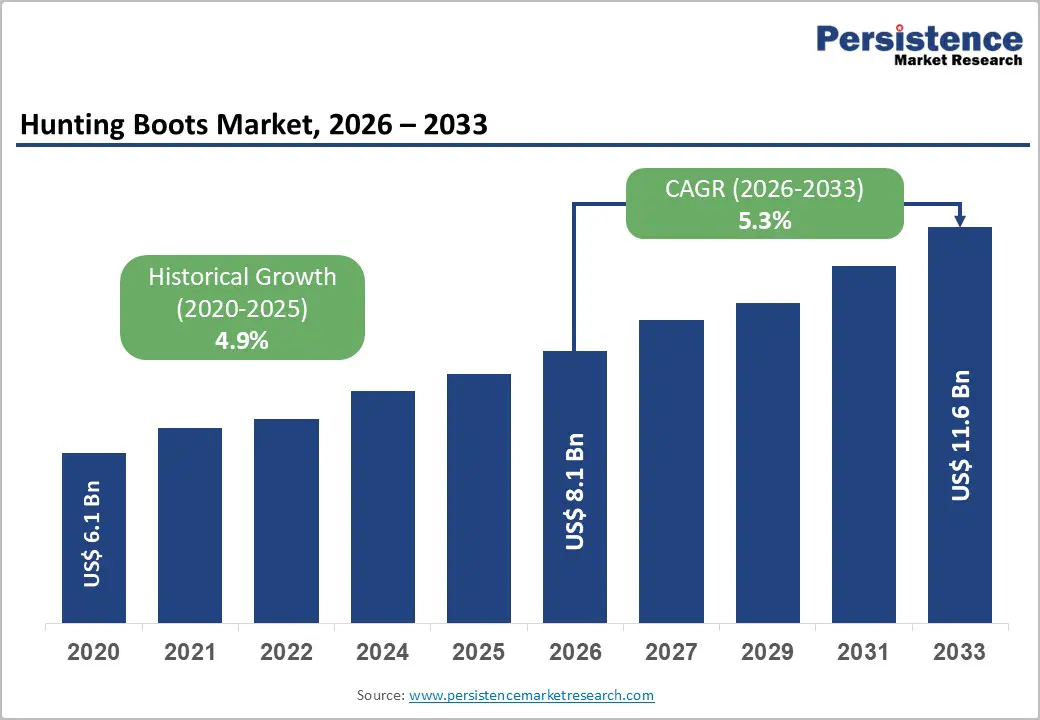
The global Hunting Boots Market size is likely to be valued at US$ 8.1 Billion in 2026 and is expected to reach US$ 11.6 Billion by 2033, growing at a CAGR of 5.3% during the forecast period from 2026 to 2033. Technological advancements in waterproofing and insulation, such as Gore-Tex and Thinsulate, boost demand by enhancing comfort and durability for diverse terrains.

Key Market Highlights:

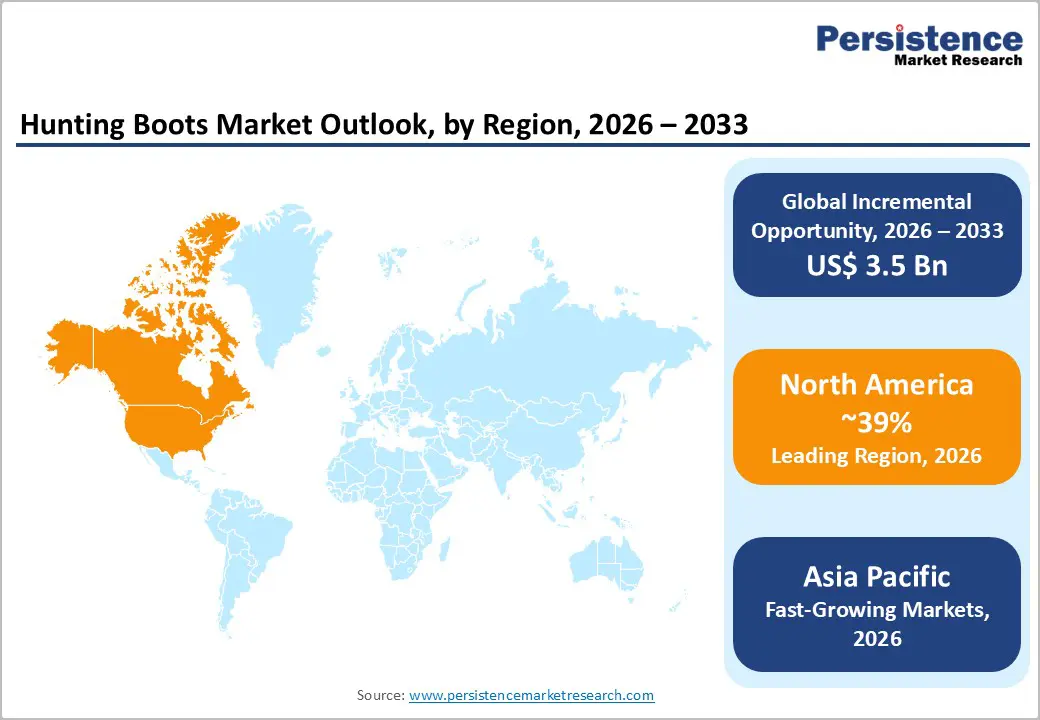
  • Leading Region: North America is the leading region with 39% share in the market, powered by 14.4 million U.S. hunters and innovation in waterproof tech per Fish and Wildlife Service data.
  • Fastest-growing Region: Asia Pacific emerges as fastest-growing with rising CAGR of 6.8%, driven by China's tourism policies and youth outdoor trends.
  • Leading Segment: Full Grain Leather prevails in materials with 50% share for superior durability in rugged hunts.
  • Fastest-growing Segment: 400 to 800 grams insulation grows quickest, suiting moderate cold hunts with balanced warmth.
  • Key Opportunity: Sustainable innovations like plant-based coatings unlock major opportunities for eco-conscious consumers.
Key Insights Details

Hunting Boots Market Size (2026E)

US$ 8.1 Billion

Market Value Forecast (2033F)

US$ 11.6 Billion

Projected Growth CAGR(2026-2033)

5.3%

Historical Market Growth (2020-2025)

4.9%

hunting-boots-market-2026-2033

Market Dynamics

Drivers - Growing Outdoor Participation and Post-Pandemic Lifestyle Shifts Driving Strong Demand for Durable Hunting Boots

Growing participation in outdoor recreation and hunting is strongly driving demand in the hunting boots market. According to the U.S. Fish and Wildlife Service, around 14.4 million active hunters were recorded in 2022, reflecting steady growth after the pandemic. Increasing urbanization is encouraging consumers to seek nature-based experiences, which is also influencing related outdoor activities.

The Recreational Boating & Fishing Foundation reported 5.1 million new fishing participants in 2024, highlighting a broader shift toward outdoor lifestyles. This trend is positively impacting hunting gear, especially footwear that offers durability, comfort, and adaptability across terrains. Seasonal hunting activities further boost demand during peak periods, while new entrants to the sport expand the consumer base. As more individuals invest in outdoor hobbies, the need for high-performance hunting boots continues to grow steadily.

Advanced Waterproof and Insulation Technologies Enhancing Performance and Competitive Differentiation in Hunting Footwear

Continuous material innovation is significantly enhancing product performance and driving competition in the hunting boots market. Advanced technologies such as Gore-Tex membranes and PrimaLoft insulation provide superior waterproofing, breathability, and thermal efficiency. Manufacturers are increasingly combining lightweight fabrics with durable construction to reduce overall boot weight while improving grip and stability across uneven terrains.

These improvements appeal to both experienced hunters and beginners seeking reliable all-weather footwear. Enhanced traction systems, shock absorption, and moisture management features further differentiate premium models in a performance-focused market. As consumers become more quality-conscious, brands that integrate advanced materials gain a competitive advantage. This innovation-driven approach not only improves comfort and safety but also supports higher price realization, strengthening overall market growth and encouraging repeat purchases.

Restraint - Tight Wildlife Regulations and Ethical Concerns Influencing Hunting Activity and Equipment Demand across Key Regions

Strict wildlife protection regulations in several regions, particularly across Europe, are influencing the hunting boots market indirectly. Tighter hunting permit rules and restrictions on specific game species have limited hunting activities in certain areas, thereby affecting demand for related equipment, including boots. Governments are increasingly prioritizing biodiversity protection and sustainable wildlife management practices. In addition, growing ethical concerns regarding hunting practices are shaping public opinion, with surveys across EU countries indicating strong support for environmental conservation.

These changing attitudes are also encouraging demand for vegan and cruelty-free footwear alternatives, challenging traditional leather-based products. Compliance with evolving environmental standards increases regulatory pressure on manufacturers and retailers. As a result, companies must adapt by aligning with sustainability norms and offering eco-friendly product lines while navigating potential reductions in hunting participation in highly regulated markets.

Rising Raw Material Prices and Supply Chain Pressures Impacting Profit Margins and Market Expansion

Rising production and material costs remain a key challenge for manufacturers in the hunting boots market. Fluctuating prices of raw materials such as leather, rubber, and synthetic fabrics increase overall manufacturing expenses and compress profit margins. In addition, supply chain disruptions and transportation cost volatility further add to operational pressures. Sustainable sourcing requirements and environmental compliance standards create additional cost burdens, particularly for small and mid-sized producers with limited economies of scale.

These financial pressures often result in higher retail prices, which can restrict affordability in price-sensitive and emerging markets. Limited pricing flexibility also affects competitiveness against low-cost alternatives. As companies balance quality, durability, and sustainability expectations, managing cost efficiency becomes critical to maintaining profitability and supporting long-term market expansion.

Opportunities - Eco-Friendly Material Innovations Creating Growth Opportunities in Sustainable Hunting Footwear Segment

Sustainability is emerging as a major opportunity within the hunting boots market. Manufacturers are investing in biodegradable rubber outsoles, recycled components, and plant-based coatings to reduce environmental impact. The development of water-repellent vegan materials is attracting ethically conscious consumers who seek cruelty-free alternatives without compromising performance. Growing global awareness around climate change and environmental responsibility is accelerating demand for green outdoor gear.

Governments and regulatory bodies are also promoting low-impact manufacturing practices, further supporting this shift. Brands that prioritize sustainable innovation can strengthen their market positioning and appeal to younger demographics. In addition, eco-friendly product differentiation creates opportunities for premium pricing and brand loyalty. As sustainability becomes a core purchasing criterion, companies integrating environmentally responsible materials are likely to gain significant competitive advantage and long-term growth potential.

Rapid E-commerce Expansion and Omnichannel Strategies Transforming Hunting Boots Distribution Landscape

The rapid expansion of e-commerce platforms is reshaping distribution strategies in the hunting boots market. Online sales channels are growing at an estimated annual rate of 18–22%, enabling brands to directly connect with consumers. Digital platforms offer features such as virtual try-ons, detailed product comparisons, and personalized recommendations, improving the overall shopping experience.

Retailers such as Bass Pro Shops are adopting omnichannel strategies to integrate physical stores with online platforms. This approach enhances accessibility, particularly for hunters located in remote or rural areas. E-commerce also helps brands target younger, tech-savvy consumers through seasonal promotions and digital marketing campaigns. While offline channels remain strong, online expansion creates new revenue streams and improves market reach, contributing to overall industry growth.

Category-wise Analysis

Insulation Insights

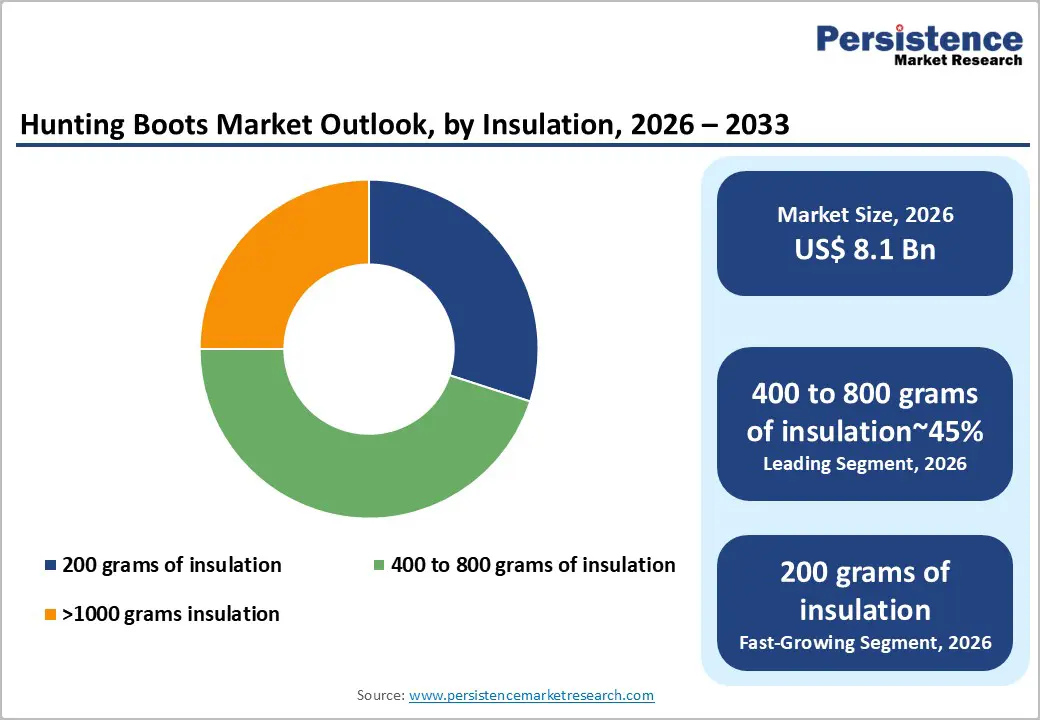
The 400 to 800 grams insulation segment accounts for approximately 45% of the market share, making it the leading category. This insulation range is well-suited for moderate cold-weather hunting conditions, which are common in key markets such as North America. It provides an effective balance between warmth and breathability, preventing overheating during physically demanding activities.

Hunters prefer this range because it supports comfort during long outdoor sessions in fall and early winter seasons. Industry evaluations highlight that boots within this insulation category offer versatile performance across various terrains and weather conditions. While lighter insulation options are available, the 400 to 800 grams range remains the most practical choice for a broad consumer base. Its ability to combine protection, comfort, and flexibility continues to sustain its dominant market position.

Hunting Style Insights

The Custom-fit Rugged Style segment holds nearly 40% of the market share, reflecting strong demand for durable and terrain-ready designs. Hunters operating in challenging environments such as mountains, forests, and wetlands prioritize boots that provide enhanced grip, ankle support, and long-lasting construction. Custom-fit features improve comfort during extended outdoor use, reducing fatigue and improving performance.

Sales data from U.S. consumer surveys show consistent preference for rugged styles tailored to big game and upland hunting. The adaptability of these boots to various hunting conditions further strengthens their popularity. As consumers increasingly value reliability and ergonomic design, this segment continues to expand. Its focus on durability and performance-driven construction ensures sustained leadership within the hunting boots category.

Material Type Insights

Full grain leather dominates with approximately 50% share, primarily due to its durability, natural strength, and resistance to harsh outdoor conditions. When properly treated, full grain leather offers excellent water resistance while maintaining breathability. Despite the growing availability of lightweight synthetic materials, traditional hunters often prefer leather boots for their longevity and premium feel.

Product comparisons frequently highlight leather’s superior performance in extreme terrains and heavy-duty usage. Its ability to mold to the user’s foot over time further enhances comfort and fit. Although synthetic alternatives provide cost and weight advantages, leather’s strong brand perception and reliability continue to drive demand. This combination of durability, performance, and premium positioning sustains its leading role in the market.

Shaft Height Insights

The 8 to 12 inches shaft height segment leads with around 55% market share, offering a balanced combination of ankle protection and mobility. This range protects hunters from brush, mud, water exposure, and snake encounters with a flexibility for walking across uneven terrain. Several outdoor footwear studies indicate strong user preference for mid-to-high shaft category. Hunters value the added stability and safety the high shafts offer without compromising comfort. The versatility of this design makes it suitable for a wide range of hunting environments, including forests, wetlands, and grasslands. As safety and performance remain top priorities, the 8 to 12 inches segment continues to dominate purchasing decisions across key markets.

Sales Channel Insights

Offline sales channels account for nearly 70% of the market share, driven by the importance of physical fitting and expert consultation. Hunting boots are technical products that require proper sizing, comfort testing, and performance evaluation before purchase. Specialty retailers such as Cabela’s build strong customer loyalty through in-store demonstrations and personalized guidance.

Supermarkets and dedicated footwear stores also contribute significantly to offline sales. Although online platforms are expanding rapidly, many consumers still prefer in-person experiences for high-investment outdoor gear. Hands-on interaction, immediate product availability, and expert advice continue to support the dominance of traditional retail channels in this market.
hunting-boots-market-outlook-by-insulation-2026-2033

Regional Insights

North America Hunting Boots Market Trends

North America remains the leading region in the global hunting boots market, supported by a strong hunting culture and established outdoor traditions. The U.S. Fish and Wildlife Service reported approximately 14.4 million hunters in 2022, highlighting a stable consumer base. U.S.-based manufacturers continuously introduce advanced technologies, including waterproof membrane innovations and performance-enhancing designs.

Well-defined regulatory frameworks ensure product quality and safety standards across the region. In addition, the expansion of e-commerce platforms such as Shopify improves accessibility, especially in rural communities. Omnichannel strategies adopted by leading outdoor retailers further strengthen distribution networks. Steady demand driven by cultural heritage, seasonal hunting activities, and growing outdoor tourism continues to support market leadership in North America.

Europe Hunting Boots Market Trends

Europe represents a mature but evolving market, with countries such as Germany, the U.K., France, and Spain maintaining strong hunting traditions. The region recorded over 3.8 million hunters across key nations in 2023, sustaining consistent equipment demand. Harmonized EU regulations emphasize ethical hunting and conservation, encouraging the use of durable, long-lasting footwear.

At the same time, stricter wildlife protection laws are promoting sustainable product alternatives, including vegan materials. The U.K. market is projected to grow at a steady CAGR of around 6.0%, reflecting balanced demand. Diverse landscapes, from forests to mountainous regions, drive the need for specialized performance footwear. As sustainability and compliance gain importance, manufacturers are adapting their product portfolios to meet evolving regulatory and consumer expectations.

Asia Pacific Hunting Boots Market Trends

Asia Pacific is witnessing rapid growth in the hunting boots market, driven by rising interest in outdoor recreation across China, Japan, and India. China plays a leading role in regional manufacturing and sales due to its strong production capabilities. Government initiatives promoting rural tourism and adventure activities are encouraging greater participation among urban youth populations.

ASEAN countries benefit from cost-effective manufacturing and expanding digital retail channels. The growth of e-commerce platforms enhances access to both local and premium imported brands. Increasing disposable income among the expanding middle class is also fueling spending on adventure and outdoor gear. As awareness of performance footwear rises, Asia Pacific is expected to emerge as a high-growth region within the global hunting boots market.
hunting-boots-market-outlook-by-region-2026-2033

Competitive Landscape

The hunting boots market remains moderately fragmented, with a mix of premium manufacturers and large-scale brands competing across regions. Established players such as Danner focus on craftsmanship and performance innovation, while broader sportswear brands like Under Armour compete through brand recognition and mass distribution. Companies invest heavily in research and development to enhance waterproofing technologies, insulation efficiency, and sustainable materials.

Strategic collaborations, product diversification, and omnichannel retail expansion are common growth strategies. Direct-to-consumer sales models are also gaining traction, improving margins and strengthening customer relationships. Although competition remains intense, innovation and sustainability continue to shape differentiation and long-term market positioning.

Key Market Developments

  • In December, 2024: Danner introduced limited-edition Cascade Range hunting boots featuring its proprietary DANNER DRY waterproof membrane and high-traction Vibram soles. The launch focused on durability, weather resistance, and superior grip for rugged terrains, strengthening Danner’s premium outdoor positioning.
  • In March 2023: Danner expanded its sustainable footwear portfolio by launching hunting boots made with recycled materials, reducing environmental impact while maintaining durability standards. This move aligned with rising consumer demand for eco-conscious outdoor gear and reinforced the brand’s sustainability commitment.

Companies Covered in Hunting Boots Market

  • SharpeZone
  • Lacrosse
  • Under Armour
  • Altra Running Shoes
  • Chippewa
  • Danner
  • Irish Setter
  • Northside USA
  • ROCKYBOOTS
  • L.L.Bean Inc.
  • Crispi Sport
  • WC Russell Moccasins Co.
  • Bogs Footwear
  • Wolverine World Wide
  • Schnee’s Boots
  • Muck Boot
Frequently Asked Questions

The hunting boots market is valued at US$ 8.1 Billion in 2026, reaching US$ 11.6 Billion by 2033 at 5.3% CAGR.

Rising outdoor participation, with 14.4 million U.S. hunters, and material innovations like Gore-Tex fuel growth.

Full Grain Leather leads with 50% share for its durability and weather resistance in rugged conditions.

North America dominates, backed by strong hunting culture and U.S. Fish and Wildlife data showing millions of participants.

Sustainable materials like biodegradable outsoles offer growth amid eco-trends and regulations.

Major companies include Danner, Under Armour, ROCKYBOOTS, and Lacrosse, focusing on innovation.
Global Hunting Boots Market Report Scope
Report Attribute Details

Historical Data/Actuals

2020 - 2025

Forecast Period

2026 - 2033

Market Analysis Units

Value: US$ Bn, Volume: Units

Geographical Coverage

  • North America
  • Europe
  • Asia Pacific
  • Latin America
  • Middle East & Africa

Segmental Coverage

  • Insulation
  • Hunting Style
  • Material Type
  • Shaft Height
  • Sales Channel

Competitive Analysis

  • SharpeZone
  • Lacrosse
  • Under Armour
  • Altra Running Shoes
  • Chippewa
  • Danner
  • Irish Setter
  • Northside USA
  • ROCKYBOOTS
  • L.L.Bean Inc.
  • Crispi Sport
  • WC Russell Moccasins Co.
  • Bogs Footwear
  • Wolverine World Wide
  • Schnee’s Boots
  • Muck Boot

Report Highlights

  • Market Forecast and Trends
  • Competitive Intelligence & Share Analysis
  • Growth Factors and Challenges
  • Strategic Growth Initiatives
  • Pricing Analysis
  • Future Opportunities and Revenue Pockets
  • Market Analysis Tools
Market Segmentation

By Insulation

  • 200 grams of insulation
  • 400 to 800 grams of insulation
  • >1000 grams insulation

By Hunting Style

  • Custom-fit Rugged Style
  • Over Boots
  • Hiking Boots
  • High Altitude Hunting Boots
  • Snake Boots

By Material Type

  • Nylon
  • Mesh
  • Full Grain Leather
  • Vulcanised Rubber
  • Others

By Shaft Height

  • 7 inches
  • 8 to 12 inches
  • 13 to 16 inches
  • >17 inches

By Sales Channel

  • Online
  • Supermarkets
  • Footwear Stores
  • Convenience Stores
  • Others

By Regions

  • North America
  • Europe
  • Asia Pacific
  • Latin America
  • Middle East & Africa

Related Reports

  1. Executive Summary
    1. Global Hunting Boots Market Snapshot 2026 and 2033
    2. Market Opportunity Assessment, 2026-2033, US$ Bn
    3. Key Market Trends
    4. Industry Developments and Key Market Events
    5. Demand Side and Supply Side Analysis
    6. PMR Analysis and Recommendations
  2. Market Overview
    1. Market Scope and Definitions
    2. Value Chain Analysis
    3. Macro-Economic Factors
      1. Global GDP Outlook
      2. Global Consumer Goods Industry Overview
    4. Forecast Factors – Relevance and Impact
    5. COVID-19 Impact Assessment
    6. PESTLE Analysis
    7. Porter's Five Forces Analysis
    8. Geopolitical Tensions: Market Impact
    9. Regulatory and Technology Landscape
  3. Market Dynamics
    1. Drivers
    2. Restraints
    3. Opportunities
    4. Trends
  4. Price Trend Analysis, 2020 – 2033
    1. Region-wise Price Analysis
    2. Price by Segments
    3. Price Impact Factors
  5. Global Hunting Boots Market Outlook: Historical (2020 – 2025) and Forecast (2026 – 2033)
    1. Key Highlights
    2. Global Hunting Boots Market Outlook: Insulation
      1. Introduction/Key Findings
      2. Historical Market Size (US$ Bn) and Volume (Units) Analysis by Insulation, 2020-2025
      3. Current Market Size (US$ Bn) and Volume (Units) Forecast, by Insulation, 2026-2033
        1. 200 grams of insulation
        2. 400 to 800 grams of insulation
        3. >1000 grams insulation
      4. Market Attractiveness Analysis: Insulation
    3. Global Hunting Boots Market Outlook: Hunting Style
      1. Introduction/Key Findings
      2. Historical Market Size (US$ Bn) and Volume (Units) Analysis by Hunting Style, 2020-2025
      3. Current Market Size (US$ Bn) and Volume (Units) Forecast, by Hunting Style, 2026-2033
        1. Custom-fit Rugged Style
        2. Over Boots
        3. Hiking Boots
        4. High Altitude Hunting Boots
        5. Snake Boots
      4. Market Attractiveness Analysis: Hunting Style
    4. Global Hunting Boots Market Outlook: Material Type
      1. Introduction/Key Findings
      2. Historical Market Size (US$ Bn) and Volume (Units) Analysis by Material Type, 2020-2025
      3. Current Market Size (US$ Bn) and Volume (Units) Forecast, by Material Type, 2026-2033
        1. Nylon
        2. Mesh
        3. Full Grain Leather
        4. Vulcanised Rubber
        5. Others
      4. Market Attractiveness Analysis: Material Type
    5. Global Hunting Boots Market Outlook: Shaft Height
      1. Introduction/Key Findings
      2. Historical Market Size (US$ Bn) and Volume (Units) Analysis by Shaft Height, 2020-2025
      3. Current Market Size (US$ Bn) and Volume (Units) Forecast, by Shaft Height, 2026-2033
        1. 7 inches
        2. 8 to 12 inches
        3. 13 to 16 inches
        4. >17 inches
      4. Market Attractiveness Analysis: Shaft Height
    6. Global Hunting Boots Market Outlook: Sales Channel
      1. Introduction/Key Findings
      2. Historical Market Size (US$ Bn) and Volume (Units) Analysis by Sales Channel, 2020-2025
      3. Current Market Size (US$ Bn) and Volume (Units) Forecast, by Sales Channel, 2026-2033
        1. Online
        2. marketsmarkets/Supermarkets
        3. Footwear Stores
        4. Convenience Stores
        5. Others
      4. Market Attractiveness Analysis: Sales Channel
  6. Global Hunting Boots Market Outlook: Region
    1. Key Highlights
    2. Historical Market Size (US$ Bn) and Volume (Units) Analysis by Region, 2020-2025
    3. Current Market Size (US$ Bn) and Volume (Units) Forecast, by Region, 2026-2033
      1. North America
      2. Europe
      3. East Asia
      4. South Asia & Oceania
      5. Latin America
      6. Middle East & Africa
    4. Market Attractiveness Analysis: Region
  7. North America Hunting Boots Market Outlook: Historical (2020 – 2025) and Forecast (2026 – 2033)
    1. Key Highlights
    2. Pricing Analysis
    3. North America Market Size (US$ Bn) and Volume (Units) Forecast, by Country, 2026-2033
      1. U.S.
      2. Canada
    4. North America Market Size (US$ Bn) and Volume (Units) Forecast, by Insulation, 2026-2033
      1. 200 grams of insulation
      2. 400 to 800 grams of insulation
      3. >1000 grams insulation
    5. North America Market Size (US$ Bn) and Volume (Units) Forecast, by Hunting Style, 2026-2033
      1. Custom-fit Rugged Style
      2. Over Boots
      3. Hiking Boots
      4. High Altitude Hunting Boots
      5. Snake Boots
    6. North America Market Size (US$ Bn) and Volume (Units) Forecast, by Material Type, 2026-2033
      1. Nylon
      2. Mesh
      3. Full Grain Leather
      4. Vulcanised Rubber
      5. Others
    7. North America Market Size (US$ Bn) and Volume (Units) Forecast, by Shaft Height, 2026-2033
      1. 7 inches
      2. 8 to 12 inches
      3. 13 to 16 inches
      4. >17 inches
    8. North America Market Size (US$ Bn) and Volume (Units) Forecast, by Sales Channel, 2026-2033
      1. Online
      2. marketsmarkets/Supermarkets
      3. Footwear Stores
      4. Convenience Stores
      5. Others
  8. Europe Hunting Boots Market Outlook: Historical (2020 – 2025) and Forecast (2026 – 2033)
    1. Key Highlights
    2. Pricing Analysis
    3. Europe Market Size (US$ Bn) and Volume (Units) Forecast, by Country, 2026-2033
      1. Germany
      2. Italy
      3. France
      4. U.K.
      5. Spain
      6. Russia
      7. Rest of Europe
    4. Europe Market Size (US$ Bn) and Volume (Units) Forecast, by Insulation, 2026-2033
      1. 200 grams of insulation
      2. 400 to 800 grams of insulation
      3. >1000 grams insulation
    5. Europe Market Size (US$ Bn) and Volume (Units) Forecast, by Hunting Style, 2026-2033
      1. Custom-fit Rugged Style
      2. Over Boots
      3. Hiking Boots
      4. High Altitude Hunting Boots
      5. Snake Boots
    6. Europe Market Size (US$ Bn) and Volume (Units) Forecast, by Material Type, 2026-2033
      1. Nylon
      2. Mesh
      3. Full Grain Leather
      4. Vulcanised Rubber
      5. Others
    7. Europe Market Size (US$ Bn) and Volume (Units) Forecast, by Shaft Height, 2026-2033
      1. 7 inches
      2. 8 to 12 inches
      3. 13 to 16 inches
      4. >17 inches
    8. Europe Market Size (US$ Bn) and Volume (Units) Forecast, by Sales Channel, 2026-2033
      1. Online
      2. marketsmarkets/Supermarkets
      3. Footwear Stores
      4. Convenience Stores
      5. Others
  9. East Asia Hunting Boots Market Outlook: Historical (2020 – 2025) and Forecast (2026 – 2033)
    1. Key Highlights
    2. Pricing Analysis
    3. East Asia Market Size (US$ Bn) and Volume (Units) Forecast, by Country, 2026-2033
      1. China
      2. Japan
      3. South Korea
    4. East Asia Market Size (US$ Bn) and Volume (Units) Forecast, by Insulation, 2026-2033
      1. 200 grams of insulation
      2. 400 to 800 grams of insulation
      3. >1000 grams insulation
    5. East Asia Market Size (US$ Bn) and Volume (Units) Forecast, by Hunting Style, 2026-2033
      1. Custom-fit Rugged Style
      2. Over Boots
      3. Hiking Boots
      4. High Altitude Hunting Boots
      5. Snake Boots
    6. East Asia Market Size (US$ Bn) and Volume (Units) Forecast, by Material Type, 2026-2033
      1. Nylon
      2. Mesh
      3. Full Grain Leather
      4. Vulcanised Rubber
      5. Others
    7. East Asia Market Size (US$ Bn) and Volume (Units) Forecast, by Shaft Height, 2026-2033
      1. 7 inches
      2. 8 to 12 inches
      3. 13 to 16 inches
      4. >17 inches
    8. East Asia Market Size (US$ Bn) and Volume (Units) Forecast, by Sales Channel, 2026-2033
      1. Online
      2. marketsmarkets/Supermarkets
      3. Footwear Stores
      4. Convenience Stores
      5. Others
  10. South Asia & Oceania Hunting Boots Market Outlook: Historical (2020 – 2025) and Forecast (2026 – 2033)
    1. Key Highlights
    2. Pricing Analysis
    3. South Asia & Oceania Market Size (US$ Bn) and Volume (Units) Forecast, by Country, 2026-2033
      1. India
      2. Southeast Asia
      3. ANZ
      4. Rest of SAO
    4. South Asia & Oceania Market Size (US$ Bn) and Volume (Units) Forecast, by Insulation, 2026-2033
      1. 200 grams of insulation
      2. 400 to 800 grams of insulation
      3. >1000 grams insulation
    5. South Asia & Oceania Market Size (US$ Bn) and Volume (Units) Forecast, by Hunting Style, 2026-2033
      1. Custom-fit Rugged Style
      2. Over Boots
      3. Hiking Boots
      4. High Altitude Hunting Boots
      5. Snake Boots
    6. South Asia & Oceania Market Size (US$ Bn) and Volume (Units) Forecast, by Material Type, 2026-2033
      1. Nylon
      2. Mesh
      3. Full Grain Leather
      4. Vulcanised Rubber
      5. Others
    7. South Asia & Oceania Market Size (US$ Bn) and Volume (Units) Forecast, by Shaft Height, 2026-2033
      1. 7 inches
      2. 8 to 12 inches
      3. 13 to 16 inches
      4. >17 inches
    8. South Asia & Oceania Market Size (US$ Bn) and Volume (Units) Forecast, by Sales Channel, 2026-2033
      1. Online
      2. marketsmarkets/Supermarkets
      3. Footwear Stores
      4. Convenience Stores
      5. Others
  11. Latin America Hunting Boots Market Outlook: Historical (2020 – 2025) and Forecast (2026 – 2033)
    1. Key Highlights
    2. Pricing Analysis
    3. Latin America Market Size (US$ Bn) and Volume (Units) Forecast, by Country, 2026-2033
      1. Brazil
      2. Mexico
      3. Rest of LATAM
    4. Latin America Market Size (US$ Bn) and Volume (Units) Forecast, by Insulation, 2026-2033
      1. 200 grams of insulation
      2. 400 to 800 grams of insulation
      3. >1000 grams insulation
    5. Latin America Market Size (US$ Bn) and Volume (Units) Forecast, by Hunting Style, 2026-2033
      1. Custom-fit Rugged Style
      2. Over Boots
      3. Hiking Boots
      4. High Altitude Hunting Boots
      5. Snake Boots
    6. Latin America Market Size (US$ Bn) and Volume (Units) Forecast, by Material Type, 2026-2033
      1. Nylon
      2. Mesh
      3. Full Grain Leather
      4. Vulcanised Rubber
      5. Others
    7. Latin America Market Size (US$ Bn) and Volume (Units) Forecast, by Shaft Height, 2026-2033
      1. 7 inches
      2. 8 to 12 inches
      3. 13 to 16 inches
      4. >17 inches
    8. Latin America Market Size (US$ Bn) and Volume (Units) Forecast, by Sales Channel, 2026-2033
      1. Online
      2. marketsmarkets/Supermarkets
      3. Footwear Stores
      4. Convenience Stores
      5. Others
  12. Middle East & Africa Hunting Boots Market Outlook: Historical (2020 – 2025) and Forecast (2026 – 2033)
    1. Key Highlights
    2. Pricing Analysis
    3. Middle East & Africa Market Size (US$ Bn) and Volume (Units) Forecast, by Country, 2026-2033
      1. GCC Countries
      2. South Africa
      3. Northern Africa
      4. Rest of MEA
    4. Middle East & Africa Market Size (US$ Bn) and Volume (Units) Forecast, by Insulation, 2026-2033
      1. 200 grams of insulation
      2. 400 to 800 grams of insulation
      3. >1000 grams insulation
    5. Middle East & Africa Market Size (US$ Bn) and Volume (Units) Forecast, by Hunting Style, 2026-2033
      1. Custom-fit Rugged Style
      2. Over Boots
      3. Hiking Boots
      4. High Altitude Hunting Boots
      5. Snake Boots
    6. Middle East & Africa Market Size (US$ Bn) and Volume (Units) Forecast, by Material Type, 2026-2033
      1. Nylon
      2. Mesh
      3. Full Grain Leather
      4. Vulcanised Rubber
      5. Others
    7. Middle East & Africa Market Size (US$ Bn) and Volume (Units) Forecast, by Shaft Height, 2026-2033
      1. 7 inches
      2. 8 to 12 inches
      3. 13 to 16 inches
      4. >17 inches
    8. Middle East & Africa Market Size (US$ Bn) and Volume (Units) Forecast, by Sales Channel, 2026-2033
      1. Online
      2. marketsmarkets/Supermarkets
      3. Footwear Stores
      4. Convenience Stores
      5. Others
  13. Competition Landscape
    1. Market Share Analysis, 2025
    2. Market Structure
      1. Competition Intensity Mapping
      2. Competition Dashboard
    3. Company Profiles
      1. SharpeZone
        1. Company Overview
        2. Product Portfolio/Offerings
        3. Key Financials
        4. SWOT Analysis
        5. Company Strategy and Key Developments
      2. Lacrosse
      3. Under Armour
      4. Altra Running Shoes
      5. Chippewa
      6. Danner
      7. Irish Setter
      8. Northside USA
      9. ROCKYBOOTS
      10. L.L.Bean Inc.
      11. Crispi Sport
      12. WC Russell Moccasins Co.
      13. Bogs Footwear
      14. Wolverine World Wide
      15. Schnee’s Boots
  14. Appendix
    1. Research Methodology
    2. Research Assumptions
    3. Acronyms and Abbreviations

Research Methodology Framework for Market Research Excellence

At Persistence Market Research, we implement a comprehensive, validated, and multi-dimensional approachto market analysis that delivers actionable insights across complex market landscapes. Our methodology combines the analytical rigor of leading consulting firms with innovative research techniques, ensuring robust market assessments that guide strategic decision-making with confidence.

Core Research Philosophy

Our methodology is built on four foundational pillars:

Research Philosophy Image

At Persistence Market Research, our methodology is designed to transcend conventional market studies by combining analytical rigor, multi-source validation, and future-focused insights.

We integrate advanced research frameworks, robust data collection strategies, cutting-edge analytics, and innovative technologies to deliver a 360-degree view of complex markets.

We integrate advanced research frameworks, robust data collection strategies, cutting-edge analytics, and innovative technologies to deliver a 360-degree view of complex markets.

Each stage spanning from strategic scoping and hypothesis-building to competitive intelligence, quality validation, and actionable recommendations is engineered to provide clients with unmatched clarity, precision, and confidence in decision-making.

By embedding innovation and technology at the core, our approach ensures that insights are not only comprehensive but also predictive, empowering businesses to seize opportunities, mitigate risks, and achieve sustainable growth

Research Philosophy Image

Capturing Key Information and Events

During this phase, key research objectives focus on essential information and data points for assessing the market, including:

Research Philosophy Image

TAM-SAM-SOM Framework Implementation

We employ both top-down and bottom-up approaches to ensure accurate market sizing.

Top-Down Market SizingBottom-Up Market Sizing
Universe Definition: Total global/regional market identificationUnit Economics: Average transaction values, purchase frequencies, customer lifecycle
Segmentation Filters: Geographic, demographic, and behavioral constraintsCustomer Segmentation: Detailed buyer persona development and sizing
Market Share Analysis: Competitive landscape assessment and share allocationPenetration Analysis: Market penetration rates by segment and geography
Growth Rate Application: Historical trends and forward-looking growth assumptionsScaling Methodology: Extrapolation techniques with confidence intervals

Validation & Cross-Verification

  • Triangulation: Comparing top-down and bottom-up results for consistency
  • Sensitivity Analysis: Testing key assumptions and parameter variations
  • Peer Benchmarking: Comparison with analogous markets and industry benchmarks
  • Expert Review: External validation through industry specialist consultation

Research Philosophy Image

Forecasting & Projection Modeling

Our proprietary forecasting models incorporate multiple variables and scenarios.

Forecasting Components

  • Historical Trend Analysis: 10-year historical growth patterns and cyclical variations
  • Driver-Based Modeling: Economic indicators, demographic shifts, technology adoption
  • Scenario Planning: Base case, optimistic, and conservative projections
  • Monte Carlo Simulations: Probability-weighted outcomes and risk assessments

Model Validation

  • Back-Testing: Historical accuracy assessment over 3–5-year periods
  • Cross-Validation: Multiple modeling approaches for result comparison
  • External Benchmarking: Comparison with established market forecasts
  • Continuous Calibration: Quarterly model updates based on new data

Comprehensive Data Collection Strategy

Our secondary research phase establishes a robust knowledge base utilizing diverse, credible sources.

Secondary Data Sourcess

  • Industry Publications & Reports
  • Government & Regulatory Data
  • Financial Intelligence (filings & reports)
  • Academic Research & Digital Intelligence

Quality Assurance Protocol

  • Source credibility assessment and publication date validation
  • Data consistency checks across multiple sources
  • Bias identification and neutralization techniques
  • Information gap tracking for primary research prioritization

Research Philosophy Image

Primary Research Excellence

Our primary research methodology employs best-in-class techniques to capture unique market insights.

Quantitative Research Methods

  • Large-Scale Surveys: Statistically representative samples with 95% confidence intervals
  • Survey Methodology: Multi-channel deployment (online, telephone, in-person)
  • Question Architecture and Response Optimization

Qualitative Research Methods

  • Executive Interviews
  • Focus Groups
  • Expert Consultations

Quality Assurance & Validation Framework

Multi-Stage Validation Process

  • Source Verification and Consistency Testing
  • Outlier Detection and Bias Assessment
  • Peer Review Process and External Validation
  • Sensitivity Analysis and Confidence Intervals

Research Philosophy Image

Methodology Validation & Credibility

Our research methodology has been extensively validated through:

  • Academic Partnerships: Collaborations with top-tier business schools and research institutions
  • Client Success Stories: Documented case studies demonstrating research impact and ROI
  • Continuous Benchmarking: Performance comparison with leading global research firms

This comprehensive methodology framework positions Persistence Market Research at the forefront of market intelligence, combining the analytical sophistication of top-tier consulting firms with innovative research techniques. Our approach ensures that every market assessment delivers precise, actionable, and strategically valuable insights that drive business success in competitive market environments.

Ready to unlock your market potential? Contact our research experts to discuss how our validated methodology can transform your strategic decision-making with data-driven market intelligence.

Copyright © 2026 Persistence Market Research. All Rights Reserved

Connect With Us -