




- Specialty & Fine Chemicals
- Formamidine Acetate Market
Formamidine Acetate Market Size, Share, and Growth Forecast 2026 - 2033
Formamidine Acetate Market by Grade (Pharmaceutical, Agrochemical, Industrial), End-use Industry (Pharmaceutical, Personal Care, Solar, Fertilizer, Chemical, Other), and Regional Analysis for 2026-2033

Formamidine Acetate Market Size and Trend Analysis
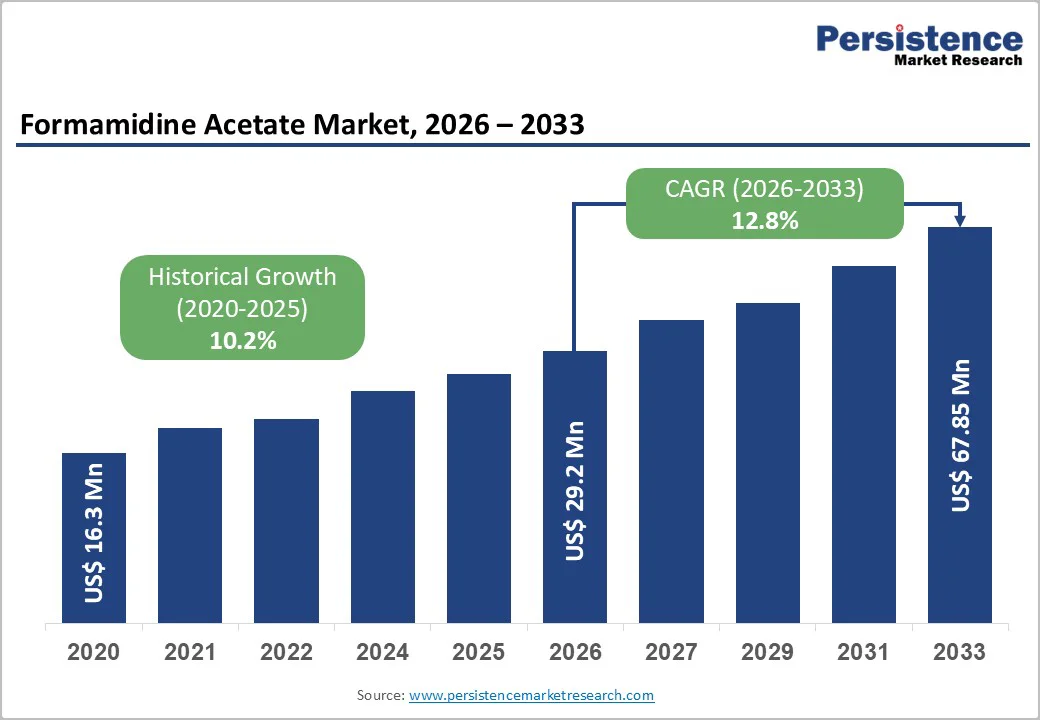
The global formamidine acetate market size is supposed to be valued at US$ 29.2 Mn in 2026 and is projected to reach US$ 67.8 Mn by 2033, growing at a CAGR of 12.8% between 2026 and 2033.
The market expansion is primarily propelled by the escalating pharmaceutical industry demand for high-purity chemical intermediates essential for active pharmaceutical ingredient synthesis, coupled with the explosive growth in perovskite solar cell technology demanding formamidine acetate as a critical precursor material. Regulatory pressures for sustainable agrochemical solutions and the rising adoption of advanced materials in display applications further consolidate market growth. Additionally, increasing investments in research and development infrastructure across Asia-Pacific and North America regions are amplifying production capacities and product innovations.
Key Market Highlights
- Regional Leader: North America maintains the largest regional market valuation, capturing approximately 36% market share, supported by advanced pharmaceutical research infrastructure, substantial government renewable energy investments, and an established perovskite solar cell research ecosystem driving consistent intermediate demand.
- Fastest Growing Region: Asia-Pacific represents the fastest-growing regional market expanding at 14.2% CAGR through 2033, driven by pharmaceutical industry expansion across China, India, and Southeast Asia, coupled with the emergence as the global perovskite solar cell manufacturing hub and government support for chemical sector modernization.
- Leading Segment: Pharmaceutical-grade Formamidine Acetate dominates the product segment with 48% market share, reflecting stringent quality requirements, premium pricing justification, and continued demand from active pharmaceutical ingredient manufacturers developing innovative therapeutic agents.
- Fastest Growing Segment: Solar cell manufacturing emerges as the fastest-growing end-use segment expanding at 28% CAGR within the 2026-2033 forecast period, driven by perovskite photovoltaic technology commercialization, government renewable energy incentives, and breakthroughs achieving solar cell efficiencies exceeding 23% in laboratory settings.
- Key Market Opportunity: High-purity chemical intermediate supply chain expansion in sustainable agrochemical formulations represents a key market opportunity, supported by global agrochemical market growth at 2.7% CAGR, government policy support for biopesticide adoption, and emerging demand for formamidine-based acaricides and insecticides in integrated pest management.
| Report Attribute | Details |
|---|---|
|
Formamidine Acetate Size (2026E) |
US$ 29.2 Mn |
|
Market Value Forecast (2033F) |
US$ 67.8 Mn |
|
Projected Growth CAGR (2026-2033) |
12.8% |
|
Historical Market Growth (2020-2025) |
10.2% |
Market Dynamics
Market Growth Drivers
Escalating Pharmaceutical Intermediate Demand
The pharmaceutical industry's global expansion is significantly amplifying the demand for high-purity chemical intermediates, including Formamidine Acetate. Pharmaceutical manufacturers increasingly require Formamidine Acetate as a crucial building block in the synthesis of active pharmaceutical ingredients, particularly for anticancer and antiviral medications.
The compound's unique properties enable efficient formamidinium incorporation into complex drug molecules, making it indispensable for modern drug development processes. Furthermore, stringent regulatory compliance requirements and quality standards mandate the use of premium-grade intermediates, directly benefiting suppliers like Merck KGaA and Evonik Industries AG, who maintain high production standards.
Perovskite Solar Cell Technology Proliferation
The perovskite solar cell market is experiencing extraordinary growth. Formamidine Acetate serves as a fundamental precursor in synthesizing formamidinium lead iodide (FAPbI3) perovskites, which exhibit superior light absorption properties and efficiency rates exceeding 21% in laboratory settings. Major technological breakthroughs, including the certification of solar cells achieving power conversion efficiencies above 23.7%, demonstrate the critical importance of high-quality formamidine acetate in achieving these performance metrics.
Government initiatives supporting renewable energy, including the U.S. Department of Energy's USD 44 million funding for perovskite research in 2024 and Japan's USD 1.5 billion commitment to perovskite commercialization, are substantially expanding the addressable market.
Market Restraints
Supply Chain Vulnerabilities and Raw Material Price Volatility
The Formamidine Acetate manufacturing process depends on specialized raw materials and controlled synthesis conditions, making producers susceptible to supply chain disruptions and input cost fluctuations. Geopolitical tensions, regulatory changes in chemical manufacturing, and environmental compliance costs have elevated production expenses.
Smaller manufacturers face particular challenges in maintaining consistent supply during market volatility, potentially limiting their competitive positioning and market share expansion. Price sensitivities in downstream applications, especially in price-conscious agrochemical formulations, constrain end-user demand growth and compress supplier margins.
Regulatory Compliance and Quality Control Challenges
Stringent pharmaceutical and chemical industry regulations requiring GMP (Good Manufacturing Practice) certifications and ISO 9001:2015 compliance impose substantial operational and capital expenditures on manufacturers. The requirement for batch-to-batch quality consistency, enhanced safety protocols, and comprehensive documentation systems elevates production costs significantly.
Additionally, the compound's hygroscopic and moisture-sensitive nature necessitates sophisticated storage and handling infrastructure, increasing operational complexity and expense. Failure to maintain regulatory compliance can result in substantial financial penalties and market access restrictions, creating significant barriers for smaller market participants.
Market Opportunities
Emerging Display and Optoelectronic Applications
The convergence of formamidine acetate applications in perovskite quantum dot light-emitting diodes (QD-LEDs) and advanced display technologies represents a substantial growth opportunity for market participants. Recent breakthrough research demonstrates that formamidine acetate additives enhance photoluminescence quantum yields from 10% to 65% in pure blue perovskite quantum dots, enabling commercial viability for next-generation display applications.
The global shift toward flexible and energy-efficient display technologies in consumer electronics, wearables, and automotive applications creates expanding demand for high-performance quantum dot materials. Major technology companies and manufacturers collaborating on commercialization of perovskite-based displays provide premium pricing opportunities for specialized-grade Formamidine Acetate suppliers.
Sustainable Agrochemical Formulation Expansion
Formamidine compounds demonstrate significant effectiveness as synthetic acaricides and insecticides, particularly against spider mites, ticks, and resistant pest populations, positioning them as critical components in integrated pest management strategies. Government policies promoting biopesticide adoption and reduced chemical inputs, such as India's subsidy rationalization scheme favoring bio-inputs, and the European Green Deal's sustainability initiatives, are creating favorable market conditions for advanced intermediate suppliers. The India agrochemical market is signaling robust opportunities for formamidine acetate-dependent agrochemical manufacturers.
Category-wise Insights
Grade Analysis
The pharmaceutical-grade Formamidine Acetate segment commands approximately 48% of the market share, reflecting the stringent quality requirements of pharmaceutical manufacturers for active pharmaceutical ingredient synthesis. Pharmaceutical-grade materials must demonstrate purity levels exceeding 99% and comply with USP/EP specifications, justifying premium pricing and generating higher margins for producers. The pharmaceutical segment's dominance is supported by the industry's non-negotiable emphasis on batch consistency, stability documentation, and regulatory compliance, which systematically exclude lower-grade alternatives. Merck KGaA and Tokyo Chemical Industry Co., Ltd. maintain significant market presence through their specialized pharmaceutical-grade production capabilities and established relationships with contract research organizations and API manufacturers.
End-use Industry Analysis
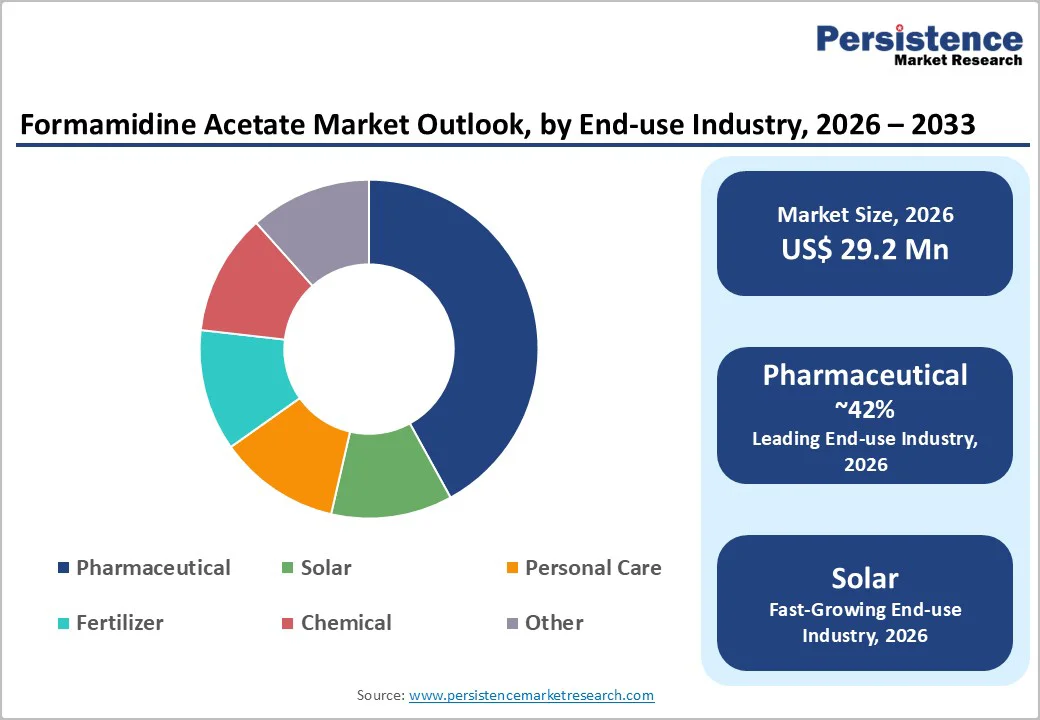
The pharmaceutical end-use sector represents 42% of the market, driven by continuous demand for innovative therapeutic agents and the industry's expansion into personalized medicine and targeted drug development. Solar cell manufacturing emerges as the fastest-growing segment, expanding at 28% CAGR within the forecast period, reflecting the explosive commercialization trajectory of perovskite photovoltaic technology. Personal care and cosmetics applications are experiencing accelerated adoption driven by consumer demand for innovative formulations and regulatory acceptance of formamidine-derived compounds in beauty and skincare products. Chemical intermediate manufacturers increasingly diversify into fertilizer and specialty chemical applications, where formamidine acetate facilitates advanced synthesis pathways, establishing new revenue streams and customer diversification.
Regional Insights
North America Formamidine Acetate Trends
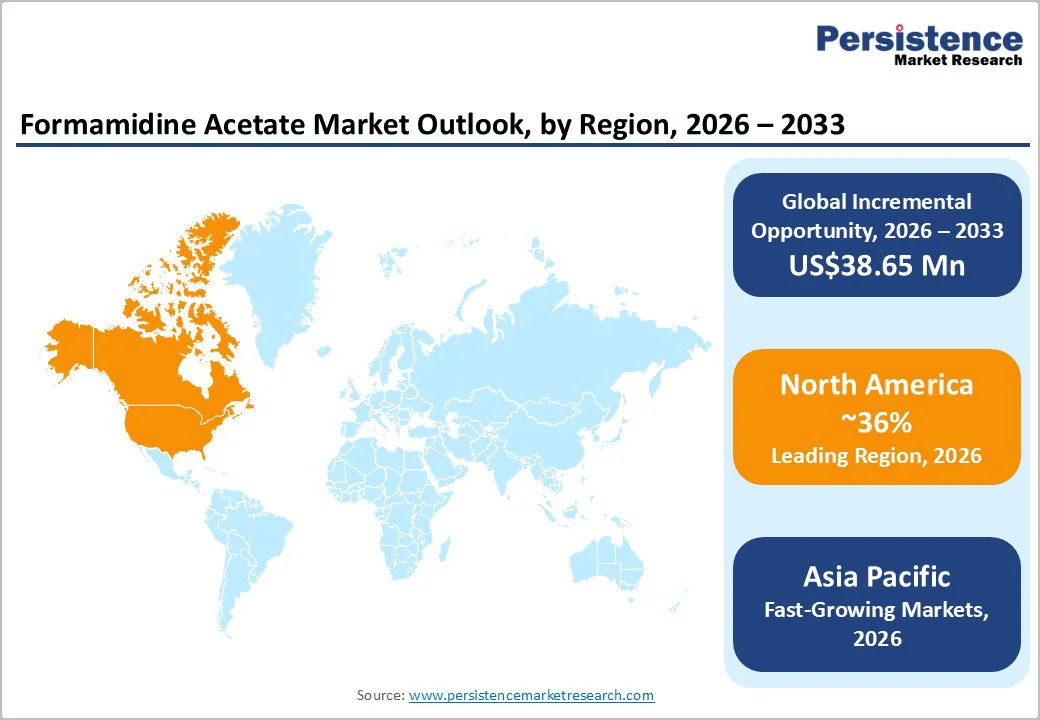
North America maintains the largest regional market valuation, capturing approximately 36% of global market share, supported by advanced pharmaceutical research infrastructure, substantial government R&D investments, and an established perovskite solar research ecosystem. The United States pharmaceutical market provides substantial end-user demand for high-quality intermediates, including Formamidine Acetate. Government initiatives, particularly the U.S. Department of Energy's continued funding of perovskite solar technology research and the federal government's emphasis on renewable energy infrastructure, are catalyzing commercial-scale production investments.
Honeywell International Inc. and other multinational chemical producers maintain significant North American production and distribution capabilities, serving pharmaceutical, solar, and specialty chemical customers. The region's mature regulatory framework, including FDA oversight and ICH guidelines compliance, establishes a quality assurance ecosystem that attracts premium suppliers and justifies elevated pricing for certified-grade materials. Research collaborations between academic institutions, government laboratories, and commercial enterprises continue generating innovations in formamidine-based synthesis and applications, sustaining regional competitive advantage.
Europe Formamidine Acetate Trends
Europe commands approximately 28% of the global market share, driven by the region's pharmaceutical excellence, chemical manufacturing heritage, and aggressive renewable energy adoption targets outlined in the European Green Deal. Germany's chemical industry leadership, exemplified by companies including Merck KGaA and Evonik Industries AG, establishes Europe as a quality and innovation hub for specialty chemical intermediates. The region's stringent REACH regulations mandate comprehensive safety documentation and environmental impact assessments, elevating compliance costs but simultaneously creating barriers protecting established manufacturers from competitive pressure.
European pharmaceutical manufacturers, particularly in France, Spain, and the United Kingdom, maintain substantial API production capabilities requiring consistent access to high-purity intermediates, sustaining robust Formamidine Acetate demand. The region's commitment to perovskite solar cell commercialization, including major research initiatives and pilot production facilities, positions Europe as a critical growth driver for solar-grade formamidine acetate applications. Regulatory harmonization across EU member states facilitates cross-border supply chains and market integration, enabling efficient distribution and competitive pricing while maintaining quality standards.
Asia Pacific Formamidine Acetate Trends
Asia-Pacific represents the fastest-growing regional market, accounting for 31% of current market share and expanding at 14.2% CAGR, driven by pharmaceutical industry expansion, agricultural intensification, and the emergence as the global perovskite solar cell manufacturing hub. China's pharmaceutical market is experiencing robust growth through expanding domestic consumption and export-oriented manufacturing, supported by government initiatives promoting domestic API production capabilities and technology innovation. Japan maintains technological leadership in specialty chemical manufacturing and perovskite solar research, with companies like Tokyo Chemical Industry Co., Ltd. and Wako Pure Chemical Industry Ltd. serving as critical regional suppliers of high-purity formamidine acetate.
India's pharmaceutical sector, supplying approximately 20% of the world's generic medicines and benefiting from 7.8% year-on-year growth in April 2025, increasingly demands consistent access to reliable intermediate suppliers. Suzhou Highfine Biotech Co., Ltd., headquartered in China's Suzhou High-tech Industrial Development Zone, exemplifies the region's emerging manufacturing capabilities, leveraging cost advantages and technical expertise to capture growing market share. Government policies across India, Vietnam, and Thailand supporting chemical manufacturing expansion and export promotion are systematically elevating production capacities and market participation, establishing Asia-Pacific as the supply chain anchor for global Formamidine Acetate markets.
Competitive Landscape
Market Structure Analysis
The Formamidine Acetate market exhibits a moderately consolidated competitive structure with approximately 12-15 significant manufacturers controlling 70% of global supply, while numerous smaller regional and specialty producers serve niche applications. Multinational chemical companies including Merck KGaA (Germany), Evonik Industries AG (Germany), and Honeywell International Inc. (United States) leverage extensive manufacturing infrastructure, regulatory expertise, and global distribution networks to dominate premium pharmaceutical-grade segments. Market leaders employ differentiation strategies emphasizing quality certifications, technical support services, and research collaborations to establish premium positioning and justify price premiums. Emerging Chinese manufacturers including Suzhou Highfine Biotech Co., Ltd., Haihang Industry Co., Ltd., and Changzhou HuanLing Chemical Co. Ltd. are systematically capturing cost-sensitive segments and expanding market share through aggressive pricing and production capacity expansion, creating competitive pressure on established suppliers.
Key Market Developments
- June 2024: JinkoSolar achieved a certified perovskite-silicon tandem solar cell efficiency of 33.24%, driving accelerated commercialization and increased formamidine acetate demand in high-efficiency solar cell manufacturing.
- May 2024: U.S. Department of Energy announced USD 44 million funding for perovskite and thin-film photovoltaic research projects, stimulating R&D investments and commercial-scale production initiatives across the North American solar industry.
- December 2024: Major pharmaceutical companies expanded API production capacities in India and Southeast Asia, requiring increased intermediate supplies including Formamidine Acetate for active pharmaceutical ingredient synthesis.
Top Companies in Formamidine Acetate Market
Merck KGaA (Darmstadt, Germany) represents the market leader through its extensive pharmaceutical-grade chemical portfolio, robust quality assurance systems, and established relationships with global pharmaceutical manufacturers. The company leverages its vertically integrated production capabilities and technical expertise to serve premium customers across pharmaceutical, life science research, and advanced materials applications. Merck KGaA's strategic investments in sustainable production technologies and regulatory compliance infrastructure position the company as a preferred supplier for quality-critical applications.
Suzhou Highfine Biotech Co., Ltd. (Suzhou, China), established in 2003 as a high-tech enterprise, has emerged as a leading Asian manufacturer of specialty chemicals including peptide synthesis reagents and pharmaceutical intermediates. The company operates extensive R&D facilities covering 14,000 square meters and maintains ISO 9001:2015 certification, serving pharmaceutical R&D and API production companies across multiple geographies. Suzhou Highfine's cost-competitive positioning and technical capabilities position it as a strategic alternative supplier for cost-sensitive applications while maintaining pharmaceutical-grade quality standards.
Evonik Industries AG (Germany) operates a diversified specialty chemicals portfolio including high-purity intermediates, catalysts, and advanced materials serving pharmaceutical, chemical, and energy sectors. The company's commitment to sustainable chemistry and green synthesis technologies, exemplified through its Chemistry in Water initiative enabling aqueous-phase organic reactions, differentiates it in environmentally-conscious markets. Evonik's global production infrastructure spanning multiple continents enables efficient supply chain management and customer service delivery across diverse geographic markets.
Companies Covered in Formamidine Acetate Market
- Merck KGaA
- Honeywell International Inc.
- Tokyo Chemical Industry Co., Ltd.
- Evonik Industries AG
- Santa Cruz Biotechnology Inc.
- Haihang Industry Co., Ltd.
- Wako Pure Chemical Industry Ltd.
- Changzhou HuanLing Chemical Co. Ltd.
- Suzhou Highfine Biotech Co. Ltd.
- Jinan Bond Chemical Technology
- CDH Fine Chemical
- Matrix Fine Chemicals
Frequently Asked Questions
The global Formamidine Acetate market is projected to reach US$ 67.8 Mn by 2033, expanding from US$ 29.2 Mn in 2026 at a CAGR of 12.8%, reflecting accelerating demand across pharmaceutical, solar, and agrochemical applications.
Market growth is driven by escalating pharmaceutical industry demand for high-purity intermediates, explosive perovskite solar cell technology adoption requiring formamidine acetate precursors, government renewable energy investments, and expanding agrochemical applications in pest management and crop protection.
The pharmaceutical-grade segment dominates with 48% market share, reflecting the stringent quality requirements and premium pricing in pharmaceutical active ingredient synthesis, coupled with established market relationships and regulatory compliance certifications.
Asia-Pacific represents the fastest-growing regional market expanding at 14.2% CAGR through 2033, driven by pharmaceutical industry expansion across China and India, emergence as the global perovskite solar cell manufacturing hub, and government policies supporting chemical sector growth.
Significant opportunities include emerging perovskite quantum dot display applications enabling photoluminescence enhancement, sustainable agrochemical formulation expansion driven by integrated pest management adoption and government policy support, and commercial-scale perovskite solar cell production acceleration.
Leading companies include Merck KGaA, Evonik Industries AG, Honeywell International Inc., Tokyo Chemical Industry Co., Ltd., Suzhou Highfine Biotech Co., Ltd., and Wako Pure Chemical Industry Ltd., with differentiated competitive positioning across quality, cost, and technical support dimensions.


