




- Off-Road Equipment & Machinery
- Fairway Mowers Market
Fairway Mowers Market Size, Share and Growth Forecast, 2026-2033
Fairway Mowers Market by Product Type (Reel Fairway Mowers, Others), Power Source (Diesel, Gasoline, Others), Automation Level (Manual, Assisted Control, GPS-enabled, IoT-connected, Semi-autonomous, Fully Autonomous), and Regional Analysis for 2026-2033

Fairway Mowers Market Size and Trends Analysis
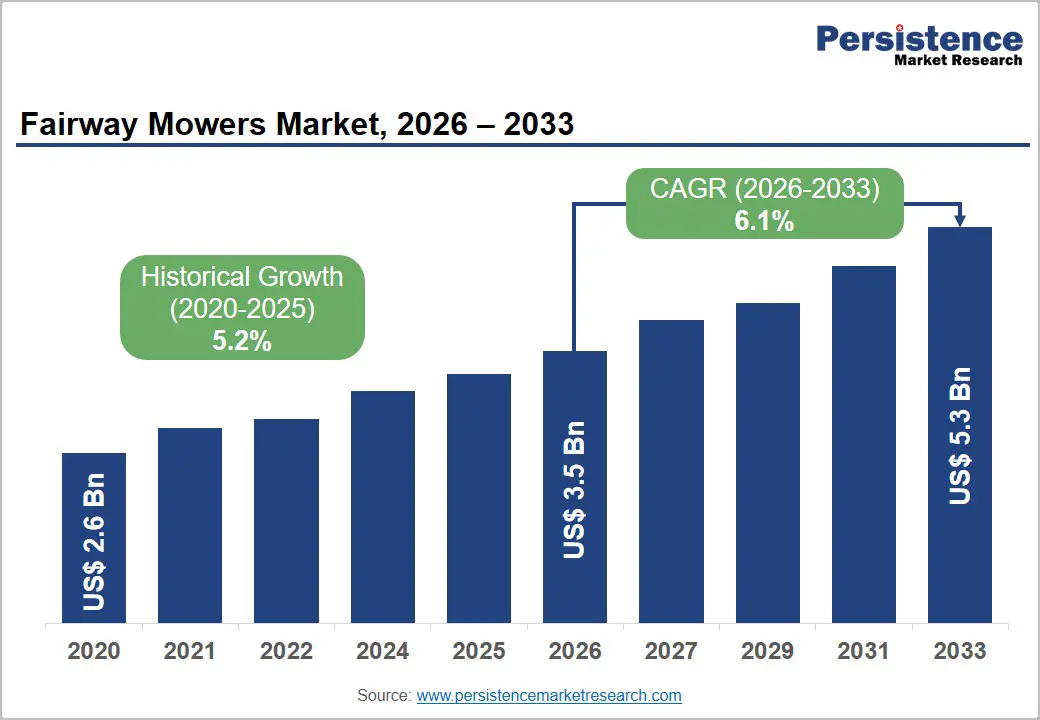
The global fairway mowers market size is likely to be valued at US$3.5 billion in 2026 and is projected to reach US$5.3 billion by 2033, growing at a CAGR of 6.1% during the forecast period from 2026 to 2033, driven by increasing investments in golf course modernization, turf quality enhancement programs, and mechanized landscaping solutions across developed economies. Growth is also supported by rising adoption of precision turf maintenance technologies and the shift toward energy-efficient mowing systems. Additionally, automation integration and sustainability mandates from turf management associations are reshaping procurement strategies globally.
Key Industry Highlights:
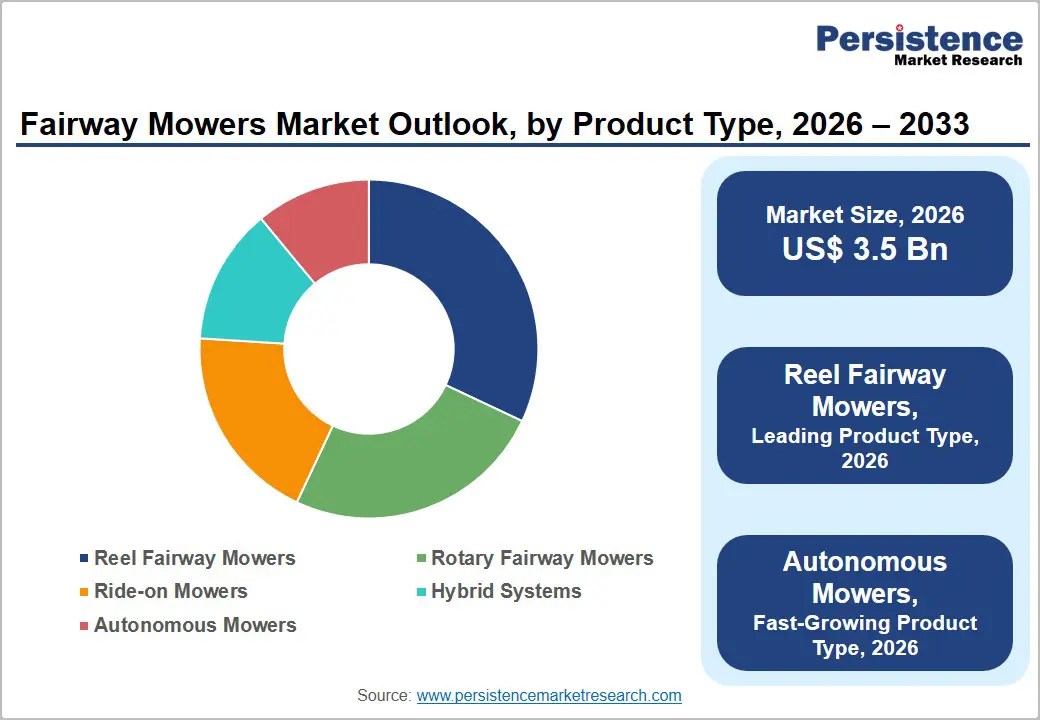
- Leading Product Type: Reel fairway mowers are expected to account for 32% of the market share in 2026, while autonomous fairway mowers are projected to be the fastest-growing segment through 2033, driven by increasing adoption of AI, robotics, and precision turf management technologies.
- Dominant Power Source: Diesel-powered fairway mowers are expected to hold 42% market share in 2026, while battery-electric and hybrid diesel-electric systems are likely to register the fastest growth during 2026–2033, supported by emissions regulations and sustainability initiatives.
- Leading Automation Level: Assisted control systems are expected to lead with an estimated 30% share in 2026, while IoT-connected and fully autonomous mowers are projected to witness the strongest growth through 2033 as smart turf management adoption increases.
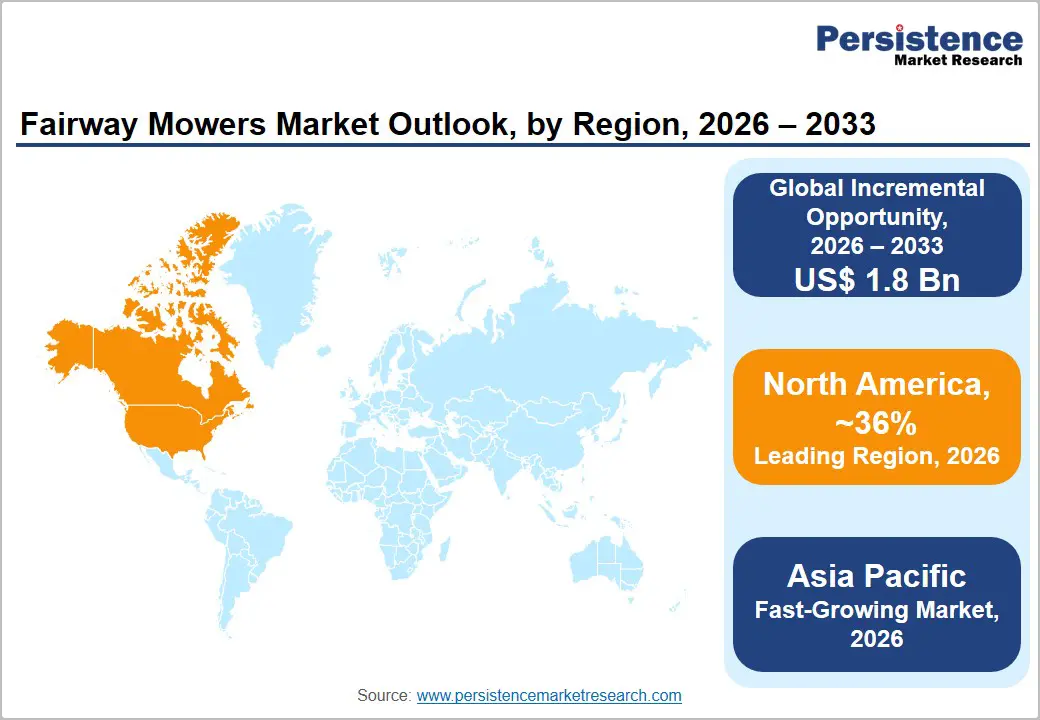
- Regional Leadership: North America is poised to dominate with an estimated 36% share in 2026 and maintain steady growth through 2033, while Asia Pacific is expected to record the fastest regional expansion, supported by golf infrastructure development and urban landscaping investments.
- Competitive Environment: Competitive dynamics are characterized by investments in autonomous mowing technologies, electrification initiatives, IoT-enabled fleet management systems, and strategic partnerships to enhance sustainable turf maintenance capabilities.
DRO Analysis
Driver - Rising Golf Course Modernization and Turf Quality Standardization Initiatives
The global push toward standardized turf quality management is a major driver for the fairway mowers market. According to turf management guidelines issued by organizations such as the United States Golf Association (USGA) and The R&A, golf courses are increasingly required to maintain uniform grass height, density, and playing surface consistency. This has significantly increased demand for precision mowing equipment capable of maintaining fairway conditions within strict agronomic thresholds.
In the U.S. alone, over 16,000 golf courses undergo periodic turf upgrades, directly influencing equipment replacement cycles. Similar modernization programs in Europe and Japan are reinforcing the adoption of high-efficiency mowers. The market impact is evident in rising procurement budgets allocated toward advanced mowing systems with improved cut quality, reduced downtime, and adaptive terrain handling capabilities.
Restraint - High Capital Investment and Maintenance Costs of Advanced Fairway Mowing Equipment
One of the primary constraints in the fairway mowers market is the high upfront cost associated with advanced systems such as GPS-enabled, hybrid, and autonomous mowers. Industry procurement data from public golf facility budgets and municipal landscaping authorities indicates that high-end fairway mowers can cost 30–50% more than conventional rotary systems.
Battery-electric and hybrid models require specialized maintenance infrastructure, increasing the total cost of ownership. Smaller golf courses and regional municipalities often face budget constraints, delaying replacement cycles and limiting the adoption of next-generation equipment. This cost sensitivity creates a structural barrier, particularly in emerging economies where capital expenditure approval cycles are longer, and financing options for turf equipment are limited.
Opportunity - Expansion of Autonomous and Electrified Turf Maintenance Systems
A major opportunity in the fairway mowers market lies in the rapid development of autonomous mowing systems and battery-electric fairway mowers. Driven by environmental regulations from agencies such as the European Environment Agency (EEA) and U.S. EPA emissions standards, golf courses are increasingly transitioning toward low-emission turf equipment.
The adoption of fully-electric and IoT-connected mowing platforms is expected to accelerate, particularly in Europe and North America. Industry estimates indicate that electrified turf equipment could account for nearly one-third of new equipment sales by 2033. This shift creates significant opportunities for OEMs investing in AI-driven navigation, fleet management systems, and remote-controlled mowing technologies, particularly in premium golf resorts and smart city landscaping projects.
Category-wise Analysis
Product Type
Reel fairway mowers are expected to account for approximately 32% of the market in 2026, making them the leading product category. Their dominance stems from their ability to deliver a precise, scissor-action cut that meets the turf quality standards required by professional golf courses. Facilities hosting tournaments sanctioned by organizations such as the PGA Tour and DP World Tour continue to prioritize reel mowers because they help maintain consistent ball roll, surface uniformity, and fairway aesthetics, all of which are critical to course performance and player experience.
Autonomous fairway mowers are projected to be the fastest-growing segment, expanding at a CAGR of approximately 8.5% through 2033. Growth is being driven by the increasing adoption of robotic turf maintenance technologies at golf resorts facing persistent labor shortages. For example, several golf facilities across the United States and Scandinavia have begun integrating GPS-guided autonomous mowing fleets to reduce routine maintenance hours, improve mowing consistency, and optimize workforce allocation during peak golfing seasons.
Power Source
Diesel-powered mowers are anticipated to capture around 42% of market revenue in 2026, maintaining their leadership due to their ability to support long operating hours and demanding workloads. Large golf destinations such as those in Florida, Arizona, Scotland, and Ireland continue to rely heavily on diesel-powered fleets because these machines can cover extensive fairway acreage efficiently while providing the torque needed for varying terrain and dense turf conditions.
Battery-electric mowers are expected to register the fastest growth, with an estimated 9.1% CAGR between 2026 and 2033. Adoption is accelerating as golf courses respond to sustainability targets and local emissions regulations. Equipment manufacturers, including The Toro Company and Husqvarna Group, have expanded their electric turf maintenance portfolios, while golf facilities in California, Germany, and the Netherlands are increasingly investing in electric fleets to reduce fuel consumption, operating noise, and long-term maintenance costs.
Automation Level
Assisted control systems are projected to hold the largest market share at approximately 30% in 2026. Their popularity is driven by features such as automated speed adjustment, straight-line guidance, and precision cutting controls that improve mowing quality without eliminating operator oversight. These systems are widely adopted by mid-sized golf courses seeking productivity improvements while avoiding the higher capital costs associated with fully autonomous equipment.
Fully autonomous systems are forecast to be the fastest-growing category, advancing at a CAGR of roughly 10.2% through 2033. Growth is supported by advancements in RTK-GPS positioning, machine vision, and cloud-connected fleet management. In 2025, equipment manufacturers, including John Deere and Husqvarna, continued expanding autonomous turf management capabilities, reflecting growing demand from golf course operators seeking to lower labor dependency, improve operational efficiency, and achieve consistent mowing performance across large fairway areas.
Regional Analysis
North America Fairway Mowers Market Trends
North America is expected to account for approximately 36% of the global fairway mowers market in 2026, maintaining its position as the largest regional market. Growth is likely to be supported by a well-established golf industry, strong equipment replacement cycles, and increasing adoption of GPS-enabled and automated turf management technologies. Rising investments in golf course modernization and sustainable maintenance practices are expected to further strengthen demand for advanced fairway mowing equipment across the region.
U.S. Fairway Mowers Market Trends
The U.S. is anticipated to contribute nearly 82% of the North America market in 2026, supported by the world's largest golf course network and continued investments in premium golf infrastructure. The country is expected to remain at the forefront of automation adoption, with manufacturers such as Deere & Company and The Toro Company continuing to expand their autonomous and electric turf equipment portfolios. The growing demand for labor-efficient maintenance solutions is likely to support equipment upgrades throughout the forecast period.
Canada Fairway Mowers Market Trends
Canada is projected to account for approximately 18% of the regional market in 2026, driven by ongoing investments in golf tourism and environmentally sustainable course management. The adoption of battery-electric and hybrid mowing systems is expected to increase as golf facilities seek to reduce operating costs and emissions. Expanded distribution networks and enhanced product availability from leading equipment manufacturers are also likely to support future market growth.
Europe Fairway Mowers Market Trends
Europe is projected to hold approximately 29% of the global fairway mowers market in 2026, supported by stringent environmental standards and increasing emphasis on sustainable turf maintenance. The region is expected to witness continued adoption of electric, hybrid, and robotic mowing technologies as golf facilities align with emissions reduction objectives. Investments in smart turf management systems and golf tourism infrastructure are likely to create additional growth opportunities.
Germany Fairway Mowers Market Trends
Germany is anticipated to account for nearly 24% of the Europe market in 2026, benefiting from strong demand for technologically advanced and low-emission turf equipment. The country's focus on sustainability is expected to accelerate the adoption of battery-powered and automated mowing systems. Continued expansion of robotic turf maintenance solutions by companies such as Husqvarna Group is likely to support market development across golf courses and recreational landscapes.
U.K. Fairway Mowers Market Trends
The U.K. is projected to represent approximately 22% of the regional market in 2026, supported by its extensive base of golf courses and internationally recognized golf destinations. Investments in course modernization and tournament-grade turf management are expected to sustain demand for precision mowing equipment. The ongoing transition toward electric maintenance fleets is also likely to contribute to equipment replacement activity over the forecast period.
Asia Pacific Fairway Mowers Market Trends
Asia Pacific is expected to capture approximately 25% of the global fairway mowers market in 2026 and is projected to register the fastest growth through 2033. Market expansion is likely to be driven by increasing golf tourism, rising sports infrastructure investments, and large-scale urban landscaping projects. Strong regional manufacturing capabilities are also expected to improve equipment accessibility and accelerate technology adoption across emerging markets.
China Fairway Mowers Market Trends
China is anticipated to account for nearly 38% of the Asia Pacific market in 2026, supported by continued investments in public green spaces, recreational developments, and smart city initiatives. Demand for advanced fairway mowing equipment is expected to rise alongside urban landscaping activities and infrastructure expansion. The country's manufacturing ecosystem is also likely to remain a key advantage, attracting production and supply chain investments from global turf equipment manufacturers.
Japan Fairway Mowers Market Trends
Japan is projected to contribute approximately 26% of the regional market in 2026, supported by one of the largest golf course networks in Asia and a strong focus on operational efficiency. The adoption of GPS-enabled and automated mowing technologies is expected to increase as golf course operators address workforce shortages and enhance turf quality standards. Companies such as Kubota Corporation and Yanmar Holdings are likely to continue advancing technology-driven turf maintenance solutions, reinforcing Japan's position as a leading market for precision fairway management.
Competitive Landscape
The global fairway mowers market is moderately consolidated, with leading players such as Deere & Company, The Toro Company, Kubota Corporation, Husqvarna Group, and Jacobsen collectively accounting for a substantial share of market revenue. These companies leverage strong distribution networks, long-standing relationships with golf course operators, and continuous investments in precision mowing, electrification, and autonomous turf management technologies to maintain their competitive positions.
Regional manufacturers and niche turf equipment providers are focusing on specialized applications and local market opportunities. High capital requirements, brand loyalty, and after-sales service capabilities create barriers for new entrants, while growing demand for autonomous, GPS-enabled, and battery-electric mowers is encouraging technology partnerships and product innovation. Market competition is expected to intensify as manufacturers expand their smart turf management portfolios and strengthen their presence in high-growth regions.
Key Industry Developments:
- In February 2025, Deere & Company launched the Gator™ GS Electric Utility Vehicle featuring lithium-ion battery technology, enhancing sustainable transportation and maintenance capabilities for golf course operations while supporting the industry's transition toward lower-emission equipment fleets.
- In February 2025, The Toro Company introduced the Turf Pro™ 300 and Turf Pro™ 500 Autonomous Mowers at the GCSAA Conference, strengthening its position in autonomous turf maintenance and helping golf course operators address labor shortages through advanced robotic mowing solutions.
Companies Covered in Fairway Mowers Market
- Deere & Company
- The Toro Company
- Kubota Corporation
- Husqvarna Group
- Jacobsen
- Honda Motor Co.
- Jacobsen Textron
- STIHL Group
- Ariens Company
- Bucher Industries
- CNH Industrial
- Agco Corporation
- EGO Power+
- Yanmar Holdings
- Jacobsen UK Operations
Frequently Asked Questions
The global fairway mowers market is projected to reach US$3.5 billion in 2026.
The growing golf course modernization, automation adoption, and demand for precision turf management drive market growth.
The fairway mowers market is expected to grow at a CAGR of 6.1% from 2026 to 2033.
Autonomous mowing technologies, equipment electrification, and smart turf management systems create significant growth opportunities.
Deere & Company, The Toro Company, Kubota Corporation, Husqvarna Group, and Jacobsen are among the leading market participants.


