




- Beauty & Personal Care
- Eyeshadow Stamp Market
Eyeshadow Stamp Market Size, Share, and Growth Forecast 2026 - 2033
Eyeshadow Stamp Market by Product Functionality (Single-Use Fixed Design, Dual-Ended, Modular / Interchangeable), by Eye Look Category (Winged / Cat-Eye, Smokey Eye, Cut Crease, Everyday Eye), by Consumer Skill Level (Beginner, Intermediate, Professional), by Distribution Channel (Direct-to-Consumer, E-commerce Marketplaces, Specialty Beauty Retail, Professional / Salon), by Regional Analysis, 2026-2033

Eyeshadow Stamp Market Size and Trend Analysis
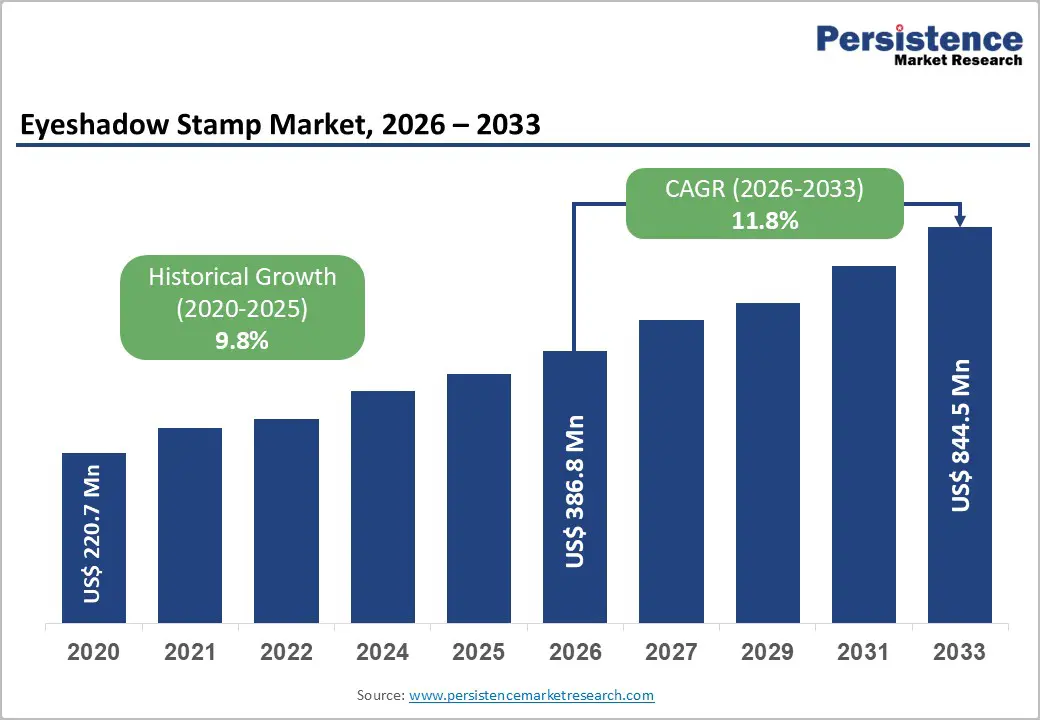
The global Eyeshadow Stamp Market size is likely to be valued at US$ 0.39 Billion in 2026 and is expected to reach US$ 0.84 Billion by 2033, growing at a CAGR of 11.8% during the forecast period from 2026 and 2033. Rapid consumer adoption of simplified eye makeup tools, including winged eyeliner and eyeshadow stamps, is driven by social media tutorials and the growing preference for time-saving beauty solutions among beginners and busy professionals.
Key Market Highlights
- Leading Region: North America is emerging as a leading region for the eyeshadow stamp arket, underpinned by high cosmetic spending, strong U.S. regulatory oversight, and a dynamic innovation ecosystem focused on convenience and long-wear eye-makeup tools.
- Fastest-Growing Region: Asia Pacific is projected to be the fastest-growing region, leveraging manufacturing strengths in China and rising beauty engagement in India, Japan, and ASEAN, particularly through mobile-first e-commerce and social media–driven discovery.
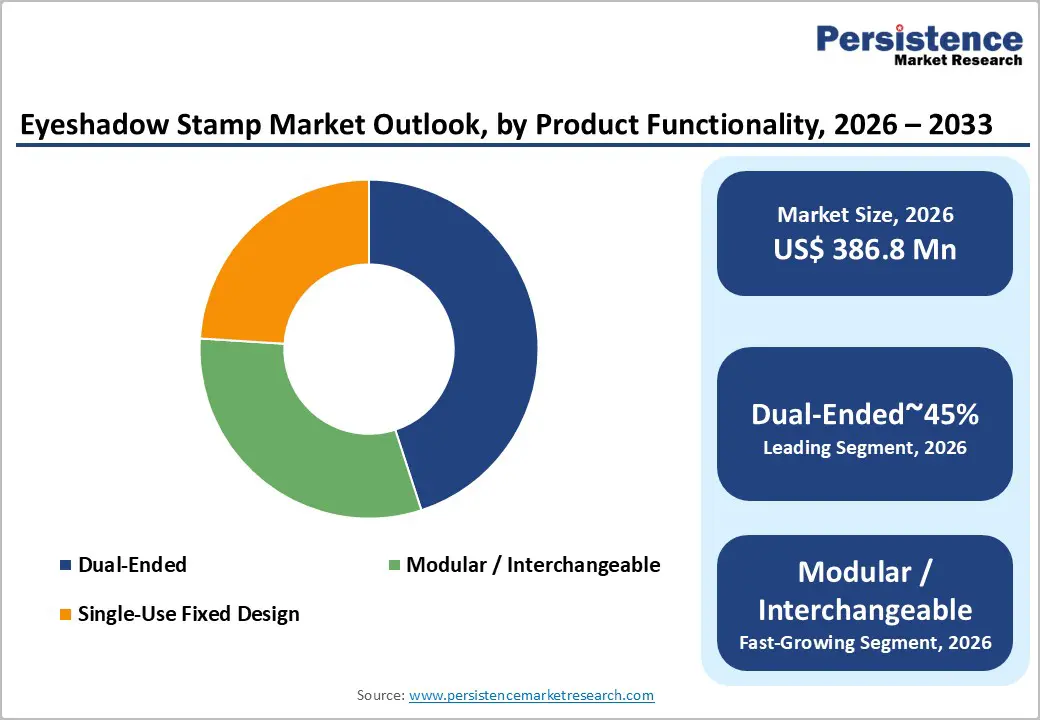
- Leading Segment: In product segmentation, Dual-Ended eyeshadow and eyeliner stamps dominate due to their multifunctionality, travel-friendly design, and ability to combine precise liner application with shaped stamp tips in a single, value-driven format.
- Fastest-Growing Segment: The Beginner skill-level segment is the fastest-growing user group, as first-time and casual makeup users seek tools that reduce application errors, shorten learning curves, and replicate professional looks with minimal technique.
- Key Opportunity lies in modular/interchangeable stamp systems distributed via e-commerce marketplaces and D2C channels, enabling multiple eye looks from one kit while aligning with clean-label, long-wear, and sustainability-focused consumer preferences.
| Key Insights | Details |
|---|---|
| Eyeshadow Stamp Market Size (2026E) | US$ 386.8 Million |
| Market Value Forecast (2033F) | US$ 844.5 Million |
| Projected Growth CAGR (2026-2033) | 11.8% |
| Historical Market Growth (2020-2025) | 9.8% |
Market Dynamics
Market Growth Drivers
Rising Demand for Easy Eye-Makeup Solutions
The primary growth driver for the eyeshadow stamp market is the increasing demand for convenient, easy-to-use eye makeup tools among beginner and time-constrained users. Tutorials across social platforms have popularized winged/cat-eye and cut-crease looks. Still, users frequently report difficulty achieving symmetry with traditional brushes and liners, leading to increased interest in stamp and stencil formats that reduce application time from several minutes to just a few seconds. Consumer surveys in the broader color cosmetics segment indicate that more than 60% of users seek products that simplify application without compromising on finish, and this preference is now directly benefiting eyeshadow and eyeliner stamp solutions that provide consistent shape templates.
Expansion of Long-Wear and Smudge-Proof Formulations
Another strong driver is the rapid expansion of long-wear, smudge-proof, and waterproof formulations integrated into dual-ended eyeliner and eyeshadow stamp products. For instance, clinical testing of a leading wing eyeliner stamp format demonstrated up to 8 hours of color persistence and smudge-proof performance, aligning with consumer expectations for workday and event-long wear. In parallel, major cosmetic brands are increasingly using film-forming polymers and high-purity pigments, while responding to growing demand for vegan or low-irritant formulations in line with broader color cosmetics market trends toward cleaner ingredient profiles, thereby encouraging premium pricing and category uptrading.
Market Restraints
Regulatory Scrutiny on Cosmetic Ingredients and Safety
A key restraint for the eyeshadow stamp market is intensifying regulatory scrutiny on cosmetic ingredients, especially in eye-area products, where safety margins are narrow. Authorities such as the U.S. Food and Drug Administration (FDA) and the European Commission require strict adherence to safety, labeling, and traceability norms for pigments, preservatives, and adhesive or film-forming components used around the eye. Compliance raises development and testing costs, extends time-to-market for new stamp designs or formulas, and may deter smaller manufacturers from launching innovative variants, slowing product diversification in certain regions.
Product Performance Variability and Consumer Trust Issues
Another restraint is performance inconsistency across low-cost stamp products, particularly in online marketplaces where third-party brands may offer non-uniform quality. Consumer reviews for some eyeliner and stamp duo products highlight issues such as poor ink payoff, lack of water resistance, and mismatched wing angles, with some buyers reporting dissatisfaction or return attempts, which can undermine trust in the overall category. As negative word-of-mouth and user-generated content spread quickly, especially when stamps smudge or fail in humid conditions, potential first-time users may hesitate to try stamps, limiting penetration among more conservative or professional segments.
Market Opportunities
Growth of E-commerce Marketplaces and Direct-to-Consumer Brands
A significant opportunity lies in leveraging e-commerce marketplaces and direct-to-consumer (D2C) channels to scale visibility and experimentation with new stamp formats and finishes. Platforms listing tens of thousands of eyeliner and eyeshadow stamp-related products and thousands of suppliers demonstrate the breadth of global supply, with many listings offering innovative silicone and modular stamps tailored for different eye shapes and looks. D2C beauty brands can leverage targeted advertising, influencer collaborations, and subscription models to drive trial and repeat usage, particularly among the beginner and intermediate consumer base that actively searches for “instant cat-eye” or “lazy crease” tools, making this one of the most attractive revenue pockets for future growth.
Innovation in Modular / Interchangeable Stamp Systems
There is also a strong opportunity in modular/interchangeable stamp systems that can deliver multiple eye looks—such as winged / cat-eye, smokey eye, and cut crease—from a single handle or kit. As makeup artists and content creators showcase multi-look palettes and more intricate designs, consumers increasingly seek tools that enable professional-style results without extensive training, and modular kits address this by providing multiple stamp heads tuned to different eye shapes and occasions. Coupled with high-performance, ophthalmologist-tested formulations and clean-label positioning, such kits can command premium price points, align with sustainability narratives by reducing single-use plastic components, and open opportunities in professional / salon channels as well as at-home segments.
Category-wise Insights
Product Functionality Analysis
Within Product Functionality, Dual-Ended designs are expected to hold a leading share of around 45% of category revenue, supported by their practicality and perceived value. Dual-ended tools typically combine a precision liquid liner on one side with a stamp or stencil tip on the other, allowing users to switch seamlessly between outlining and filling steps, which aligns with consumer expectations for compact, travel-friendly makeup solutions. The success of dual-ended wing eyeliner stamps, which offer verified long-wear performance and smudge-proof benefits, has further embedded this format in consumer routines, especially in markets where multi-functional beauty tools are gaining traction as part of a broader shift toward minimal yet efficient makeup bags.
Eye Look Category Analysis
In the Eye Look Category, Winged / Cat-Eye products are anticipated to dominate with approximately 40% share, reflecting their central role in eyeliner and eyeshadow stamp design. Winged and cat-eye styles remain among the most-searched eye looks globally, and solutions such as wing stamps, eyeliner strips, and winged stencils directly address user pain points around symmetry and angle precision. Promotional campaigns by leading beauty brands emphasizing “flash cat-eye” or quick wing solutions, combined with influencer tutorials that showcase instant transformations, reinforce demand and create a robust funnel of first-time users into the broader eyeshadow stamp ecosystem.
Consumer Skill Level Analysis
Across Consumer Skill Level, the Beginner segment is projected to account for close to 50% of demand, as these users have the highest need for guidance and error-reducing tools. Surveys in the wider cosmetics space show that a large proportion of novice makeup users feel intimidated by advanced eye looks, which has accelerated interest in stamps that provide pre-shaped templates and reduce reliance on brush techniques. Beginner consumers are also more likely to discover products via short-form video and tutorials that explicitly market stamps as “failsafe” or “one-step” solutions, making this segment a key target for brands focusing on user-friendly design and educational content.
Distribution Channel Analysis
Within the distribution channel, E-commerce Marketplaces are expected to command around 42% of the market share, reflecting the proliferation of stamp products on global online platforms and their ability to aggregate niche brands. Marketplaces support discovery through customer reviews, star ratings, and algorithmic recommendations, which is particularly important for innovative tools like eyeshadow stamps, where social proof heavily influences purchase decisions. At the same time, cross-border listings from manufacturers in China and other Asian hubs, often with low minimum order quantities and competitive pricing, further expand choice for consumers and professional buyers, underpinning sustained channel dominance compared to brick-and-mortar specialty beauty retail.
Regional Insights
North America Eyeshadow Stamp Market Trends
In North America, the eyeshadow stamp market benefits from high per-capita spending on cosmetics and a mature U.S. innovation ecosystem emphasizing convenience-oriented makeup tools. Consumers in the region show strong interest in cruelty-free, vegan, and long-wear products, with surveys indicating that roughly 70% of American cosmetic buyers prefer natural or cleaner ingredient profiles. This trend encourages the reformulation of eye products for safety and comfort. The U.S. regulatory environment, overseen by the FDA, requires adherence to safety and labeling requirements for color additives and eye-area cosmetics, pushing brands to invest in compliant, dermatologically tested stamp products that can withstand scrutiny while delivering bold looks.
Digital channels play a central role, with online tutorials and social media challenges popularizing winged stamps, crease stamps, and “instant eye look” tools that resonate strongly with younger demographics. The combination of large specialty beauty chains, a robust direct-to-consumer brand presence, and the strong influence of beauty influencers positions North America as one of the leading and trend-setting regions for innovation in dual-ended and modular eyeshadow stamp formats.
Europe Eyeshadow Stamp Market Trends
In Europe, the eyeshadow stamp market is shaped by stringent regulatory harmonization and sophisticated consumer preferences across countries such as Germany, the U.K., France, and Spain. The European Commission framework for cosmetics emphasizes safety, ingredient transparency, and environmental impact, and a 2023 assessment indicated that about 65% of European consumers consider ecological aspects when purchasing beauty products. This fosters demand for eyeshadow and eyeliner stamps featuring recyclable packaging, reduced plastic content, and ethically sourced pigments, while still delivering professional-quality finishes.
European consumers are also increasingly interested in vegan, cruelty-free, and fragrance-free formulations, encouraging brands to adapt stamp inks and gels to minimize potential eye irritation. Established beauty houses in France and Italy, alongside indie brands in the U.K. and Germany, are experimenting with clean-label winged and cut-crease stamping tools that align with the region’s preference for sophisticated yet understated looks, helping maintain steady growth within the broader color cosmetics market.
Asia Pacific Eyeshadow Stamp Market Trends
In the Asia-Pacific region, including China, Japan, India, and ASEAN countries, the eyeshadow stamp market is driven by rapid urbanization, rising disposable incomes, and strong social media influence on beauty trends. Regional consumers are highly engaged with K-beauty and J-beauty innovations, and many adopt gradient eyeshadow, aegyo-sal, and soft winged looks, creating fertile ground for stamps that can replicate these styles with minimal effort. Furthermore, the region leads the global color cosmetics market in share, reflecting the scale of its young, beauty-conscious population and frequent experimentation with new formats.
Manufacturing advantages in China and parts of Southeast Asia contribute to competitive pricing and rapid product iteration for eyeshadow stamps, with numerous OEM and ODM suppliers listed on major online platforms. This supply-side strength supports both domestic and export markets, while growing e-commerce penetration in countries such as India and Indonesia accelerates access to dual-ended and modular kits, positioning Asia Pacific as both the largest and fastest-growing regional hub for the category.
Competitive Landscape
The eyeshadow stamp market is relatively fragmented, with a mix of indie beauty labels, regional manufacturers, and emerging direct-to-consumer brands competing alongside established cosmetic companies. Key strategies include launching dual-ended and modular/interchangeable products with improved ergonomics, investing in waterproof and clean formulations, and using influencer partnerships to demonstrate real-life performance such as time savings and smudge resistance. Differentiation increasingly revolves around eye-shape–specific designs, sustainable packaging, and inclusive shade ranges, while some companies explore subscription models and limited-edition collaborations to maintain consumer engagement and support repeat purchases.
Key Market Developments
- In July 2024, Swiss Beauty expanded its CRAZE Eyeliner and Stamp Duo line, emphasizing ease-of-use for creating sharp wings and promoting long-wear benefits through online tutorials and reviews.
- In December 2024, Kaja Beauty reported strong demand for its Wink Stamp waterproof winged eyeliner, backed by clinical testing showing up to 8 hours of smudge-proof and waterproof performance.
- In November 2025, Accio highlighted increased listings and supplier participation for eyeshadow and eyeliner stamps, indicating robust B2B and B2C demand across global marketplaces.
Companies Covered in Eyeshadow Stamp Market
- Bronson Professional
- Swiss Beauty
- First Class Beauty Co.
- Boutipa
- Ginny
- Accio
- Lyda Beauty
- SAVI
- CALANDIS
- SHEGLAM
- Shenzhen Enimei Technology Development Co., Ltd.
- Guangzhou Kailulin Cosmetic Co., Ltd.
- Shenzhen Thincen Technology Co., Ltd.
- Guangdong Meca Cosmetics Co., Ltd.
- Shenzhen Nuwelltek Technology Co., Ltd.
Frequently Asked Questions
The Eyeshadow Stamp Market is expected to reach about US$ 844.5 Million by 2033, expanding from approximately US$ 386.8 Million in 2026 at a forecast CAGR of 11.8%.
Demand is driven by consumers seeking easy, time-saving eye-makeup tools, particularly for achieving winged or cut-crease looks, as well as the rise of long-wear, smudge-proof formulations in the broader color cosmetics space.
Dual-Ended products lead the market within Product Functionality, offering combined liner and stamp features that deliver high convenience and strong perceived value for both beginners and experienced users.
Asia Pacific holds a prominent and growing position, supported by its leading share in the global color cosmetics market, strong manufacturing capacity, and rapidly expanding online beauty consumption in China, Japan, India, and ASEAN.
A key opportunity lies in developing modular / interchangeable stamp systems with clean, long-wear formulas, distributed via e-commerce marketplaces and D2C channels to meet diverse style preferences and sustainability expectations.
Key players include Swiss Beauty, Bronson Professional, Lyda Beauty, Accio, SHEGLAM, Kaja Beauty, L’Oréal Paris, and several specialized OEM/ODM manufacturers from China supplying silicone and eyeliner stamp tools globally.


