




- Food Ingredients & Additives
- Emulsified Shortenings Market
Emulsified Shortenings Market Size, Share, and Growth Forecast, 2026 - 2033
Emulsified Shortenings Market by Product Type (All-Purpose Emulsified Shortening, Cake & Icing Shortening, Others), Source (Plant-Based Emulsified Shortening, Non-Hydrogenated & Clean-Label Plant-Based Shortening, Others), Application, and Regional Analysis for 2026 - 2033

Emulsified Shortenings Market Size and Trends Analysis
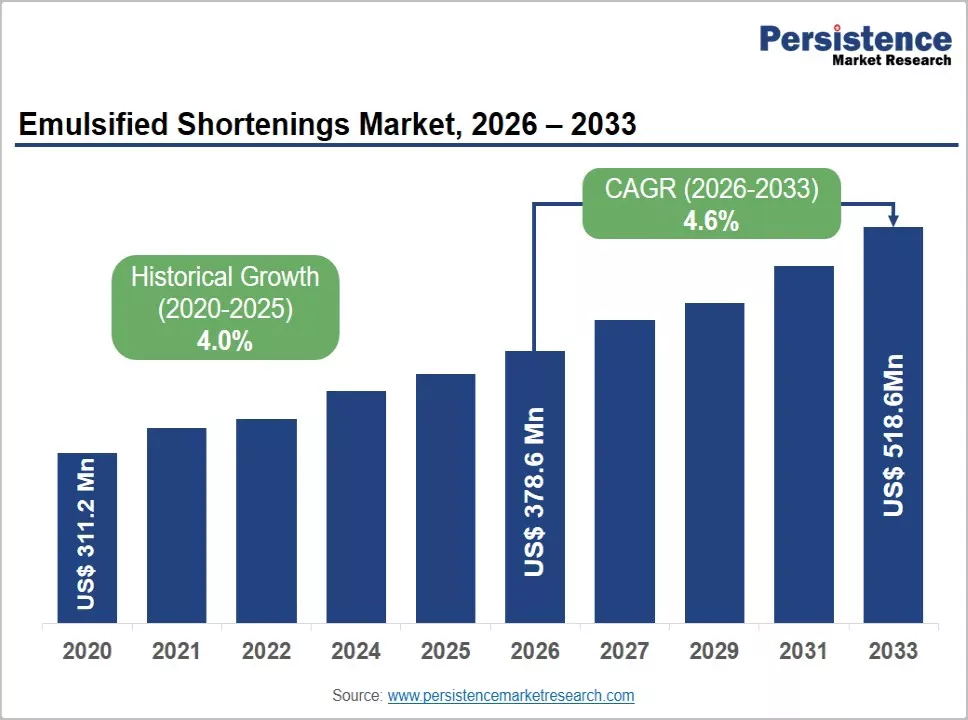
The global emulsified shortenings market size is likely to be valued at US$378.6 million in 2026 and is expected to reach US$518.7 million by 2033, growing at a CAGR of 4.6% between 2026 and 2033, driven by the increasing use of functional fats in commercial baking, packaged bakery products, confectionery, and processed foods.
All-purpose emulsified shortening remains the leading product category, while cake and icing shortenings offer opportunities for specialized formulations. Plant-based products dominate the source mix, and demand for non-hydrogenated alternatives is encouraging manufacturers to reformulate their products.
Key Industry Highlights:
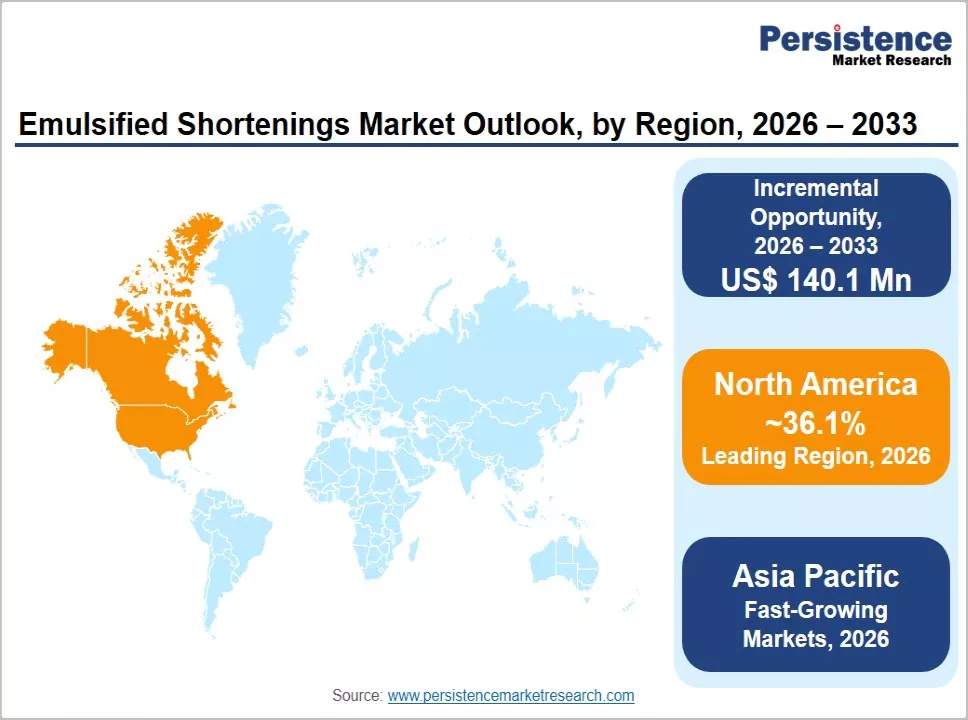
- Leading Region: North America is expected to lead, accounting for an estimated 36.1% share in 2026, supported by established commercial bakeries, packaged-food manufacturers, and specialty-fat suppliers.
- Fastest-growing Region: Asia Pacific is anticipated to record the fastest growth, driven by expanding bakery chains, packaged-food production, foodservice demand, and increasing adoption of non-hydrogenated shortening formulations.
- Dominant Product Type: Plant-based emulsified shortening is anticipated to dominate by source, accounting for approximately 66.7% of the market in 2026, supported by the availability of vegetable oils and their versatility across bakery and processed-food applications.
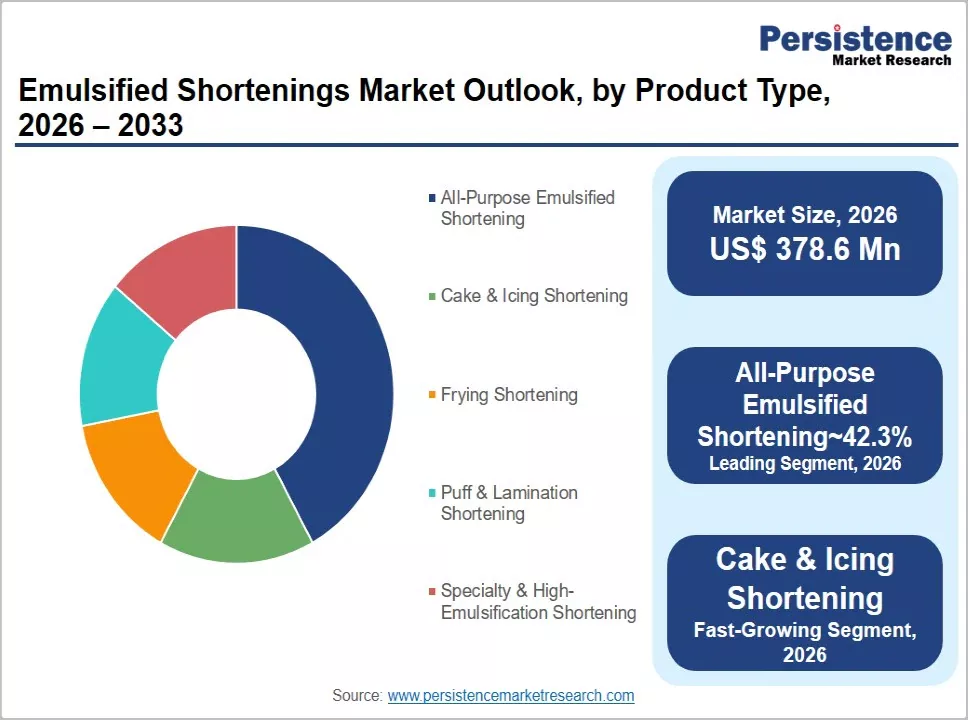
- Leading Source: All-purpose emulsified shortening is anticipated to account for 42.3% of the market in 2026, owing to its broad use in cookies, cakes, biscuits, pastries, and other commercial bakery products.
DRO Analysis
Drivers - Regulatory Pressure and Reformulation toward Non-Hydrogenated Fats
Food safety requirements and nutritional priorities are encouraging manufacturers to develop shortening formulations that limit industrially produced trans fatty acids while preserving the functional properties of conventional fats. In the United States, the Food and Drug Administration determined in 2015 that partially hydrogenated oils were no longer generally recognized as safe for their intended food uses, prompting manufacturers to reformulate numerous food products.
The European Union limits industrial trans fat, excluding naturally occurring trans fat in animal-origin fats, to 2 grams per 100 grams of fat in food intended for consumers and retail supply. India has also implemented a limit of 2% by mass of total oils and fats in food products.
These regulatory measures have increased the importance of alternative fat blends, interesterified fats, selected vegetable oils, and emulsifier systems that reproduce the performance of traditional shortening. Suppliers that can deliver suitable aeration, plasticity, shelf stability, and melting behavior without relying on partially hydrogenated oils can strengthen their competitive position. Reformulation also creates opportunities for technical partnerships between ingredient suppliers and bakery manufacturers. The commercial priority is to achieve regulatory compliance without compromising product quality, production efficiency, or affordability.
Industrial Baking and Demand for Consistent Product Performance
Industrial bakeries and processed-food manufacturers require ingredients that deliver repeatable results across large production runs. Emulsified shortenings support cake batter stability, air incorporation, crumb structure, moisture management, and mouthfeel. Depending on the formulation, they can also help manufacturers maintain processing consistency and finished-product quality during storage and distribution. These characteristics are particularly important in packaged cakes, biscuits, pastries, doughnuts, icings, and cream-filled products.
The expansion of commercial bakery operations and the growing variety of packaged foods create opportunities for application-specific shortening formulations. Manufacturers often require different fat properties for aerated cakes, laminated pastry, frying, and frozen bakery products. This creates scope for suppliers to differentiate their offerings through technical expertise, product customization, and consistent ingredient specifications. For industrial customers, a suitable formulation can reduce batch variation and simplify production management. Suppliers that demonstrate measurable performance advantages can compete on total cost of use rather than relying exclusively on ingredient pricing.
Restraint - Raw-Material Price Volatility and Formulation Complexity
The emulsified shortenings market depends on vegetable oils, specialty fats, emulsifiers, and other formulation inputs whose prices fluctuate with crop yields, weather conditions, trade flows, energy costs, and regional availability. Changes in palm, soybean, canola, and sunflower oil prices can affect manufacturing expenses and procurement decisions. The U.S. Department of Agriculture's oil-crops statistics track production, supply, demand, inventories, trade, and prices across major oilseeds and vegetable oils, highlighting the range of variables affecting the industry's raw-material base.
Price volatility can compress margins when manufacturers cannot immediately pass higher input costs to customers. Reformulation also presents technical challenges because oils with different melting characteristics and solid-fat profiles may not provide equivalent texture, aeration, or stability. Manufacturers may need production trials, shelf-life testing, and customer approval before adopting substitutes. These requirements can increase development costs and delay commercialization. Diversified sourcing, effective inventory management, and formulation expertise are essential to reducing exposure to cost fluctuations.
Opportunities - Non-Hydrogenated and Clean-Label Product Development
Non-hydrogenated, plant-based shortenings offer opportunities for suppliers that combine functional performance with ingredient transparency and reliable sourcing. Manufacturers must ensure that reformulated products maintain aeration, spreadability, plasticity, mouthfeel, and stability during mixing, baking, storage, and distribution. These requirements create demand for carefully designed oil blends, specialty fats, and emulsifier systems that can reproduce the performance of conventional shortening while meeting changing customer specifications.
Suppliers can develop differentiated formulations for bakery manufacturers seeking to eliminate partially hydrogenated oils, adjust saturated-fat content, or simplify ingredient declarations. The strongest opportunities lie in application-specific products supported by formulation assistance, production trials, and consistent raw-material specifications. However, clean-label positioning alone does not guarantee commercial success. Customers also evaluate price, processing efficiency, finished-product quality, and shelf life. Manufacturers that combine nutritional objectives with practical cost-in-use advantages can build stronger long-term customer relationships.
Expansion in Asia Pacific and Localized Technical Support
Asia Pacific presents growth opportunities through expanding food manufacturing, bakery chains, quick-service restaurants, and packaged-food distribution. The region's vegetable-oil processing infrastructure supports access to palm-based and other plant-derived fats, although individual markets differ in raw-material availability and sourcing requirements. Growing demand for commercially produced bakery products creates opportunities for specialized shortenings that improve texture, processing consistency, and product stability.
Ingredient suppliers can strengthen their regional presence by establishing application partnerships with industrial bakeries, premix manufacturers, foodservice operators, and packaged-food producers. Local manufacturing and technical centers can reduce delivery times and help customers adapt formulations to regional recipes, production equipment, and storage conditions. Investment in application testing can also accelerate customer trials and product commercialization. The most attractive opportunities are likely to emerge where suppliers combine dependable sourcing with localized technical support and formulations tailored to specific end-use requirements.
Category-wise Analysis
Product Type Insights
All-purpose emulsified shortening is anticipated to account for 42.3% of the market share in 2026. Its versatility across cookies, pie dough, cakes, biscuits, pastries, and selected frying applications supports widespread adoption. Commercial bakeries use these formulations to simplify ingredient procurement and maintain consistent product quality across multiple production lines. For example, all-purpose shortenings are used in cookie dough, pie crusts, and doughnut production, where handling properties and texture influence finished-product quality.
Cake and icing shortening is anticipated to be the fastest-growing product segment, driven by demand for aerated cakes, stable icings, smooth cream fillings, and prepared desserts. These formulations help manufacturers achieve consistent crumb structure, batter aeration, and icing texture. Other categories include frying shortening, puff and lamination shortening, and specialty or high-emulsification shortening. Frying formulations require suitable thermal stability, while lamination fats must maintain plasticity during rolling and folding. Specialty shortenings serve products requiring enhanced aeration, stability, or freeze-thaw performance.
Source Insights
Plant-based emulsified shortening is anticipated to account for 66.7% of the market share in 2026. Its dominance reflects the availability and versatility of vegetable oils in bakery and processed-food applications. Palm oil is commonly used in formulations requiring suitable solid-fat characteristics, while soybean, canola, and sunflower oils provide alternatives for developing different nutritional and functional profiles. For example, palm-based shortenings are used in bakery fillings and pastry applications, while selected vegetable-oil blends support non-hydrogenated shortening formulations.
Non-hydrogenated and clean-label plant-based shortening is anticipated to be the fastest-growing source segment, supported by trans-fat regulations and manufacturers' interest in ingredient transparency. Suppliers combine suitable oil blends, fat-structuring techniques, and emulsifiers to maintain aeration, texture, and stability without relying on partially hydrogenated oils. Other categories include animal-based shortenings and blended specialty fats. Manufacturers evaluate these options based on melting behavior, oxidation stability, cost, supply reliability, and application requirements. Formulation flexibility will remain a key competitive advantage as food producers balance nutritional objectives, product performance, and sourcing expectations.
Regional Insights
North America Emulsified Shortenings Market Trends
North America is expected to lead the global emulsified shortenings market, accounting for an estimated 36.1% share. Its established commercial baking industry, packaged-food manufacturing base, and extensive ingredient distribution network sustain demand for fats that deliver consistent texture, aeration, and processing performance.
U.S. Emulsified Shortenings Market Trends
The U.S. anchors regional demand through large-scale bakery and food manufacturing operations. Companies such as Cargill and Bunge supply specialty fats and oils used across bakery, confectionery, and foodservice applications. Their formulation capabilities support manufacturers producing cookies, cakes, icings, fillings, and pastries at scale. The U.S. Food and Drug Administration’s removal of partially hydrogenated oils from the list of ingredients generally recognized as safe for their intended uses accelerated reformulation toward alternative fat systems. This has strengthened demand for non-hydrogenated shortenings that retain the functional characteristics required for commercial production.
Canada Emulsified Shortenings Market Trends
Canada contributes through industrial bakeries, packaged foods, and foodservice suppliers. Manufacturers serving the Canadian market must balance ingredient functionality, reliable sourcing, and applicable food-labeling requirements. Demand for all-purpose and cake shortenings is supported by the need for consistent performance across multiple product lines, while specialty fats create opportunities for suppliers offering technical assistance and customized formulations.
Europe Emulsified Shortenings Market Trends
Europe’s market is supported by established bakery, patisserie, confectionery, and packaged-food industries. Regulatory compliance, product quality, and demand for application-specific fats shape supplier strategies.
Germany Emulsified Shortenings Market Trends
Germany’s industrial food-processing sector supports demand for standardized shortening systems used in cakes, biscuits, pastries, and prepared foods. Suppliers with broad ingredient portfolios can serve manufacturers seeking repeatable processing performance and dependable specifications. The European Union’s limit of 2 grams of industrial trans fat per 100 grams of fat in foods for consumers and retail supply has encouraged the use of alternatives to partially hydrogenated fats. This regulatory environment reinforces interest in non-hydrogenated formulations and improved fat structuring.
France Emulsified Shortenings Market Trends
France offers opportunities in patisserie, laminated pastry, cakes, and confectionery, where fat plasticity, aeration, and texture are important. Palsgaard, a Danish emulsifier specialist, supports food manufacturers through emulsifier technologies and application expertise that can help optimize bakery formulations. In July 2026, the European Commission adopted Regulation (EU) 2026/1825 concerning maximum levels and related provisions for 3-MCPD, its fatty acid esters, and glycidyl fatty acid esters in certain foods. Such requirements increase the importance of quality control and supply-chain documentation for fats and oils used in food production.
Asia Pacific Emulsified Shortenings Market Trends
Asia Pacific is the fastest-growing regional market, supported by expanding bakery chains, packaged-food manufacturing, foodservice demand, and greater use of standardized ingredient systems. Its established vegetable-oil supply networks also support a range of plant-based shortening formulations, although commodity-price volatility remains a challenge.
India Emulsified Shortenings Market Trends
India’s bakery, confectionery, and foodservice sectors offer opportunities for emulsified shortenings used in cakes, biscuits, puffs, pastries, and cream fillings. Cargill’s NatureFresh Professional portfolio includes bakery shortenings and margarines for products such as khari, puffs, doughnuts, and cakes, reflecting the need for application-specific fats across traditional and modern bakery categories.
India’s industrial trans-fat limit of 2% by mass of total oils and fats in food products, effective from January 2022, has also increased the importance of reformulation expertise. In July 2025, Palsgaard opened an application center in Navi Mumbai, equipped with pilot-scale facilities for bakery, dairy, ice cream, chocolate, and confectionery applications. The center enables local manufacturers to test and refine formulations under production-like conditions, strengthening regional technical support for emulsifiers and related food ingredients.
China Emulsified Shortenings Market Trends
China’s large food-processing industry and demand for commercially produced cakes, pastries, biscuits, and confectionery create opportunities for industrial shortening suppliers. Manufacturers require fats that deliver consistent texture, stability, and processing performance across large production volumes. Bunge’s bakery portfolio, which includes specialized fats for icings, fillings, pies, and pastries, illustrates how suppliers tailor formulations to specific product requirements.
Across Asia Pacific, investment in local application support, non-hydrogenated formulations, and dependable vegetable-oil sourcing can help suppliers respond to varied regional recipes and evolving food-safety requirements.
Competitive Landscape
The global emulsified shortenings market includes multinational agricultural processors, specialty-fat manufacturers, regional shortening suppliers, and ingredient companies that support emulsification and formulation. Competition reflects access to vegetable oils, refining and blending capabilities, product consistency, application expertise, and distribution reach. Major participants include Cargill, Bunge, AAK, Archer Daniels Midland, Wilmar International, and Fuji Oil, alongside regional producers and specialist ingredient suppliers.
Leading suppliers use product innovation, sourcing scale, formulation expertise, and geographic expansion to differentiate their businesses. Non-hydrogenated alternatives, tailored emulsifier systems, application laboratories, and customer co-development are important strategic themes. Companies also balance ingredient functionality with cost-in-use, supply reliability, and sourcing expectations. Regional manufacturing and technical partnerships can improve customer responsiveness, while diversified vegetable-oil sourcing helps manage commodity exposure.
Key Industry Developments
- In March 2026, Cargill announced the expansion of its edible oil facility in Port Klang, Malaysia, with a new specialty fats production line, strengthening its supply of fats for bakery, frying, fillings, and confectionery applications.
Companies Covered in Emulsified Shortenings Market
- Cargill, Incorporated
- Bunge Global SA
- Archer Daniels Midland Company (ADM)
- AAK AB
- Wilmar International Limited
- Ventura Foods, LLC
- Stratas Foods, LLC
- Fuji Oil Holdings Inc.
- IOI Corporation Berhad
- Musim Mas Group
- Mewah International Inc.
- Puratos Group
- Zeelandia Group
- Vandemoortele NV
- Walter Rau Neusser Öl und Fett AG
- Manildra Group
Frequently Asked Questions
The global emulsified shortenings market is estimated to be valued at US$378.6 million in 2026.
The emulsified shortenings market is expected to reach US$518.7 million by 2033.
Key trends include increasing adoption of non-hydrogenated and clean-label formulations, growing demand for plant-based shortening, and the development of application-specific fats that deliver consistent texture, aeration, and processing performance.
By source, plant-based emulsified shortening is anticipated to lead, accounting for approximately 66.7% of the market in 2026. By product type, all-purpose emulsified shortening is anticipated to hold the leading position, with an estimated 42.3% share.
The emulsified shortenings market is projected to grow at a CAGR of 4.6% from 2026 to 2033.
Major companies include Cargill, Incorporated; Bunge Global SA; Archer Daniels Midland Company (ADM); AAK AB; and Fuji Oil Holdings Inc.


