




- Food Ingredients & Additives
- Dextrose Monohydrate Market
Dextrose Monohydrate Market Size, Share, Growth, and Regional Forecast, 2026 - 2033
Dextrose Monohydrate Market by Drugs (Corn-based, Wheat-based, Others), Form (Powder, Crystals, Liquid), Application, and Regional Analysis from 2026 - 2033

Dextrose Monohydrate Market Share and Trends Analysis
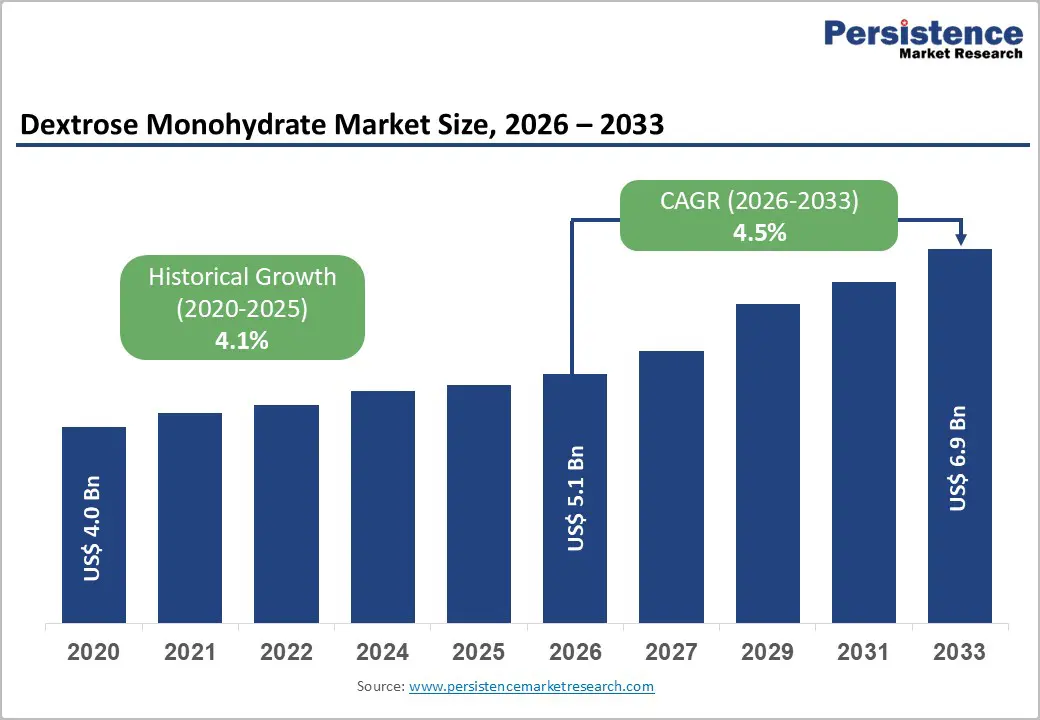
The global dextrose monohydrate market is projected to grow from US$5.4 billion in 2026 to US$7.2 billion by 2033, at a CAGR of 4.2% over the forecast period.
Dextrose monohydrate is commonly used as a sweetener, energy source, fermentation substrate, and excipient due to its high purity and quick solubility. Rising demand from processed foods, beverages, oral rehydration solutions, and intravenous fluids is supporting market growth. The pharmaceutical sector, in particular, benefits from its role in clinical nutrition and emergency care. Additionally, expanding nutraceutical consumption and increasing industrial fermentation activities are strengthening demand.
Key Industry Highlights
- Food and beverage applications dominate demand, owing to their widespread use as sweeteners and energy-enhancing ingredients in processed foods.
- Pharmaceutical-grade dextrose monohydrate is in strong demand for IV fluids, oral rehydration solutions, and clinical nutrition products.
- Powder form dominates the market owing to ease of handling, long shelf life, and compatibility across food, pharmaceutical, and industrial applications.
- Corn-based dextrose monohydrate remains the primary source due to its abundant availability and well-established global starch-processing infrastructure.
- The Asia-Pacific region is the fastest-growing region, supported by expanding food-processing industries and rising healthcare consumption.
- Increasing demand for sports nutrition and nutraceutical products is driving the use of a rapid-energy-providing carbohydrate ingredient.
| Key Insights | Details |
|---|---|
|
Dextrose Monohydrate Market Size (2026E) |
US$5.4 Bn |
|
Market Value Forecast (2033F) |
US$7.2 Bn |
|
Projected Growth (CAGR 2026 to 2033) |
4.2% |
|
Historical Market Growth (CAGR 2020 to 2025) |
3.6% |
Market Dynamics
Driver - Rapid Absorption Nutrition in Sports & Fitness
The growing emphasis on performance optimization, endurance building, and faster recovery among athletes and fitness-oriented consumers is significantly driving demand for rapidly absorbable carbohydrates such as dextrose monohydrate. Unlike complex carbohydrates, dextrose is a simple sugar with a high glycemic index, enabling it to enter the bloodstream quickly and provide immediate energy during intense physical activity. This characteristic makes it a preferred ingredient in sports drinks, energy gels, intra-workout powders, and post-exercise recovery formulations. With the global rise in gym memberships, endurance sports participation, and recreational fitness activities, consumers increasingly seek products that can prevent fatigue, maintain blood glucose levels, and enhance workout performance.
Dextrose monohydrate also supports faster glycogen replenishment in muscles after exercise, which is critical for athletes involved in high-frequency training or competitive sports. Additionally, its neutral taste, high solubility, and cost-effectiveness allow manufacturers to formulate palatable, fast-acting energy products without compromising texture or stability. The trend toward personalized nutrition and evidence-based sports supplements further strengthens the adoption of dextrose, as it is often recommended in carbohydrate-loading and recovery protocols. Moreover, the expanding market for ready-to-drink sports beverages and on-the-go energy formats in emerging economies is amplifying volume consumption. As active lifestyles continue to integrate into daily routines beyond professional athletics, dextrose monohydrate remains a core ingredient enabling rapid energy delivery, improved workout efficiency, and accelerated recovery in the sports and fitness nutrition segment.
Restraints - High Transport and Storage Cost due to Hygroscopic Nature
One significant challenge restraining the growth of the dextrose monohydrate market is the high cost and complexity associated with its transportation and storage. Dextrose monohydrate is highly hygroscopic, meaning it readily absorbs moisture from the surrounding environment. This characteristic makes it highly sensitive to humidity, which can lead to clumping, caking, or microbial growth if not properly managed. To maintain its purity and functional properties, manufacturers and distributors must invest in specialized packaging solutions such as moisture-proof bags, sealed containers, and controlled-atmosphere storage facilities. Additionally, transportation requires climate-controlled vehicles or containers to prevent exposure to heat and moisture during transit.
These precautionary measures significantly increase logistical and operational costs compared to other sugar derivatives or sweeteners. Furthermore, the need for continuous monitoring of storage conditions, including temperature and humidity, adds another layer of expense and complexity. For smaller suppliers or markets with limited infrastructure, these requirements can constitute substantial barriers to entry, limiting distribution reach and overall market expansion. Consequently, while dextrose monohydrate remains a versatile ingredient across the food, beverage, and pharmaceutical industries, its hygroscopic nature imposes a persistent financial and operational burden, thereby restraining broader adoption and supply chain scaling.
Opportunity - Gut Health & Prebiotic Functional Foods
Dextrose monohydrate, traditionally classified as a simple carbohydrate, is emerging as a strategic ingredient in next-generation functional foods for gut health and prebiotic effects. Its high solubility and fermentability make it an ideal substrate for the beneficial gut microbiota, including Bifidobacteria and Lactobacilli, which are critical for maintaining intestinal homeostasis. Unlike conventional prebiotics such as inulin or FOS, dextrose can be precisely dosed to support targeted microbial growth, enabling the formulation of customized digestive health products. Innovative applications include beverages, yogurt-based snacks, and powdered drink mixes fortified with dextrose to enhance probiotic efficacy and improve overall gut resilience.
Beyond digestion, optimized microbial fermentation of dextrose can influence metabolic pathways, potentially supporting immune modulation, nutrient absorption, and short-chain fatty acid production. Additionally, dextrose-based prebiotics can be combined with plant extracts, polyphenols, or adaptogens to create multifunctional wellness foods, appealing to the growing consumer demand for clean-label, scientifically backed nutrition. This positions dextrose monohydrate not merely as a sweetener, but as a versatile functional ingredient driving innovation in digestive and holistic health markets.
Category-wise Analysis
By Source Insights
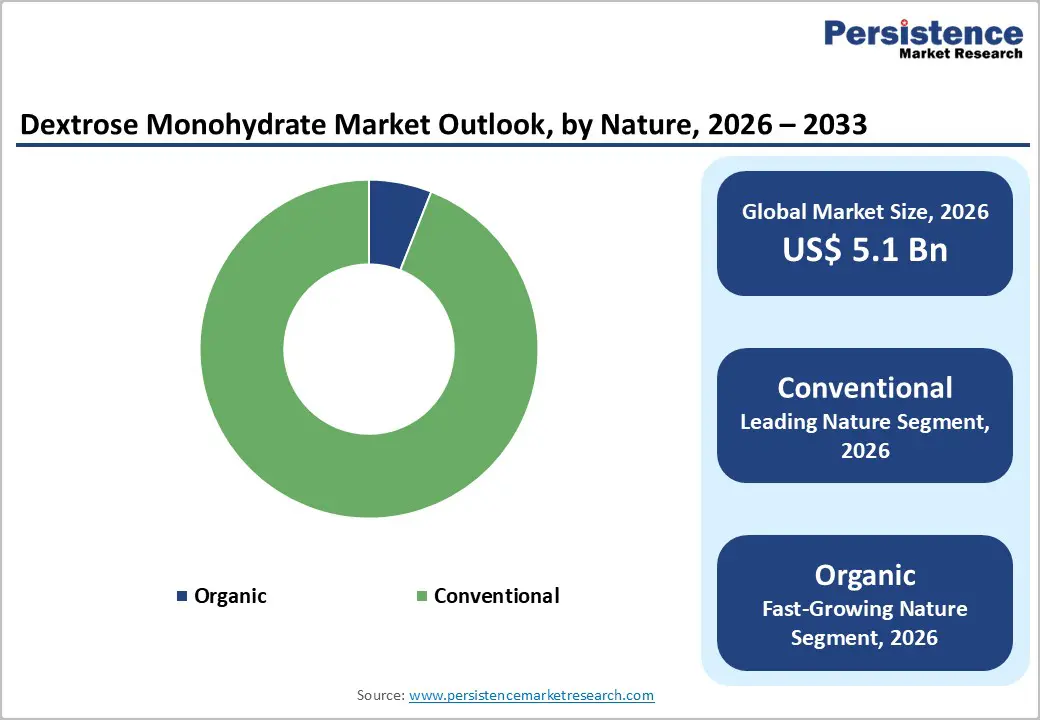
Corn-based dextrose monohydrate dominates the global market primarily due to its abundant availability, cost efficiency, and well-established processing infrastructure. Corn starch is highly fermentable, producing high-purity dextrose in large volumes with consistent quality, which is crucial for industries like food, pharmaceuticals, and fermentation. In contrast, wheat-based dextrose is constrained by limited raw material availability, seasonal variability, and slightly higher processing costs, making it less competitive for large-scale production. Additionally, corn cultivation benefits from extensive global acreage, mechanized farming, and strong supply chains, ensuring year-round availability and stable pricing. The versatility of corn also enables manufacturers to produce a range of dextrose grades, from food-grade sweeteners to pharmaceutical- and industrial-grade products, thereby further reinforcing its market share. While alternative sources such as cassava or rice starch exist, their production remains niche due to regional cultivation constraints, lower yields, and higher costs. Furthermore, corn-based dextrose aligns with global consumer trends such as clean-label sweeteners and functional ingredients, making it the preferred choice for new product development. Overall, corn’s scalability, reliability, and economic advantages ensure that it continues to hold the largest share in the dextrose monohydrate market.
By Application Insights
The bakery segment dominates the global dextrose monohydrate market due to its essential functional and sensory roles in baked goods. Dextrose acts as a primary fermentable sugar for yeast, ensuring consistent dough rising and optimal crumb texture in bread, pastries, and cakes. Beyond fermentation, it contributes to browning through the Maillard reaction, imparting appealing color, aroma, and flavor that are critical for consumer acceptance. Its hygroscopic nature helps retain moisture, extending shelf life and preventing staling, which is particularly valuable in industrial-scale production and packaged bakery goods. The versatility of dextrose allows manufacturers to fine-tune sweetness levels without overpowering delicate flavors, making it ideal for a wide range of bakery formulations.
Additionally, the growing demand for clean-label, functional bakery products- such as fortified breads, low-calorie baked snacks, and probiotic-enriched items-further boosts dextrose use. Compared with other segments such as dairy, confectionery, and beverages, bakery requires larger batch volumes, solidifying its position as the largest share application in the market. Overall, dextrose monohydrate’s multifunctional properties, cost-effectiveness, and compatibility with modern baking innovations make it indispensable to the global bakery industry.
Regional Insights
North America Dextrose Monohydrate Market Trends
North America holds a leading position in the global dextrose monohydrate market, driven by advanced food processing infrastructure, high consumer demand for bakery and confectionery products, and strong pharmaceutical applications. The region’s focus on clean-label and functional ingredients has encouraged manufacturers to incorporate dextrose not only as a sweetener but also as a moisture-retaining, browning, and fermentation-enhancing agent.
In addition, North America’s growing health-conscious population is increasing demand for functional foods and beverages, in which dextrose serves as a reliable energy source and prebiotic substrate. The region also benefits from well-established corn production, thereby ensuring a steady and cost-effective supply of raw material. Technological innovations in industrial baking, snack production, and nutraceutical formulations further reinforce the adoption of dextrose. Regulatory support and high consumer awareness of quality and safety standards make North America an attractive hub for new product development, solidifying its role as a trendsetter and high-volume consumer in the dextrose monohydrate market.
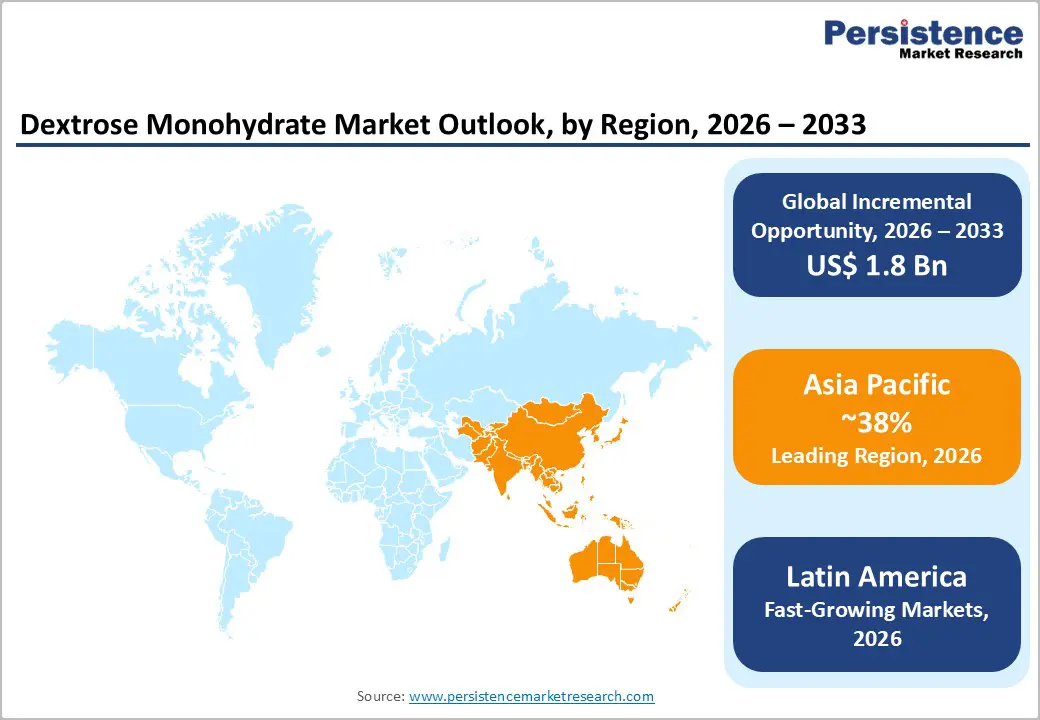
Asia Pacific Dextrose Monohydrate Market Trends
The Asia-Pacific region is emerging as a high-growth market for dextrose monohydrate, driven by rapid urbanization, rising disposable incomes, and increasing demand for processed foods, bakery, and confectionery products. Countries such as China, India, and Japan are experiencing a surge in industrial-scale food manufacturing, in which dextrose is used as a sweetener, fermentation agent, and moisture-retaining ingredient. The region’s growing awareness of functional and fortified foods has opened opportunities for dextrose in nutraceuticals, prebiotic formulations, and energy beverages. Additionally, the expansion of the pharmaceutical and healthcare sectors is driving demand for pharmaceutical-grade dextrose in intravenous solutions and oral nutrition products. Asia-Pacific also benefits from cost-competitive raw materials, particularly corn and wheat starch, which enable large-scale production and exports. Rising consumer preference for clean-label, high-quality products, combined with government initiatives supporting food innovation and manufacturing infrastructure, is accelerating market growth. Overall, the Asia Pacific is poised to become a strategically important and rapidly expanding market for dextrose monohydrate in the coming years.
Competitive Landscape
The dextrose monohydrate market is highly competitive, characterized by well-established manufacturers focusing on product differentiation, quality, and scalability. Companies are investing in advanced production technologies, R&D for specialty grades, and value-added formulations to capture market share across food, beverage, and pharmaceutical segments. Strategic initiatives such as capacity expansion, regional distribution networks, and partnerships with end-user industries are common to strengthen market presence.
Key Industry Developments:
- In June 2024, Omnia Europe SA, a globally operating specialty starch and derivatives manufacturer serving the food, feed, and bioindustrial market segments and headquartered in Constanta, Romania, announced strategic investments to diversify its product and solutions portfolio in response to evolving market demands for plant-based, nutritional, healthier, and cost-efficient solutions delivered in a safe, responsible, and sustainable manner.
Companies Covered in Dextrose Monohydrate Market
- Archer Daniels Midland Company
- NOW Foods
- Cargill, Incorporated
- Tate & Lyle Plc
- Atlantic Chemicals Trading GmbH
- Roquette Frères S.A.
- Belgosuc
- Hangzhou Focus Corporation
- Tereos Starch & Sweeteners
- Gulshan Polyols Ltd.
- Sinofi Ingredients
- Penta Manufacturing Company
- Global Sweeteners Holdings Limited
- Foodchem International Corporation
- Spectrum Chemical Manufacturing Corp.
- Others
Frequently Asked Questions
The global dextrose monohydrate market is projected to be valued at US$5.4 Bn in 2026.
Rising demand from the bakery and confectionery industry due to dextrose’s role in sweetness, browning, moisture retention, and fermentation.
The global market is poised to witness a CAGR of 4.2% between 2026 and 2033.
Growing sports and clinical nutrition demand, especially for quick-energy formulations and recovery products.
Archer Daniels Midland Company, NOW Foods, Cargill, Incorporated, Tate & Lyle Plc, and others.


