




- Industrial Machinery
- Currency Counting Machine Market
Currency Counting Machine Market Size, Share, and Growth Forecast, 2026 - 2033
Currency Counting Machine Market by Product Type (Banknote Counters, Coin Counters, Sorters), Technology Type (UV Detection, Magnetic Detection, Infrared/AI), Portability (Stationary/Desktop, Portable/Handheld), End-user, and Regional Analysis 2026 - 2033

Currency Counting Machine Market Size and Trends Analysis
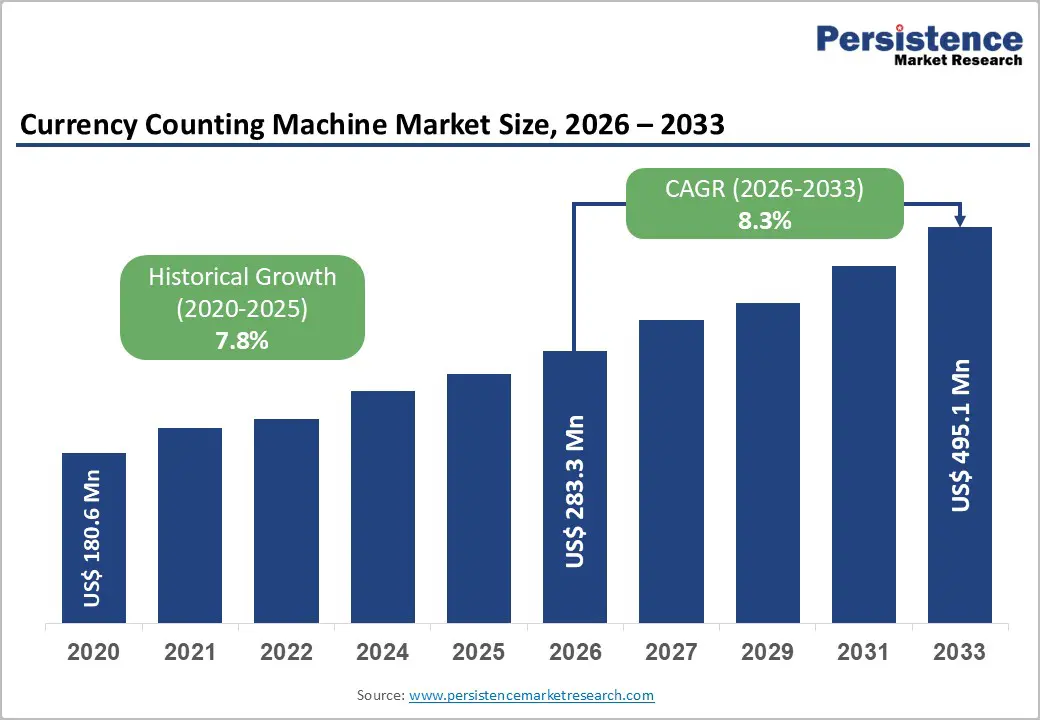
The global currency counting machine market size is likely to be valued at US$283.3 million in 2026 and is expected to reach US$495.1 million by 2033, growing at a CAGR of 8.3% during the forecast period from 2026 to 2033, underpinned by a transition from manual cash handling to automated, high-precision processing systems.
The market is primarily propelled by the persistent volume of cash-in-circulation in emerging economies and the heightening demand for sophisticated counterfeit detection technologies within the BFSI and retail sectors. Growth stems from rising cash circulation in emerging economies and heightened counterfeit threats, with Asia Pacific, driven by high-volume transactions. Advanced detection technologies such as UV and AI boost adoption in BFSI and retail, while automation in sorters/recyclers accelerates segment expansion.
Key Industry Highlights:
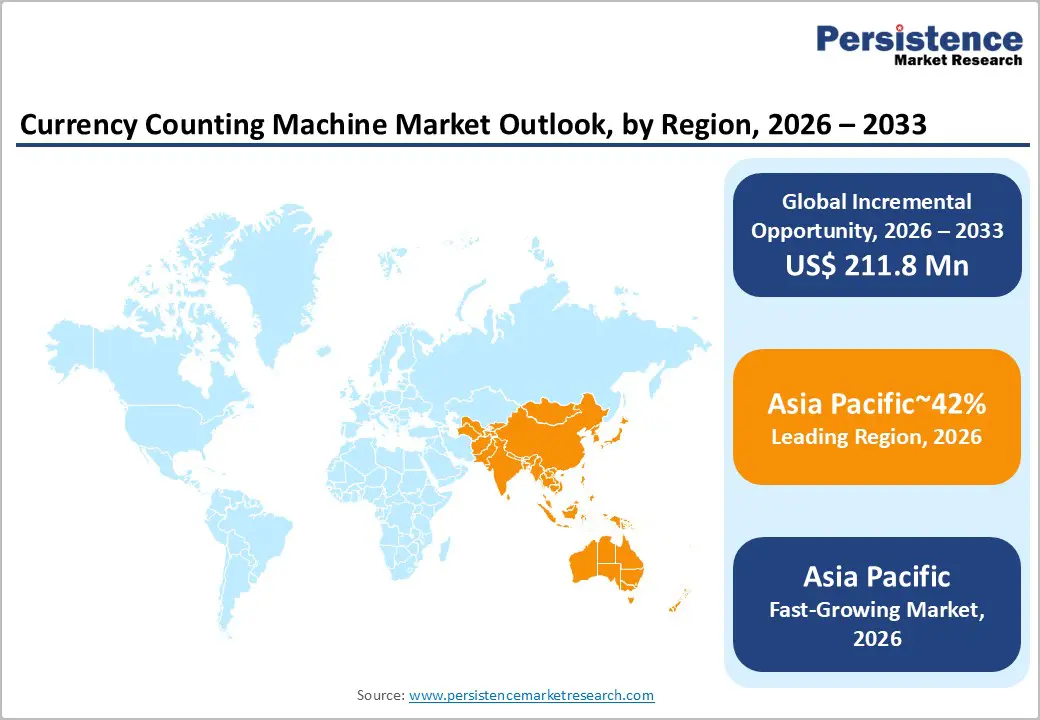
- Leading Region: Asia Pacific is projected to lead due to persistent high cash-in-circulation levels, large unbanked populations, expanding retail networks, and strong domestic manufacturing ecosystems, accounting for approximately 42% share in 2026, supported by advanced UV, magnetic, and AI-based detection adoption and integrated banking automation infrastructure.
- Fastest-growing Region: Asia Pacific is anticipated to grow the fastest due to rapid financial inclusion programs, expanding E-commerce and cash-on-delivery ecosystems, regulatory tightening on counterfeit detection, and increasing deployment of IoT-enabled smart recyclers across banking and retail sectors.
- Leading Product Type: Banknote counters are expected to lead accounting with approximately 63% share in 2026, through extensive industrial adoption across BFSI and retail, high-throughput processing capabilities, operational accuracy, and integration into centralized vault and branch workflows supporting high-value transaction environments.
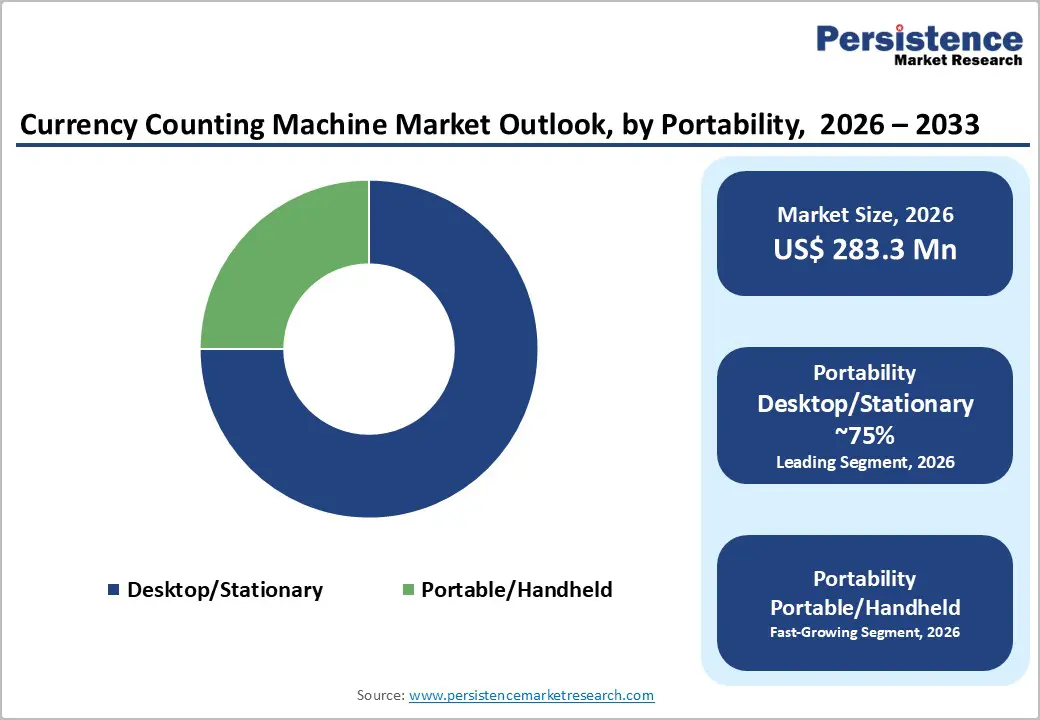
- Leading Portability: The desktop/stationary segment is projected to dominate for operational durability, cost efficiency in high-volume environments, widespread enterprise adoption, and functional integration across banking branches and centralized retail back offices, holding approximately 75% share in 2026.
| Key Insights | Details |
|---|---|
|
Currency Counting Machine Market Size (2026E) |
US$283.3 Mn |
|
Market Value Forecast (2033F) |
US$495.1 Mn |
|
Projected Growth (CAGR 2026 to 2033) |
8.3% |
|
Historical Market Growth (CAGR 2020 to 2025) |
7.6% |
Market Factors - Growth, Barriers, and Opportunity Analysis
Growth Analysis - Persistent High Levels of Cash-in-Circulation in Emerging Markets
Despite the global push toward digital payment systems, cash continues to function as a primary medium of exchange across multiple high-growth regions. Central banks report steady increases in banknotes in circulation to support transactional liquidity, reflecting persistent dependence on physical currency for daily economic activity. In developing nations, cash provides a critical financial safety net and remains essential for unbanked populations lacking digital access. Technology adoption, including advanced detection sensors, enhances operational reliability and minimizes human error while meeting regulatory standards for secure cash handling. The value chain extends from currency issuance and sorting to end-user processing, embedding automated counters as critical operational assets. Operational efficiencies realized at the first mile of cash circulation improve throughput, reduce labor intensity, and support financial stability across emerging market economies.
The Asia Pacific region experiences particularly high market impact due to concentrated population centers and rapid economic growth, necessitating efficient currency processing frameworks. Banks, cooperative credit institutions, and microfinance operators increasingly integrate automated counting machines to manage elevated cash volumes safely and accurately. Infrastructure investments at regional clearinghouses and centralized processing centers further reinforce demand for high-capacity equipment. Supply chain integration with armored transport and branch distribution networks ensures continuous availability and operational readiness. Collectively, these dynamics underscore the structural growth potential for currency counting machines across emerging economies, maintaining relevance despite increasing digital transaction penetration.
Rising Counterfeit Currency Threats
Global escalation in counterfeit currency circulation is intensifying the demand for advanced detection technologies across banking and retail sectors. Central banks and financial authorities report significant increases in fake banknotes. UV, magnetic, and infrared detection technologies embedded in modern currency counting machines enable rapid authentication, reducing manual verification errors and supporting compliance with regulatory anti-fraud mandates. This trend is particularly pronounced in regions with high cash usage, where the risk of circulation of counterfeit notes can disrupt transactional integrity and operational efficiency. Supply chain considerations, including deployment across branch networks and cash-in-transit systems, further strengthen the operational reliance on automated detection solutions.
Emerging markets experience amplified demand due to sustained cash-in-circulation levels and limited digital penetration, exposing physical currency to heightened counterfeit threats. High-volume cash handlers, including commercial banks, credit unions, and retail chains, increasingly adopt sophisticated counters to safeguard operational continuity. Integration with vault management and cash reconciliation workflows ensures efficiency and accuracy while meeting stringent regulatory oversight. The machines also optimize labor allocation by minimizing manual sorting and verification efforts, enhancing cost structures at operational nodes. Collectively, rising counterfeit risks structurally reinforce the strategic importance of automated counting and authentication solutions within value chains, supporting adoption across both emerging and mature economies.
Barrier Analysis - Rapid Proliferation of Digital Payment Ecosystems
The widespread adoption of contactless payments, central bank digital currencies, and unified payment infrastructures is structurally constraining traditional currency counting machine demand. Governments in mature economies are incentivizing cash-lite systems to enhance tax transparency, reduce operational costs, and streamline financial reporting, diminishing the frequency of physical currency circulation. As transactional velocity declines in high-income urban centers, the requirement for large-scale banknote counting infrastructure correspondingly decreases, affecting procurement planning for commercial banks, retail chains, and cash-in-transit operators. This transition impacts the value chain, as manufacturers must adapt production strategies, recalibrate capacity, and incorporate software integration to maintain relevance within evolving financial ecosystems. Operational efficiency metrics and branch-level cash processing volumes are now recalculated with digital transaction prevalence factored into demand forecasts, reshaping strategic deployment across cash handling networks.
Market variation increasingly emphasizes multi-functional machines capable of interfacing with digital cash management platforms while retaining basic physical counting functionality. Investment in R&D focuses on enhancing software connectivity, reporting analytics, and automated reconciliation to align with evolving compliance frameworks. Smaller, portable solutions are favored in mixed-cash environments where hybrid models can optimize labor allocation and reduce operational costs. The pace of cash-lite adoption varies regionally, but structural implications for traditional counting equipment remain pervasive, necessitating business model evolution to sustain market participation in a progressively digital financial landscape.
Technical Complexity and Accuracy Sensitivity
Currency counting machines face significant operational challenges due to variability in banknote condition, including soiling, tears, and folds, which frequently cause jams or miscounts. High-accuracy performance demands precision engineering across sensor arrays and mechanical pathways, ensuring reliable handling of diverse substrates and denominations. Maintenance intensity increases as sensors and rollers require regular cleaning, calibration, and component replacement to sustain operational reliability. These technical constraints influence the total cost of ownership and affect deployment strategies within banks, retail operations, and cash-in-transit networks. Reliability standards are tightly linked to regulatory and audit expectations, embedding accuracy as a critical performance metric throughout the cash handling value chain.
These complexities slow adoption in regions with mixed banknote quality and high transaction volumes. Operators prioritize machines capable of minimizing downtime while maintaining audit-ready accuracy, which elevates engineering and software sophistication requirements. Supply chain considerations, including spare part availability and technical support, become central to maintaining operational continuity across branch networks. Performance expectations in high-volume cash centers reinforce the demand for robust design, precise calibration, and adaptive software algorithms, making technical reliability a structural determinant of market penetration and long-term adoption.
Opportunity Analysis – Expansion of Portable Models for Retail and Logistics
The growing demand for portable and handheld currency counting machines is structurally transforming cash management in the retail and logistics sectors. Compact, lightweight units enable small businesses and mobile operations to perform accurate cash counting without relying on stationary infrastructure. E-commerce growth, particularly cash-on-delivery models in emerging markets, creates operational pressure for rapid, on-site currency verification and reconciliation. These portable solutions enhance labor efficiency, reduce manual handling errors, and facilitate real-time reporting across decentralized transaction points. Technology integration, including UV, magnetic, and infrared detection, ensures counterfeit verification even in high-mobility environments, embedding compliance and reliability into operational workflows. The shift toward portable devices also reflects broader value-chain decentralization, as cash management extends beyond central banking or retail branches to last-mile collection points.
Regional adoption is particularly pronounced in Asia Pacific retail ecosystems, where e-commerce penetration and high cash-on-delivery prevalence drive structural demand. Mobility gains allow businesses to perform frequent audits, reconcile collections efficiently, and maintain secure cash handling without major infrastructure investment. Integration with cloud-based cash management and reporting platforms further enhances operational transparency and accountability. The ability to deploy units across multiple locations with minimal training strengthens operational continuity and supports emerging market growth dynamics. These portable models create a structural opportunity to expand market coverage while addressing evolving cash-handling needs in dynamic retail and logistics environments.
Rise of Smart Cash Recyclers and IoT Integration
The integration of Internet of Things (IoT) technologies with cash management systems is driving a structural transformation in currency handling across banking and financial networks. Smart cash recyclers provide real-time visibility into cash levels, machine health, and counterfeit trends, enabling optimized cash-in-transit logistics and enhanced operational efficiency. Cloud-based analytics and connected platforms allow financial institutions to monitor distributed assets remotely, reducing manual interventions and supporting predictive maintenance protocols. The technology evolution also facilitates the transition from traditional hardware sales to recurring Software-as-a-Service (SaaS) revenue models, aligning with broader digital transformation agendas.
The market is prominent in mature financial ecosystems seeking to integrate physical currency handling with digital asset management dashboards. Banks, retail chains, and cash-in-transit operators leverage smart recycler data to optimize replenishment schedules, reduce idle cash, and enhance labor allocation efficiency. The combination of IoT sensors, cloud computing, and analytics software creates structural differentiation, embedding predictive insights and real-time monitoring into operational protocols. High-volume environments benefit from reduced downtime, faster reconciliation, and enhanced counterfeit detection, which collectively improve cash handling reliability.
Category–wise Analysis
Product Type Insights
Banknote counters are expected to lead, accounting for approximately 63% share in 2026, underpinned by their entrenched role in high-volume cash processing across BFSI and retail operations. Adoption remains anchored by their operational speed, counting accuracy, and ability to reliably handle large-scale daily transactions, with providers prioritizing standardized technology, scale efficiency, and seamless integration into branch and vault workflows. Leading market players such as Glory Ltd., Cummins Allison, and Giesecke+Devrient offer comprehensive product ecosystems that embed enterprise workflows, ensuring auditability, counterfeit detection, and multi-currency processing. The combination of mature infrastructure, widespread deployment, and predictable transactional demand sustains the segment’s dominance, particularly in regions with high cash-in-circulation levels.
Sorters are expected to be the fastest-growing segment, driven by emerging operational gaps in legacy cash handling across retail, casinos, and branch automation scenarios. Accelerating adoption is supported by IoT-enabled connectivity, multi-modal biometric authentication, and cloud-based reporting, reducing operational friction for first-time adopters and smaller urban branches. Brands including Glory Ltd. and NCR Atleos are deploying new recycler platforms to capture early-cycle demand, embedding operational standards and audit compliance into enterprise workflows. As urbanization, labor cost pressures, and regulatory mandates for clean notes intensify, the segment is expected to outpace overall market growth.
Portability Insights
The desktop/stationary segment is expected to lead, accounting for approximately 75% share in 2026, underpinned by their entrenched role in high-volume cash processing across BFSI and centralized retail operations. Adoption remains anchored by operational durability, continuous-duty capability, and high-speed multi-pocket sorting, with enterprises prioritizing stability, throughput, and advanced counterfeit detection in back-office environments. Ongoing platform evolution, including AI-driven predictive maintenance, modular sensor upgrades, ultra-quiet brushless motors, and antimicrobial feed surfaces, continues to reinforce replacement cycles and utilization intensity. Leading brands such as Glory Global Solutions, Cassida Corporation, and Billcon Corp provide comprehensive desktop platforms that integrate with cloud-based accounting systems and offer multi-user authentication.
The portable/handheld segment is expected to be the fastest-growing segment in the currency counting machine market, driven by emerging operational gaps in decentralized retail, e-commerce cash-on-delivery, and mobile banking services. Growth is catalyzed by technological inflection points such as lightweight lithium-ion batteries, miniaturized CIS/UV/MG sensors, hybrid clamshell designs, and app-integrated ecosystems, materially improving portability, counting accuracy, and on-the-spot cash verification. As cash-intensive micro-retail and last-mile delivery channels expand, this segment is expected to outpace overall market growth, enabling rapid, secure, and accurate cash handling outside traditional branch infrastructure.
Regional Insights
Asia Pacific Currency Counting Machine Market Trends
Asia Pacific is assumed to lead the market, accounting for approximately 42% share in 2026, underpinned by its entrenched role in high cash-in-circulation economies such as China, India, and Japan. The adoption remains anchored by expanding banking networks, high-volume retail operations, and the persistent use of cash among unbanked and underbanked populations, with enterprises prioritizing high-speed counting, advanced multi-currency support, and hybrid UV/MG/IR detection for counterfeit mitigation. Ongoing platform evolution, including AI-driven image processing, IoT-enabled cloud connectivity, polymer-ready mechanisms, and voice-controlled operations, continues to reinforce replacement cycles and utilization intensity. Leading brands such as Glory Ltd., Kisan Electronics, and Hitachi-Omron Terminal Solutions provide comprehensive solutions that integrate predictive maintenance and real-time monitoring. This combination of technological sophistication, large-scale deployment, and regulatory-driven adoption sustains APAC’s dominance within structured financial and retail cash-handling networks.
Asia Pacific is expected to be the fastest-growing region, driven by emerging operational gaps in decentralized retail, e-commerce cash-on-delivery, and branch automation across developing economies. India is expected to anchor Asia Pacific’s market momentum, shaping regional growth through its persistent high cash usage, festive seasonal inflows, and widespread financial inclusion initiatives. RBI mandates for BIS-compliant note sorting machines accelerate the deployment of advanced counters and recyclers, while domestic retail expansion and e-commerce cash-on-delivery systems increase demand for portable and desktop units. Accelerating adoption is supported by mobile banking initiatives, multi-currency recognition, and cost-optimized local manufacturing, lowering barriers for SMEs and small-scale retailers. As high cash utilization persists alongside rapid digital and physical retail expansion, APAC is projected to outpace global growth, establishing itself as both market leader and innovation frontier.
North America Currency Counting Machine Market Trends
North America is expected to remain a mature and structurally stable market for currency counting machines, supported by a sophisticated banking and retail ecosystem, high-value commercial transactions, and a concentrated vendor landscape. Demand is primarily anchored in system replacement cycles, compliance-driven upgrades, and enterprise optimization strategies rather than greenfield expansion, with institutions emphasizing precision, reliability, and integration of advanced detection technologies. The region’s financial sector leverages AI-based currency recognition, IoT-enabled monitoring, and hybrid UV/MG/IR counters, while retail chains and casinos reinforce high-accuracy processing requirements. Leading vendors, including Glory Ltd., Cummins Allison, and Giesecke+Devrient, continue to focus on multi-currency support, predictive maintenance, and software-enabled analytics to sustain operational efficiency and regulatory compliance in high-volume cash environments.
The U.S. is expected to anchor North America’s market stability, shaping regional demand through strict Anti-Money Laundering (AML) and compliance frameworks that necessitate precise cash flow documentation. Federal and state regulations reinforce the deployment of automated counters and logging systems across banks, casinos, and retail networks. Vendor strategies are projected to advance with AI-driven counterfeit detection, real-time digital reporting, and integration with enterprise software, ensuring high operational accuracy and audit readiness. Forward-looking adoption is likely to be driven by system replacement cycles, technology refresh programs, and ongoing enhancements in machine learning for high-fidelity currency authentication, sustaining North America’s mature market positioning.
Europe Currency Counting Machine Market Trends
Europe is expected to remain a mature and structurally stable market for currency counting machines, supported by harmonized regulatory frameworks, high cash circulation, and a fragmented yet technologically advanced vendor ecosystem. Demand is primarily anchored in replacement cycles, compliance-driven upgrades, and operational optimization, with retail and banking institutions emphasizing high-speed, multi-currency counters capable of precise authentication and counterfeit detection. Germany, the U.K., and France are driving the adoption of energy-efficient, recyclable “Green Machines” and hybrid UV/MG/IR systems. Leading vendors such as De La Rue, Giesecke+Devrient, and Glory Ltd. continue to invest in multi-currency platforms, predictive maintenance, and software-integrated analytics, reinforcing operational reliability and regulatory alignment across high-volume cash environments.
Germany is expected to anchor Europe’s market stability, driving regional momentum through strong cultural preference for cash and robust retail and banking operations. ECB compliance mandates and AML directives reinforce the deployment of automated counters with advanced counterfeit detection and serial number capture. Forward-looking adoption is likely to emphasize energy-efficient and recyclable solutions, modular sensor upgrades, and multi-currency capabilities, while EU funding initiatives support investments in technologically advanced counters. Germany’s market influence ensures replacement cycles, compliance upgrades, and operational optimization continue to sustain Europe’s mature and structurally resilient positioning.
Competitive Landscape
The global currency counting machine market is semi-consolidated, with the top five players, including Glory Ltd., Cummins Allison, Giesecke+Devrient, Japan Cash Machine, and GRG, collectively controlling approximately 55–60% of the market. Leadership is reinforced by proprietary sensor technologies, AI-driven counterfeit detection, and cloud-enabled analytics that define procurement choices in high-volume banking and enterprise applications. Competitive positioning varies across segments: the high-end banking market exhibits vertical specialization and platform integration, while retail and APAC markets remain fragmented, populated by numerous local manufacturers offering entry-level solutions. Industry dynamics are shaped by ongoing platform evolution, AI and IoT adoption, and service-led models that embed predictive maintenance and data analytics into hardware, ensuring operational reliability, regulatory compliance, and sustained enterprise penetration across diverse global workflows.
Key Industry Developments:
- In February 2026, Glory’s USF-200 Banknote Sorter became a benchmark for compact, multi-pocket sorting technology. This device represents a 40% speed increase over its predecessor (the USF-100) and features a 3-way sorting process (two stackers and one reject pocket) in a single pass. It is specifically designed to handle serial number recognition and fitness sorting simultaneously without speed loss.
- In October 2025, Giesecke+Devrient was selected by the ECB to develop the offline "Digital Euro" solution. This framework ensures that digital currency can be verified and "counted" offline, similar to physical cash, using secure hardware modules.
- In May 2025, De La Rue transitioned into a pure-play currency specialist following the £300 million (US$400 million) divestment of its Authentication division. This strategic move enabled the company to eliminate legacy debt and focus exclusively on high-security banknote production and substrate innovation.
Companies Covered in Currency Counting Machine Market
- Glory Ltd.
- Giesecke+Devrient
- Cummins Allison
- Japan Cash Machine
- GRG Banking
- De La Rue
- Hitachi-Omron Terminal Solutions
- Kisan Electronics
- Billcon Corporation
- Cassida Corporation
- Safescan
- Kolibri USA
- Magner International
- BCash Electronics
- Guangdong Baijia
- Swaggers Technologies
Frequently Asked Questions
The global currency counting machine market is projected to be valued at US$283.3 million in 2026 and is expected to reach US$495.1 million by 2033, driven by the transition from manual cash handling to automated, high-precision processing systems across banking and retail sectors.
Despite rapid digital payment expansion, cash remains essential in emerging economies and unbanked populations, sustaining demand for automated counting, sorting, and counterfeit detection solutions. Financial institutions and retailers rely on these systems to improve operational efficiency, reduce human error, strengthen audit trails, and comply with regulatory mandates related to cash handling and fraud prevention.
The currency counting machine market is forecast to grow at a CAGR of 8.3% from 2026 to 2033, reflecting steady adoption of AI-enabled detection systems, IoT-integrated recyclers, and portable counting solutions across high-volume cash environments.
Asia Pacific is the leading regional market, accounting for approximately 42% share, supported by high cash-in-circulation levels, expanding banking networks, strong retail penetration, and large-scale manufacturing ecosystems in countries such as China and India.
The currency counting machine market is semi-consolidated, with key players including Glory Ltd., Giesecke+Devrient, Cummins Allison, Japan Cash Machine, and GRG Banking. These companies compete through proprietary sensor technologies, AI-based counterfeit detection, multi-currency processing capabilities, and integration of cloud-enabled analytics platforms.


