




- Industrial Machinery
- Cryogenic Equipment Market
Cryogenic Equipment Market Size, Share, and Growth Forecast 2026 - 2033
Cryogenic Equipment Market by Equipment (Tank, Valves, Vaporizers, Pumps, Other), Cryogen (Nitrogen, Argon, Oxygen, LNG, Hydrogen, Other), End-Use Industry (Metallurgy, Energy & Power, Chemical, Electronics, Transportation, Other), and Regional Analysis for 2026 - 2033

Cryogenic Equipment Market Size and Trend Analysis
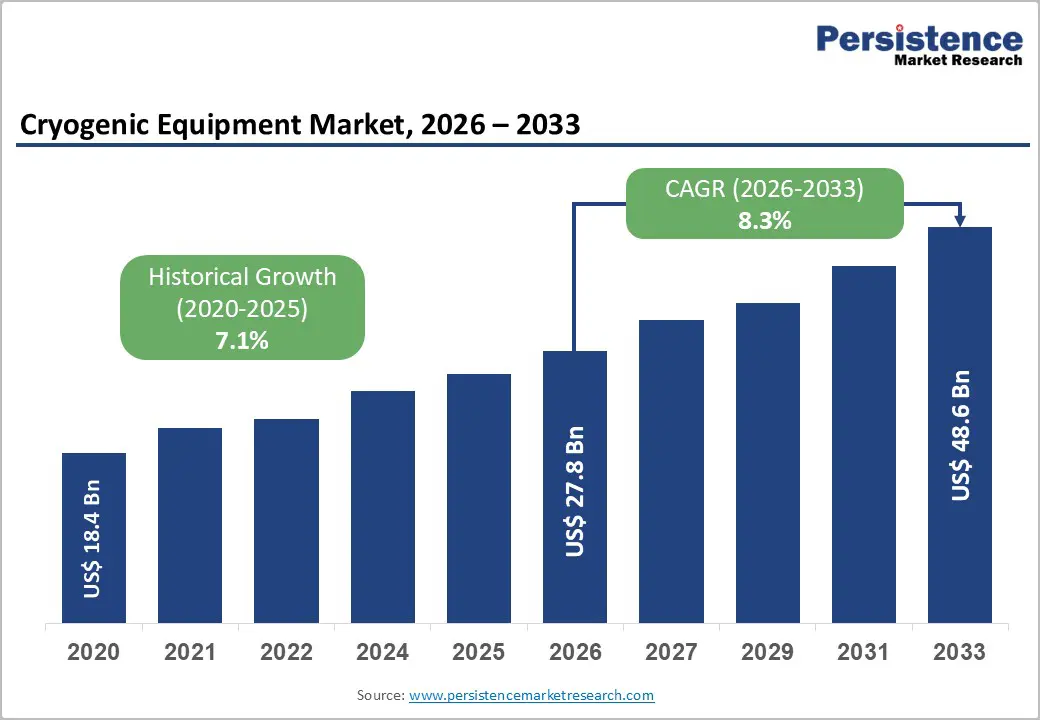
The global cryogenic equipment market is valued at US$ 27.8 billion in 2026 and is projected to reach US$ 48.6 billion by 2033, growing at a robust CAGR of 8.3% between 2026 and 2033. This sustained growth momentum is driven primarily by the accelerating global demand for liquefied natural gas (LNG) as a cleaner transition fuel, the rapid expansion of hydrogen infrastructure, and the increasing utilization of industrial gases in energy-intensive end-use sectors.
The market's strong historical trajectory underscores the structural demand for cryogenic storage, transportation, and processing systems. Key end-use industries, including metallurgy, energy & power, and chemicals, continue to deepen their reliance on advanced cryogenic solutions, reinforcing long-term revenue visibility.
Key Industry Highlights:
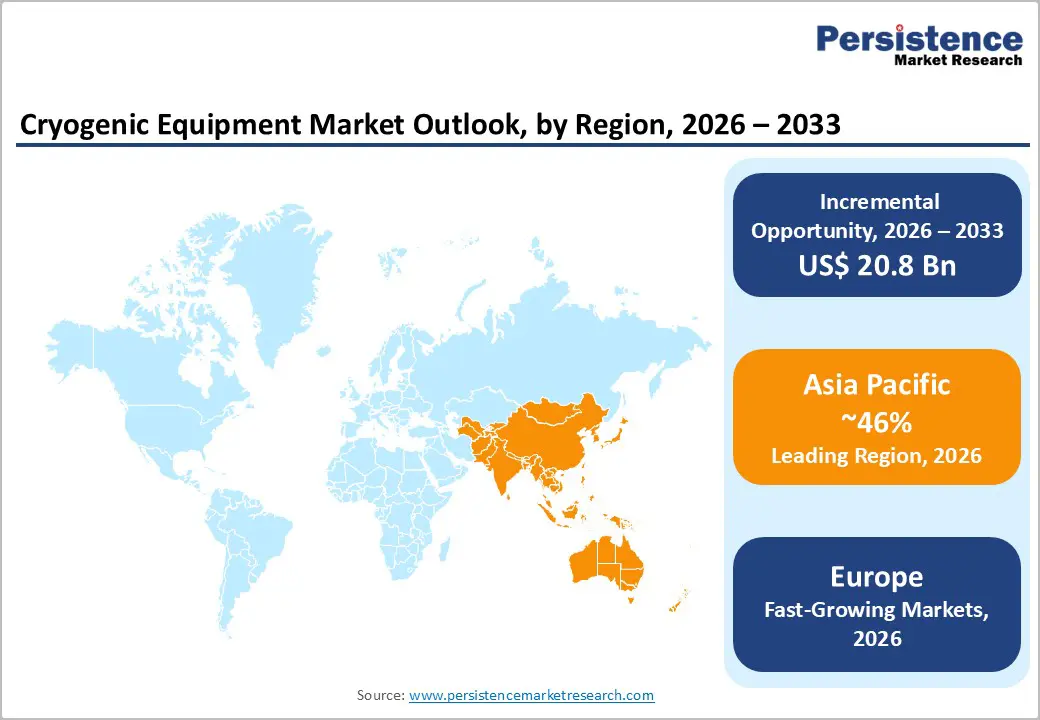
- Leading Region: Asia Pacific dominates the global cryogenic equipment market with approximately 46% revenue share in 2026, anchored by China's massive LNG terminal network, green hydrogen production scale-up, and rapid industrialization driving demand for industrial gas handling equipment.
- Fastest Growing Region: Europe is the fastest-growing regional market, propelled by record LNG import volumes, the EU Green Deal's EUR 1.9 Bn hydrogen investment, and accelerating liquid air energy storage deployments for grid decarbonization.
- Leading Equipment: The tank segment leads the equipment category with approximately 33% market share, driven by massive LNG storage infrastructure build-out in North America and Asia Pacific, and Chart Industries' record-scale Alabama manufacturing facility.
- Fastest Growing Segment: The liquid hydrogen cryogen segment is forecast to register the highest CAGR through 2033 at approximately 9.9%, driven by global green hydrogen shipping corridors, electrolyzer scale-up, and quantum computing cryogenic cooling applications.
- Key Opportunity: LAES represents a transformative opportunity for cryogenic tank and compressor manufacturers, with commercial deployments beginning in 2024 and the EU's climate-neutrality mandate creating sustained infrastructure investment momentum through 2033.
DRO Analysis
Drivers - Surge in Global LNG Demand and Infrastructure Build-Out
The escalating global appetite for liquefied natural gas (LNG) stands as the primary engine propelling the cryogenic equipment market. According to the International Energy Agency (IEA), global gas demand reached a record 4,200 billion cubic metres (bcm) in 2024, growing at over 2.7% year-on-year, above the decade-long average growth rate. More critically, the IEA projects that approximately 300 bcm per year of new LNG liquefaction capacity will be added worldwide by 2030, predominantly supported by expansions in the United States and Qatar.
Every new liquefaction train, regasification terminal, and LNG storage hub requires a substantial complement of cryogenic tanks, valves, vaporizers, and pumps. This infrastructure wave, already reflected in record Final Investment Decisions (FIDs) exceeding 90 bcm/year of capacity in 2025 alone, guarantees sustained demand for the cryogenic equipment ecosystem through the forecast period.
Expanding Hydrogen Economy and Green Energy Transition
The global pivot toward low-carbon energy solutions is catalyzing unprecedented investment in liquid hydrogen (LH2) infrastructure, creating a rapidly expanding demand for cryogenic equipment manufacturers. According to the IEA Global Hydrogen Review 2024, global hydrogen demand could reach close to 100 million tonnes (Mt) in 2024, with China accounting for nearly one-third of global demand. The European Union has committed over EUR 1.9 billion (USD 2 billion) through two auctions of the European Hydrogen Bank in 2024 to stimulate low-emissions hydrogen production.
Hydrogen must be liquefied to approximately -253°C for efficient storage and transport, an application exclusively served by advanced cryogenic systems.
As announced pipeline projects approach 40,000 km by 2035 and electrolyzer manufacturing capacity scales globally, the demand for hydrogen-grade cryogenic tanks, pumps, and vacuum-jacketed piping is set to register the fastest growth within the broader cryogenic equipment market.
Restraints - High Capital Expenditure and Complex Installation Requirements
Cryogenic equipment is inherently capital-intensive, requiring specialized materials such as stainless steel, carbon steel, and high-performance nickel alloys that can withstand operating temperatures below -150°C. The significant rise in global stainless steel prices, driven by China's dominant role as the world's largest steel producer and ongoing fluctuations in raw material costs, has meaningfully elevated the total cost of manufacturing cryogenic systems. Additionally, installation and commissioning of large-scale cryogenic infrastructure, such as LNG storage tanks or air separation units, requires specialized engineering expertise, stringent safety compliance, and extended project timelines.
For price-sensitive end-users and emerging market buyers, these factors represent a significant barrier to adoption and can introduce procurement delays, thereby tempering the pace of market expansion, particularly in developing economies.
Geopolitical Risks and LNG Supply Chain Disruptions
Geopolitical volatility remains a material restraint on the cryogenic equipment market because it disrupts LNG trade flows, project economics, and capital-allocation decisions. In addition to the Russia-Ukraine shock, where Russian gas transit via Ukraine halted in January 2025, the U.S.-Iran war in 2026 has amplified supply-chain risk in the Middle East. Reuters (March 2026) highlighted that the Strait of Hormuz carries roughly one-fifth of global oil and LNG flows, and any sustained disruption tightens LNG availability and elevates freight, insurance, and financing costs.
As a result, LNG liquefaction, regasification, and storage projects face higher contingency budgets and longer lead times, prompting developers to delay final investment decisions and defer orders for cryogenic tanks, valves, pumps, and vaporizers.
Opportunities - Liquid Hydrogen Infrastructure for Green Mobility and Energy Storage
The fastest-growing opportunity within the cryogenic equipment market lies in the liquid hydrogen (LH2) value chain, driven by the global energy transition. The IEA's Global Hydrogen Review 2025 confirms that committed investments for low-emissions hydrogen projects have grown to more than 200 projects worldwide. Investment spending on electrolysis projects is set to rise by as much as 150% in 2024 based on recent Final Investment Decisions (FIDs).
Japan's New Energy and Industrial Technology Development Organization (NEDO) has invested over US$ 3.4 Bn in hydrogen demonstration projects, many involving cryogenic liquefaction and transport systems. In May 2025, Linde plc signed a contract to design and build one of the world's largest cryogenic cooling systems to support a utility-scale quantum computer, illustrating the broadening application spectrum.
Liquid Air Energy Storage (LAES) and Grid-Scale Clean Energy Applications
Beyond conventional LNG and industrial gas applications, Liquid Air Energy Storage (LAES) is emerging as a compelling long-duration energy storage solution, opening a new demand vertical for cryogenic tanks, compressors, and heat exchangers. In November 2024, INOX India Limited delivered five specialized cryogenic tanks to Highview Power for the LAES project in Manchester, UK, one of the first commercial-scale deployments of this technology. As electricity grids globally integrate higher shares of intermittent renewables, the need for multi-hour and multi-day energy storage solutions is accelerating.
The European Union's Green Deal, targeting climate neutrality by 2050, is driving significant infrastructure investments aligned with LAES scalability requirements. Equipment manufacturers with expertise in large-format cryogenic vessels and vacuum-insulated systems are particularly well-positioned to capitalize on this nascent but rapidly scaling market opportunity.
Category-wise Analysis
Equipment Insights
Among all equipment types, the tank segment holds the dominant position in the global cryogenic equipment market, accounting for approximately 33% of total market revenue. Cryogenic tanks, including vertical, horizontal, and microbulk varieties, are indispensable for the large-scale, long-duration storage of liquefied gases such as LNG, liquid nitrogen, and liquid oxygen. The dominance of this segment is directly tied to the accelerating global build-out of LNG import and export terminals.
According to the U.S. EIA, underground working natural gas storage capacity grew by 124 billion cubic feet (Bcf) during 2023, reaching peak levels since 2017. In July 2023, Chart Industries commenced production at its Alabama facility, designed to manufacture the world's largest shop-built cryogenic tanks, which are 70% larger than previous models. The valves, vaporizers, and pumps sub-segments represent complementary demand driven by LNG terminal operations and hydrogen distribution infrastructure.
Cryogen Insights
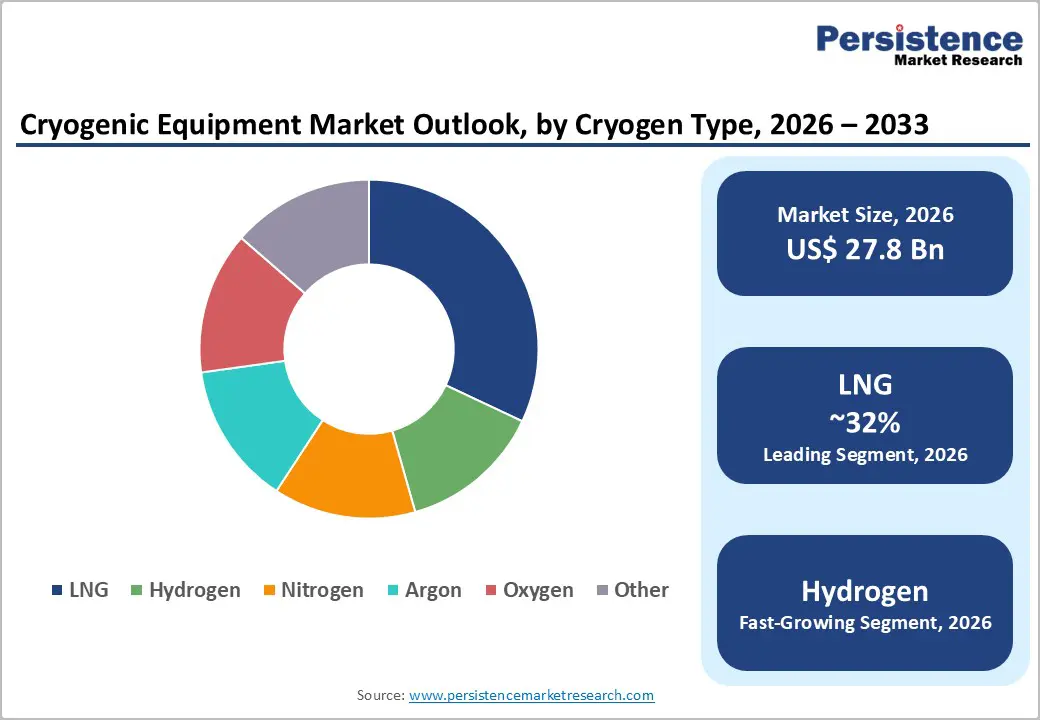
The liquefied natural gas (LNG) segment leads the cryogen category, commanding 32% of total market revenue. LNG's dominance is underpinned by its pivotal role as a transition fuel bridging the gap between conventional fossil energy and renewable sources. According to Shell's LNG Outlook 2024, global LNG trade is set to expand significantly over the next several years, driven by surging demand across Asia, particularly China and India, and heightened energy security imperatives in Europe.
The IEA confirms that global LNG supply grew by more than 5% year-on-year in the first nine months of 2025, with North America accounting for the vast majority of incremental output. The hydrogen cryogen segment is anticipated to register the highest growth rate during the forecast period, driven by the build-out of large-scale green hydrogen liquefaction and export infrastructure across Europe, Australia, and Asia.
End-use Industry Insights
The metallurgy segment holds the leading position in the end-use industry category, accounting for approximately 28% of total market revenue. This dominance is rooted in the extensive utilization of industrial gases, primarily oxygen, nitrogen, and argon, across critical metallurgical processes, including metal forming, fabrication, welding, and combustion. According to the World Steel Association (WSA), approximately 73% of global steel production is produced using the Basic Oxygen Process, which depends directly on the supply of cryogenic-grade oxygen.
The growing demand for high-strength alloys in electric vehicles (EVs), lightweight composites for aerospace, and corrosion-resistant materials for marine applications is further amplifying cryogenic gas consumption in metallurgy. The energy & power segment represents the fastest-growing end-use vertical, propelled by the global transition to LNG-based power generation and grid-scale clean energy storage systems.
Regional Analysis
North America Cryogenic Equipment Market Trends & Analysis
North America is the second-largest regional market for cryogenic equipment, representing approximately 24% of the global market share in 2026. According to the IEA, more than 80 bcm per year of LNG liquefaction capacity reached Final Investment Decision (FID) in the U.S. in 2025 alone, a new record for the sector. The CHIPS and Science Act is spurring demand for cryogenic systems in semiconductor manufacturing.
- U.S. Cryogenic Equipment Market Size
The United States cryogenic equipment market is estimated at approximately US$ 5.8 Bn in 2026, supported by robust LNG export infrastructure investment and the growing adoption of cryogenic cooling in quantum computing and semiconductor fabrication.
Europe Cryogenic Equipment Market Trends, Drivers, & Insights
Europe represents approximately 18% of the global cryogenic equipment market in 2026 and is the fastest-growing developed region within the forecast period, propelled by the European Union's Green Deal and rapid LNG import infrastructure expansion. Europe's LNG imports rose to an all-time high of 127 bcm in the first three quarters of 2025, according to the IEA, driven by the curtailment of Russian piped gas. The European Hydrogen Backbone initiative, comprising 33 gas infrastructure operators, is spearheading the development of a pan-European hydrogen pipeline network, including the commencement of construction of the Dutch hydrogen backbone (1,200 km planned) in October 2024.
- Germany Cryogenic Equipment Market Size
Germany cryogenic equipment market is estimated at approximately US$ 1.6 Bn in 2026, underpinned by large-scale LNG terminal commissioning, industrial gas demand, and significant investments in green hydrogen infrastructure.
- U.K. Cryogenic Equipment Market Size
The United Kingdom cryogenic equipment market is estimated at approximately US$ 1.0 Bn in 2026, driven by LNG import terminal expansions, liquid air energy storage deployments, and growing pharmaceutical and healthcare sector needs.
- France Cryogenic Equipment Market Size
France cryogenic equipment market is estimated at approximately US$ 0.8 Bn in 2026, supported by industrial gas demand from the chemical and aerospace sectors as well as the country's ongoing energy diversification strategy.
Asia Pacific Cryogenic Equipment Market Drivers & Analysis
Asia Pacific is the dominant regional market, accounting for approximately 46% of global cryogenic equipment revenue in 2026. The region's supremacy is anchored in massive LNG import infrastructure, rapid industrialization, and leading-edge deployment of green hydrogen production capacity. According to the IEA, emerging market and developing economies in Asia accounted for approximately 40% of incremental global gas demand in 2024, with China's electricity demand forecast to increase by 6.5% in 2024.
- China Cryogenic Equipment Market Size
China cryogenic equipment market is estimated at approximately US$ 7.4 Bn in 2026, driven by its dominant position as the world's largest LNG importer and the country's aggressive expansion into green hydrogen production and storage.
- India Cryogenic Equipment Market Size
India cryogenic equipment market is estimated at approximately US$ 1.8 Bn in 2026, underpinned by rising LNG import capacity, expanding city gas distribution networks, and surging demand for industrial gases across the metals and chemical sectors.
- Japan Cryogenic Equipment Market Size
The Japan cryogenic equipment market is estimated at approximately US$ 1.5 Bn in 2026, driven by its role as one of the world's largest LNG importers and active participation in international liquid hydrogen shipping demonstration projects.
Competitive Landscape
The global cryogenic equipment market exhibits a moderately consolidated structure, with the top five players, Chart Industries, Linde PLC, Flowserve Corporation, Air Products and Chemicals, and Air Liquide, collectively commanding approximately 35% of global market share. Market leaders differentiate through integrated end-to-end capabilities spanning equipment design, industrial gas production, and long-term service contracts. Key competitive strategies include geographic expansion into high-growth Asia Pacific markets, targeted acquisitions to broaden technology portfolios, and deep R&D investments in hydrogen-compatible cryogenic systems.
Key Developments:
- April 2026: Emerson Electric Co. announced the launch of its new Fisher™ IC2 cryogenic top-entry control valve, designed to reduce leakage and energy loss in extreme low-temperature applications such as LNG production, hydrogen liquefaction, and air separation units. It also includes an enhanced ENVIRO-SEAL™ packing system and bellows that limit emissions to 100 ppm, meeting stringent environmental standards, while improving sustainability, durability, and ease of maintenance.
- March 2026: Linde plc announced plans to build, own, and operate a new air separation unit (ASU) in Oshkosh, Wisconsin, strengthening its industrial gas supply network in the U.S. Midwest. The facility will produce liquid oxygen, nitrogen, and argon using cryogenic separation technology and is expected to be operational by the second half of 2028.
- April 2026: Nikkiso Co., Ltd. announced that its Clean Energy & Industrial Gases Group supplied a CO2 purification and liquefaction system for the successful commissioning of Deep Sky Alpha, Canada’s first direct air capture (DAC) facility in Alberta. The system serves as the final processing stage, enabling safe handling, liquefaction, and permanent storage of captured CO2.
Top Companies in Cryogenic Equipment Market
- Linde PLC (Dublin, Ireland) is the undisputed global leader in the cryogenic equipment and industrial gases market, leveraging an integrated business model that combines equipment manufacturing with gas production and distribution. Linde's cryogenic portfolio spans storage tanks, vaporizers, valves, and advanced LNG and hydrogen distribution systems, giving it unrivalled breadth across the entire cryogenic value chain.
- Chart Industries, Inc. (Ball Ground, U.S.) is a leading pure-play cryogenic equipment manufacturer, with an estimated revenue of approximately US$ 4.2 Bn from cryogenic segments in the 2024-2025 period. The company holds a distinctive position as the world's largest manufacturer of shop-built cryogenic tanks and has pioneered LNG bunkering and renewable energy cryogenic storage applications.
- Air Liquide SA (Paris, France) is a global industrial gas and cryogenic technology powerhouse, leveraging its Turbo-Brayton reliquefier technology that has achieved a milestone of nearly 70 units ordered in 2024 alone. The company's cryogenic portfolio spans storage tanks, vaporizers, and distribution systems, tightly integrated with gas supply solutions for LNG, liquid nitrogen, and liquid oxygen. Air Liquide's US$ 850 million investment in a Texas hydrogen project with ExxonMobil in 2024 underscores its leadership in clean energy cryogenic infrastructure.
Companies Covered in Cryogenic Equipment Market
- Linde PLC
- Chart Industries Inc.
- Nikkiso Co., Ltd.
- Air Liquide SA
- Flowserve Corporation
- Emerson Electric Co.
- SHI Cryogenics Group
- Herose GmbH
- Wessington Cryogenics
- Air Products and Chemicals Inc.
- INOX India Ltd.
- Parker-Hannifin Corporation
- Braunschweiger Flammenfilter GmbH
Frequently Asked Questions
The global Cryogenic Equipment market is valued at US$ 27.8 Bn in 2026 and is projected to reach US$ 48.6 Bn by 2033, expanding at a CAGR of 8.3% during the forecast period. This growth is driven by surging LNG infrastructure investment, green hydrogen adoption, and rising industrial gas consumption globally.
The key growth drivers include the accelerating global build-out of LNG liquefaction and regasification infrastructure, with the IEA projecting 300 bcm/year of new LNG capacity by 2030, and the rapid expansion of the green hydrogen economy, which requires cryogenic tanks, pumps, and piping for liquid hydrogen storage and distribution. Growing industrial gas demand in metallurgy, chemicals, and electronics further sustains long-term market momentum.
The tank segment is the leading equipment category, holding approximately 33% of total market revenue. Cryogenic tanks are essential for the large-scale, safe, and long-duration storage of LNG, liquid nitrogen, and liquid hydrogen. The commissioning of new LNG export and import terminals, combined with the need for hydrogen liquefaction storage, makes cryogenic tanks the single largest product category by revenue in this market.
Asia Pacific leads the global Cryogenic Equipment market with approximately 46% revenue share in 2026. The region's dominance is anchored by China's extensive LNG terminal network (29 operating terminals), the world's largest green hydrogen production base (125,000 tonnes/year), and rapid industrialization driving high consumption of industrial gases in metallurgy, chemicals, and electronics manufacturing.
The most significant growth opportunity lies in liquid hydrogen (LH2) cryogenic infrastructure and Liquid Air Energy Storage (LAES). As governments worldwide scale up clean hydrogen production and grid-scale energy storage to meet net-zero commitments, demand for hydrogen-grade cryogenic tanks, liquefiers, vacuum-jacketed piping, and pumps is poised to grow at the highest rate, approximately 9.9% CAGR, within the cryogenic equipment ecosystem through 2033.
The leading companies in the global Cryogenic Equipment market include Linde PLC, Chart Industries Inc., Air Liquide SA, Air Products and Chemicals Inc., Flowserve Corporation, SHI Cryogenics Group, Wessington Cryogenics, and Braunschweiger Flammenfilter GmbH, among others.


