




- Off-Road Equipment & Machinery
- Crawler Drilling Machine Market
Crawler Drilling Machine Market Size, Share, and Growth Forecast, 2026 - 2033
Crawler Drilling Machine Market by System (Hydraulic, Pneumatic, Electric), Application (Mining, Construction, Quarrying, Oil & Gas), End-User (Construction Industry, Mining Industry, Oil & Gas Industry), and Regional Analysis for 2026-2033

Crawler Drilling Machine Market Share and Trends Analysis
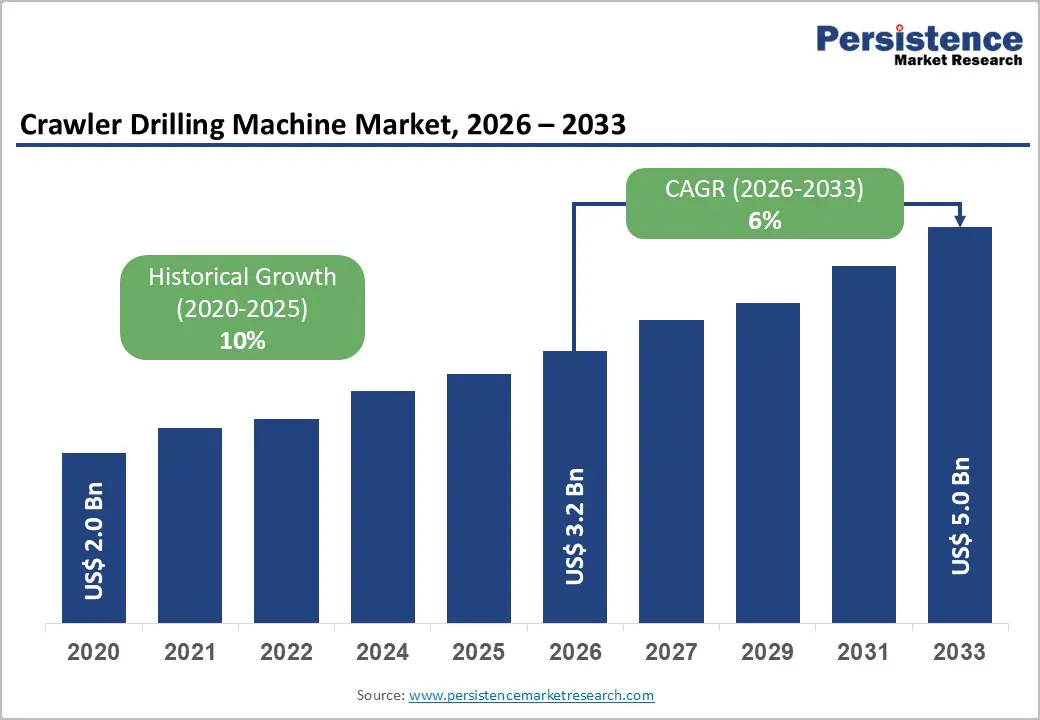
The global crawler drilling machine market size is likely to be valued at US$ 3.2 billion in 2026, and is projected to reach US$ 5.0 billion by 2033, growing at a CAGR of 6.0% during the forecast period 2026−2033.
Expansion in the construction sector is driving equipment demand as governments and private developers are investing in transportation corridors, urban transit systems, and high rise commercial complexes. Rapid urbanization across emerging economies is increasing the need for foundation drilling, rock excavation, and site preparation. Contractors are deploying crawler mounted drilling systems to achieve higher stability, mobility, and operational efficiency across complex project environments.
Infrastructure programs such as highways, metro rail networks, bridges, and underground tunnels are requiring heavy duty drilling platforms capable of operating in uneven and remote terrains. Engineering firms are prioritizing machinery that delivers consistent penetration rates, fuel efficiency, and reduced downtime. Equipment manufacturers are integrating advanced hydraulic controls, automation features, and telematics solutions to improve productivity and asset monitoring.
Key Industry Highlights
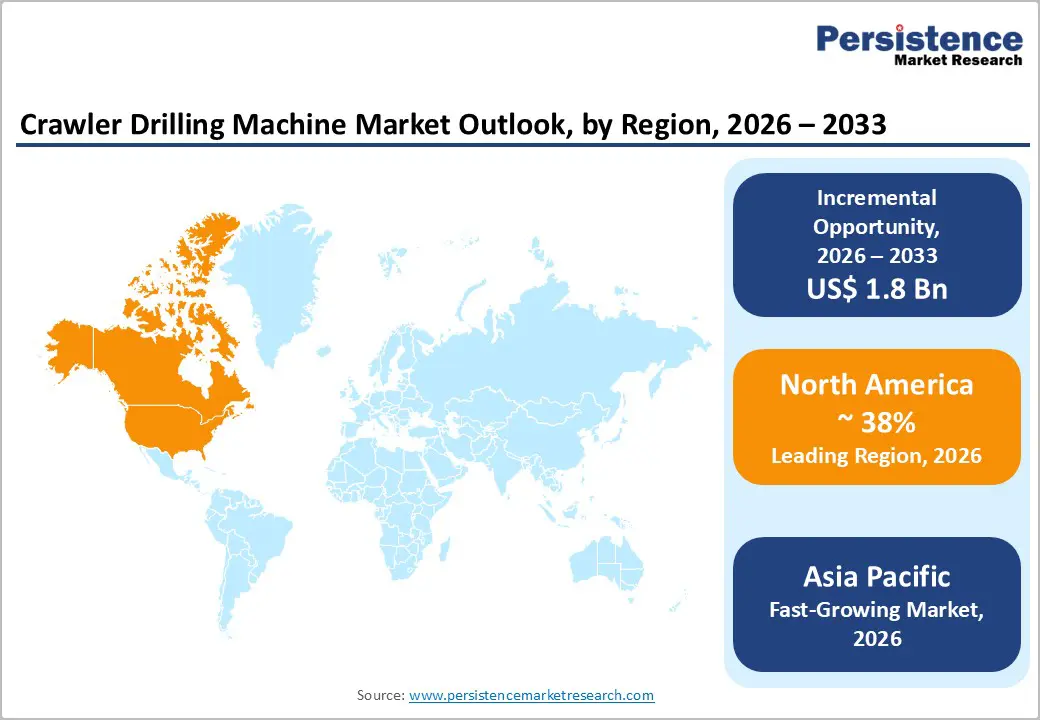
- Dominant & Fastest-growing Market: Asia Pacific is likely to be both the leading and fastest-growing regional market in 2026, accounting for approximately 38% share, supported by rapid industrialization and infrastructural development.
- Leading System: Hydraulic systems are set to dominate with around 68% revenue share in 2026, driven by their superior performance and versatility.
- Fastest-growing System: Electric systems are poised to grow the fastest through 2033, propelled by their environmental benefits and lower operating costs.
- Major Driver: Government infrastructure initiatives worldwide to modernize transportation networks and expand connectivity across borders are generating a huge demand for advanced drilling equipment.
| Key Insights | Details |
|---|---|
| Crawler Drilling Machine Market Size (2026E) | US$ 3.2 Bn |
| Market Value Forecast (2033F) | US$ 5.0 Bn |
| Projected Growth (CAGR 2026 to 2033) | 6% |
| Historical Market Growth (CAGR 2020 to 2025) | 10% |
Market Factors – Growth, Barriers, and Opportunity Analysis
Accelerating Global Infrastructure Development
Government infrastructure initiatives worldwide generate strong demand for crawler drilling machines. Nations actively launch ambitious programs to modernize transportation networks and expand connectivity across borders. These efforts center on key projects such as highways, bridges, rail systems, and urban transit hubs. Construction firms depend on mobile, high-capacity equipment to manage foundation work across varied terrains, from rocky hillsides to soft soils. Crawler drills excel with their superior stability, powerful traction, and ability to navigate challenging sites. Governments prioritize these large-scale developments to boost economic activity and improve logistics. This opens doors for companies to supply reliable solutions. These machines help maintain tight project timelines while upholding strict quality standards, reducing downtime and enhancing overall efficiency.
Strategic planning gains significant value from monitoring these global trends closely. Businesses thrive by targeting regions with robust public spending commitments, where contracts for major works abound. Firms that invest early in versatile, terrain-adaptable machines gain a competitive edge to tackle diverse geological conditions effectively. Forward-thinking leaders anticipate upcoming policy shifts and regulatory changes by engaging with government announcements and industry forums and building strong partnerships with contractors well in advance, securing preferred supplier status. This proactive stance strengthens market presence and drives sustained revenue growth. Companies can further optimize operations through customized training programs for operators, ensuring seamless integration of crawler drills into project workflows.
Renewable Energy Sector Expansion
The global shift to renewable energy sources creates strong demand for specialized drilling equipment. Developers install offshore wind turbines and require precise foundation work in marine environments. Geothermal projects demand deep-well capabilities to tap underground heat reservoirs. Solar farms need extensive groundwork for stable, ground-mounted arrays. Crawler drilling machines support these applications with their mobility and power. They operate effectively across coastal zones, volcanic areas, and open fields. Energy firms turn to these versatile rigs to accelerate clean power deployments and meet rising sustainability goals.
They should assess regional renewable targets to identify high-potential sites for equipment supply. Investments in adaptable drills with enhanced depth and corrosion resistance open new revenue streams. Companies benefit from tracking policy incentives and partnering with project developers early. Forward planners customize fleets to match specific energy needs, such as enhanced stability for offshore bases or precision for geothermal wells. Training teams on renewable-site operations boosts efficiency and client trust. This strategy positions firms to capture growth in the expanding clean energy sector while building resilient operations.
Environmental Regulations and Compliance Costs
Increasingly stringent environmental regulations raise compliance costs for equipment manufacturers and operators. Authorities enforce emission limits that demand advanced exhaust systems on drilling machines. Urban zones impose noise controls, requiring soundproofing features for smoother operations. Groundwater protection rules call for detailed impact studies before projects start. Operators face penalties for violations, which strain budgets and delay timelines. Crawler drill users must adapt quickly to these standards to avoid disruptions and maintain site access.
Companies benefit from auditing current fleets against latest rules and upgrading to compliant models early. Training staff on regulatory requirements builds internal expertise and reduces error risks. Firms gain an edge by selecting suppliers who offer turnkey solutions, such as pre-certified kits for retrofits. Partnering with legal experts helps streamline permit processes across regions. Leaders who integrate sustainability into core strategies turn compliance into a differentiator, attracting eco-conscious clients and securing long-term contracts in regulated markets.
High Initial Cost of Advanced Drilling Machinery
Crawler drilling machines deliver strong efficiency and performance benefits, yet their high purchase prices often deter small and medium-sized enterprises (SMEs). These firms face tight budgets that limit investments in advanced equipment. Operators also encounter elevated maintenance and fuel expenses, which add pressure over time. Buyers hesitate to commit without clear paths to affordability. This barrier restricts market access for innovative rigs that could boost productivity in diverse projects.
Manufacturers succeed by developing cost-effective designs and flexible financing plans. They offer modular components for easier upgrades and lower ownership costs. Leasing programs allow SMEs to access top models without large upfront payments. Suppliers gain loyalty through tailored service packages that bundle repairs and parts. Business advisors recommend pilot programs to demonstrate returns on investment quickly. Firms that prioritize affordability expand their customer base and drive adoption across sectors. This focus turns a key restraint into a growth opportunity for the entire industry.
Increasing Focus on Sustainable and Environmentally Friendly Drilling Solutions
Growing awareness of environmental impact and stricter regulations fuel demand for low-emission drilling equipment. Operators seek machines that cut energy use and meet compliance standards across regions. Construction and mining firms prioritize greener options to align with sustainability goals and avoid penalties. Crawler drills stand out as versatile platforms for these upgrades. Manufacturers gain a prime chance to innovate with electric and hybrid models that reduce reliance on fossil fuels. Battery advancements enable longer run times and faster charging, while hybrid systems blend power with efficiency for demanding sites.
Developers enhance appeal through smart features such as regenerative braking and optimized hydraulics. These technologies lower operational costs and boost uptime in remote areas. Electric variants produce zero tailpipe emissions, ideal for urban projects or sensitive ecosystems. Hybrid designs offer flexibility by switching seamlessly between power sources to match job needs. Companies position themselves as leaders by certifying machines under global standards, such as European Union Stage V norms. This shift not only addresses regulatory pressures but also opens doors to premium markets. Leaders who integrate sustainability into product lines capture long-term value and strengthen competitive positioning in a rapidly evolving sector.
Integration of Advanced Automation Technologies and Remote Control Systems
Technological advancements revolutionize the crawler drilling machine market by boosting operational efficiency, safety, and precision. Automated systems handle repetitive tasks with little human input. They cut labor needs and raise output levels. Remote control features let operators manage rigs from secure locations. Operators avoid dangers in unstable terrains or toxic sites. Manufacturers seize this moment to embed sensors and artificial intelligence (AI) into designs. These features enable real-time adjustments for optimal performance. The upgrades lower downtime and extend machine life. They make machines essential for modern projects.
Firms develop modular platforms that integrate automation easily. These platforms appeal to diverse clients from mining to construction. Safety enhancements attract insurers with lower premium rates. Precision drilling reduces waste and rework costs. Business leaders prioritize partnerships with tech providers. These alliances accelerate innovation cycles. They offer training programs that upskill operators on digital interfaces. The programs ensure smooth adoption. Pilot projects demonstrate quick returns. They build client trust and repeat business. Companies that lead in these areas secure premium pricing. They enter high-growth segments such as urban tunneling.
Category-wise Analysis
System Insights
Hydraulic systems are poised to dominate, commanding approximately 68% of the crawler drilling market revenue share in 2026, driven their its superior performance and versatility. These machines excel in heavy-duty tasks such as rock breaking and deep foundation work in construction and mining operations. End-users favor them for reliable performance across challenging terrains and harsh conditions, including steep slopes and wet environments. Advancements in hydraulic technology enhance energy efficiency and reduce environmental impact. Engineers develop variable displacement pumps and smart valves that optimize fluid flow and minimize waste. These innovations lower fuel consumption and emissions, aligning with global sustainability standards. As a result, demand surges among operators seeking versatile, eco-friendly solutions for demanding projects.
Electric crawler drilling machines are likely to be the fastest-growing during the 2026-2033 forecast period, propelled by their environmental benefits and lower operating costs. As industries embrace sustainable practices, electric drilling machines gain traction in the crawler drill market. Operators choose these models for key benefits, such as zero tailpipe emissions, quieter performance, and reduced energy use compared to diesel counterparts. These machines suit urban sites and noise-sensitive areas where traditional rigs face restrictions. Battery technology advances and efficient electric motors boost runtime and power output. Engineers integrate fast-charging systems and modular packs for minimal downtime. These improvements make electric crawler drills viable for extended shifts in mining and construction, incentivizing firms to adopt them to meet regulatory demands and attract green projects, positioning this segment for rapid growth.
Application Insights
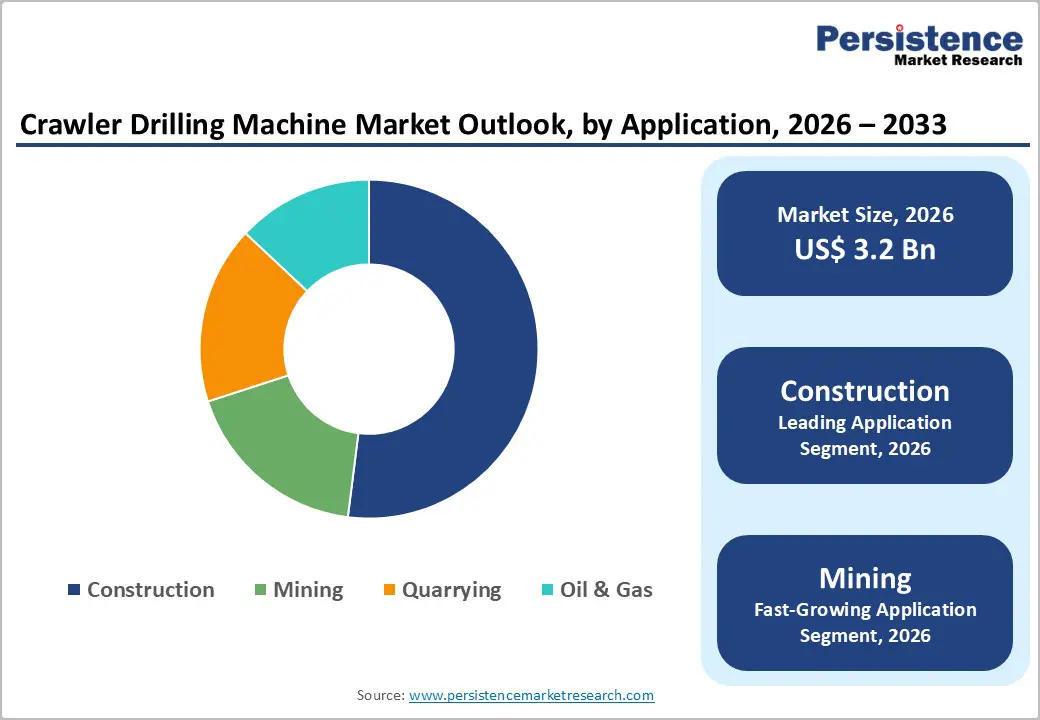
Construction represents the dominant application segment, holding around 52% of the crawler drilling machine market share in 2026. Rapid urbanization drives infrastructure projects worldwide and spurs demand for advanced drilling solutions. Developers deploy these rigs in diverse tasks such as road building, tunnel excavation, and deep foundation work for high-rises and bridges. The tracked design ensures stability on uneven ground. It enables precise penetration in rock or soil. Crawler drills deliver versatility and reliability under tough conditions. Operators value quick setup times and high torque for efficient progress. Safety features such as enclosed cabs and anti-vibration systems protect crews during long shifts. These attributes make the machines indispensable for contractors. They ensure timely completion while minimizing risks and rework.
Mining is expected to be the fastest-growing segment over the 2026-2033 forecast period. Operators require efficient, durable rigs to meet constant demand for minerals and resources worldwide. These machines play a crucial role in extraction processes, from blast hole drilling to ore recovery in open-pit and underground sites. Crawler drills penetrate hard rock formations with precision, supporting high-volume production cycles. Tough conditions define mining environments, such as steep slopes and abrasive surfaces. Crawler designs excel with robust tracks and high-torque hydraulics that maintain stability and uptime. Operators rely on their adaptability to handle deep holes and variable geology. Rising global resource needs amplify this segment's influence, positioning it to propel market expansion. Contractors favor these rigs for reduced downtime and enhanced safety during intensive operations.
Regional Insights
Asia Pacific Crawler Drilling Machine Market Trends
Asia Pacific market is likely to be both the leading and fastest-growing regional market for crawler drilling machines in 2026, accounting for an estimated 38% market share. Robust infrastructure programs fuel demand for crawler drilling machines across key nations such as China, Japan, and India. Contractors deploy these rigs in major projects such as highways, ports, and power plants. Local manufacturing hubs produce equipment at competitive costs and attract global buyers. Chinese firms expand overseas through international connectivity initiatives. They boost exports of advanced models. Japan focuses on resilient structures to withstand natural disasters. India accelerates urban development through ambitious pipelines. ASEAN countries such as Indonesia and Vietnam address urbanization gaps with new transit and industrial zones.
Business leaders capitalize on this dynamic landscape through targeted strategies. They establish local assembly plants. These plants cut logistics expenses and speed delivery. Partnerships with regional suppliers ensure compliance with diverse rules. Developed areas enforce strict emission controls. Emerging markets apply flexible standards. Investors prioritize technology transfers. These transfers blend local expertise with cutting-edge designs. Firms gain an edge by offering customized rigs for seismic zones or tropical climates. Monitoring policy announcements helps secure early contracts ahead of competitors. This approach unlocks sustained growth. It strengthens supply chains and positions companies as preferred partners in Asia Pacific's infrastructure boom.
Europe Crawler Drilling Machine Market Trends
Europe serves as a key region for crawler drilling machines. Steady demand for these equipment stems from infrastructure upgrades being implemented in the region. Germany leads efforts to modernize transport and energy networks, while the U.K. advances high-speed rail connections. France and Spain pursue renewable energy installations and city renewals. Contractors rely on versatile rigs for foundation work in tunnels, bridges, and offshore wind bases. Harmonized rules across the European Union (EU) streamline equipment approvals. These rules favor standardized designs. Sustainability initiatives push operators toward greener machines. These machines feature lower emissions and noise levels.
Strategic advisors recommend compliance-ready solutions to thrive here. Manufacturers succeed by offering retrofit kits for older fleets. These kits extend asset life and meet emission norms. Local service networks build trust through rapid support and parts availability. Firms differentiate with hybrid models suited to urban constraints and sensitive sites. Investors target partnerships with regional leaders. These leaders master EU regulations. Early engagement with public tenders secures long-term contracts. This positioning taps into green construction trends. It strengthens presence amid competitive local players.
North America Crawler Drilling Machine Market Trends
North America is emerging as a strategic market for crawler drilling machines due to sustained infrastructure renewal and capital allocation toward asset modernization. The United States is advancing large scale highway rehabilitation and bridge reconstruction programs, which are increasing demand for high performance drilling platforms. Canada is supporting mining expansion and energy development initiatives, which are strengthening equipment utilization across resource rich provinces. Contractors are deploying crawler rigs for deep foundation supports, ground stabilization, and seismic retrofitting across varied geological conditions. The transition toward renewable energy is further stimulating installations for offshore wind foundations and grid reinforcement projects. Environmental regulations are encouraging fleet upgrades, and operators are adopting low emission and zero emission equipment to meet compliance standards.
Manufacturers are collaborating with construction technology providers to integrate automation systems and digital twin simulations that are enhancing planning accuracy and execution control. Companies are prioritizing electric and hybrid models to align with stringent state level emission frameworks. Regional service networks are ensuring rapid maintenance response and higher equipment uptime. Investors are backing hybrid configurations suited for dense urban infrastructure as well as remote field operations. Industry participants are tracking federal funding allocations to position bids for high value public contracts. Training initiatives are preparing operators to manage advanced control systems, while leasing models are lowering capital barriers for mid-sized contractors. Strategic partnerships with technology startups are accelerating innovation in real time monitoring and predictive maintenance, aligning equipment portfolios with regional priorities that emphasize resilient infrastructure and sustainable energy development.
Competitive Landscape
The global crawler drilling machine market structure is moderately concentrated, with Caterpillar, Sandvik, Atlas Copco, Liebherr Group, and Komatsu collectively accounting for approximately 45% to 50% of market share in 2026. These companies are strengthening their competitive positions through global distribution networks, vertically integrated manufacturing, and diversified product portfolios. Market concentration is creating high entry barriers, particularly in segments that require advanced engineering capabilities and strong after sales service infrastructure. Established brands are leveraging scale advantages to optimize production efficiency and maintain pricing discipline across key geographies.
Competition among major manufacturers is intensifying as firms are investing heavily in research and development to introduce advanced drilling technologies for construction, mining, and energy applications. Companies are focusing on automation integration, fuel efficiency optimization, and emission reduction engineering to meet evolving regulatory and customer expectations. Product differentiation is occurring through enhanced durability, smart control systems, and customized service agreements that improve lifecycle value. This competitive dynamic is driving continuous improvements in machine productivity and environmental performance.
Key Industry Developments
- In September 2025, Xtra-Gold Resources acquired its fourth company-owned diamond drill rig to significantly speed up its exploration drilling at the Kibi Gold Project in Ghana, aiming to advance resource expansion more efficiently. By operating its own rigs rather than contracting third parties, the company lowers drill costs and enhances its ability to expand gold discoveries on its land holdings.
- In September 2025, De Beers’ Upstream Technology arm developed and deployed a next-generation subsea crawler on Debmarine Namibia’s Benguela Gem vessel, enhancing marine diamond recovery off Namibia’s coast by combining advanced automation and precision engineering for higher efficiency and reliability.
- In April 2025, Barrick Gold chose Sandvik Mining and Rock Solutions to supply seven new surface drill rigs for its Porgera gold mine in Papua New Guinea, replacing an older non-Sandvik fleet with advanced DR410i and DI650i rigs, with deliveries scheduled from June to November 2025.
Companies Covered in Crawler Drilling Machine Market
- Caterpillar Inc.
- Sandvik AB
- Atlas Copco AB
- Liebherr Group
- Komatsu Ltd.
- XCMG Group
- SANY Group
- Bauer AG
- Soilmec S.p.A.
- Casagrande S.p.A.
- Junttan Oy
- Watson Inc.
- Yutani Corporation
Frequently Asked Questions
The global crawler drilling machine market is projected to reach US$ 3.2 billion in 2026.
Surging expansion in the construction industry and accelerating urbanization worldwide, particularly in developing economies, are primarily driving the market.
The market is poised to witness a CAGR of 6% from 2026 to 2033.
Integration of advanced technologies such as automation and remote control systems is set to unlock high-value market opportunities.
Caterpillar Inc., Sandvik AB, Atlas Copco AB, Liebherr Group and Komatsu Ltd. are some of the key players in the market.


