




- Specialty & Fine Chemicals
- Corrosion Inhibitors Market
Corrosion Inhibitors Market Size, Share, and Growth Forecast 2026 - 2033
Corrosion Inhibitors Market by Compound (Organic Corrosion Inhibitors, Inorganic Corrosion Inhibitors), Application (Water Treatment, Process and Product Additives, Oil & Gas Production, Others), Product Type (Water-based Corrosion Inhibitors, Oil-based Corrosion Inhibitors, Volatile Corrosion Inhibitors), End-Use (Oil & Gas, Power Generation, Chemicals, Metals Processing, Pulp & Paper, Others), and Regional Analysis for 2026 - 2033

Corrosion Inhibitors Market Size and Trends Analysis
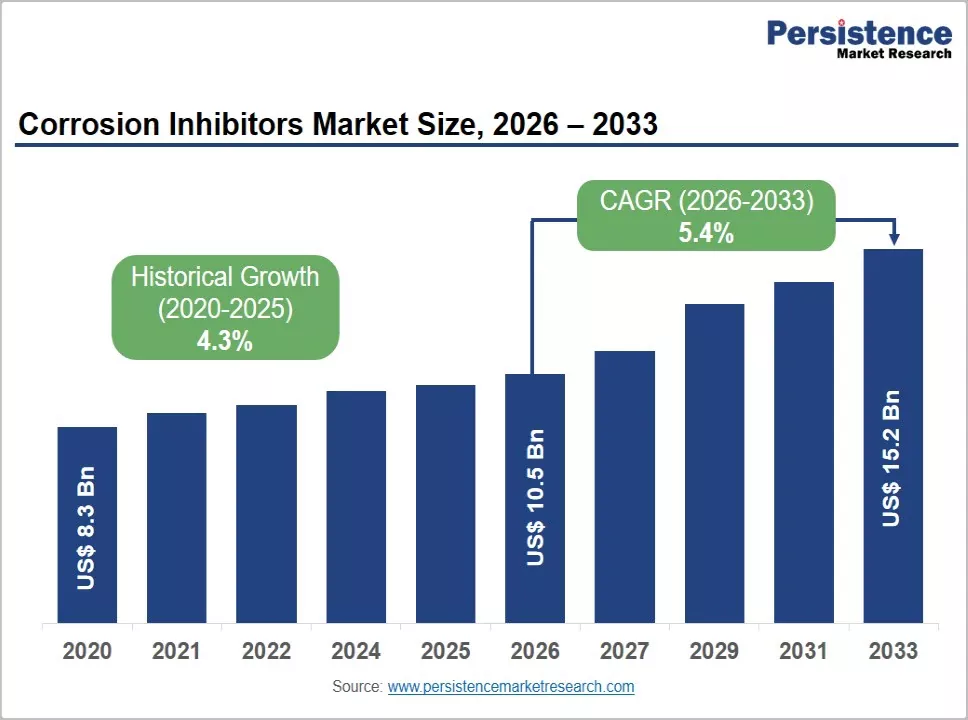
The global corrosion inhibitors market is expected to be valued at US$ 10.5 billion in 2026 and is projected to reach US$ 15.2 billion by 2033, growing at a CAGR of 5.4% between 2026 and 2033. Demand is rising because corrosion remains one of the costliest threats to industrial assets. AMPP, formerly NACE International, estimates the global cost of corrosion at nearly US$ 2.5 trillion, equivalent to about 3.4% of world GDP.
Rising investment in water networks, oil and gas production, and power generation facilities is increasing inhibitor consumption. Stricter drinking water regulations and the shift toward greener organic chemistries further support market growth.
Key Industry Highlights
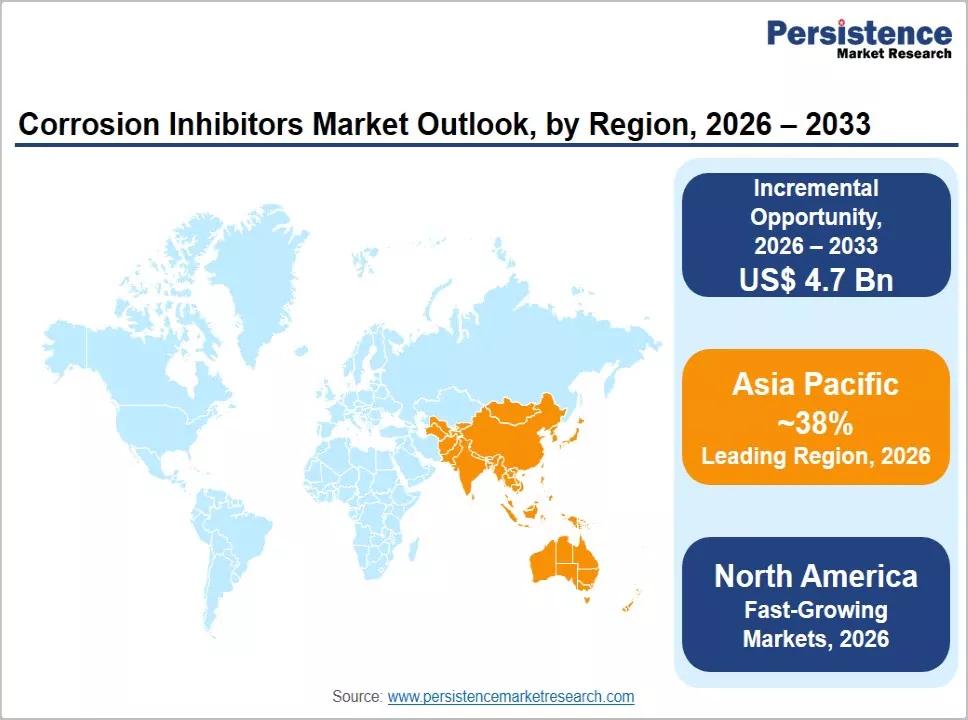
- Leading Region: Asia Pacific is likely to lead the global corrosion inhibitors market with around 38% share in 2026, supported by large refining capacity, rapid water infrastructure development in China and India, and dense manufacturing clusters requiring continuous metal protection.
- Fastest-growing Region: Europe represents the fastest-growing market, growing at an 8% CAGR through 2033, driven by offshore wind, hydrogen, and carbon capture projects, water network modernization, and stringent regulations favoring biodegradable inhibitor chemistries.
- Leading Segment: Organic corrosion inhibitors are the leading compound segment, holding around 64% market share in 2026, supported by the strong performance of film-forming amines, imidazolines, and azoles at low concentrations and their alignment with tightening environmental discharge requirements.
- Fastest-growing Segment: Volatile corrosion inhibitors are the fastest-growing product type segment, expanding at a 6.8% CAGR through 2033, driven by rising adoption among exporters, electronics manufacturers, and defense agencies seeking vapor-phase protection for storage and long-distance transportation.
- Key Market Opportunity: Green, low-toxicity corrosion inhibitors designed for hydrogen pipelines, carbon dioxide transport, and offshore wind structures present a high-value market opportunity, particularly as North Sea and EU chemical approval requirements increase demand for alternatives to legacy formulations.
Market Dynamics
Driver - Rising Investment in Water & Wastewater Infrastructure
Water infrastructure spending is a major driver of corrosion inhibitor demand, as utilities rely on phosphate, silicate, and blended inhibitors to protect aging pipes and limit metal contamination in drinking water. The U.S. Environmental Protection Agency estimates that drinking water systems require US$ 625 billion in investment over 20 years. Its Lead and Copper Rule Improvements, finalized in October 2024, require optimized corrosion control treatment and replacement of most lead service lines within 10 years.
The Bipartisan Infrastructure Law also allocated US$ 15 billion for lead pipe replacement. Similar programs are expanding internationally, with India's Jal Jeevan Mission extending tap water connections to more than 150 million rural households. Each new or rehabilitated network creates recurring demand for inhibitor dosing, supporting stable contract-based revenue for suppliers.
Restraint - Stringent Environmental and Toxicity Regulations
Tightening chemical regulations increase compliance costs and narrow the range of usable inhibitor chemistries. Traditional inorganic inhibitors, including chromates, nitrites, and certain zinc and phosphate blends, face scrutiny because of toxicity and nutrient pollution concerns. The European Chemicals Agency has placed several hexavalent chromium compounds on the REACH authorization list and, in 2024, proposed a wider restriction on these substances. Offshore operators in the North Sea also register chemicals under the OSPAR Harmonised Mandatory Control Scheme, supporting the substitution of products with poor biodegradability.
Phosphate discharge limits in wastewater permits have also tightened across the U.S. and Europe to reduce algal blooms. Reformulation and toxicity testing can require several years and add significant product development costs. Smaller suppliers often face greater difficulty absorbing these expenses, slowing product launches and pressuring margins across the market.
Opportunity - Expanding Use of Volatile Corrosion Inhibitors in a Range of Applications
Volatile corrosion inhibitors, or VCIs, represent a fast-growing product opportunity for suppliers. VCI films, papers, and emitters release protective molecules that form a thin layer on metal surfaces within enclosed spaces. This approach is suited to long-distance export shipments, military stockpiles, and sensitive electronics requiring extended corrosion protection. World Trade Organization data show that merchandise trade value exceeded US$ 24 trillion in 2024, with a substantial share involving machinery, automotive parts, and metal goods transported by sea.
Humid and saline marine conditions make vapor-phase protection a practical alternative to greasy oils. Defense agencies also use VCIs for long-term storage of vehicles and weapons systems, while electric vehicle and battery manufacturers use VCI packaging for copper busbars and connectors. Suppliers offering recyclable, nitrite-free, and biobased VCI films can address growing demand for corrosion protection alongside packaging sustainability requirements.
Category-wise Analysis
Compound Insights
Organic corrosion inhibitors represent the dominant segment, accounting for an estimated 64% of the market share in 2026. The segment leads because organic molecules form a protective adsorbed film on metal surfaces, providing effective corrosion protection at low dosages. Imidazolines, amines, amides, and azoles are widely used in oilfield and cooling water applications, while benzotriazole and tolyltriazole remain widely adopted for protecting copper alloys in heat exchangers. Organic formulations also reduce reliance on heavy-metal chemistries associated with chromate- and zinc-based inorganic inhibitors.
Increasing regulatory preference for readily biodegradable chemistries in Europe and North America further supports demand for advanced organic formulations. Manufacturers can tailor molecular structures to specific fluids, temperatures, and metal substrates, enabling application-specific performance across industrial systems. Ongoing research into plant-extract and amino-acid-based inhibitors is also expanding the range of environmentally compatible solutions for industrial and municipal applications.
Application Insights
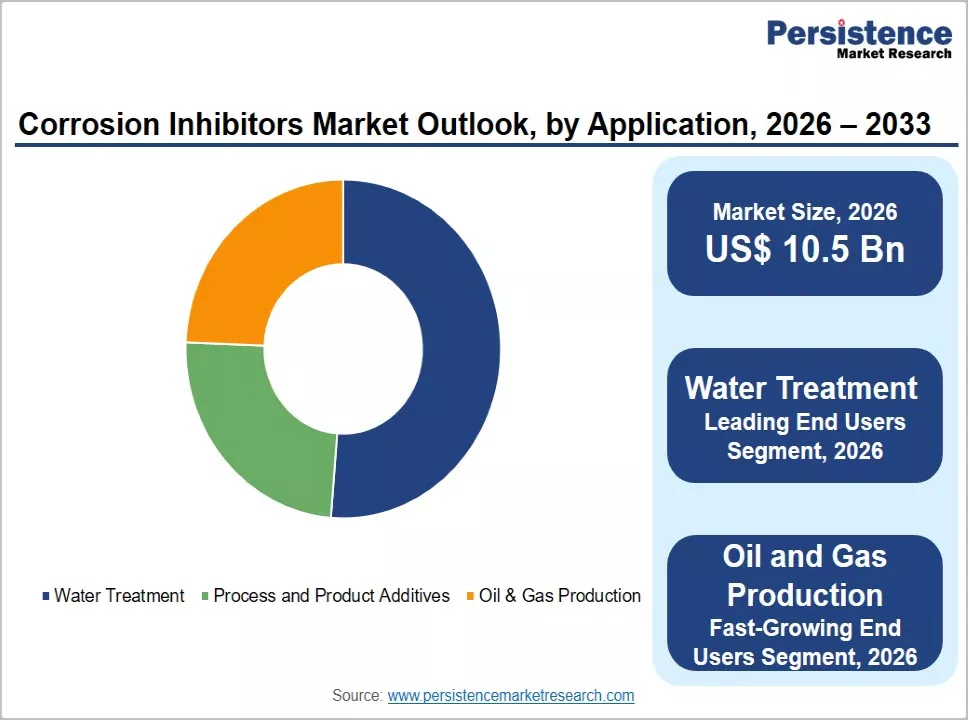
Water treatment is likely to be the leading application segment, holding about 41% share of the corrosion inhibitors market in 2026. Cooling towers, boilers, and drinking water networks require continuous corrosion control to protect metal infrastructure and maintain system efficiency. Power plants, refineries, chemical facilities, and data centers circulate substantial volumes of cooling water through steel and copper equipment, creating recurring demand for corrosion inhibitors. The U.S. Geological Survey reports that thermoelectric power accounts for roughly 40% of total water withdrawals in the United States.
Municipal utilities also use orthophosphate and silicate inhibitors to control lead and copper release from drinking water systems. Expanding data center capacity is creating additional cooling requirements, increasing demand for corrosion protection in closed- and open-loop systems. The recurring nature of water treatment programs and ongoing infrastructure maintenance supports consistent inhibitor consumption across municipal and industrial applications.
Product Type Insights
Water-based corrosion inhibitors are the leading product type segment, holding around 52% market share in 2026. The segment leads because corrosion inhibitors are extensively required in aqueous environments, including cooling water, boiler feedwater, produced water, and potable water systems. Water-based formulations dissolve and disperse efficiently throughout circulating fluids, enabling consistent protection across large industrial systems. Their low volatile organic compound content also helps users address air quality requirements under U.S. EPA and EU Industrial Emissions Directive frameworks.
Water-based products offer additional advantages through easier handling, lower fire risk, and simpler cleanup compared with solvent-based alternatives. Metalworking fluid users are increasingly adopting water-soluble formulations to address worker safety and environmental requirements. Concentrated formulations also enable suppliers to reduce transportation costs and packaging requirements, supporting continued adoption across industrial applications.
Volatile corrosion inhibitors are expected to be the fastest-growing product type, driven by increasing demand for vapor-phase corrosion protection in packaging, electronics, defense equipment, and long-distance transportation. VCI films, papers, and emitters protect metal surfaces within enclosed spaces without requiring direct application of liquid coatings or oils. Growing international trade, extended equipment storage requirements, and demand for recyclable and nitrite-free packaging further support adoption across these applications.
End-Use Insights
Oil & gas remains the leading segment, holding an estimated 33% share of the market in 2026. Production, transportation, and refining assets face severe corrosion risks due to exposure to sour gas, carbon dioxide, chlorides, and high-pressure operating conditions. The U.S. Pipeline and Hazardous Materials Safety Administration regulates more than 3.3 million miles of gas and hazardous liquid pipelines, with corrosion ranking among the leading causes of reported incidents.
Refineries also use corrosion inhibitors in overhead systems to control acid attack and protect critical processing equipment. Operators prioritize corrosion management to reduce the risk of leaks, regulatory penalties, equipment damage, and unplanned downtime. Rising water cut in mature oilfields further increases corrosion-control requirements and inhibitor consumption, supporting continued demand from the oil and gas sector.
Regional Analysis
North America Corrosion Inhibitors Market Trends and Insights
North America is expected to hold about 26% share of the corrosion inhibitors market in 2026, supported by large-scale shale production, an extensive pipeline network, and stringent drinking water standards. Federal infrastructure funding is supporting pipe rehabilitation and water treatment upgrades across thousands of utilities. Operators in the Permian Basin and Gulf of Mexico rely on continuous chemical injection to manage produced water and sour gas, while oil sands and mining operations generate additional demand because of highly corrosive process water.
Service-based models, including remote monitoring and automated dosing, are gaining traction as operators seek more efficient chemical management. Expanding data center capacity is also increasing demand for cooling water treatment. Lead pipe replacement programs and ongoing water infrastructure upgrades are expected to sustain municipal inhibitor consumption through 2033.
U.S. Corrosion Inhibitors Market Size
The U.S. accounts for about 84% of North American market revenue, supported by crude output above 13 million barrels per day and strong demand from oilfield and municipal applications under the EPA's Lead and Copper Rule Improvements. Rapid data center construction is creating additional cooling water treatment requirements, while federal lead pipe funding is supporting new infrastructure projects. These investments are expected to reinforce corrosion inhibitor demand across energy, water treatment, and industrial applications.
Asia Pacific Corrosion Inhibitors Market Trends and Insights
Asia Pacific is expected to lead the global corrosion inhibitors market with around 38% share in 2026, supported by expanding industrial production, refining capacity, and water infrastructure. China forms the core of regional demand, holding close to 45% of Asia Pacific consumption, supported by the world's largest steel and chemical output and refining capacity above 18 million barrels per day. Rapid urban water system expansion is increasing treatment requirements, while petrochemical complexes across China, India, and Southeast Asia generate additional process additive demand.
Local producers compete primarily on cost, while multinational suppliers focus on high-performance treatment programs and specialized formulations. High humidity and salt exposure across coastal industrial zones further increase corrosion risks. LNG terminal and desalination plant development is expected to sustain regional demand through the forecast period.
India Corrosion Inhibitors Market Size
India is projected to hold about 17% share of the Asia Pacific corrosion inhibitors market in 2026, supported by expanding refining, water infrastructure, and industrial activity. Refining capacity above 250 million tons per year, as reported by the Petroleum Planning and Analysis Cell, generates substantial process demand. The Jal Jeevan Mission and Smart Cities programs are expanding water networks, while refinery expansions and city gas distribution projects are expected to further increase corrosion inhibitor consumption.
Japan Corrosion Inhibitors Market Size
Japan is anticipated to hold a significant share of the Asia Pacific market in 2026, supported by aging infrastructure and ongoing industrial maintenance requirements. The Ministry of Land, Infrastructure, Transport and Tourism expects about 63% of road bridges to be over 50 years old by 2033, increasing demand for infrastructure protection and maintenance. Power generation, shipbuilding, and electronics manufacturing also require high-performance inhibitors, supporting steady demand through the forecast period.
Southeast Asia Corrosion Inhibitors Market Size
Southeast Asia is expected to hold a considerable share of the Asia Pacific market in 2026, supported by offshore oil and gas activity, manufacturing expansion, and LNG infrastructure development. Malaysia, Indonesia, and Vietnam generate strong oilfield chemical demand, while hot, humid, and saline coastal conditions increase corrosion risks across ports and industrial facilities. Expanding electronics manufacturing and new LNG import terminals are creating additional opportunities for water-based and volatile corrosion inhibitor suppliers.
Europe Corrosion Inhibitors Market Trends and Insights
Europe represents the fastest-growing market, expanding at an estimated CAGR of 8% between 2026 and 2033, driven by energy transition investment, water infrastructure renewal, and stringent chemical regulations. REACH and OSPAR requirements are accelerating the transition toward biodegradable and low-toxicity inhibitors, supporting demand for higher-value formulations. Water utilities are renewing aging networks, while chemical manufacturers are upgrading cooling systems.
Offshore wind, hydrogen, and carbon capture projects are creating additional corrosion control requirements in harsh marine and acidic environments. LNG import terminals developed after 2022 are adding further demand, while suppliers with certified green portfolios are benefiting from the region's growing preference for compliant and environmentally compatible formulations.
Germany Corrosion Inhibitors Market Size
Germany accounts for around 26% of European corrosion inhibitors market revenue, supported by its large chemical industry, strong automotive manufacturing base, and extensive industrial infrastructure. KfW estimates a municipal investment backlog of about EUR 186 billion, including water and wastewater systems, creating additional infrastructure-related demand. Offshore wind expansion toward 30 GW by 2030 and new hydrogen pipeline networks are expected to increase demand for marine-grade and high-performance corrosion inhibitors.
U.K. Corrosion Inhibitors Market Size
The U.K. is projected to hold a substantial share of the European market in 2026, supported by water infrastructure investment, offshore energy activity, and carbon management projects. Ofwat's final determination for 2025-2030 allows water companies to invest about GBP 104 billion, supporting corrosion control demand across water networks. North Sea decommissioning, carbon storage licensing, and offshore wind development are expanding marine applications, while carbon capture clusters are expected to create additional opportunities after 2027.
France Corrosion Inhibitors Market Size
France is anticipated to hold a notable share of the European corrosion inhibitors market in 2026, supported by nuclear power infrastructure, industrial activity, and water network modernization. EDF operates 57 nuclear reactors, whose cooling circuits require corrosion control to protect condensers and heat exchangers. The government's plan for six new EPR2 reactors, along with chemical plant and water network upgrades, is expected to support steady inhibitor demand across energy, industrial, and municipal applications through 2033.
Competitive Landscape
The corrosion inhibitors market is moderately consolidated. A small group of global specialty chemical and water treatment firms controls a large share of oilfield and industrial water programs. Hundreds of regional formulators compete on price in commodity blends. Leaders differentiate through application expertise, field service teams, and proprietary molecules. Many now bundle chemicals with sensors, remote monitoring, and automated dosing under performance-based contracts. Such digital service models tie revenue to asset uptime rather than volume sold. Research priorities center on biodegradable chemistries, greener vapor-phase films, and inhibitors for hydrogen and carbon dioxide service. Mergers and acquisitions continue as firms seek scale, wider geographic reach, and access to high-growth energy transition segments.
Key Industry Developments
- July 2025, SLB completed its acquisition of ChampionX, first announced in April 2024 as an all-stock deal. The move combines ChampionX production chemicals, including oilfield corrosion inhibitors, with SLB's digital and reservoir technology portfolio.
- October 2024, the U.S. Environmental Protection Agency finalized the Lead and Copper Rule Improvements, requiring most lead service lines to be replaced within 10 years and strengthening corrosion control treatment requirements for drinking water systems.
- July 2023, Solenis completed its acquisition of Diversey, expanding its water treatment and hygiene portfolio. The combined company broadened its reach in industrial water programs, which include corrosion inhibitors for cooling and boiler systems.
Companies Covered in Corrosion Inhibitors Market
- BASF SE
- Ecolab Inc.
- SLB (ChampionX)
- Solenis
- Kurita Water Industries Ltd.
- Veolia Water Technologies
- Baker Hughes Company
- Halliburton Company
- Dow Inc.
- Nouryon
- Clariant AG
- LANXESS AG
- Cortec Corporation
- Italmatch Chemicals S.p.A.
Frequently Asked Questions
The global corrosion inhibitors market is expected to be valued at US$ 10.5 billion in 2026 and is projected to reach US$ 15.2 billion by 2033, growing at a CAGR of 5.4%.
Rising investment in water infrastructure, stricter drinking water rules, and sustained oil and gas production drive demand.
Asia Pacific is likely to lead the market with a 38% share in 2026, supported by large refining, steel, and chemical output in China and fast-growing water networks in India and Southeast Asia.
Green, low-toxicity inhibitors for hydrogen, carbon capture, and offshore wind assets offer a significant opportunity, along with volatile corrosion inhibitors for export packaging, electronics, and defense storage.
Leading companies include BASF SE, Ecolab Inc., SLB (ChampionX), Solenis, Kurita Water Industries Ltd., Veolia Water Technologies, Baker Hughes Company, and Halliburton Company.


