




- Specialty & Fine Chemicals
- Behenic Acid Market
Behenic Acid Market Size, Share, and Growth Forecast 2026 - 2033
Behenic Acid Market by Grade (Pharma Grade, Technical Grade), Application (Industrial Surfactant, Surface Active Agents, Plasticizers, Stabilizers, Lubricating Oil), and Regional Analysis for 2026 - 2033

Behenic Acid Market Size And Trends Analysis
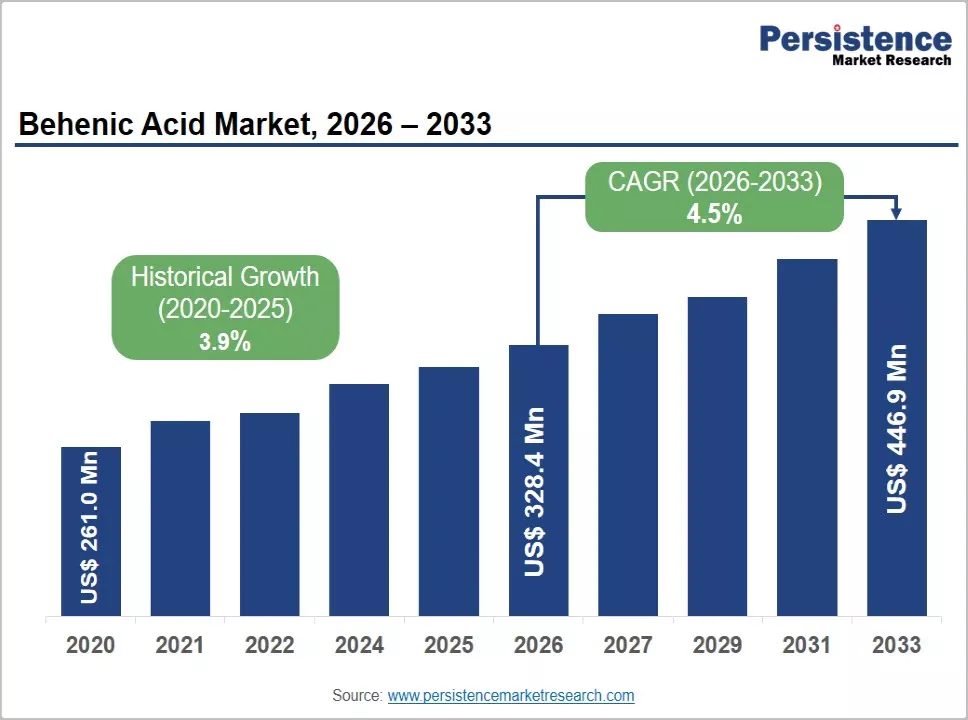
The global behenic acid market size is expected to be valued at US$ 328.4 million in 2026 and is projected to reach US$ 446.9 million by 2033, growing at a CAGR of 4.5% during the forecast period from 2026 to 2033.
This growth trajectory reflects the combined impact of rising demand for pharmaceutical-grade products and the expansion of Asia Pacific's oleochemical manufacturing base. The European Chemicals Agency (ECHA), through its ongoing REACH regulatory compliance and chemical safety assessments, is influencing procurement specifications for fatty acid derivatives across the EU. This is reinforcing the shift toward high-purity, well-documented behenic acid supply chains and favoring established, vertically integrated producers.
Key Industry Highlights
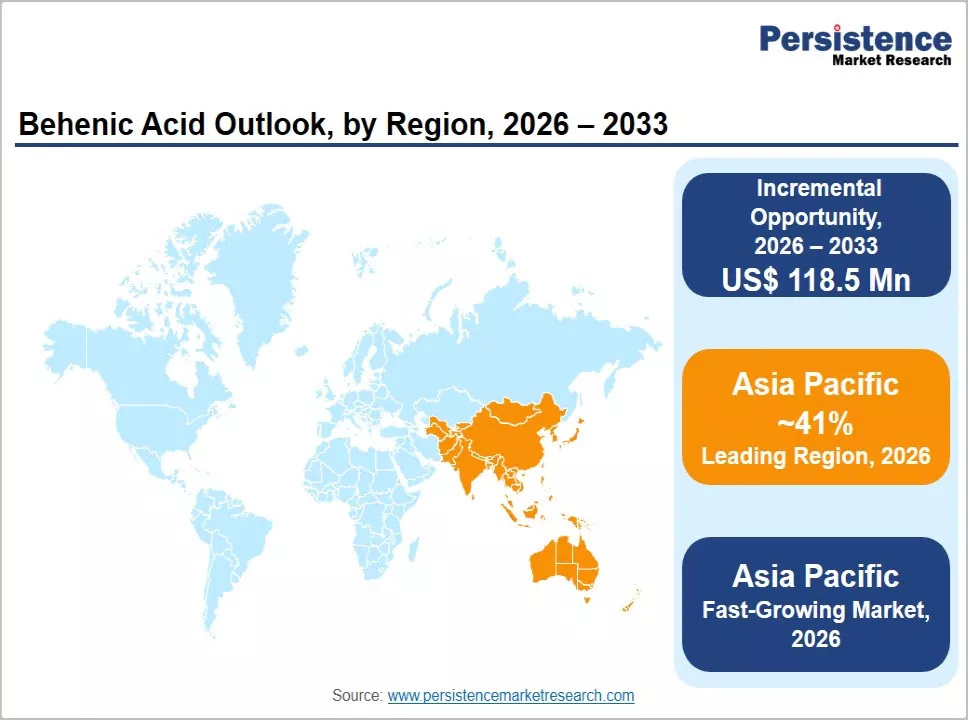
- Leading Region: Asia Pacific is expected to lead the global market, accounting for 41% of the market share in 2026, and is projected to expand at the fastest regional CAGR of 5.6% through 2033. Growth is supported by production-side capacity expansions in Malaysia and Indonesia and rising consumption across China, India, and Southeast Asian personal care markets, creating a combination of manufacturing and consumption-driven demand.
- Dominant Grade Type: Pharma-grade behenic acid is expected to account for 67.5% of the market share in 2026, supported by USP and Ph.Eur. monograph requirements among pharmaceutical manufacturers and premium personal care formulators. Its leading position is reinforced by stringent quality specifications and regulatory documentation requirements that limit substitution with lower-grade alternatives.
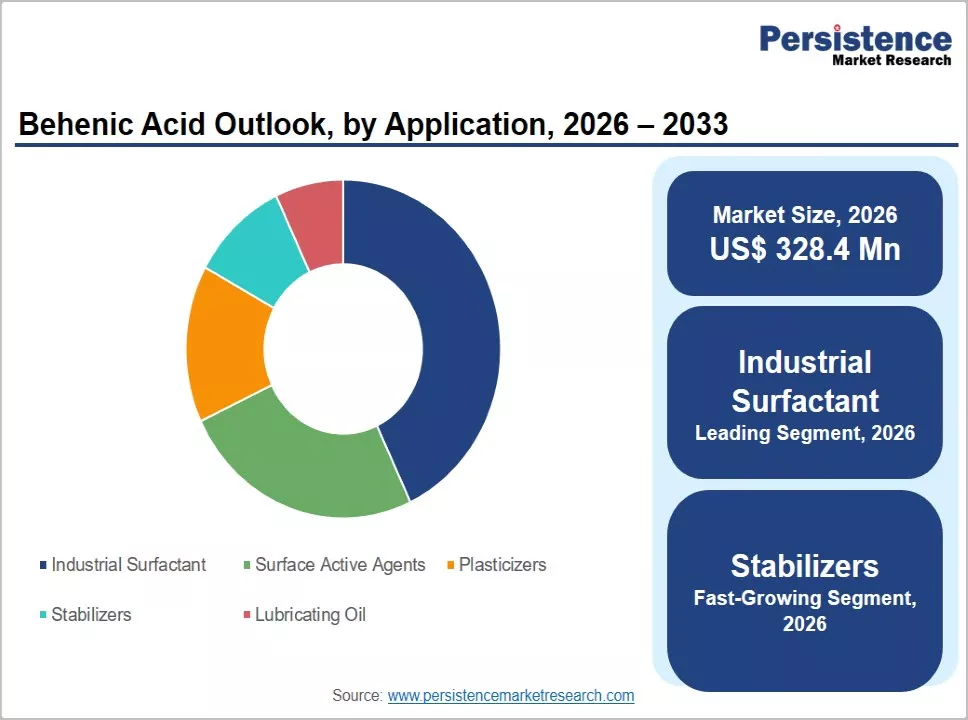
- Leading Application: Industrial surfactants are expected to capture 43% of the market share, supported by recurring procurement from manufacturers of behenyl-derived quaternary ammonium compounds and major fabric care brands. This application provides a stable demand base for the overall behenic acid market.
- Fastest-Growing Application: Stabilizers represent the fastest-growing application segment, supported by increasing demand for alternative PVC stabilizer formulations and regulatory scrutiny of certain hazardous substances used in conventional stabilizer systems. These developments are creating opportunities for behenic acid-based calcium-zinc fatty acid salts across flexible PVC manufacturing.
Market Dynamics
Driver - Rising Demand for High-Purity Fatty Acids in Pharmaceutical and Personal Care Formulations
Pharmaceutical manufacturers and premium personal care brands are increasingly specifying behenic acid, a C22 saturated fatty acid derived from ben oil or hydrogenated rapeseed oil, as a functional excipient and formulation ingredient in lipstick bases, hair conditioning agents, and solid oral dosage form coatings. Croda International Plc, a leading specialty chemicals producer, has continued investing in its care chemicals business, reflecting growing customer demand for traceable, high-purity fatty acid derivatives in regulated end markets.
This preference for pharma-grade material over technical-grade alternatives reflects stricter quality assurance requirements under frameworks such as the United States Pharmacopeia (USP) and the European Pharmacopoeia (Ph.Eur.), which establish specifications for pharmaceutical excipients. Formulators willing to pay a premium for product documentation, purity, and consistency are supporting demand for certified behenic acid supplies.
Restraint - Feedstock Price Volatility and Supply Chain Concentration
Behenic acid production depends primarily on feedstocks such as hydrogenated rapeseed oil and ben oil, which are subject to agricultural commodity price fluctuations driven by weather conditions, geopolitical disruptions, and energy costs. The Food and Agriculture Organization of the United Nations (FAO) reported that vegetable oil price indices reached multi-year highs during 2022 before partially correcting. This volatility can compress margins for behenic acid producers operating under fixed-price supply contracts. Concentration of palm-based oleochemical processing in Malaysia and Indonesia adds a geographic supply risk, encouraging procurement teams at multinational chemical companies to adopt dual-sourcing strategies.
Opportunity - Green and Bio-Based Chemistry Mandates Opening Premium Positioning
The accelerating transition toward bio-based specialty chemicals is creating a distinct pricing and market positioning opportunity for behenic acid producers that can document the renewable origin and carbon footprint of their supply chains. The European Green Deal and the EU Chemicals Strategy for Sustainability prioritize safer chemicals, sustainable production, and alternatives to certain hazardous chemical inputs. Buyers in the EU personal care and industrial formulation sectors are increasingly evaluating bio-based fatty acid suppliers to meet Scope 3 emissions targets and product-level environmental requirements. Producers offering RSPO-certified or identity-preserved rapeseed-derived behenic acid are positioned to capture premium market opportunities.
Category-Wise Analysis
Grade Insights
Why Does Pharma Grade Command a Dominant Share of the Behenic Acid Market?
Pharma-grade behenic acid is projected to lead the grade segment, accounting for 67.5% of the market share in 2026, reflecting high-value, specification-driven demand from pharmaceutical and premium personal care manufacturers. Buyers in these end markets select pharma-grade material because it meets applicable USP and Ph.Eur. quality specifications, supporting its use in oral dosage form coatings, suppository formulations, and conditioning agents for professional haircare products, including formulations used in salon systems such as those supplied by L'Oréal Professionnel.
Pharma grade is also likely to be the fastest-growing segment, supported by expanding research and development in lipid-based drug delivery systems. Developers of lipid nanoparticle (LNP) formulations, a technology platform that gained widespread validation through mRNA vaccine production, are exploring different lipid components and formulation ingredients, creating potential opportunities for specialized fatty acid suppliers. Pharmaceutical ingredient manufacturers, including Evonik Industries AG, continue to expand their lipid and pharmaceutical excipient capabilities, supporting the broader development of this application landscape.
Application Insights
Industrial surfactants represent the leading application segment, commanding about 43% of the market share in 2026, supported by the widespread use of behenyl-derived quaternary ammonium compounds as fabric softening actives and industrial process surfactants. Textile finishing operations and fabric care product manufacturers, including major consumer goods companies such as Procter & Gamble and Henkel AG & Co. KGaA, use long-chain fatty acid-derived cationic surfactants for their conditioning properties and affinity for hair and fabric surfaces.
Stabilizers are likely to be the fastest-growing application segment. A key growth catalyst is the increasing regulatory scrutiny of certain hazardous substances in conventional PVC stabilizer systems, encouraging the development and qualification of alternative fatty acid metal salts, particularly calcium-zinc-based formulations, for flexible PVC applications. Manufacturers of specialty chemical additives are increasingly focusing on alternative stabilizer technologies, creating downstream opportunities for high-purity long-chain fatty acid inputs.
Regional Analysis
North America Behenic Acid Market Trends And Insights
North America is projected to hold about 22% share of the global market in 2026. The region's demand is supported by pharmaceutical excipient procurement and a well-established personal care manufacturing base concentrated in the northeastern United States and Ontario, Canada. The U.S. Food and Drug Administration (FDA)'s Inactive Ingredient Database provides an important reference for pharmaceutical manufacturers evaluating excipient use in approved drug products, reinforcing demand for verified, high-purity fatty acid supplies. Growth through 2033 is expected to remain moderate but consistent, supported by the region's mature pharmaceutical quality and regulatory infrastructure.
U.S. Behenic Acid Market Size
The U.S. is anticipated to hold nearly 87.0% of the North American market share in 2026. Demand is concentrated among pharmaceutical contract manufacturers and specialty cosmetics formulators that require high-purity, quality-controlled fatty acid ingredients for regulated product applications. Consolidation among U.S. contract development and manufacturing organizations (CDMOs) is expected to support larger and more standardized procurement volumes, sustaining demand growth throughout the forecast period.
Canada Behenic Acid Market Size
Canada is estimated to account for around 13.0% of the North American market share in 2026. Canadian demand is driven primarily by natural and organic personal care manufacturers based in Ontario and British Columbia that specify sustainably sourced fatty acid ingredients to meet certification requirements under frameworks such as the COSMOS-standard. Rising domestic interest in bio-based ingredient sourcing is expected to support demand for sustainably sourced behenic acid, particularly in the technical-grade segment, through 2033.
Europe Behenic Acid Market Trends And Insights
Europe is projected to hold about 25.0% share of the global market in 2026. The region's regulatory environment, principally REACH and the EU Cosmetics Regulation (EC) No. 1223/2009, requires rigorous ingredient safety documentation and regulatory compliance, favoring established, well-characterized fatty acid suppliers with comprehensive analytical traceability. The European Green Deal and Chemicals Strategy for Sustainability are also supporting demand for safer and bio-based alternatives to certain conventional surfactant and stabilizer inputs, providing a structural growth opportunity for the behenic acid market through 2033.
Germany Behenic Acid Market Size
Germany is expected to command about 36.0% share of the European market in 2026. Germany's position as Europe's leading specialty chemicals producer, supported by companies such as BASF SE and a well-established network of formulation manufacturers, sustains demand for fatty acid inputs across stabilizer, lubricant, and surfactant applications. Continued investment in sustainable chemistry research and development by German chemical companies is expected to create additional application opportunities for behenic acid derivatives through the forecast period.
U.K. Behenic Acid Market Size
The U.K. is estimated to hold around 29.0% share of the European market in 2026. Demand is supported by the country's established personal care and cosmetics manufacturing sector, which uses high-purity behenic acid as a conditioning and emulsifying ingredient in premium haircare and skincare formulations. The UK's post-Brexit cosmetics regulatory framework, administered by the Office for Product Safety and Standards (OPSS), maintains specific product safety and ingredient compliance requirements, supporting continued demand for qualified ingredient suppliers.
Asia Pacific Behenic Acid Market Insights
Asia Pacific is expected to dominate the global market by capturing around 41.0% share in 2026. The region's dual role as a major production hub and an expanding consumption market creates a strong growth dynamic. Rising middle-class spending on personal care products across China, India, and Southeast Asia is driving formulation demand, while expanding oleochemical manufacturing capacity in Malaysia and Indonesia is strengthening regional supply capabilities. Regional chemical industry development initiatives across ASEAN economies are further supporting capacity investment and supply chain expansion.
China Behenic Acid Market Size
China is expected to hold nearly 40.0% of the Asia Pacific market share in 2026. China's integrated oleochemical sector, supported by producers such as Sichuan Sipo Chemical Co., Ltd., is contributing to the production and domestic application of behenic acid derivatives across personal care, PVC stabilization, and industrial lubricant end markets. Increasing quality and regulatory requirements for pharmaceutical ingredients, overseen by the National Medical Products Administration (NMPA), are supporting demand for higher-purity fatty acid materials.
India Behenic Acid Market Size
India is likely to account for nearly 35.0% of the Asia Pacific market share in 2026. India's expanding pharmaceutical manufacturing sector, which ranks among the world's largest by production volume, is generating sustained demand for compliant fatty acid excipients as domestic manufacturers expand exports to regulated markets. Government-led initiatives under Production Linked Incentive (PLI) schemes for pharmaceuticals are supporting capacity investments in pharmaceutical manufacturing and related ingredient supply chains, creating immense opportunities through 2033.
Competitive Landscape
The global behenic acid market operates as a moderately concentrated specialty chemical market, where technical capability, regulatory compliance credentials, and feedstock integration determine competitive positioning far more decisively than price alone. KLK OLEO Group and Croda International Plc hold structural advantages through vertically integrated oleochemical supply chains and established pharmacopoeial grade certifications.
VVF Limited and Global Seven (Ethox Chemicals, LLC) compete effectively in the technical-grade and industrial surfactant segments on the basis of application engineering support. Smaller participants including Selleck Chemicals LLC, Cayman Chemical Company, and TOKYO CHEMICAL INDUSTRY CO., LTD. serve high-purity research and analytical reagent niches where volume is modest but margins are structurally elevated. PHOENIX CHEMICAL, INC. and Koster Keunen Inc. maintain positions in the personal care and wax-derivative segments through formulation expertise and long-standing customer relationships.
Key Industry Developments
- In October 2026, researchers reported that creams containing behenic acid or ceramides accelerated skin barrier recovery in experimentally damaged skin. The study, published in the International Journal of Cosmetic Science, compared different skin lipid components to evaluate their moisture-retention, occlusive, and skin-repair properties. The behenic acid formulation demonstrated the highest water-holding capacity, while both behenic acid and ceramide creams significantly improved the skin barrier sealing effect.
Companies Covered in Behenic Acid Market
- KLK OLEO Group
- Koster Keunen Inc.
- Croda International Plc
- Global Seven (Ethox Chemicals, LLC)
- PHOENIX CHEMICAL, INC.
- VVF Limited
- Selleck Chemicals LLC
- TOKYO CHEMICAL INDUSTRY CO., LTD.
- Cayman Chemical Company
- Sichuan Sipo Chemical Co., Ltd.
Frequently Asked Questions
The global behenic acid market is valued at US$ 328.4 million in 2026.
Increasing pharmaceutical excipient qualification requirements under USP and Ph.Eur. monograph standards, and the European Commission's Chemicals Strategy for Sustainability accelerating substitution of synthetic surfactants and stabilizers with bio-based fatty acid alternatives across EU manufacturing sectors.
Asia Pacific is likely to dominate the global market with a 41% share in 2026, driven by its position as the world's primary oleochemical production hub centred on Malaysia and Indonesia and by rapidly growing personal care and pharmaceutical consumption across China and India.
The most significant opportunity lies in supplying RSPO-certified or bio-based behenic acid to EU buyers under the European Commission's Chemicals Strategy for Sustainability, which mandates renewable ingredient sourcing.
Leading market participants include KLK OLEO Group, Croda International Plc, VVF Limited, and Koster Keunen Inc., alongside speciality suppliers such as TOKYO CHEMICAL INDUSTRY CO., LTD., and Cayman Chemical Company.


