




- Specialty & Fine Chemicals
- Battery Additives Market
Battery Additives Market Size, Share, and Growth Forecast, 2026 - 2033
Battery Additives Market by Product Type (Conductive Additive, Porous Additive, Nucleating Additive), Application (Lithium-Ion Batteries, Lead-Acid Batteries), And Regional Analysis for 2026 - 2033

Battery Additives Market Size and Trends Analysis
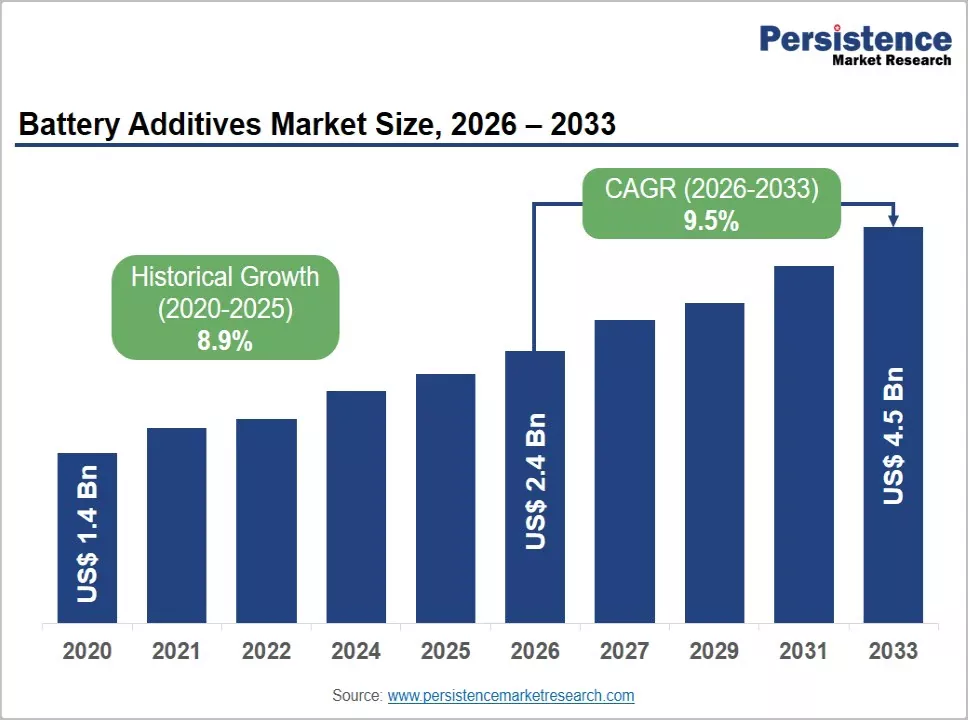
The global battery additives market size is likely to be valued at US$ 2.4 billion in 2026 and is projected to reach US$ 4.5 billion by 2033, growing at a CAGR of 9.5% during the forecast period from 2026 to 2033.
Market is growing as electric vehicles, grid storage, and consumer electronics require batteries with higher energy density, faster charging, longer life, and improved safety. Small quantities of specialized additives help electrodes conduct electrons efficiently, manage structural stress, and control crystal growth, making them essential for performance improvements. Silicon-rich anodes, high-nickel cathodes, and new cell formats are further increasing the demand for advanced additive technologies.
Key Industry Highlights
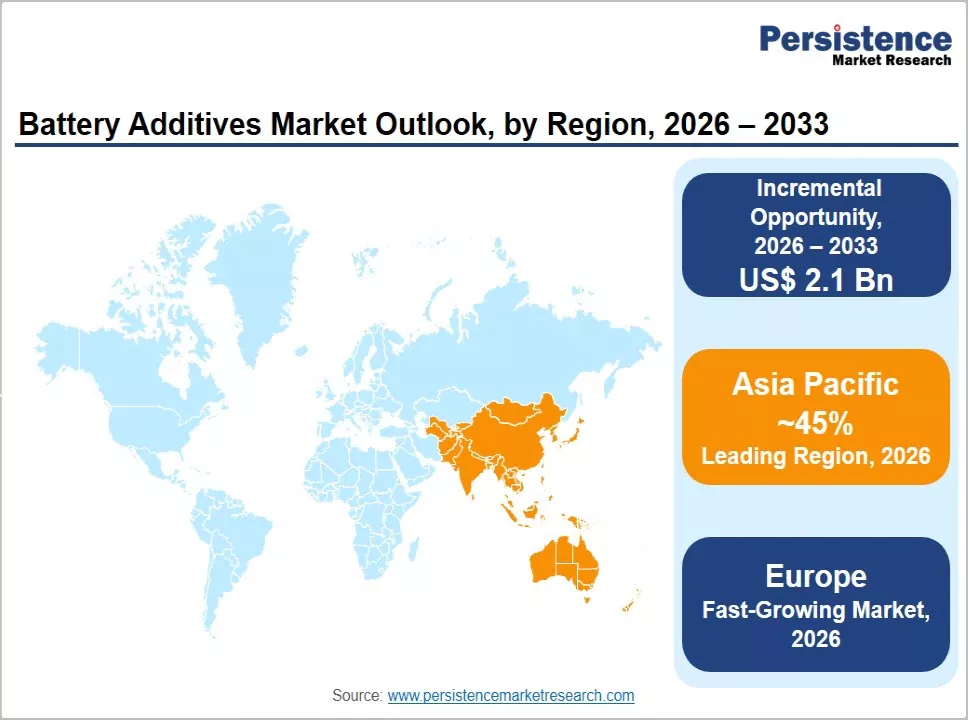
- Leading Region: Asia Pacific is anticipated to be the leading region, accounting for a market share of 45% in 2026, driven by the concentration of battery cell manufacturing facilities and a mature supply chain for carbon materials and electrode chemicals.
- Fastest-Growing Region: Europe is likely to represent the fastest-growing market, supported by new gigafactory projects, local content incentives, and strong demand from automakers and battery manufacturers for localized additive supply and technical support.
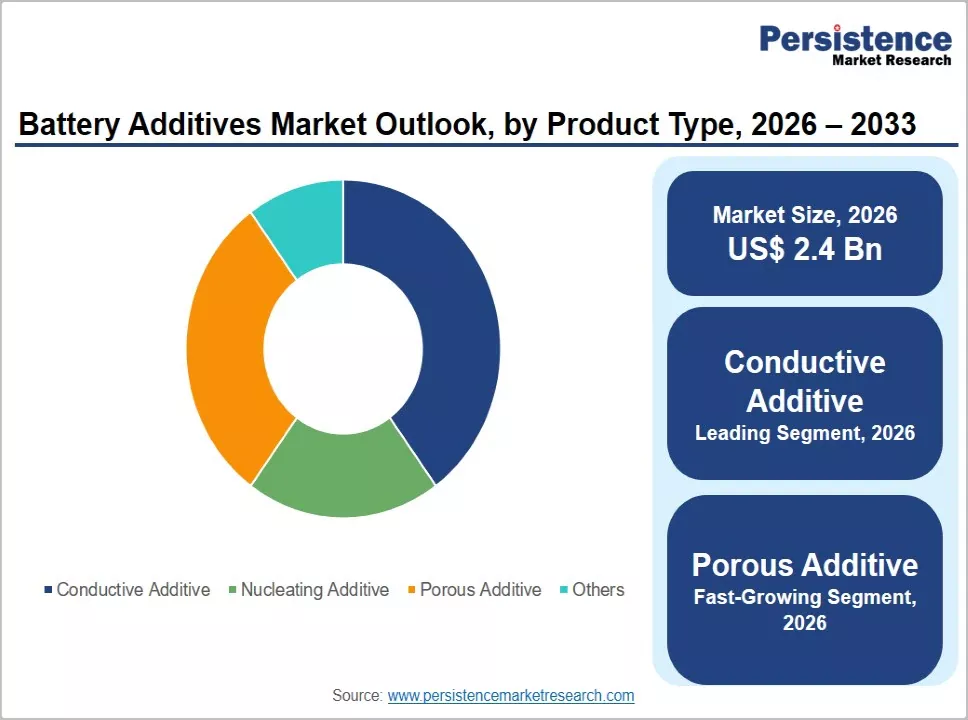
- Leading Product Type: Conductive additives are projected to represent the leading product type, accounting for 58% of the market share in 2026, owing to their essential role in lithium-ion electrodes, where carbon black and carbon nanotubes improve electron transport.
- Leading Application: Lithium-ion batteries are anticipated to be the leading application segment, accounting for 78% of the revenue share in 2026, as electric vehicles and energy storage systems drive large-scale and growing cell production.
- Key Opportunity: The key market opportunity lies in scaling single-wall carbon nanotubes and hybrid conductive systems for silicon-rich anodes and fast-charging cells, supported by regional production facilities located close to battery gigafactories.
Market Dynamics
Driver - Expanding Electric Vehicle Battery Production and Shift Toward High-Energy Chemistries
Battery manufacturers are building production capacity at an accelerated pace to supply electric vehicles and stationary storage systems. Each additional gigawatt-hour of cell production requires conductive, porous, and nucleating materials during electrode manufacturing. As automakers seek longer driving ranges and faster charging, cell designers are adopting silicon-rich anodes and high-nickel cathodes, which depend more heavily on advanced conductive additives to maintain performance.
Carbon nanotubes illustrate this shift. LG Energy Solution notes that applying carbon nanotube conductive additives in cathodes can reduce the amount of additive required to about 20% of that needed with conventional carbon black. The space saved can be allocated to more active material, increasing energy density. This efficiency advantage is encouraging battery manufacturers to blend nanotubes with carbon black and increase nanotube content over time. Fast-charging requirements are also tightening additive specifications, as electrodes need to tolerate high current without losing contact between particles, while suppliers are required to demonstrate consistent product quality across batches.
Supply agreements demonstrate growing commercial traction. In January 2026, Cabot signed a multiyear agreement with PowerCo, Volkswagen Group's battery subsidiary, to supply conductive carbons and dispersions for electric vehicle battery electrodes in Europe. In June 2026, PowerCo selected OCSiAl to supply nanotube solutions for graphite anodes in its Unified Cell platform, underscoring demand for specialized additives. Energy storage projects for grids and data centers are adding another layer of demand because stationary batteries require long cycle life and stable performance, which depend heavily on electrode additives that maintain conductivity as cells age.
Restraint - High Costs, Dispersion Challenges, and Competition from Alternative Approaches
Advanced additives such as single-wall carbon nanotubes cost significantly more than traditional carbon black, and battery manufacturers face continuous pressure to reduce cell costs. Adoption therefore depends on measurable performance improvements that justify price premiums. Dispersing nanotubes uniformly in electrode slurries is technically demanding and requires specialized dispersions, mixing equipment, and process control, which can limit adoption among smaller producers. Technological shifts also influence demand, as cell manufacturers continue experimenting with dry electrode processes, new binders, and solid-state designs that change additive requirements.
Some innovations reduce the need for certain additives, while others require new formulations that suppliers need to qualify with individual customers. Long qualification cycles, strict purity standards, and regional trade policies can delay commercialization and add uncertainty to investment plans. Volatility in carbon black feedstock prices, energy costs, and trade policies can also affect margins, while customers often negotiate long-term pricing agreements that limit how quickly suppliers can pass on higher input costs.
Opportunity - Single-Wall Nanotubes, Hybrid Conductive Systems, and Regional Supply Capacity
Capacity expansion for high-performance conductive materials presents a significant growth opportunity. Zeon announced in April 2026 a new single-wall carbon nanotube production line at Tokuyama, aiming to increase capacity more than tenfold, with full-scale operations scheduled for 2028. OCSiAl has also planned a manufacturing hub in Europe worth about US$ 300 million, highlighting the industry's shift toward locating production closer to battery customers.
Hybrid additives can further broaden adoption. Birla Carbon and Chasm Advanced Materials have developed nanotube-enhanced carbon black that combines the dispersion advantages of carbon black with the high conductivity of nanotubes. Such products can ease the transition for battery manufacturers that are not ready for full nanotube substitution while improving rate capability and anode capacity.
Additives for emerging chemistries also offer growth opportunities. Silicon-carbon anodes, lithium iron phosphate cells, sodium-ion batteries, and solid-state designs all require tailored conductive and structural additives. Lead-acid batteries, which remain widely used in automotive starting and backup power applications, continue to require carbon and expander additives that improve charge acceptance and cycle life, supporting steady demand alongside lithium-ion growth. Recycling and sustainability goals are further encouraging new additive designs, as cell manufacturers seek materials that improve electrode stability, reduce scrap rates, and facilitate the reuse of recovered materials in new batteries.
Category-Wise Analysis
Product Type Insights
Conductive additives are expected to lead the product type category while holding around 58% market share in 2026. Their role is to connect active material particles and maintain electron pathways, which are essential for rate performance and cycle life. Carbon black remains widely used, while carbon nanotubes are gaining market share because they achieve conductivity at lower dosages. Battery manufacturers increasingly combine carbon black with multiwall nanotubes in cathodes and anodes. For example, Cabot supplies conductive carbons and dispersions for battery electrodes.
Porous additives represent the fastest-growing segment, supported by demand for structures that accommodate silicon expansion, improve electrolyte access, and support fast charging. Nucleating additives remain important for controlling crystal formation in specific chemistries, including lead-acid systems, where they support consistent plate structures and improved charge acceptance.
Application Insights
Lithium-ion batteries are projected to lead the application category, capturing around 78% of the market share in 2026, and are also likely to represent the fastest-growing application. Electric vehicles, consumer electronics, and stationary storage are driving rapid cell production, with additive requirements increasing as electrodes become thicker and more energy-dense. Conductive carbon and nanotube suppliers work closely with cell manufacturers to qualify materials for individual battery platforms.
Lead-acid batteries are expected to remain a significant application segment, supported by automotive starting, lighting, and ignition (SLI) batteries, telecom backup systems, and industrial applications. Additives such as carbon materials and expanders help improve charge acceptance and battery lifespan, particularly in start-stop vehicles, while replacement demand in emerging markets provides steady volumes.
Regional Analysis
North America Battery Additives Market Trends
North America is expected to hold a significant share of the battery additives market in 2026, driven by new battery manufacturing facilities, domestic content incentives, and growing electric vehicle and energy storage deployment. Additive suppliers are expanding local production capacity and dispersion capabilities to serve regional cell manufacturers. Government funding and private investments are supporting the expansion of domestic conductive carbon production.
U.S. Battery Additives Market Trends
The U.S. is expected to dominate the North American market, accounting for around 88% of the regional market share in 2026, owing to major cell manufacturing investments by automakers and battery companies. Suppliers are modifying and expanding existing facilities producing conductive carbons and carbon nanostructures, supported by federal funding and corporate investments.
Canada Battery Additives Market Trends
Canada is expected to hold a 12% share of the North American market in 2026. Critical mineral resources, planned battery manufacturing facilities, and expanding electric vehicle initiatives support demand for battery materials. Research programs and graphite and carbon development projects are also exploring opportunities across additive and anode material supply chains.
Europe Battery Additives Market Trends
Europe is likely to represent the fastest-growing market for battery additives, as gigafactory projects, electric vehicle policies, and efforts to localize supply chains increase demand for locally available additives. Automakers and cell manufacturers are seeking secure European supplies of conductive carbons and nanotube dispersions. Supply agreements and planned manufacturing facilities are strengthening regional production capacity.
Germany Battery Additives Market Trends
Germany is projected to hold around 34% share of the European market in 2026, owing to its large automotive industry and battery cell manufacturing plans from major automakers. Volkswagen's PowerCo battery unit's supply arrangements with Cabot and OCSiAl highlight the growing demand for localized additive supplies and technical support.
U.K. Battery Additives Market Trends
The U.K. is expected to emerge as a significant market, holding around 20% of the European market share in 2026. Automotive electrification is creating demand for battery materials that improve performance, stability, and charging efficiency. Domestic cell manufacturing initiatives are creating opportunities for suppliers of electrolyte formulations, conductive materials, and electrode additives. Growth in stationary energy storage is generating additional demand for durable battery systems.
Asia Pacific Battery Additives Market Trends
Asia Pacific is anticipated to be the leading region in the global market, accounting for a market share of 45% in 2026, supported by the concentration of battery cell manufacturing facilities and a mature supply chain for carbon materials. Large producers are investing in nanotube production capacity, while regional additive manufacturers serve domestic cell makers with competitive pricing and technical support.
China Battery Additives Market Trends
China is expected to dominate the regional market, accounting for around 35% of the Asia Pacific market share in 2026, owing to its dominant battery manufacturing base and extensive supply of conductive carbon and nanotube materials. Domestic additive manufacturers are scaling production to supply electric vehicle and energy storage cell producers, while research institutions continue advancing new conductive materials.
India Battery Additives Market Trends
India is likely to emerge as a significant market for battery additives, holding around 17% of the Asia Pacific market share in 2026. Demand for electrolyte additives, conductive materials, and electrode-processing chemicals is expected to increase as domestic cell production advances. Government initiatives are encouraging local manufacturing and reducing reliance on imported advanced battery materials.
Competitive Landscape
The global battery additives market exhibits a moderately consolidated structure, driven by the presence of established carbon material producers, specialized nanotube developers, and chemical companies. Key competitive factors include product performance, dispersion quality, qualification with cell manufacturers, production capacity, regional proximity, and the ability to support emerging battery chemistries.
With key players including Cabot Corporation, Birla Carbon, OCSiAl, Zeon Corporation, and Orion Engineered Carbons S.A., the market comprises suppliers with varying technological capabilities and geographic footprints. These players compete through nanotube and hybrid additive development, capacity expansion, long-term supply agreements with battery manufacturers, and application-specific technical support.
Key Industry Developments:
- In April 2026, Zeon Corporation announced a new single-wall carbon nanotube production line at Tokuyama, Japan, targeting a capacity increase of more than tenfold with full-scale operation in 2028 to meet growing lithium-ion battery demand.
- In January 2026, Cabot Corporation signed a multiyear supply agreement with PowerCo, Volkswagen Group's battery subsidiary, to supply advanced conductive carbons and dispersions for electric vehicle battery electrodes in Europe.
Companies Covered in Battery Additives Market
- Cabot Corporation
- Birla Carbon
- OCSiAl
- Zeon Corporation
- Orion Engineered Carbons S.A.
- Imerys Graphite & Carbon
- Arkema S.A.
- LG Chem Ltd.
- Denka Company Limited
- Mitsubishi Chemical Group Corporation
- Hammond Group, Inc.
- Jiangsu Cnano Technology Co., Ltd.
Frequently Asked Questions
The battery additives market is projected to reach US$ 2.4 billion in 2026.
Rapid growth in electric vehicle and energy storage battery production, adoption of silicon-rich anodes, and demand for higher energy density and fast charging.
The battery additives market is expected to grow at a CAGR of 9.5% from 2026 to 2033.
Scaling single-wall carbon nanotubes and hybrid conductive systems for silicon-rich anodes and fast-charging cells, supported by regional production close to battery gigafactories.
Cabot Corporation, Birla Carbon, OCSiAl, Zeon Corporation and Orion Engineered Carbons S.A. are the leading players.


