




- Specialty & Fine Chemicals
- Chiral Chromatography Columns Market
Chiral Chromatography Columns Market Size, Share, and Growth Forecast 2026–2033
Chiral Chromatography Columns Market by Type (Prepacked Column, Preparative Column), Application (Gas Chromatography, Liquid Chromatography), End User (Pharmaceutical and Biotechnology Companies), and Regional Analysis, 2026–2033

Chiral Chromatography Columns Market Size and Trend Analysis
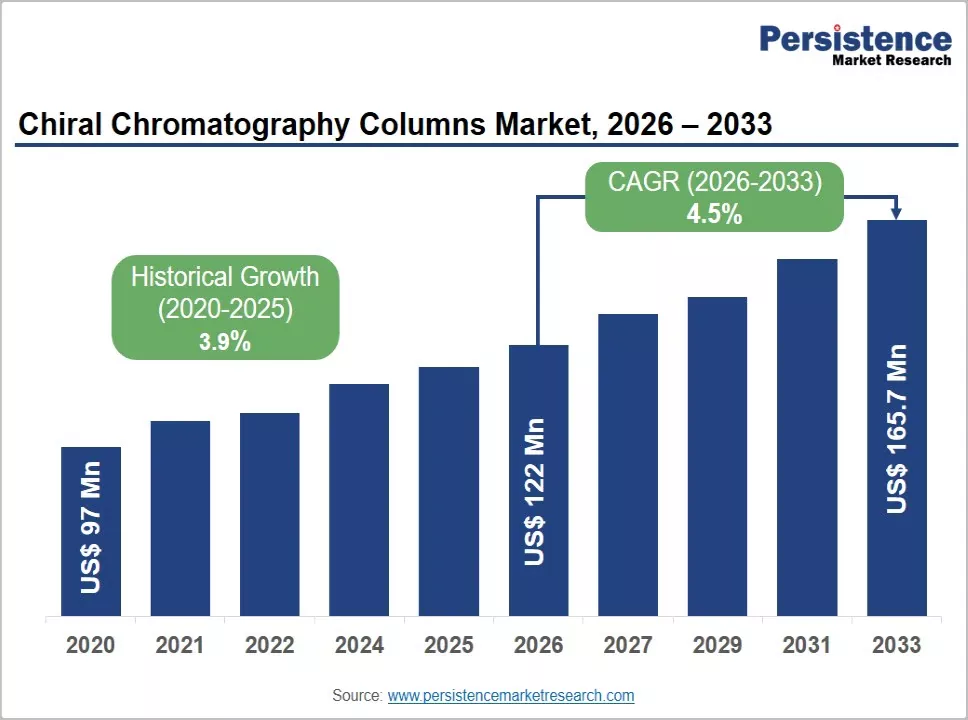
The global chiral chromatography columns market size is likely to be valued at US$ 122 million in 2026 and is projected to reach US$ 165.7 million by 2033, growing at a CAGR of 4.5% during the forecast period between 2026 and 2033.
Chiral chromatography columns are a small but strategically critical consumable within the analytical and purification toolkit, because regulators expect drug developers to characterize and control the individual enantiomers of chiral molecules. Demand is recurring and method-locked: once a validated chiral method is filed with regulators, the column chemistry is rarely changed, which supports stable replacement revenues.
Suppliers are now competing on broader selectivity, faster separations compatible with mass spectrometry, and sustainable techniques such as supercritical fluid chromatography that cut organic solvent use. This should be read as a niche, high-margin consumables segment with innovation premiums concentrated in pharmaceutical workflows.
Key Industry Highlights
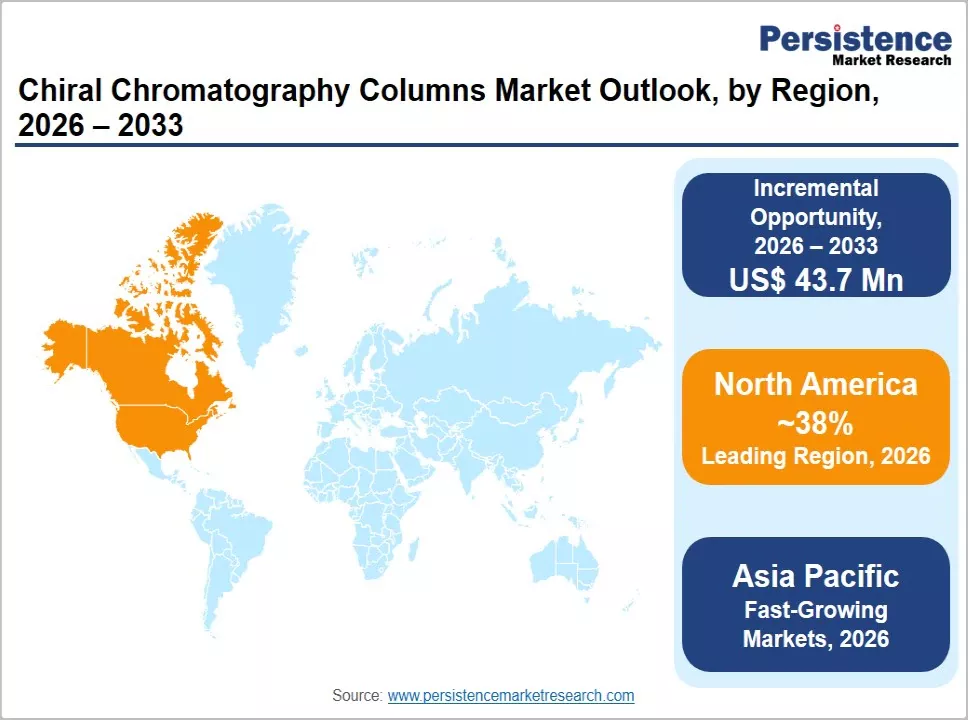
- Dominant Region: North America holds 38% of the chiral chromatography columns market share in 2026, reflecting the concentration of pharmaceutical research and development, contract research organizations, and regulatory-driven analytical testing in the U.S. The region’s heavy investment in biologics and small-molecule pipelines creates continuous demand for method development and quality-control columns.
- Fastest-growing Region: Asia Pacific is expected to grow at an estimated 6.1% CAGR through 2033, supported by the rapid expansion of contract development and manufacturing organizations in China and India and increasing adoption of international regulatory standards. Local generic and innovative drug producers are building enantiomeric purity testing capacity.
- Leading Type: Prepacked columns account for about 52% of 2026 revenue because they offer validated reproducibility and are the default choice for regulated analytical laboratories. Polysaccharide-based immobilized phases dominate prepacked offerings owing to broad selectivity and compatibility with many solvents.
- Fastest-growing Application and Emerging Opportunity: Supercritical fluid chromatography (SFC) is the fastest-growing technique as laboratories substitute carbon dioxide for organic solvents in both analytical and preparative chiral separations. Daicel Corporation’s Vaast column, which separates all 21 natural amino acids in a single five-minute LC-MS run, shows how novel phases can open new application niches in clinical and food testing.
DRO Analysis
Driver- Regulatory Emphasis on Enantiomeric Purity and Growth of Chiral Drug Pipelines
The majority of new small-molecule drugs are developed as single enantiomers because opposite forms can differ in efficacy, metabolism, and toxicity. Regulators including the U.S. Food and Drug Administration, the European Medicines Agency, and authorities guided by International Council for Harmonization standards expect developers to establish stereochemical identity and purity throughout development and manufacturing.
This creates durable demand for chiral columns during screening, method validation, batch release, and stability testing. As pipelines expand to include complex molecules such as peptides, oligonucleotides, and conjugates, laboratories need broader selectivity and higher throughput, which favors suppliers with extensive stationary phase libraries, including Daicel Corporation, Waters Corporation, and Merck.
Restraint- High Column Cost, Method Lock-in, and Competition from Alternative Techniques
Chiral columns are priced at a premium relative to standard reversed-phase products because of specialized stationary phase manufacturing, and costs can be significant for preparative-scale purification. Screening and method development remain time-intensive and require a large inventory of phases, which can discourage smaller laboratories. Alternatives such as chiral derivatisation, capillary electrophoresis, and asymmetric synthesis that avoids racemic mixtures reduce the need for separation in some workflows. Because validated methods are rarely changed, new entrants face high barriers to displace incumbent column brands in regulated settings.
Opportunity- SFC Adoption, Biomolecule Applications, and Emerging-market Laboratories
Sustainability targets are encouraging pharmaceutical manufacturers to adopt SFC and greener solvent strategies, creating demand for columns optimized for carbon dioxide-based mobile phases and for scale-up from analytical to preparative columns. New phases for amino acids, peptides, and oligonucleotides open clinical, nutritional, and biologic quality-control applications. Capacity additions in India, China, and Southeast Asia are creating new customer bases that require locally supported columns and application expertise. Suppliers that bundle columns with method-development services, screening kits, and digital tools can lock in longer relationships.
Category-wise Analysis
Why Do Prepacked Columns Command a Majority of the Global Chiral Chromatography Columns Market?
Prepacked columns are projected to lead the segment, capture nearly 52% of market share in 2026. Laboratories operating under good manufacturing and good laboratory practice rules favour factory-packed columns with documented batch-to-batch reproducibility, which removes the variability and time associated with in-house packing. Suppliers provide application support, column screening kits, and method transfer guidance, which makes prepacked formats the standard for pharmaceutical analytical development. Daicel Corporation’s CHIRALPAK family and Merck’s Astec phases illustrate how broad portfolios build loyalty among method developers.
Preparative columns are likely to be the fastest-growing type, propelled by the need to isolate pure enantiomers at gram to kilogram scale for toxicology studies, clinical supplies, and sometimes commercial production. Growth in SFC-based purification, which reduces solvent use and evaporation time, is lifting demand for larger-diameter columns and bulk stationary phases. Empty columns and analytical columns remain important for custom packing and routine analysis, while analytical columns continue to benefit from the trend towards smaller particle sizes and faster separations.
Application Insights
What Is Driving Liquid Chromatography Dominance Across the Chiral Chromatography Columns Industry?
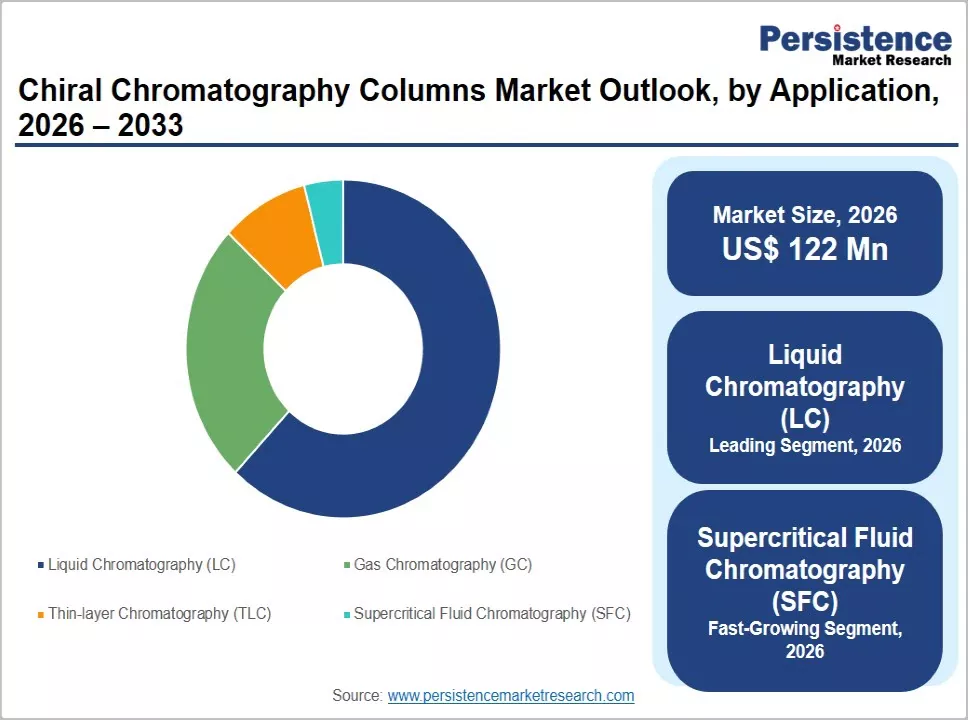
Liquid chromatography (LC) is expected to lead the segment, command about 62% of market share in 2026, because it is the established technique in pharmaceutical analysis and is compatible with a wide range of detectors, including mass spectrometers. High-performance and ultra-high-performance LC platforms from Agilent Technologies, Inc., Waters Corporation, Thermo Fisher Scientific, Inc., and Shimadzu Corporation provide the installed base on which chiral columns operate. Waters’ completion of its combination with BD’s Biosciences and Diagnostic Solutions businesses on February 9, 2026 broadens its reach into clinical and diagnostic laboratories, where chiral and achiral separations increasingly merge.
Supercritical fluid chromatography is likely to be the fastest-growing application, driven by solvent reduction, higher speed, and complementary selectivity compared with LC. Pharmaceutical companies increasingly use SFC as the first-choice technique for chiral screening and purification. Gas chromatography remains important for volatile compounds in flavor, fragrance, and environmental testing, while thin-layer chromatography serves low-cost screening and educational use. Pharmaceutical and biotechnology companies are the dominant end users, while food and beverage laboratories and hospital and clinical laboratories are growing niches.
Regional Insights
North America Chiral Chromatography Columns Market Trends and Insights
North America is forecast to account for around 38% of the chiral chromatography columns market share in 2026. The region hosts many of the world’s largest drug developers, contract research and manufacturing organizations, and analytical instrument suppliers. The U.S. Food and Drug Administration’s policy on stereoisomeric drugs, first issued in 1992, continues to anchor demand for enantiomer-specific testing in new drug applications.
U.S. Chiral Chromatography Columns Market Size
The U.S. is estimated to hold around 87% of the North America regional market in 2026. Demand is led by clusters in Massachusetts, New Jersey, and California, where discovery and process development laboratories run frequent chiral screens. Waters Corporation, Agilent Technologies, Inc., and Thermo Fisher Scientific, Inc. support laboratories with integrated instrument and consumable offerings.
Canada Chiral Chromatography Columns Market Size
Canada is expected to account for over 13% of the North America regional market in 2026. Academic research institutions and a growing contract research sector create steady demand, while regulatory expectations under Health Canada match those of the U.S. Environmental and food testing laboratories add smaller volumes of gas chromatography chiral columns.
Europe Chiral Chromatography Columns Market Trends and Insights
Europe is anticipated to command around 28% of the chiral chromatography columns market in 2026. The region has a strong base of pharmaceutical companies, academic centers, and chiral technology specialists, and European Medicines Agency guidance emphasizes stereochemical control. Daicel’s European subsidiary in Strasbourg, France, and a dense network of contract laboratories in Switzerland, Germany, and the U.K. make Europe a hub for method development.
Germany Chiral Chromatography Columns Market Size
Germany is projected to account for around 26% of the Europe regional market in 2026. The country’s large chemical and pharmaceutical sector, represented by companies such as Merck KGaA and Boehringer Ingelheim, supports consistent demand across analytical and preparative columns. Strong academic research in stereoselective synthesis further adds to usage.
France Chiral Chromatography Columns Market Size
France is estimated to account for nearly 17% of the Europe regional market in 2026. Strasbourg is a center of chiral separation expertise through Daicel Chiral Technologies Europe, which introduced the Vaast amino acid column, and French pharmaceutical groups sustain steady analytical demand. Growth in nutrition and cosmetics testing contributes incremental volume.
Which Region Will Drive the Fastest Chiral Chromatography Columns Growth Through 2033?
Asia Pacific is forecast to be the fastest-growing region, capturing around 25% of market share in 2026 and expanding at an estimated 6.1% CAGR through 2033. The rise of contract development and manufacturing organizations, growing domestic drug innovation, and tighter enforcement of impurity and stereochemical requirements are expanding the customer base. Japan remains a technology leader through Daicel Corporation and Shimadzu Corporation, while China and India provide volume growth.
China Chiral Chromatography Columns Market Size
China is projected to hold 36% of the Asia Pacific regional market in 2026. Government support for innovative drug development and the country’s large contract research and manufacturing sector are driving adoption of chiral screening and purification. Domestic column manufacturers are growing but international brands retain preference in regulated submissions.
India Chiral Chromatography Columns Market Size
India is expected to account for around 18% of the Asia Pacific regional market in 2026. The country’s generic and specialty pharmaceutical industry, active pharmaceutical ingredient manufacturers, and expanding contract research sector rely on chiral methods for regulatory filings in the U.S. and Europe. Price sensitivity favors locally supported and refurbishable column solutions.
Competitive Landscape
The global chiral chromatography columns market is moderately concentrated, with a handful of chromatography specialists controlling most regulated pharmaceutical demand. Daicel Corporation is the best-known chiral stationary phase specialist, while Agilent Technologies, Inc., Waters Corporation, Thermo Fisher Scientific, Inc., Merck, and Shimadzu Corporation offer broad column and instrument ecosystems. Cytiva, Danaher, GE Healthcare, Bio-Rad Laboratories, and Perkin Elmer participate through bioprocess purification and analytical portfolios.
Competition revolves around selectivity breadth, durability, solvent compatibility, and the ability to supply screening kits and application support. Winning in this landscape requires deep chemistry expertise, consistent manufacturing, and close alignment with the instruments and workflows used by pharmaceutical laboratories.
Key Industry Developments
- In February 2026, Waters Corporation completed its combination with the Biosciences and Diagnostic Solutions businesses of Becton, Dickinson and Company in a transaction valued at approximately US$ 17.5 billion. The company reorganized into four divisions, including Waters Analytical Sciences, which covers liquid chromatography, mass spectrometry, and separation science consumables, expanding its reach into regulated diagnostic and clinical laboratories.
- In October 2025, Daicel Chiral Technologies launched Vaast, a single-column solution that separates 21 natural amino acids, both chiral and achiral, in a five-minute LC-MS run. The column was developed to simplify what was previously a multi-column process and targets clinical, nutritional, and research laboratories seeking reproducible enantiomer analysis of amino acids.
Companies Covered in Chiral Chromatography Columns Market
- Agilent Technologies, Inc.
- Waters Corporation
- Thermo Fisher Scientific, Inc.
- Merck & Co., Inc.
- Cytiva
- Danaher
- GE Healthcare
- Shimadzu Corporation
- Daicel Corporation
- Bio-Rad Laboratories
- Perkin Elmer


