• Home
  • Home
  • Technology
  • Home
  • Configure, Price, Quote (CPQ) Software Market

Configure, Price, Quote (CPQ) Software Market Size, Share, and Growth Forecast, 2025 - 2032

Configure, Price, Quote (CPQ) Software Market by Deployment Type (Cloud, On-Premise), End-Use (Manufacturing, Healthcare and Life Sciences, IT and Telecom, BFSI, Retail and E-Commerce, Automotive, Others), Sales Channel, and Regional Analysis for 2025 - 2032

ID: PMRREP19822
Calendar

September 2025

187 Pages

Author : Sayali Mali

Market Dynamics

Driver - Increasing Demand for Automation in Complex Sales Processes

The growing complexity of sales processes in industries such as manufacturing, IT and telecom, and automotive has significantly driven the adoption of CPQ software. In today’s competitive business environment, companies face growing pressure to deliver accurate, timely, and customized quotes while managing intricate product configurations and diverse pricing models. Traditional manual methods are often time-consuming, error-prone, and inefficient, leading to delays, lost opportunities, and customer dissatisfaction. CPQ software addresses these challenges by streamlining the end-to-end quoting process, automating repetitive tasks, and ensuring real-time accuracy in product configuration and pricing. This helps in reducing human error and accelerates sales cycles, improves deal closure rates, and enhances customer experience.

Industries such as manufacturing, IT, telecom, and healthcare are increasingly adopting CPQ solutions to manage complex offerings and dynamic pricing structures. For instance, Siemens Digital Industries uses CPQ solutions to automate its highly complex industrial equipment sales, enabling sales teams to configure thousands of product combinations quickly and accurately. The shift toward digital transformation and the integration of AI and analytics in CPQ tools further amplify their value, making automation a crucial growth driver for the sector.

Restraint - High Implementation and Integration Costs

The high costs associated with implementing and integrating CPQ software hamper market growth. Deploying CPQ solutions requires significant financial investment, including software licensing, customization, employee training, and ongoing maintenance. For organizations with complex product portfolios and legacy IT systems, integration with existing enterprise resource planning (ERP) and customer relationship management (CRM) platforms can be both technically challenging and costly. These expenses often deter small and medium-sized enterprises (SMEs) that operate with limited budgets, slowing down their adoption of advanced CPQ tools.

The implementation process can be time-consuming, demanding specialized IT expertise, and extensive coordination between sales, IT, and operations teams. Any disruptions or misalignment during this phase may lead to increased costs and delays, reducing the short-term return on investment. For instance, many SMEs adopting Salesforce CPQ report challenges in customizing integrations with their legacy ERP systems, leading to extended implementation timelines and higher consulting costs. Although CPQ software offers long-term benefits in efficiency and accuracy, the high upfront expenditure and complex integration process remain significant barriers for wider market penetration.

Opportunity - Advancements in AI and Cloud-based CPQ Solutions

Advancements in AI and cloud-based CPQ solutions present a significant growth opportunity for the domain. As sales processes become more dynamic, organizations are increasingly seeking intelligent solutions that go beyond basic automation. AI-powered CPQ platforms can analyze customer behavior, historical sales data, and market trends to recommend optimal product configurations, pricing strategies, and cross-selling opportunities. This enhances decision-making and allows companies to deliver more personalized and competitive quotes, thereby improving customer satisfaction and driving revenue growth.

At the same time, the growing adoption of cloud-based CPQ solutions offers businesses flexibility, scalability, and cost efficiency compared to traditional on-premise systems. Cloud deployment enables seamless integration with CRM and ERP platforms, while supporting remote accessibility for global sales teams. For instance, Oracle and Salesforce have expanded their cloud CPQ offerings with AI-driven capabilities to provide predictive pricing and real-time configuration insights. These innovations open significant opportunities for organizations to transform sales operations and gain a competitive edge.

Category-wise Analysis

Deployment Type Insights

Cloud-based CPQ dominates, and is expected to account for approximately 59% of the share in 2025. Its dominance stems from its scalability, cost-effectiveness, and ease of integration with other cloud-based enterprise systems such as CRM and ERP. Cloud-based CPQ solutions, such as those offered by Salesforce (Apttus) and Oracle, enable real-time updates, remote access, and seamless collaboration across sales teams, making them a preferred choice for industries such as IT and telecom, and retail. Their subscription-based pricing models also reduce upfront costs, driving adoption among SMEs.

The On-Premise CPQ segment is the fastest-growing, driven by industries with stringent data security and compliance requirements, such as BFSI and healthcare. On-premise solutions offer greater control over data and customization, appealing to large enterprises with complex workflows. The growing focus on data privacy regulations, such as GDPR and CCPA, is accelerating the adoption of on-premise CPQ systems in regions such as Europe and North America, with significant growth potential in highly regulated industries.

End-use Insights

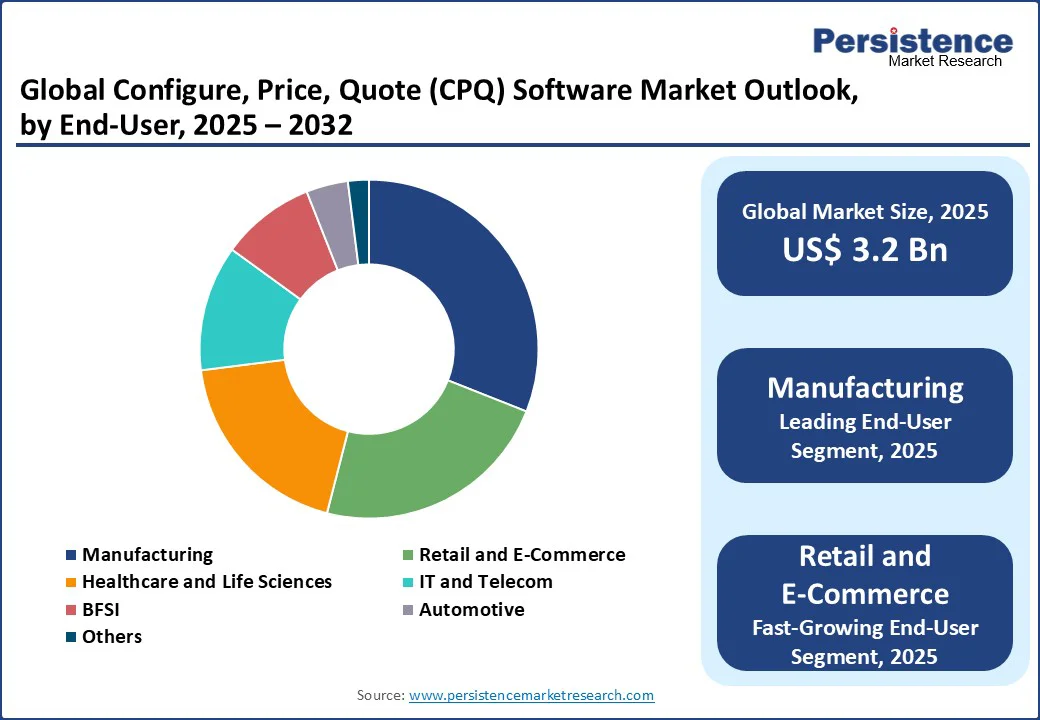
Manufacturing leads the CPQ software market and is poised to account for a 31% share in 2025. The segment’s dominance is driven by the need for efficient product configuration and pricing in complex manufacturing processes, particularly in industries such as industrial equipment and automotive. CPQ solutions streamline the configuration of customized products, reduce errors, and improve sales efficiency, making them critical for manufacturers such as Siemens and General Electric.

The retail and e-commerce segment is the fastest-growing, fueled by the rapid growth of online retail and the need for dynamic pricing and product customization. The rise in e-commerce platforms and the increasing demand for personalized customer experiences have spurred the adoption of CPQ solutions in this sector. For instance, retailers using platforms such as SAP CPQ have reported a 20% increase in online sales conversion rates due to streamlined pricing and quoting processes.

Sales Channel Insights

Direct sales is expected to register the largest share, accounting for approximately 66% of revenue in 2025. Direct sales channels allow vendors such as Oracle, SAP, and Microsoft to maintain close relationships with customers, offer tailored solutions, and provide dedicated support. This channel is particularly dominant in industries with complex sales processes, such as manufacturing, IT, and telecom, where customized CPQ solutions are critical.

The hyperscaler cloud marketplace is the fastest-growing sales channel, driven by the increasing adoption of cloud-based CPQ solutions and the rise of platforms such as AWS Marketplace, Microsoft Azure Marketplace, and Google Cloud Marketplace. These marketplaces offer seamless access to CPQ software, enabling faster deployment and integration with other cloud services. The growing popularity of cloud marketplaces among SMEs and startups is accelerating the adoption of CPQ solutions through this channel, particularly in North America and the Asia Pacific.
global-configure-price-quote-cpq-software-market-outlook-by-end-user-2025–2032

Regional Insights

North America Configure, Price, Quote (CPQ) Software Market Trends

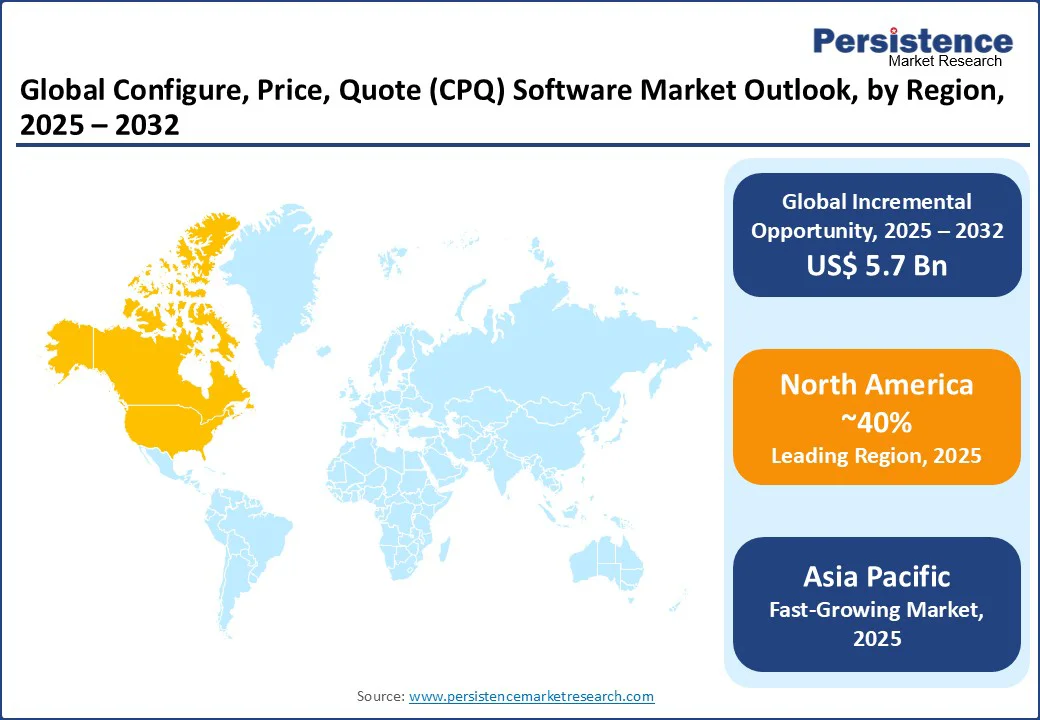
North America is expected to hold a dominant 40% share of the global Configure, Price, Quote (CPQ) software market in 2025, driven by strong technological adoption and the presence of leading industry players. The region benefits from advanced digital infrastructure and the concentration of major technology hubs in the United States, including Silicon Valley, which fosters innovation and early adoption of advanced sales automation solutions. Enterprises across industries such as manufacturing, IT and telecom, BFSI, and healthcare are increasingly adopting CPQ tools to streamline complex sales processes and improve customer engagement.

The high adoption of cloud-based solutions is another critical factor boosting market growth in the region. Cloud CPQ platforms offer scalability, real-time integration with CRM and ERP systems, and remote accessibility—features particularly important for geographically dispersed sales teams. Moreover, the growing demand for automation in sales processes is driving organizations to invest in AI-driven CPQ solutions that enable predictive pricing, personalized quoting, and faster deal closures. Supportive government initiatives promoting digital transformation and strong venture capital investments in SaaS-based platforms further enhance market expansion. Collectively, these factors position North America as the leading hub for CPQ software innovation and growth.

Europe Configure, Price, Quote (CPQ) Software Market Trends

Europe holds a significant share in the CPQ software market, driven by advanced technological adoption, stringent regulatory frameworks, and growing demand for automation in sales processes. Leading countries include Germany, the UK, and France. Germany benefits from its strong industrial base, with companies such as SAP investing heavily in CPQ solutions to cater to the manufacturing and automotive sectors. The UK’s market is supported by increasing adoption in BFSI and retail, driven by the need for dynamic pricing and compliance with GDPR. France’s market is fueled by advancements in cloud-based CPQ solutions and a focus on digital transformation in SMEs. The EU’s stringent data privacy regulations, such as GDPR, ensure high standards for CPQ software, though compliance increases costs. The region’s focus on sustainability and automation, coupled with growing demand in manufacturing and retail, is driving steady market growth from 2025 to 2032.

Asia Pacific Configure, Price, Quote (CPQ) Software Market Trends

Asia Pacific is emerging as the fastest-growing market for Configure, Price, Quote (CPQ) software, driven by rapid digitalization, increasing enterprise adoption of advanced sales automation tools, and the expansion of IT infrastructure across key economies such as China, India, Japan, and South Korea. The region’s booming e-commerce industry, coupled with the rising demand for personalized customer experiences, is encouraging businesses to deploy CPQ solutions that enable accurate product configuration, dynamic pricing, and faster quote generation.

Enterprises in manufacturing, IT and telecom, automotive, and retail sectors are leading the adoption curve, as they seek to optimize complex sales cycles and improve operational efficiency. Cloud-based CPQ platforms are particularly gaining traction due to their cost-effectiveness, scalability, and ability to support remote teams-factors critical for SMEs that form the backbone of the Asia Pacific’s economy. For instance, retailers using SAP CPQ have reported up to a 20% increase in online sales conversion rates, reflecting the platform’s impact on driving e-commerce growth.
global-configure-price-quote-cpq-software-market-outlook-by-region-2025–2032

Competitive Landscape

The global Configure, Price, Quote (CPQ) Software Market is characterized by intense competition, regional strengths, and a mix of global and niche players. In developed regions such as North America and Europe, large firms such as Oracle, SAP, and Microsoft dominate through scale, advanced R&D capabilities, and established partnerships with enterprises. In the Asia Pacific, rapid digitalization and increasing demand for automation are attracting significant investments from both international players, such as Salesforce (Apttus) and Zilliant, and regional vendors. Companies are focusing on product innovation, cloud-based solutions, and strategic alliances to gain a competitive edge. The development of AI-powered and cloud-based CPQ solutions has emerged as a key differentiator, enabling faster adoption in manufacturing, retail, and IT sectors. Strategic collaborations, acquisitions, and digital-first approaches for supply chain and marketing are further intensifying the competitive landscape. The industry exhibits a dual nature, consolidated at the top by global giants while remaining fragmented across numerous regional and niche players catering to local preferences and cost-sensitive segments.

Key Developments

  • In March 2025, Oracle’s Fusion Cloud CPQ was named a Leader in the Forrester Wave™: Configure, Price, Quote Solutions, Q1 2025, earning the highest score in the Strategy category. It was also praised for its AI-first innovation strategy and API-first, composable platform design.
  • In March 2025, Zilliant CPQ launched on the SAP Store, integrating with SAP S/4HANA, ERP, and Sales Cloud, and delivering AI-powered pricing guidance into SAP-centric workflows.

Companies Covered in Configure, Price, Quote (CPQ) Software Market

  • Oracle
  • Nuspark
  • Vendavo
  • Apttus
  • SAP
  • Microsoft
  • PandaDoc
  • Zilliant
  • QuoteWerks
  • Configure One
  • DealHub
  • Others
Frequently Asked Questions

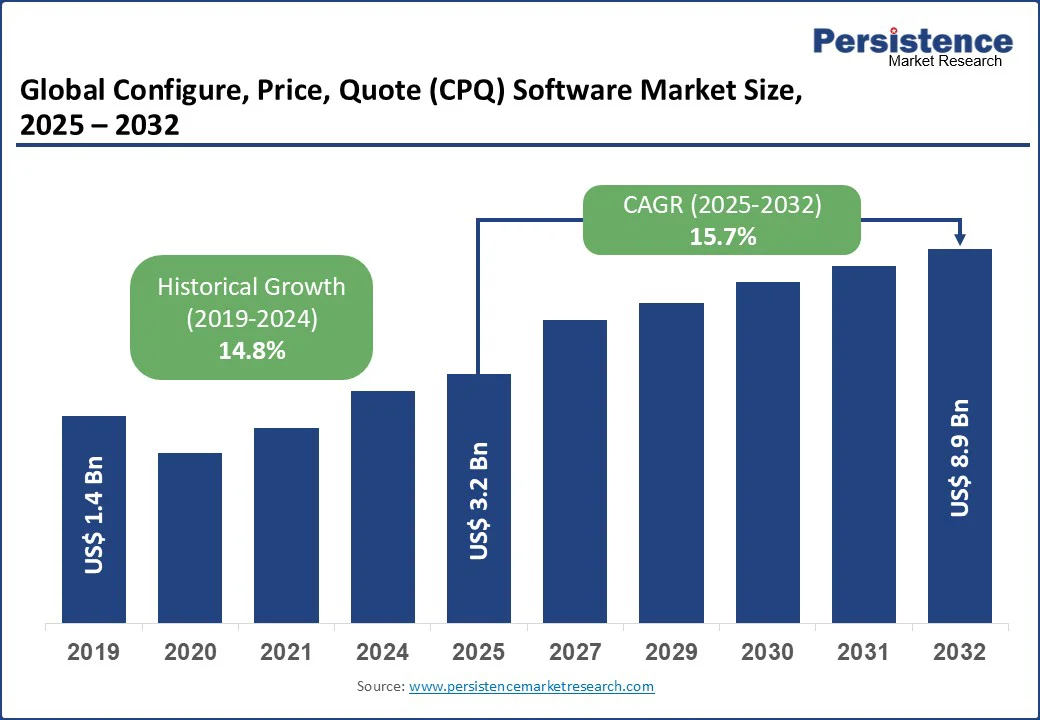
The global Configure, Price, Quote (CPQ) Software Market is projected to reach US$ 3.2 Bn in 2025.

The increasing demand for automation in complex sales processes is a key driver.

The CPQ software market is poised to witness a CAGR of 15.7% from 2025 to 2032.

Advancements in AI and cloud-based CPQ solutions are a key opportunity.

Oracle, SAP, Microsoft, Salesforce (Apttus), and Zilliant are key players.

Global Configure, Price, Quote (CPQ) Software Market Report Scope

Report Attribute

Details

Historical Data/Actuals

2019 - 2024

Forecast Period

2025 - 2032

Market Analysis

Value: US$ Bn, Volume: As Applicable

Geographical Coverage

  • North America
  • Europe
  • East Asia
  • South Asia and Oceania
  • Latin America
  • Middle East and Africa

Segmental Coverage

  • Deployment Type
  • End-Use
  • Sales Channel
  • Region

Competitive Analysis

  • Oracle
  • Nuspark
  • Vendavo
  • Apttus
  • SAP
  • Microsoft
  • PandaDoc
  • Zilliant
  • QuoteWerks
  • Configure One
  • DealHub
  • Others

Report Highlights

  • Market Forecast and Trends
  • Competitive Intelligence and Share Analysis
  • Growth Factors and Challenges
  • Strategic Growth Initiatives
  • Pricing Analysis
  • Future Opportunities and Revenue Pockets
  • Market Analysis Tools

Customization and Pricing

  • Available upon request
Market Segmentation

By Deployment Type

  • Cloud
  • On-Premise

By End-Use

  • Manufacturing
  • Healthcare and Life Sciences
  • IT and Telecom
  • BFSI
  • Retail and E-Commerce
  • Automotive
  • Others

By Sales Channel

  • Direct Sales
  • Independent Software Vendor Channel
  • Hyperscaler Cloud Marketplace
  • System Integrator / VAR Channel

By Region

  • North America
  • Europe
  • East Asia
  • South Asia and Oceania
  • Latin America
  • Middle East and Africa

Related Reports

  1. Executive Summary
    1. Global Configure, Price, Quote (CPQ) Software Market Snapshot, 2025 and 2032
    2. Market Opportunity Assessment, 2025 - 2032, US$ Bn
    3. Key Market Trends
    4. Future Market Projections
    5. Premium Market Insights
    6. Industry Developments and Key Market Events
    7. PMR Analysis and Recommendations
  2. Market Overview
    1. Market Scope and Definition
    2. Market Dynamics
      1. Drivers
      2. Restraints
      3. Opportunity
      4. Challenges
      5. Key Trends
    3. COVID-19 Impact Analysis
    4. Forecast Factors - Relevance and Impact
  3. Value Added Insights
    1. Value Chain Analysis
    2. Key Market Players
    3. Regulatory Landscape
    4. PESTLE Analysis
    5. Porter’s Five Force Analysis
    6. Consumer Behavior Analysis
  4. Price Trend Analysis, 2019 - 2032
    1. Key Factors Impacting Product Prices
    2. Pricing Analysis, By Deployment Type
    3. Regional Prices and Product Preferences
  5. Global Configure, Price, Quote (CPQ) Software Market Outlook
    1. Market Size (US$ Bn) Analysis and Forecast
      1. Historical Market Size (US$ Bn) Analysis, 2019-2024
      2. Market Size (US$ Bn) Analysis and Forecast, 2025-2032
    2. Global Configure, Price, Quote (CPQ) Software Market Outlook: Deployment Type
      1. Historical Market Size (US$ Bn) Analysis, By Deployment Type, 2019-2024
      2. Market Size (US$ Bn) Analysis and Forecast, By Deployment Type, 2025-2032
        1. Cloud
        2. On-Premise
      3. Market Attractiveness Analysis: Deployment Type
    3. Global Configure, Price, Quote (CPQ) Software Market Outlook: End-use
      1. Historical Market Size (US$ Bn) Analysis, By End-use, 2019-2024
      2. Market Size (US$ Bn) Analysis and Forecast, By End-use, 2025-2032
        1. Manufacturing
        2. Healthcare and Life Sciences
        3. IT and Telecom
        4. BFSI
        5. Retail and E-Commerce
        6. Automotive
        7. Others
      3. Market Attractiveness Analysis: End-use
    4. Global Configure, Price, Quote (CPQ) Software Market Outlook: Sales Channel
      1. Historical Market Size (US$ Bn) Analysis, By Sales Channel, 2019-2024
      2. Market Size (US$ Bn) Analysis and Forecast, By Sales Channel, 2025-2032
        1. Direct Sales
        2. Independent Software Vendor Channel
        3. Hyperscaler Cloud Marketplace
        4. System Integrator / VAR Channel
      3. Market Attractiveness Analysis: Sales Channel
  6. Global Configure, Price, Quote (CPQ) Software Market Outlook: Region
    1. Historical Market Size (US$ Bn) Analysis, By Region, 2019-2024
    2. Market Size (US$ Bn) Analysis and Forecast, By Region, 2025-2032
      1. North America
      2. Latin America
      3. Europe
      4. East Asia
      5. South Asia and Oceania
      6. Middle East & Africa
    3. Market Attractiveness Analysis: Region
  7. North America Configure, Price, Quote (CPQ) Software Market Outlook
    1. Historical Market Size (US$ Bn) Analysis, By Market, 2019-2024
      1. By Country
      2. By Deployment Type
      3. By End-use
      4. By Sales Channel
    2. Market Size (US$ Bn) Analysis and Forecast, By Country, 2025-2032
      1. U.S.
      2. Canada
    3. Market Size (US$ Bn) Analysis and Forecast, By Deployment Type, 2025-2032
      1. Cloud
      2. On-Premise
    4. Market Size (US$ Bn) Analysis and Forecast, By End-use, 2025-2032
      1. Manufacturing
      2. Healthcare and Life Sciences
      3. IT and Telecom
      4. BFSI
      5. Retail and E-Commerce
      6. Automotive
      7. Others
    5. Market Size (US$ Bn) Analysis and Forecast, By Sales Channel, 2025-2032
      1. Direct Sales
      2. Independent Software Vendor Channel
      3. Hyperscaler Cloud Marketplace
      4. System Integrator / VAR Channel
    6. Market Attractiveness Analysis
  8. Europe Configure, Price, Quote (CPQ) Software Market Outlook
    1. Historical Market Size (US$ Bn) Analysis, By Market, 2019-2024
      1. By Country
      2. By Deployment Type
      3. By End-use
      4. By Sales Channel
    2. Market Size (US$ Bn) Analysis and Forecast, By Country, 2025-2032
      1. Germany
      2. France
      3. U.K.
      4. Italy
      5. Spain
      6. Russia
      7. Rest of Europe
    3. Market Size (US$ Bn) Analysis and Forecast, By Deployment Type, 2025-2032
      1. Cloud
      2. On-Premise
    4. Market Size (US$ Bn) Analysis and Forecast, By End-use, 2025-2032
      1. Manufacturing
      2. Healthcare and Life Sciences
      3. IT and Telecom
      4. BFSI
      5. Retail and E-Commerce
      6. Automotive
      7. Others
    5. Market Size (US$ Bn) Analysis and Forecast, By Sales Channel, 2025-2032
      1. Direct Sales
      2. Independent Software Vendor Channel
      3. Hyperscaler Cloud Marketplace
      4. System Integrator / VAR Channel
    6. Market Attractiveness Analysis
  9. East Asia Configure, Price, Quote (CPQ) Software Market Outlook
    1. Historical Market Size (US$ Bn) Analysis, By Market, 2019-2024
      1. By Country
      2. By Deployment Type
      3. By End-use
      4. By Sales Channel
    2. Market Size (US$ Bn) Analysis and Forecast, By Country, 2025-2032
      1. China
      2. Japan
      3. South Korea
    3. Market Size (US$ Bn) Analysis and Forecast, By Deployment Type, 2025-2032
      1. Cloud
      2. On-Premise
    4. Market Size (US$ Bn) Analysis and Forecast, By End-use, 2025-2032
      1. Manufacturing
      2. Healthcare and Life Sciences
      3. IT and Telecom
      4. BFSI
      5. Retail and E-Commerce
      6. Automotive
      7. Others
    5. Market Size (US$ Bn) Analysis and Forecast, By Sales Channel, 2025-2032
      1. Direct Sales
      2. Independent Software Vendor Channel
      3. Hyperscaler Cloud Marketplace
      4. System Integrator / VAR Channel
    6. Market Attractiveness Analysis
  10. South Asia & Oceania Configure, Price, Quote (CPQ) Software Market Outlook
    1. Historical Market Size (US$ Bn) Analysis, By Market, 2019-2024
      1. By Country
      2. By Deployment Type
      3. By End-use
      4. By Sales Channel
    2. Market Size (US$ Bn) Analysis and Forecast, By Country, 2025-2032
      1. India
      2. Indonesia
      3. Thailand
      4. Singapore
      5. ANZ
      6. Rest of South Asia & Oceania
    3. Market Size (US$ Bn) Analysis and Forecast, By Deployment Type, 2025-2032
      1. Cloud
      2. On-Premise
    4. Market Size (US$ Bn) Analysis and Forecast, By End-use, 2025-2032
      1. Manufacturing
      2. Healthcare and Life Sciences
      3. IT and Telecom
      4. BFSI
      5. Retail and E-Commerce
      6. Automotive
      7. Others
    5. Market Size (US$ Bn) Analysis and Forecast, By Sales Channel, 2025-2032
      1. Direct Sales
      2. Independent Software Vendor Channel
      3. Hyperscaler Cloud Marketplace
      4. System Integrator / VAR Channel
    6. Market Attractiveness Analysis
  11. Latin America Configure, Price, Quote (CPQ) Software Market Outlook
    1. Historical Market Size (US$ Bn) Analysis, By Market, 2019-2024
      1. By Country
      2. By Deployment Type
      3. By End-use
      4. By Sales Channel
    2. Market Size (US$ Bn) Analysis and Forecast, By Country, 2025-2032
      1. Brazil
      2. Mexico
      3. Rest of Latin America
    3. Market Size (US$ Bn) Analysis and Forecast, By Deployment Type, 2025-2032
      1. Cloud
      2. On-Premise
    4. Market Size (US$ Bn) Analysis and Forecast, By End-use, 2025-2032
      1. Manufacturing
      2. Healthcare and Life Sciences
      3. IT and Telecom
      4. BFSI
      5. Retail and E-Commerce
      6. Automotive
      7. Others
    5. Market Size (US$ Bn) Analysis and Forecast, By Sales Channel, 2025-2032
      1. Direct Sales
      2. Independent Software Vendor Channel
      3. Hyperscaler Cloud Marketplace
      4. System Integrator / VAR Channel
    6. Market Attractiveness Analysis
  12. Middle East & Africa Configure, Price, Quote (CPQ) Software Market Outlook
    1. Historical Market Size (US$ Bn) Analysis, By Market, 2019-2024
      1. By Country
      2. By Deployment Type
      3. By End-use
      4. By Sales Channel
    2. Market Size (US$ Bn) Analysis and Forecast, By Country, 2025-2032
      1. GCC Countries
      2. Egypt
      3. South Africa
      4. Northern Africa
      5. Rest of Middle East & Africa
    3. Market Size (US$ Bn) Analysis and Forecast, By Deployment Type, 2025-2032
      1. Cloud
      2. On-Premise
    4. Market Size (US$ Bn) Analysis and Forecast, By End-use, 2025-2032
      1. Manufacturing
      2. Healthcare and Life Sciences
      3. IT and Telecom
      4. BFSI
      5. Retail and E-Commerce
      6. Automotive, Others
    5. Market Size (US$ Bn) Analysis and Forecast, By Sales Channel, 2025-2032
      1. Direct Sales
      2. Independent Software Vendor Channel
      3. Hyperscaler Cloud Marketplace
      4. System Integrator / VAR Channel
    6. Market Attractiveness Analysis
  13. Competition Landscape
    1. Market Share Analysis, 2024
    2. Market Structure
      1. Competition Intensity Mapping by Market
      2. Competition Dashboard
    3. Company Profiles (Details - Overview, Financials, Strategy, Recent Developments)
      1. Oracle
        1. Overview
        2. Segments and Deployment Type
        3. Key Financials
        4. Market Developments
        5. Market Strategy
      2. Nuspark
      3. Vendavo
      4. Apttus
      5. SAP
      6. Microsoft
      7. PandaDoc
      8. Zilliant
      9. QuoteWerks
      10. Configure One
      11. DealHub
      12. Others
  14. Appendix
    1. Research Methodology
    2. Research Assumptions
    3. Acronyms and Abbreviations

Research Methodology Framework for Market Research Excellence

At Persistence Market Research, we implement a comprehensive, validated, and multi-dimensional approachto market analysis that delivers actionable insights across complex market landscapes. Our methodology combines the analytical rigor of leading consulting firms with innovative research techniques, ensuring robust market assessments that guide strategic decision-making with confidence.

Core Research Philosophy

Our methodology is built on four foundational pillars:

Research Philosophy Image

At Persistence Market Research, our methodology is designed to transcend conventional market studies by combining analytical rigor, multi-source validation, and future-focused insights.

We integrate advanced research frameworks, robust data collection strategies, cutting-edge analytics, and innovative technologies to deliver a 360-degree view of complex markets.

We integrate advanced research frameworks, robust data collection strategies, cutting-edge analytics, and innovative technologies to deliver a 360-degree view of complex markets.

Each stage spanning from strategic scoping and hypothesis-building to competitive intelligence, quality validation, and actionable recommendations is engineered to provide clients with unmatched clarity, precision, and confidence in decision-making.

By embedding innovation and technology at the core, our approach ensures that insights are not only comprehensive but also predictive, empowering businesses to seize opportunities, mitigate risks, and achieve sustainable growth

Research Philosophy Image

Capturing Key Information and Events

During this phase, key research objectives focus on essential information and data points for assessing the market, including:

Research Philosophy Image

TAM-SAM-SOM Framework Implementation

We employ both top-down and bottom-up approaches to ensure accurate market sizing.

Top-Down Market SizingBottom-Up Market Sizing
Universe Definition: Total global/regional market identificationUnit Economics: Average transaction values, purchase frequencies, customer lifecycle
Segmentation Filters: Geographic, demographic, and behavioral constraintsCustomer Segmentation: Detailed buyer persona development and sizing
Market Share Analysis: Competitive landscape assessment and share allocationPenetration Analysis: Market penetration rates by segment and geography
Growth Rate Application: Historical trends and forward-looking growth assumptionsScaling Methodology: Extrapolation techniques with confidence intervals

Validation & Cross-Verification

  • Triangulation: Comparing top-down and bottom-up results for consistency
  • Sensitivity Analysis: Testing key assumptions and parameter variations
  • Peer Benchmarking: Comparison with analogous markets and industry benchmarks
  • Expert Review: External validation through industry specialist consultation

Research Philosophy Image

Forecasting & Projection Modeling

Our proprietary forecasting models incorporate multiple variables and scenarios.

Forecasting Components

  • Historical Trend Analysis: 10-year historical growth patterns and cyclical variations
  • Driver-Based Modeling: Economic indicators, demographic shifts, technology adoption
  • Scenario Planning: Base case, optimistic, and conservative projections
  • Monte Carlo Simulations: Probability-weighted outcomes and risk assessments

Model Validation

  • Back-Testing: Historical accuracy assessment over 3–5-year periods
  • Cross-Validation: Multiple modeling approaches for result comparison
  • External Benchmarking: Comparison with established market forecasts
  • Continuous Calibration: Quarterly model updates based on new data

Comprehensive Data Collection Strategy

Our secondary research phase establishes a robust knowledge base utilizing diverse, credible sources.

Secondary Data Sourcess

  • Industry Publications & Reports
  • Government & Regulatory Data
  • Financial Intelligence (filings & reports)
  • Academic Research & Digital Intelligence

Quality Assurance Protocol

  • Source credibility assessment and publication date validation
  • Data consistency checks across multiple sources
  • Bias identification and neutralization techniques
  • Information gap tracking for primary research prioritization

Research Philosophy Image

Primary Research Excellence

Our primary research methodology employs best-in-class techniques to capture unique market insights.

Quantitative Research Methods

  • Large-Scale Surveys: Statistically representative samples with 95% confidence intervals
  • Survey Methodology: Multi-channel deployment (online, telephone, in-person)
  • Question Architecture and Response Optimization

Qualitative Research Methods

  • Executive Interviews
  • Focus Groups
  • Expert Consultations

Quality Assurance & Validation Framework

Multi-Stage Validation Process

  • Source Verification and Consistency Testing
  • Outlier Detection and Bias Assessment
  • Peer Review Process and External Validation
  • Sensitivity Analysis and Confidence Intervals

Research Philosophy Image

Methodology Validation & Credibility

Our research methodology has been extensively validated through:

  • Academic Partnerships: Collaborations with top-tier business schools and research institutions
  • Client Success Stories: Documented case studies demonstrating research impact and ROI
  • Continuous Benchmarking: Performance comparison with leading global research firms

This comprehensive methodology framework positions Persistence Market Research at the forefront of market intelligence, combining the analytical sophistication of top-tier consulting firms with innovative research techniques. Our approach ensures that every market assessment delivers precise, actionable, and strategically valuable insights that drive business success in competitive market environments.

Ready to unlock your market potential? Contact our research experts to discuss how our validated methodology can transform your strategic decision-making with data-driven market intelligence.

Copyright © 2026 Persistence Market Research. All Rights Reserved

Connect With Us -
CPQ Software Market Size, Share & Forecast 2025 - 2032