




- Food Ingredients & Additives
- Confectionery Flavors Market
Confectionery Flavors Market Size, Share, and Growth Forecast, 2026 - 2033
Confectionery Flavors Market by Flavor Type (Sweet Flavors, Vanilla Flavors, Fruit Flavors, Mint Flavors), Form (Liquid, Powder, Syrup), Application (Hard & Soft Candies, Chewing Gum, Popcorn, Meringues), and Regional Analysis for 2026 - 2033

Confectionery Flavors Market Size and Trends Analysis
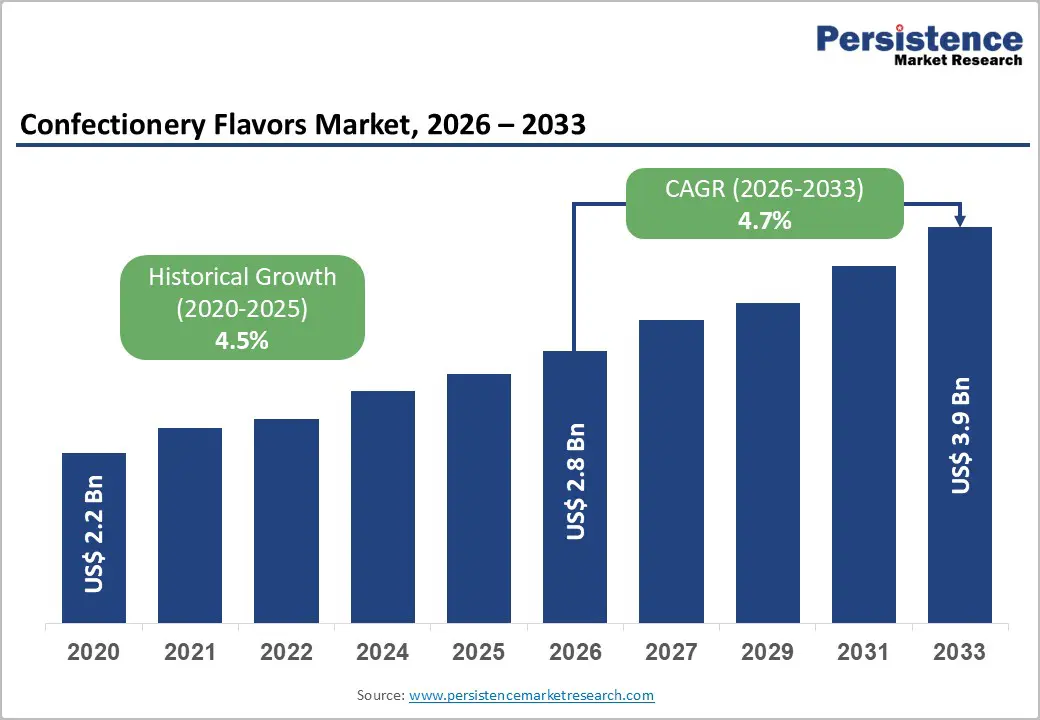
The global confectionery flavors market size is likely to be valued at US$2.8 billion in 2026 and is expected to reach US$3.9 billion by 2033, growing at a CAGR of 4.7% during the forecast period from 2026 to 2033, driven by evolving consumer preferences for unique, indulgent, and regionally inspired taste experiences across candies, gums, chocolates, and related products.
Recent developments include the rise of swicy (sweet + spicy) flavor innovations and multi-sensory profiles combining taste and texture.
Key Industry Highlights:
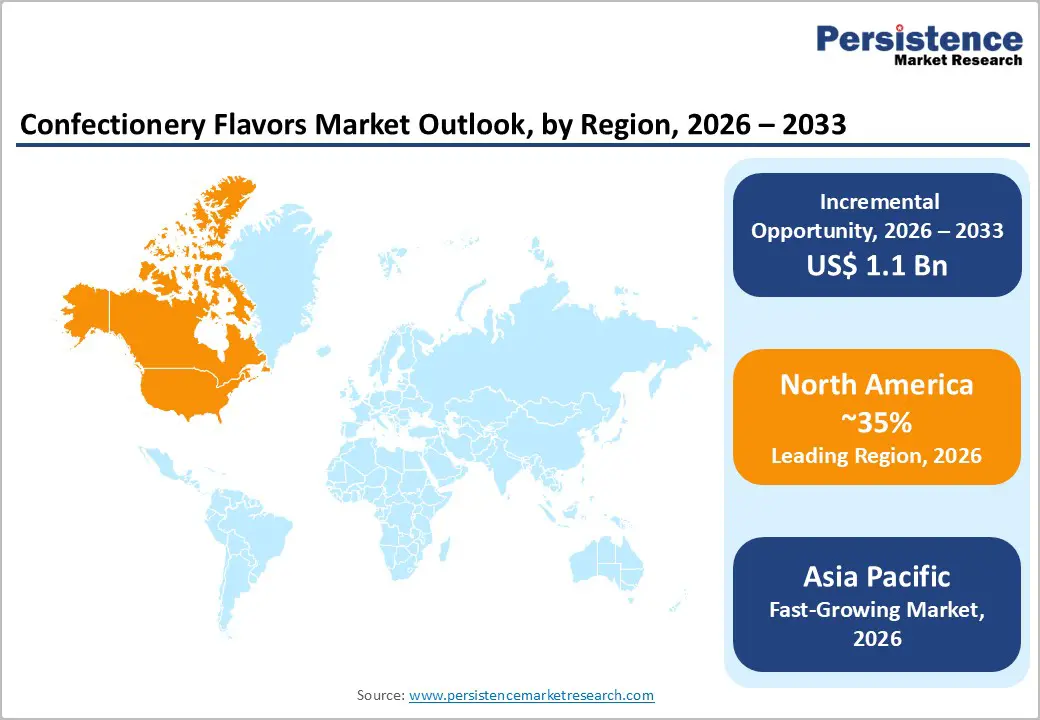
- Leading Region: North America is anticipated to be the leading region, accounting for a market share of 35% in 2026, driven by strong U.S. confectionery consumption, advanced flavor innovation, and a well-established regulatory framework.
- Fastest-growing Region: Asia Pacific is likely to be the fastest-growing region, supported by expanding middle-class consumption and strong regional manufacturing advantages.
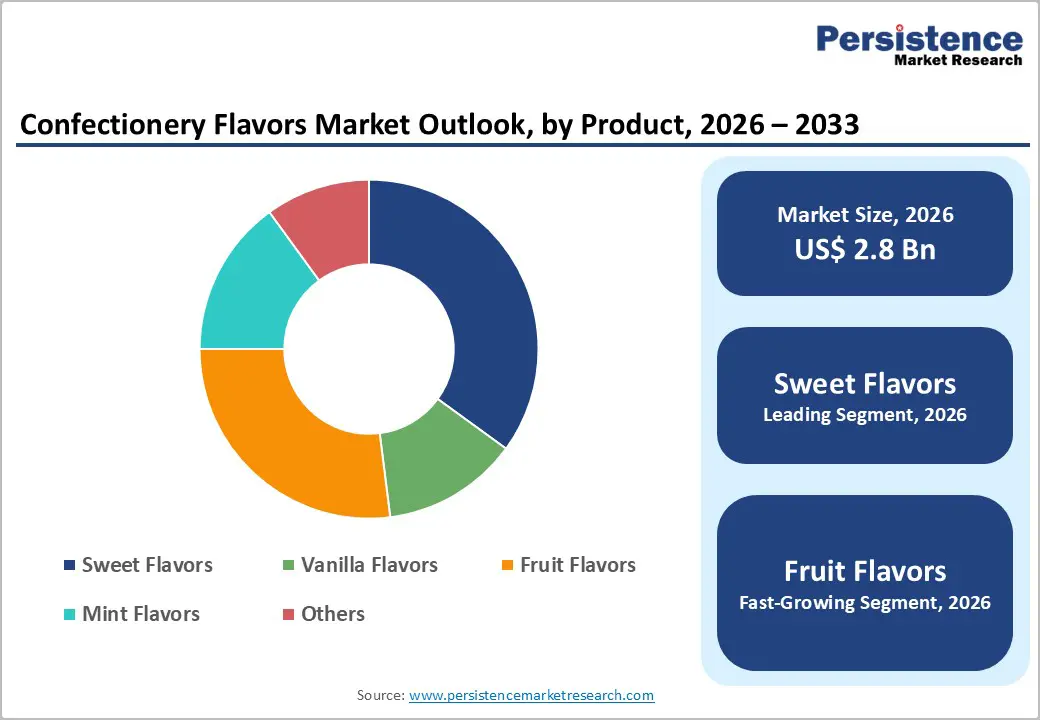
- Leading Flavor Type: Sweet is projected to represent the leading flavor type in 2026, accounting for 40% of the revenue share, driven by their widespread use across mass confectionery products and consistent consumer preference for classic sweet taste profiles.
- Leading Form Type: Liquid is anticipated to be the leading form type, accounting for over 50% of the revenue share in 2026, supported by its ease of integration, superior solubility, and widespread use in large-scale confectionery processing.
- Key Opportunity: A key recent shift in the confectionery flavors market is the growing demand for experience-based flavors featuring interactive, multi-sensory elements such as popping, sour bursts, layered textures, and mystery taste concepts to boost consumer engagement.
| Key Insights | Details |
|---|---|
| Confectionery Flavors Market Size (2026E) | US$2.8 Bn |
| Market Value Forecast (2033F) | US$3.9 Bn |
| Projected Growth (CAGR 2026 to 2033) | 4.7% |
| Historical Market Growth (CAGR 2020 to 2025) | 4.5% |
DRO Analysis
Driver - Rising Demand for Innovative and Diverse Flavor Profiles in Confectionery Products
Consumers increasingly seek unique and diverse flavor experiences in confectionery, driving manufacturers to expand beyond traditional taste profiles. Demand for exotic, fusion, and regionally inspired flavors such as tropical fruits, spice-infused sweets, and botanical blends is growing across markets. This shift is particularly evident in younger demographics who value novelty and sensory engagement in snacking.
According to the U.S. FDA (2024-2025), all flavoring ingredients in confectionery must be approved as food additives or classified as GRAS, while stricter regulatory scrutiny on additives and colorants is driving the industry toward safer, clean-label, and compliant flavor formulations.
Seasonal and limited-edition flavor launches are becoming a key strategy for maintaining consumer interest and encouraging repeat purchases. Clean-label and natural flavor trends also intersect with innovation, requiring companies to develop authentic taste profiles without synthetic additives. The rise of premium confectionery amplifies the need for complex, layered flavor systems that deliver indulgent experiences.
Restraint - Health and Wellness Trends: Reducing Sugar Confectionery Appeal
Increasing consumer focus on health and wellness is gradually impacting the demand for traditional sugar-based confectionery products, thereby influencing the flavor market. Rising awareness of issues such as obesity, diabetes, and excessive sugar consumption has led many consumers to limit their intake of sweets. This shift is particularly strong among urban and health-conscious populations, who are actively seeking low-sugar or sugar-free alternatives.
Companies are reformulating products with alternative sweeteners and reduced sugar content, which creates complexities in flavor development. Sugar reduction often alters taste perception, requiring advanced flavor masking and enhancement techniques to maintain the desired sensory experience. Stricter labeling regulations and clean-label expectations limit the use of certain artificial additives, constraining formulation flexibility.
Opportunity - Technological Convergence in Flavor Delivery Systems
Techniques such as encapsulation, controlled release systems, and nano-emulsions are enabling more precise flavor distribution and enhanced stability in confectionery products. These innovations allow manufacturers to improve taste consistency, extend shelf life, and deliver multi-layered sensory experiences. Advanced flavor delivery systems help maintain taste intensity and product quality in reduced-sugar and functional confectionery, enabling next-generation product innovation across markets.
The integration of digital tools and data-driven formulation is accelerating innovation in flavor development. Artificial intelligence and predictive analytics are being used to identify emerging consumer taste trends and optimize flavor combinations more efficiently, reducing development time and cost. For example, DSM-Firmenich, which has expanded its use of advanced flavor modulation and encapsulation technologies to enhance sugar-reduced confectionery applications while maintaining full taste impact.
Category-wise Analysis
Flavor Type Insights
Sweet flavors are expected to lead the confectionery flavors market, accounting for approximately 40% of revenue in 2026, driven by extensive usage across high-volume confectionery products such as caramels, toffees, fondants, and chocolate coatings, where consistent sweetness is essential to consumer acceptance. These flavors provide a stable base profile that supports layering with other notes, making them highly versatile across product categories. For example, caramel-flavored fillings in chocolate bars widely use sweet flavor systems to maintain uniform taste and appeal across markets.
Fruit flavors are likely to represent the fastest-growing segment, supported by rising consumer preference for refreshing, tangy, and exotic taste experiences, particularly in gummies, jellies, and sour candies. Increasing demand for natural and clean-label fruit extracts supports expansion, as consumers associate fruit-based flavors with freshness and authenticity. For example, tropical fruit-flavored gummies, such as mango or passionfruit variants, have gained popularity in Asia Pacific.
Form Type Insights
Liquid form is projected to lead the market, capturing around 50% of the revenue share in 2026, supported by ease of incorporation into confectionery processing systems, particularly in mixing, coating, and emulsification stages. Liquid flavors offer superior solubility and uniform dispersion in molten or semi-liquid bases, ensuring consistent taste across batches in high-volume manufacturing. For example, liquid flavor systems are extensively used in chocolate manufacturing to evenly distribute vanilla or caramel notes, ensuring a consistent sensory profile in finished products across different production lines.
The powder segment is likely to be the fastest-growing form type, driven by advantages such as extended shelf life, ease of storage, and compatibility with dry blending and encapsulation technologies. Powdered flavors also support clean-label formulations and precise dosing, making them suitable for modern confectionery applications requiring stability and flexibility. For example, powdered flavor systems are increasingly used in chewing gum production, where they enable controlled flavor release and long-lasting taste, demonstrating their expanding role in innovative confectionery formats.
Regional Insights
North America Confectionery Flavors Market Trends
North America is anticipated to be the leading region, accounting for a market share of 35% in 2026, driven by strong demand for classic yet evolving flavor profiles, supported by high consumption and continuous product innovation. Traditional flavors such as chocolate, vanilla, caramel, and nut-based variants remain dominant, but there is a growing shift toward seasonal, limited-edition, and fusion flavors driven by consumer demand for novelty.
Health-conscious trends are also influencing the market, with increasing adoption of reduced-sugar and functional flavor systems requiring advanced masking technologies. The region benefits from a highly developed retail ecosystem and strong R&D capabilities, enabling rapid commercialization of new flavor concepts. For example, The Hershey Company exemplifies this trend through continuous innovation in flavored chocolate variants and seasonal launches, strengthening product differentiation and consumer engagement.
Europe Confectionery Flavors Market Trends
Europe is likely to be a significant market for confectionery flavors, due to strong emphasis on premiumization, natural ingredients, and regulatory compliance. Consumers show a high preference for authentic, clean-label, and sustainably sourced flavors, including natural fruit extracts, botanical infusions, and high-quality cocoa-based profiles. The region’s rich confectionery heritage supports demand for sophisticated flavor systems such as praline, gianduja, and dark chocolate variants.
Strict regulations on additives and labeling push manufacturers toward transparent and traceable sourcing practices. For example, Nestlé has expanded its confectionery portfolio in Europe with clean-label and sustainably sourced cocoa products while introducing premium flavor variants aligned with regional taste preferences. Innovation across the region is focused on artisanal quality, organic formulations, and ethical sourcing, with sustainability playing a central role. Flavor development also reflects a balance between traditional profiles and growing demand for exotic and experimental flavor combinations.
Asia Pacific Confectionery Flavors Market Trends
The Asia Pacific region is likely to be the fastest-growing region, driven by rapid urbanization, rising disposable incomes, and increasing exposure to Western snacking habits. The region demonstrates strong demand for both flavors and localized taste profiles such as matcha, lychee, mango, and spice-infused combinations. Innovation cycles are faster, with manufacturers frequently introducing new products tailored to regional preferences and social media-driven trends.
Texture and multi-sensory experiences also play a significant role, requiring advanced flavor stability in diverse formulations. For example, Meiji Holdings highlights this trend by incorporating region-specific flavors such as matcha into chocolates and sweets, aligning with local consumer preferences. The tradition of confectionery gifting during festivals, corporate occasions, and seasonal events in Asia Pacific region, where premium chocolates and curated sweet boxes are increasingly purchased as luxury gift items for celebrations.
Competitive Landscape
The global confectionery flavors market exhibits a moderately fragmented structure, driven by strong consolidation among multinational flavor houses and rising regional competition. The market is dominated by a few leaders with advanced R&D capabilities, extensive distribution networks, and strong customer partnerships across confectionery manufacturers. Despite fragmentation at the regional level, players control a significant share due to innovation leadership and large-scale supply capabilities.
With key leaders including Givaudan, Symrise, International Flavors & Fragrances, DSM-Firmenich, and Kerry Group, along with regional and niche players such as MANE, Robertet, and Takasago. These firms collectively shape pricing, innovation, and product development standards in the industry. These players compete through continuous innovation in natural and clean-label flavors, advanced delivery systems such as encapsulation, and rapid product customization for regional tastes. Strategic mergers, acquisitions, and partnerships with confectionery brands are widely used to expand portfolios. Companies are also investing heavily in sustainable sourcing and sugar-reduction technologies to align with evolving consumer health trends.
Key Industry Developments:
- In April 2026, Iconic Candy expanded its Retro Sours confectionery range at Target retail stores in the United States, introducing four new fan-requested flavors for a limited-time launch. The expansion reflects growing consumer demand for nostalgic and sour candy profiles, along with strong retailer-driven product rotations in the confectionery segment.
- In April 2026, Sweet Venture Group introduced Gummi Popz™, a new-generation gummy candy described as the world’s first “popping gummy” experience, combining chewy texture with popping candy elements and layered flavor profiles. The launch is positioned as an innovation in the confectionery segment, targeting younger consumers who prefer interactive, multi-sensory, and customizable sweets over traditional gummies.
- In March 2026, Mondelez International expanded its Cadbury portfolio by introducing new limited-edition “Mystery Flavours” chocolate variants under the Cadbury brand, aimed at increasing consumer engagement through interactive and curiosity-driven product experiences. The launch reflects the growing industry trend of using surprise-based and experiential confectionery formats to boost impulse purchases and strengthen in-store engagement.
- In November 2025, Givaudan showcased its innovations at Fi Europe 2025 in Paris, where it launched a range of next-generation confectionery flavor solutions focused on functional, natural, and sensory-enhanced applications. The company highlighted rising consumer demand for health-oriented indulgence, including botanical flavors, clean-label formulations, and advanced chocolate and snack concepts.
Companies Covered in Confectionery Flavors Market
- Givaudan
- dsm-firmenich
- Symrise
- International Flavors & Fragrances (IFF)
- Kerry Group
- Takasago
- MANE
- Sensient Technologies
- T. Hasegawa
- Robertet
- Bell Flavors & Fragrances
- Huabao International
- Synergy Flavours
- Keva Flavours
- Flavorchem
Frequently Asked Questions
The global confectionery flavors market is projected to reach US$2.8 billion in 2026.
Rising demand for innovative, natural, and indulgent taste experiences in candies, chocolates, and gums drives the confectionery flavors market.
The confectionery flavors market is expected to grow at a CAGR of 4.7% from 2026 to 2033.
Expansion of clean-label, sugar-reduced, and functional confectionery products using advanced flavor delivery technologies creates key market opportunities.
Givaudan, DSM-Firmenich, Symrise, International Flavors & Fragrances, Kerry Group, and Takasago are the leading players.


