




- Nutraceuticals & Functional Foods
- Coenzyme Q10 Market
Coenzyme Q10 Market Size, Share, and Growth Forecast, 2025 - 2032
Coenzyme Q10 Market by Application (Dietary Supplements, Pharmaceutical, Cosmetics & Personal Care), Product Type (Ubiquinone, Ubiquinol), Form (Capsules, Powder, Liquid), and Regional Analysis for 2025-2032

Coenzyme Q10 Market Share and Trends Analysis
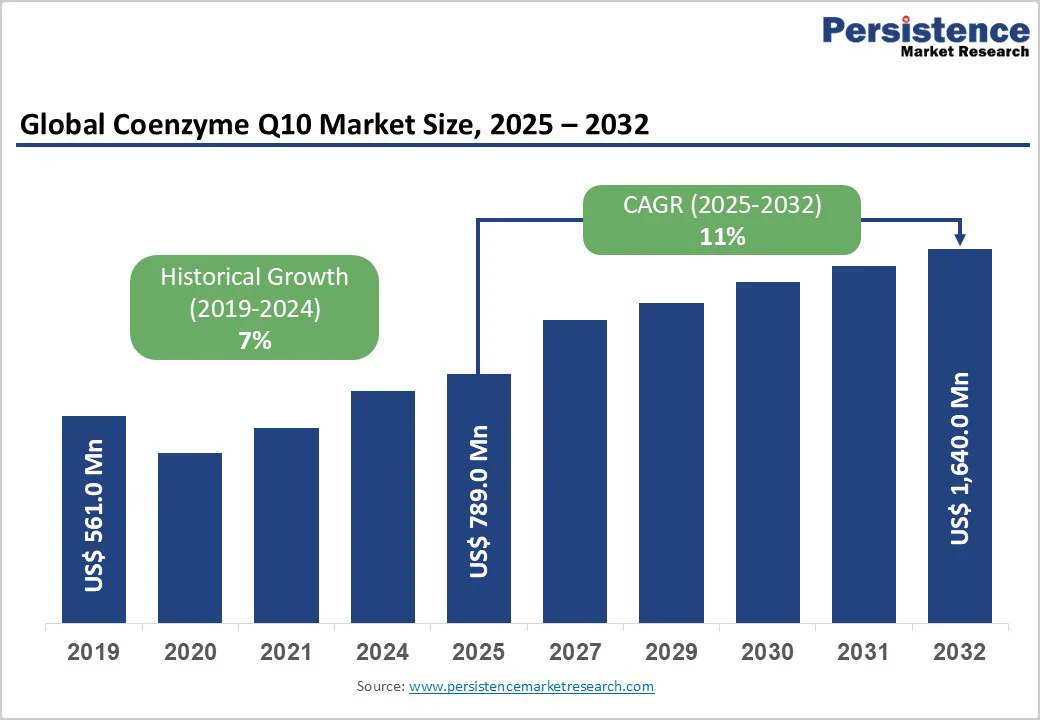
The global coenzyme Q10 market size is likely to be valued at US$ 789.0 million in 2025, and is estimated to reach US$ 1,640.0 million by 2032, growing at a CAGR of 11% during the forecast period 2025−2032. Primary growth drivers include increasing adoption in dietary supplements, expanding use in pharmaceutical applications, and rising consumer demand for natural ingredients in cosmetics and personal care products. Enhanced clinical evidence supporting health benefits, combined with regulatory approvals and innovation in product forms, underpins sustained market expansion. Technological improvements in manufacturing, especially in ubiquinol and nanoparticle-based formats, enable higher quality and bioavailability further driving uptake.
Key Industry Highlights
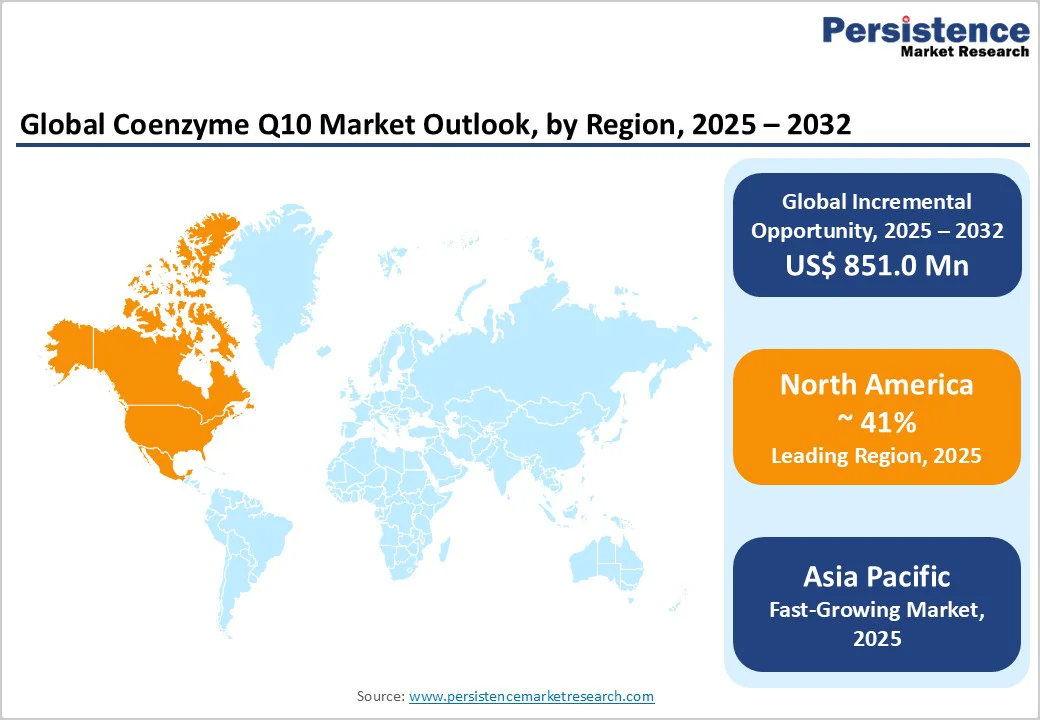
- Dominant Region: North America is set to command a significant portion of the coenzyme Q10 market share approximately 32% in 2025 due to its robust regulatory environment, advanced healthcare infrastructure, and strong industry collaboration.
- Fastest-growing Regional Market: Asia Pacific is likely to emerges as the fastest- growing regionmarket through 2032, propelled by its substantial manufacturing capabilities and favorable demographic trends.
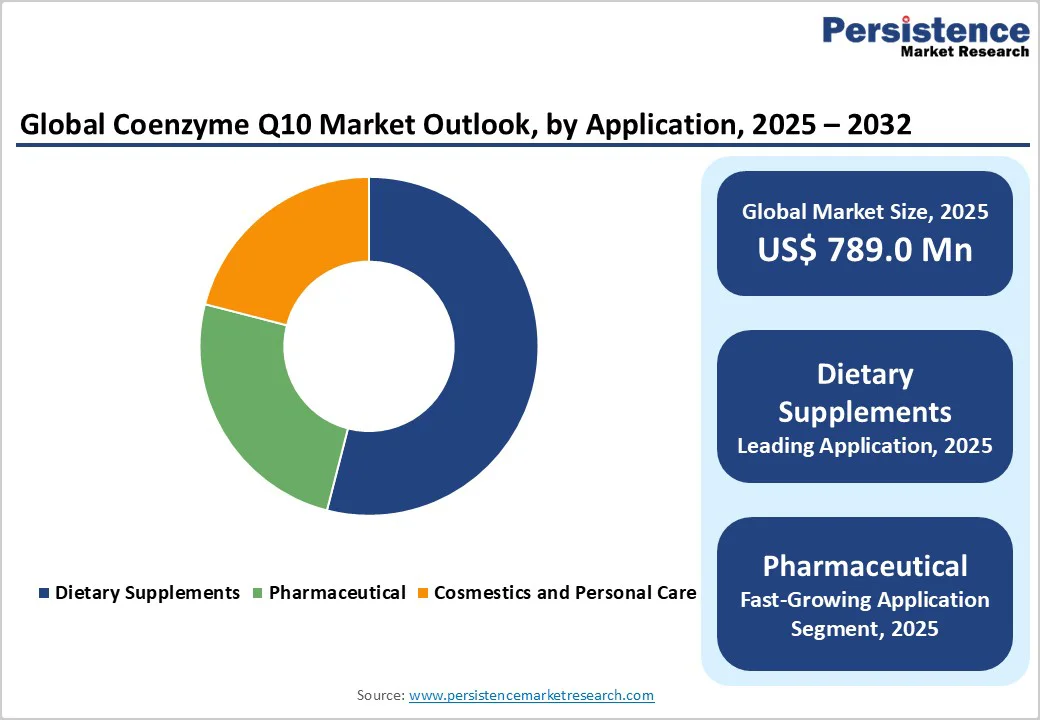
- Leading & Fastest-growing Applications: Dietary supplements segmentare slated to capture about 54% of the total coenzyme Q10 market share in 2025, while pharmaceutical is poised to be the fastest- growing segment in coenzyme Q10 market from 2025 to 2032.
- Leading Product Type: Ubiquinone product segment is expected to lead the leading with an approximateabout 62% market share in 2025, largely dueowing to its long-established effectiveness and reliability in dietary supplements and pharmaceutical preparations.
| Report Attribute | Details |
|---|---|
|
Coenzyme Q10 Market Size (2025E) |
US$ 789.0 Mn |
|
Market Value Forecast (2032F) |
US$ 1,640.0 Mn |
|
Projected Growth (CAGR 2025 to 2032) |
11% |
|
Historical Market Growth (CAGR 2019 to 2024) |
7% |
Market Factors – Growth, Barriers, and Opportunity Analysis
Advancements in Pharmaceutical Applications
Pharmaceutical-grade coenzyme Q10 plays an important role in developing therapies for neurodegenerative diseases, heart failure, and metabolic disorders, largelymainly due to its function as an antioxidant and a key ingredient in mitochondrial energy production. In neurodegenerative disorders, such as Parkinson’s, Alzheimer’s and Huntington’s, disease coenzyme Q10 has demonstrated neuroprotective effects in both laboratory and clinical contexts. This is rooted in its ability to stabilize mitochondrial function, reduce oxidative stress, and prevent neuronal damage that underlies disease progression.
Furthermore, in the area of heart failure and metabolic dysfunction, the inclusion of this ingredient in pharmaceutical regimens is based on evidence showing that it enhances cellular energy levels and improves the efficiency of cardiac muscle tissue. Its antioxidative and bioenergetic properties make it a valuable adjunct in managing chronic conditions, contributing to better patient outcomes and broader acceptance by healthcare professionals.
High Production Costs and Price Pressure
The manufacturing of coenzyme Q10, especially the higher-bioavailability ubiquinol form, involves complex extraction and purification steps that require multiple stages of solvent extraction, crystallization, and chromatographic refinement. These downstream processing steps are technically demanding and often utilize materials like adsorbent resins and silica gel components that not only increase operating costs due to limited reuse cycles but also demand high energy input and specialized waste management, impacting overall manufacturing expenses.
Manufacturers, particularly in Asia, are investing in process optimization to improve yield and efficiency, but persistent challenges remain. Raw material costs, energy consumption, and the need for high-purity standards drive up prices, especially for ubiquinol, which is more sensitive to degradation and requires additional stabilization steps. Fluctuations in global supply chains for critical inputs, such as specialty resins and solvents, also create volatility in production costs, making it difficult for smaller players to compete on price with larger, vertically integrated firms.
Technological Advancement and Product Innovation
Technological advances in the coenzyme Q10 market have led to the development of innovative delivery platforms and synergistic product formulations that greatly enhance consumer appeal and product differentiation. Novel formats such as nanoemulsions, liposomes, dispersible powders, and co-amorphous systems have been introduced to address the challenge of Coenzyme Q10 poor water solubility and limited bioavailability of this ingredient, making the ingredientit more effective and suitable for oral consumption. Technologies likesuch as self-emulsifying drug delivery systems (SEDDS) and nano-sized encapsulation not only improve stability and absorption but also allow for greater convenience and flexibility in product design, such as ready-to-mix powders and functional beverage sachets.
Product innovation is also reshaping the Coenzyme Q10 market through a variety of advanced formulations and novel delivery systems that improve both consumer experience and therapeutic effectiveness. Companies are investing in R&D to create cCoenzymeQ10 formats such as powders, crystalline forms, softgels, chewables, and micellar delivery systems each designed to boost bioavailability and accommodate diverse application needs from dietary supplements to functional foods and beverages.?
Category-wise Analysis
Application Technology Insights
The dietary supplements segment is anticipated to capture about 54% of the coenzyme Q10 market revenue share in 2025. This leadership position is supported by a high degree of trust in supplement brands, especially those that emphasize natural ingredients and scientific backing for health benefits related to energy, heart health, and anti-aging. Broad global regulatory recognition of the Coenzyme Q10 safety of this ingredient ensures that product claims are supported by compliance with health authority guidelines, making these supplements accessible and widely accepted for daily use.
On the other hand, pharmaceutical applications are likely to be is the fastest- growing segmentduring the 2025-2032 period. The market are is witnessing a substantial shift as this ingredient transitions from general supplement use toward inclusion in prescribed medical therapies, especially for heart, metabolic, and neurodegenerative disorders. This growth stems from increasing recognition by healthcare professionals of CoQ10’s clinical efficacy in supporting cardiovascular health, managing conditions exacerbated by statin therapy, and addressing deficiencies associated with certain genetic or chronic diseases.
Product Insights
The ubiquinone product segment is poised to the lleading with an approximately 62% market share in 2025, majorly due toas a result of its long-established effectiveness and reliability in dietary supplements and pharmaceutical preparations. Its popularity stems from several product advantages: ubiquinone is highly stable, making it suitable for bulk storage and transportation, and it readily integrates into various formulations such as capsules, powders, and beverages without complex processing needs.
Ubiquinol, however, is expected to be the fastest- growing segment for the market through 2032. It is highlywidely recognized for its superior absorption and effectiveness, particularly in advanced pharmaceutical and high-end personal care applications. Unlike ubiquinone, ubiquinol is the biologically active form of cCoenzyme Q10, which means it is more readily utilized by the body to combat oxidative stress and support cellular health. This form is preferred in clinical settings for its enhanced bioavailability, enabling health benefits at lower dosages and improving outcomes in areas such as cardiovascular and neurological health.
Form Insights
Capsules segment is leading with an approximateare forecasted to dominate, set to secure around 58% of the market revenue share in 2025. Capsules have established themselves as the leading delivery method for Coenzyme Q10, becausesince they offer a dependable, user-friendly, and precise way to administer this supplement. Consumers favor capsules for their reliable dosage, which ensures consistent intake and reduces the risk of incorrect consumption a crucial factor when using cCoenzyme Q10 for health maintenance or therapeutic support.
Powder form of this ingredient is the fastest growing segmentpredicted to register the highest 2025-2032 CAGR. Powder formulations of Coenzyme Q10 have rapidly gained popularity, especially in sports nutrition and functional food sectors, because they offer several advantages in terms of flexibility and effectiveness. Powders are highly versatile, allowing for easy integration into beverages, shakes, and food products which caters to the growing consumer preference for on-the-go health supplements and personalized dosing.
Regional Insights
North America Coenzyme Q10 Market Trends
North America is set to command. a significant portion of the coenzyme Q10 market share of approximately 32% in 2025. North America’s leadership in this market is underpinned by a robust regulatory environment, advanced healthcare infrastructure, and strong industry collaboration. The U.S. Food and Drug Administration (FDA) classifies CoQ10 as a dietary supplement, resulting in standards that emphasize safety, transparency, and truthful marketing claims, which build consumer confidence and ensure consistent product quality.
Manufacturers in the region continue to invest in elevating domestic production capacity and pursue new formulation techniques to boost bioavailability and stability, while also working to secure a reliable supply chain amidst global uncertainties. These combined factors help North America sustain its dominant position in the coenzyme Q10 market, with the U.S. at the forefront of supplement adoption and product innovation.
Europe Coenzyme Q10 Market Trends
The Europe coenzyme Q10 market strength is driven by several key factors, with Germany, the U.K., France, and Spain emerging as primary contributors due to their robust consumer markets and favorable regulatory environments. The European Food Safety Authority (EFSA) has established unified standards for ingredient safety, labeling, and quality, which increase trust in CoQ10 products and ease the process of launching new innovations across member countries. This harmonization supports seamless market entry and regulatory compliance for both global and local companies.
Consumer preferences in Europe emphasize natural and functional ingredients, leading to high demand in premium personal care and wellness products featuring coenzyme Q10 for skin vitality and anti-aging benefits. The regional market is characterized by significant competition, with a wide array of brands and formats addressing diverse health and beauty needs. Companies are also prioritizing sustainable production, such as the adoption of fermentation-based CoQ10 sourcing and eco-friendly packaging, reflecting the region’s focus on environmental responsibility.
Asia Pacific Coenzyme Q10 Market Trends
Asia Pacific is well-positioned to emerge as the fastest-growing regional market through 2032, propelled by its substantial manufacturing capabilities and favorable demographic trends. China, Japan, India, and the ASEAN bloc are at the forefront on the back of their expansive consumer bases and increasing urbanization. These factors can boost the adoption of health supplements, functional foods, and personal care products containing coenzyme Q10 in the region. Policy support and governmental initiatives aimed at promoting preventive healthcare and wellness further reinforce this momentum and creating a fertile environment for both international and domestic brands to innovate and expand their product portfolios.
The regional market also benefits from large-scale manufacturing efficiencies, which make the ingredient more accessible and cost-effective for a growing number of consumers. Local investment in advanced nutraceutical technologies and partnerships between global ingredient suppliers and Asian manufacturers have accelerated product innovation especially in formulations that enhance bioavailability and offer multifunctional benefits.
Competitive Landscape
The global coenzyme Q10 market displays a moderately fragmented structure, with a blend of established multinationals and dynamic regional suppliers contributing to its competitive landscape. Key players include Kaneka Corporation, DSM Nutritional Products, Gnosis by Lesaffre, and Nisshin Seifun Group Inc. These organizations command leadership through their significant production capacities, commitment to R&D, and globally integrated supply chains, ensuring product quality, regulatory compliance, and responsiveness to evolving consumer and industry trends. The market is also experiencing a gradual rise in concentration, as strategic acquisitions and alliances facilitate enable the enhancement of existing capabilities and amplify international reach.
Key Industry Developments
- In December 2025, Natural Field unveiled its Ashwagandha White Paper and received multiple awards at the 2025 Very Food Innovation Conference, recognizing its innovations in botanical actives and liposomal delivery systems. Its NF Co-loading® Liposomal Coenzyme Q10 won the Cardiovascular Health Award and Most Promising New Product Award.
- In December 2025, scientists from the University of Aberdeen, in collaboration with farmers and supported by Innovate UK, began developing a sustainable method to extract solanesol, a key compound for coenzyme Q10 and vitamin K2 production, from potato crop waste. This innovative approach aims to reduce agricultural waste, create new income sources for Scottish farmers, and support the development of eco-friendly cosmeceutical, nutraceutical, and pharmaceutical products.
- In September 2025, a study titled "Exploring the protective effects of coenzyme Q10 on female fertility," led by the Victorian Heart Institute, showed that CoQ10 enhances mitochondrial function and reduces oxidative stress in aging eggs, improving egg quality and embryo development. While promising, further clinical trials are necessary to confirm its impact on pregnancy and live birth rates.
Companies Covered in Coenzyme Q10 Market
- Kaneka Corporation
- DSM Nutritional Products
- PharmaLinea Ltd.
- Nisshin Seifun Group Inc.
- NutraScience Labs
- Hwail Pharmaceutical Co. Ltd.
- ZMC Group
- Xiamen Kingherbs Ltd.
- SourceOne Global Partners
- Biovea
- MitoQ Ltd.
- Rainbow Light Nutritional SystemsCanadian Solar Inc.
Frequently Asked Questions
The global coenzyme Q10 market is projected to reach US$ 789.0 Mn in 2025.
The growing demand for cosmetic products and widening inclusion of novel ingredients by the pharmaceuticals industry in medicinal offerings are driving the market.
The market is poised to witness a CAGR of 11% from 2025 to 2032.
Technological advances in the form of development of innovative delivery platforms are unlocking lucrative opportunities for market players.
Kaneka Corporation, DSM, and Nisshin Seifun Group are some of the key players in the market.


