




- Medical Devices
- Cochlear Implant Market
Cochlear Implant Market Size, Share, and Growth Forecast 2026 - 2033
Cochlear Implant Market by Product (Unilateral implants, Bilateral implants, Hybrid implants), Age Group (Pediatric, Adult), End-user (Hospitals, ENT/specialty clinics, Ambulatory surgical centers), and Regional Analysis for 2026 to 2033

Cochlear Implant Market Share and Trends Analysis
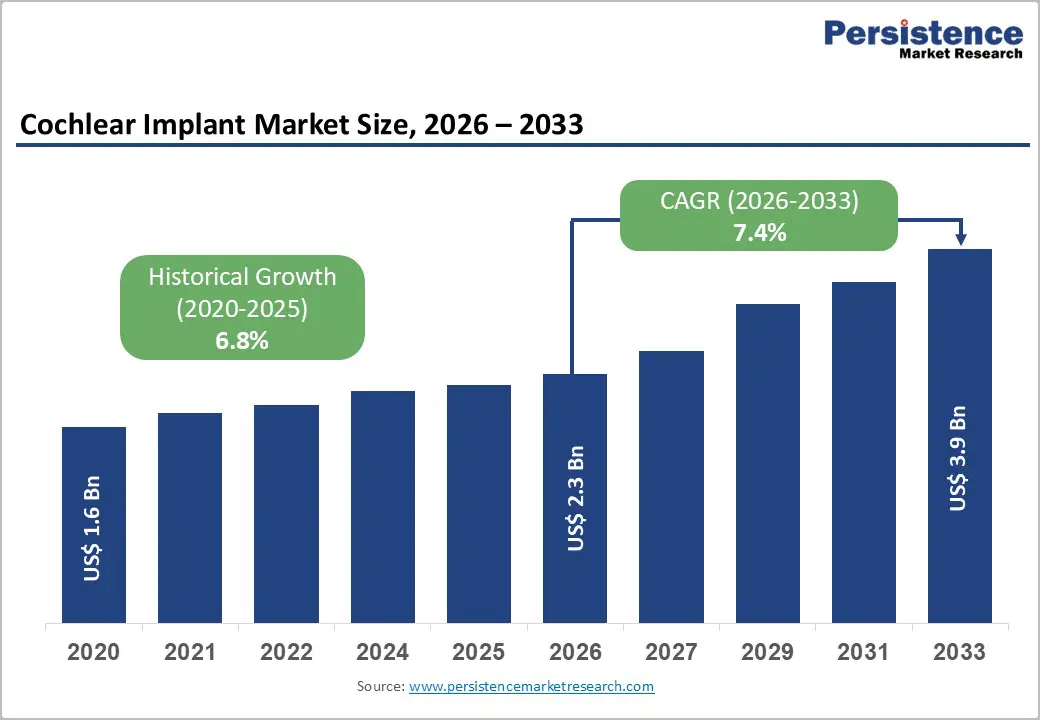
The global cochlear implant market size is expected to be valued at US$ 2.3 billion in 2026 and projected to reach US$ 3.9 billion by 2033, growing at a CAGR of 7.4% between 2026 and 2033. Growing prevalence of severe-to-profound sensorineural hearing loss, expanding indications for implantation, and supportive reimbursement in high-income economies are accelerating procedure volumes worldwide.
Rising geriatric population with age-related hearing loss, increasing adoption of bilateral implants, and ongoing innovation in sound processing and minimally invasive surgery further strengthen demand, while public health programs are progressively addressing unmet hearing needs in low and middle-income countries.
Key Industry Highlights:
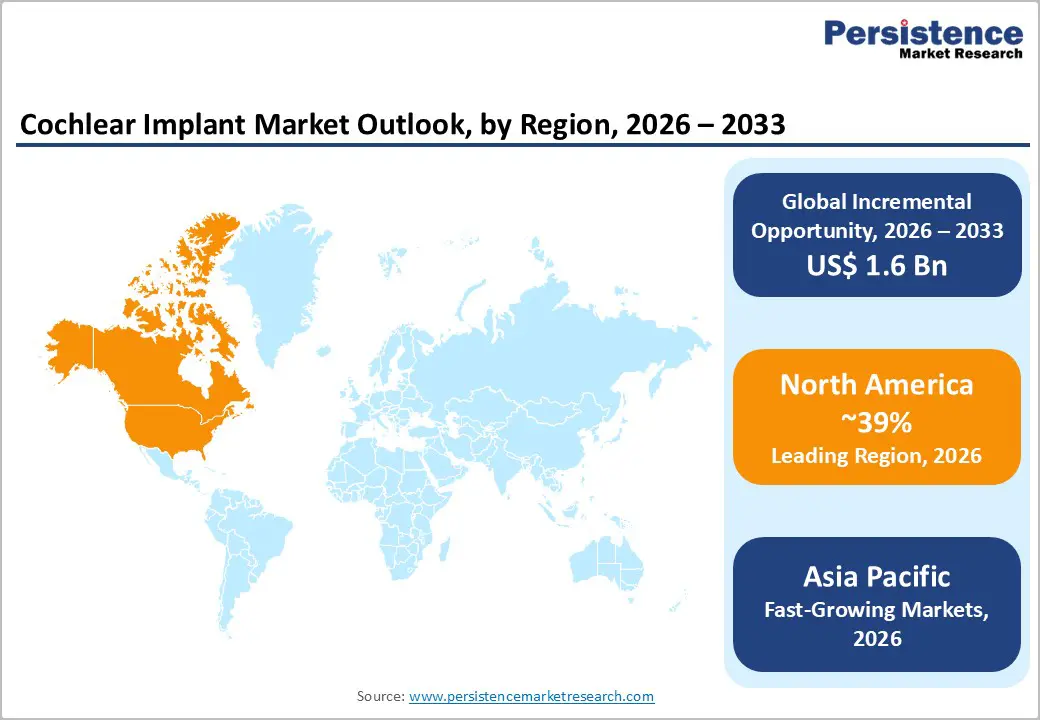
- North America is projected to remain the leading cochlear implant region, driven by high healthcare expenditure, robust reimbursement, and a strong network of implant centers and audiology professionals that support both adult and pediatric implantation.
- Asia Pacific is expected to record the fastest growth, as China, India, Japan, and ASEAN nations expand ENT capacity, launch publicly funded implant programs, and leverage regional manufacturing strengths to broaden access to advanced hearing restoration.
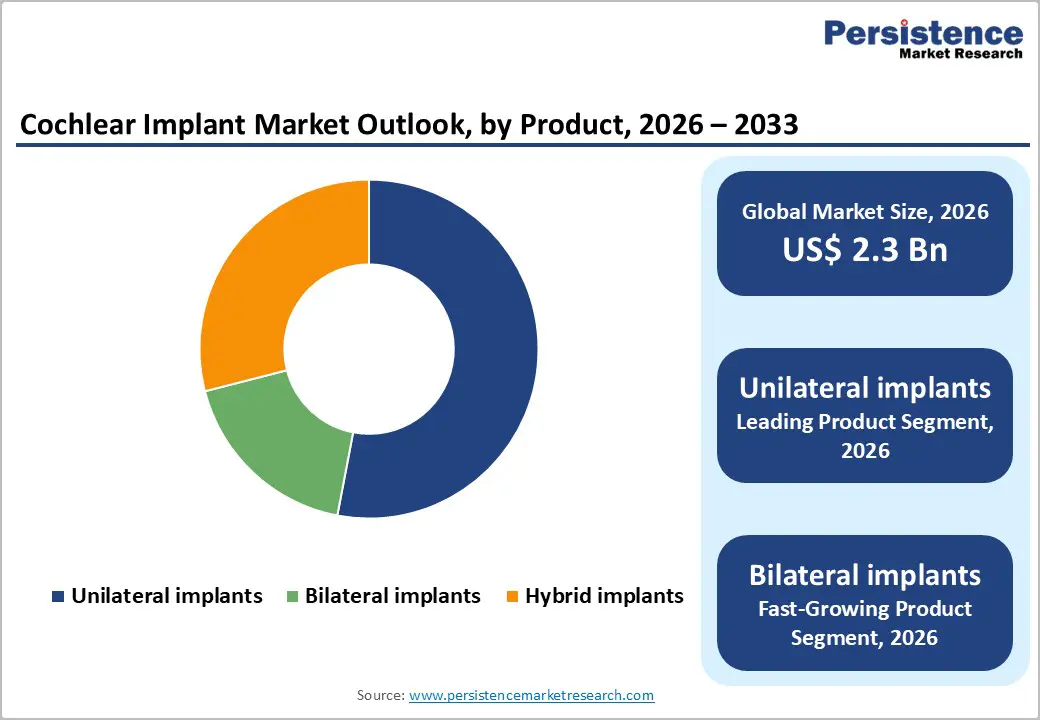
- Among product categories, unilateral implants dominate global market share due to long-standing clinical guidelines, strong reimbursement support for first-ear implantation, and a large installed base generating recurring processor and accessory revenue.
- Bilateral implants represent the fastest-growing product opportunity, especially in pediatric populations where bilateral stimulation improves speech in noise and language development, and where evolving reimbursement policies increasingly recognize long-term cost effectiveness.
- A key market opportunity lies in expanding access in emerging economies by combining government-backed funding, tele-audiology follow-up, and cost-effective regional manufacturing to address large, underserved populations with disabling hearing loss.
| Key Insights | Details |
|---|---|
| Cochlear Implant Market Size (2026E) | US$ 2.3 billion |
| Market Value Forecast (2033F) | US$ 3.9 billion |
| Projected Growth CAGR (2026 - 2033) | 7.4% |
| Historical Market Growth (2020 - 2025) | 6.8% |
Market Dynamics
Drivers - Rising burden of disabling hearing loss worldwide
A key growth driver for the cochlear implant market is the increasing prevalence of disabling hearing loss across age groups, especially among older adults. The World Health Organization (WHO) estimates that over 430 million people globally live with disabling hearing loss, a number projected to exceed 700 million by 2050, creating a substantial unmet need for advanced hearing restoration solutions such as cochlear implants. Clinical guidelines now recommend earlier implantation for severe-to-profound sensorineural loss when conventional hearing aids no longer offer sufficient benefit, improving speech perception and quality of life and thereby encouraging broader clinical adoption. In combination with growing awareness initiatives and newborn hearing screening programs, these epidemiological and clinical trends are directly expanding the eligible patient pool for cochlear implantation.
Technological innovation and expanded clinical indications
Rapid innovation in implant and processor technologies is another major growth engine for the cochlear implant market. Advances such as MRI-conditional internal devices, wireless connectivity, improved electrode arrays, and sophisticated signal processing algorithms have significantly enhanced speech recognition in noise and listening comfort, making modern systems more attractive to both clinicians and patients. Regulatory milestones, including FDA approvals for cochlear implants in single-sided deafness and asymmetric hearing loss, have expanded indications beyond traditional bilateral profound loss, opening new patient subgroups. The adoption of remote programming and tele-audiology follow-up models further improves access and reduces the long-term burden of in-person visits, particularly benefiting rural and underserved populations.
Restraints - High upfront cost and reimbursement disparities
Despite strong clinical benefits, the high upfront cost of cochlear implant surgery and post-implant rehabilitation remains a significant barrier to wider adoption. Total episode-of-care costs, including device, surgery, hospital stay, mapping sessions, and speech therapy, can reach tens of thousands of US dollars per patient, which is prohibitive in many low- and middle-income settings where insurance coverage is limited. Even in high-income countries, variability in reimbursement policies between public and private payers can lead to out-of-pocket expenses that delay or prevent implantation, especially for adults or those without comprehensive coverage. These financial constraints slow penetration in large, price-sensitive markets and can restrict demand to top-tier urban centers.
Surgical complexity, clinical capacity, and awareness gaps
Cochlear implantation is a specialized otologic surgery that requires experienced surgeons, audiologists, and rehabilitation professionals, which limits procedure capacity in many regions. In low-resource health systems, shortages of ENT specialists, audiology infrastructure, and long waiting lists can delay care, while some clinicians remain conservative in referral patterns due to limited exposure to updated evidence on cochlear implant outcomes. Patient and caregiver awareness gaps regarding candidacy, benefits, and realistic expectations also reduce uptake, as individuals may rely on inadequate hearing aids or avoid intervention entirely. Collectively, these clinical and informational barriers reduce the conversion rate from the eligible population to implanted patients.
Opportunities - Fast-growing bilateral and pediatric implantation segments
The shift toward bilateral cochlear implantation, especially among children, presents a major opportunity for device manufacturers and providers. Evidence suggests that bilateral implantation can improve sound localization, speech understanding in noise, and language development compared with unilateral systems, prompting updated clinical guidelines and reimbursement in several high-income markets. Pediatric indications are expanding as newborn and infant hearing screening programs identify severe-to-profound loss earlier, enabling implantation within critical language development windows. As governments and payers recognize the long-term educational and productivity benefits of early auditory rehabilitation, funding for bilateral pediatric cases is expected to rise, supporting sustained volume growth in this high-value segment.
Emerging markets, telehealth, and fully implantable technologies
Significant white-space opportunities exist in emerging regions such as the Asia Pacific, Latin America, and parts of the Middle East & Africa, where cochlear implant penetration remains low relative to the burden of hearing loss. Investments in tertiary care hospitals, expansion of ENT services, and government-supported hearing health initiatives are steadily improving access to implant surgery in countries such as China, India, and Brazil. At the same time, tele-audiology platforms, remote programming, and cloud-based device management reduce follow-up barriers and enable scalable post-implant support. Ongoing R&D into fully implantable or invisible cochlear systems, combined with AI-driven sound processing, offers a compelling future value proposition that can attract new candidate segments seeking more natural hearing experiences and cosmetic discretion.
Category-wise Analysis
Product Insights
Unilateral implants are expected to remain the leading product segment, accounting for around 53% share in 2025. Historically, clinical guidelines and reimbursement frameworks have prioritized unilateral implantation as the standard of care, particularly for adults with severe-to-profound hearing loss in both ears. Unilateral systems offer a well-documented balance of clinical benefit, cost-effectiveness, and surgical risk, leading to their widespread adoption in public health programs and private insurance schemes. Many health systems continue to fund a first implant more consistently than a second ear, which structurally supports the dominance of unilateral devices even as bilateral indications expand. Additionally, the long installed base of unilateral recipients ensures a steady revenue stream from processor upgrades and accessories tied to this segment.
Age Group Insights
Within the age group segmentation, adult patients are expected to be the leading segment in 2025, capturing an estimated 65% of global cochlear implant revenues as a broad approximation supported by procedure data trends. Adults represent a large and expanding cohort due to population aging and the high prevalence of age-related sensorineural hearing loss, particularly in North America, Europe, Japan, and China. Many adults progress from hearing aids to cochlear implantation when to understand verbal communication with clinical studies demonstrating meaningful gains in communication and work participation.
Although pediatric implantation delivers profound long-term benefits, adult candidacy expansions such as single-sided deafness, asymmetric hearing loss, and revised audiological criteria are driving strong uptake in this age group, sustaining its leading revenue contribution.
End-user Insights
By end-user, hospitals are anticipated to be the leading segment, accounting for an estimated 60% cochlear implant procedures and revenue in 2025. Cochlear implantation is typically performed in tertiary care or academic hospitals with access to specialized ENT surgeons, anesthesiology, imaging, and perioperative care, concentrating procedure volumes in these institutions. Hospitals also host multidisciplinary teams of otologists, audiologists, speech-language pathologists, and rehabilitation specialists required to deliver comprehensive pre-operative assessment and post-implant care. High-complexity surgeries and the need for advanced operating room infrastructure naturally favor hospital settings over smaller ENT clinics or ambulatory centers, particularly for pediatric cases and patients with comorbidities.
Regional Insights
North America Cochlear Implant Market Trends and Insights
North America, led by the United States is projected to remain the largest regional market, accounting for about 39% of global cochlear implant revenues in 2025. The region benefits from high healthcare spending, broad insurance coverage for cochlear implantation under programs such as Medicare and private payers, and well-established newborn hearing screening policies that promote early diagnosis. Strong clinical adoption is supported by leading academic medical centers, robust ENT/audiology networks, and active professional societies that promote evidence-based candidacy criteria and best practices.
The regulatory framework in the U.S. is shaped by the U.S. Food and Drug Administration (FDA), which oversees device approvals and post-market surveillance, as well as recognition of standards such as ANSI/AAMI CI86:2017 for cochlear implant system safety and reliability reporting. North America also hosts an intense innovation ecosystem, where companies such as Cochlear Ltd., Advanced Bionics (Sonova), and MED-EL invest heavily in R&D, digital programming platforms, and MRI-compatible systems. As indications expand to single-sided deafness and hybrid electro-acoustic stimulation candidates, the region is expected to maintain its leadership through both volume and premium product adoption.
Asia Pacific Cochlear Implant Market Trends and Insights
Asia Pacific is poised to be the fastest-growing regional market for cochlear implants over the forecast period, supported by large populations, rising income levels, and significant unmet need. Countries such as China, Japan, India, and leading ASEAN economies are witnessing rapid growth in ENT surgical capacity, expanded health insurance coverage, and greater public awareness of hearing restoration options. Government-backed programs in China and India to subsidize hearing implants for children and low-income adults are particularly important in driving procedure volumes and improving equity of access.
Manufacturing and cost advantages in the Asia Pacific are also encouraging local production and partnerships, with companies such as Zhejiang Nurotron Biotechnology Co., Ltd. and regional technology firms building competitively priced systems. This regional industrial base supports lower device prices and tailored designs for local patient needs, while collaborations with global leaders help transfer expertise and quality standards. As healthcare infrastructure continues to improve and ENT/audiology training expands, the Asia Pacific is expected to deliver the highest CAGR in cochlear implant adoption worldwide.
Competitive Landscape
The cochlear implants market is highly concentrated, with a few multinational manufacturers dominating global sales through strong clinical evidence, broad product portfolios, and extensive surgeon training networks. Competition is driven by continuous technological innovation, including improved sound processing, minimally invasive electrodes, wireless connectivity, and MRI-compatible designs. Pricing pressure from public healthcare systems and reimbursement negotiations shapes tender-based procurement, especially in emerging markets. Smaller and regional players compete through lower-cost devices and government partnerships. Strategic collaborations with hospitals, expansion in Asia-Pacific and Latin America, and investments in pediatric programs and post-implant rehabilitation services are key competitive strategies across the industry.
Key Developments:
- In June 2025, Cochlear, a global leader in implantable hearing solutions, launched the Cochlear™ Nucleus® Nexa™ System, described as the world’s first smart cochlear implant system. Xinyu Li, General Manager for Greater China, stated that the next-generation technology had completely reimagined the internal components of the hearing device.
Companies Covered in Cochlear Implant Market
- Cochlear Ltd
- Sonova Holding AG (Advanced Bionics)
- MED-EL Medical Electronics
- Demant A/S
- Zhejiang Nurotron Biotechnology Co., Ltd.
- Oticon Medical
- Advanced Bionics AG
- Envoy Medical Corporation
- Neubio AG
- Shanghai Listent Medical Technology Co., Ltd.
- Amplifon S.p.A.
- TODOC Co., Ltd.
- GN Hearing A/S
- WS Audiology A/S
Frequently Asked Questions
The global cochlear implant market size is estimated at around US$ 2.3 billion in 2026, with projections indicating steady expansion through 2033 at a CAGR of approximately 7.4%.
Key demand drivers include the rising prevalence of disabling hearing loss, aging populations, earlier diagnosis through newborn screening, and technological advances that improve speech perception, MRI compatibility, and remote care capabilities for cochlear implant recipients.
North America currently leads the cochlear implant market, supported by high healthcare expenditure, broad insurance coverage for implantation, a dense network of implant centers, and strong clinical adoption in the U.S. and Canada.
A major opportunity lies in expanding bilateral and pediatric implantation, particularly in emerging regions, by leveraging tele-audiology services, cost-effective devices, and government-funded programs to reach large, underserved populations with severe hearing loss.
Leading market participants include Cochlear Ltd., Sonova Holding AG (Advanced Bionics), MED-EL Medical Electronics, Demant/Oticon Medical, Zhejiang Nurotron Biotechnology Co., Ltd., and several regional and hearing-care majors such as Amplifon S.p.A., GN Hearing A/S, and WS Audiology A/S.


