




- Testing, Inspection, & Certification
- Botnet Detection Market
Botnet Detection Market Size, Share, and Growth Forecast, 2026 - 2033
Botnet Detection Market by Solution (Software/Platform, Services), Enterprise Size (Small and Medium-sized Enterprises (SMEs), Large Enterprises), Application (Network Security Management, Threat Intelligence & Analysis, Incident Detection & Response, Fraud & Financial Crime Prevention, Data Protection & Privacy Compliance, Others), Industry, and Regional Analysis for 2026 - 2033

Botnet Detection Market Size and Trends
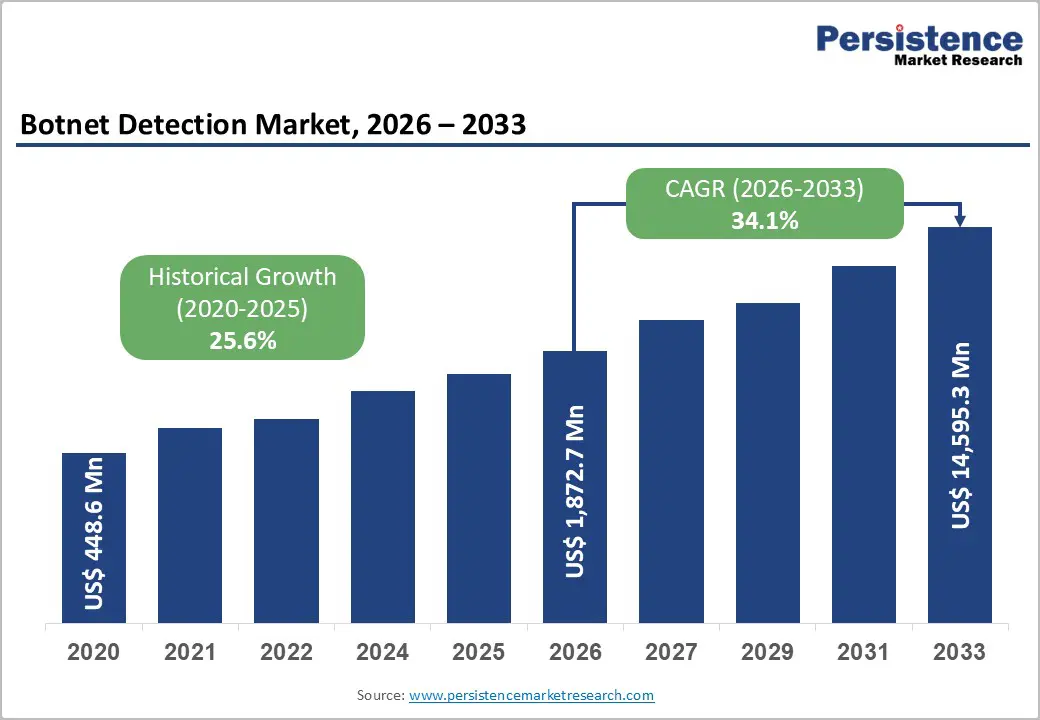
The global botnet detection market size is projected to rise from US$1,872.7 Mn in 2026 to US$14,595.3 Mn by 2033. It is anticipated to witness a CAGR of 34.1% during the forecast period from 2026 to 2033, driven by the rising frequency and sophistication of cyberattacks targeting enterprises, governments, and IoT networks.
Organizations face an urgent need to detect and mitigate botnet activities that compromise sensitive data, disrupt services, and cause financial losses. Advanced detection solutions leveraging AI, machine learning, and behavioral analytics are becoming essential to identify hidden threats in real time. The market is further fueled by the expansion of cloud infrastructure and remote work, which increases exposure to botnet attacks.
Key Industry Highlights:
- Leading Solution: Software/platform dominates with over 58% market share in 2026, valued at more than US$ 1,086.2 Mn, driven by the need for scalable, AI- and ML-enabled detection, real-time threat intelligence integration, and automated response capabilities. Services grow fastest at 39.4% CAGR, fueled by rising demand for continuous monitoring, managed detection, and rapid incident response across cloud and hybrid environments.
- Leading Enterprise Size: Large enterprises hold the largest share at over 63% in 2026, valued at over US$ 1,179.8 Mn, due to high exposure to multi-vector cyberattacks, extensive IT and cloud infrastructures, and stringent regulatory compliance requirements. SMEs grow fastest at 31.2% CAGR, driven by the adoption of cost-effective, subscription-based, and managed security solutions to defend against automated botnet attacks.
- Leading Application: Network security management commands more than 28% share in 2026, valued at over US$ 524.4 Mn, due to the critical need for real-time visibility, traffic monitoring, and control across complex enterprise networks. Threat intelligence & analysis grows fastest at 40.6% CAGR, supported by the need for proactive threat anticipation, context-aware insights, and faster incident mitigation.
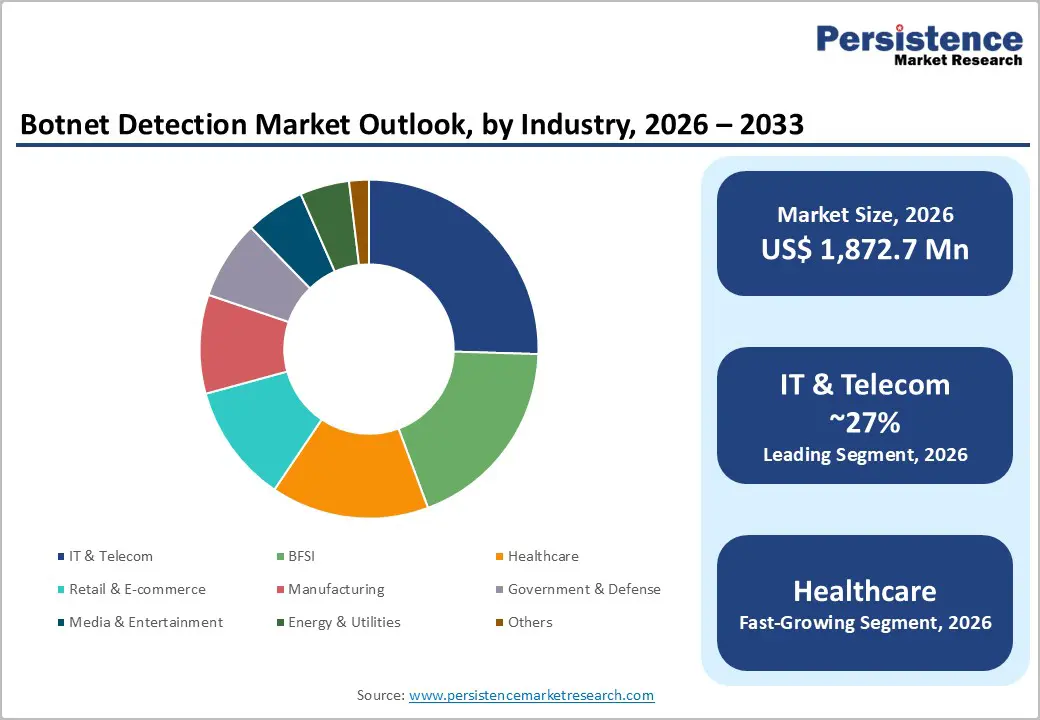
- Leading Industry: IT & telecom dominate with over 27% market share in 2026, valued at more than US$ 505.6 Mn, driven by protection of large-scale, always-on network infrastructures and regulatory compliance. Healthcare grows fastest at 41.2% CAGR, fueled by digitization, IoT-enabled medical devices, telemedicine, and strict patient data security requirements.
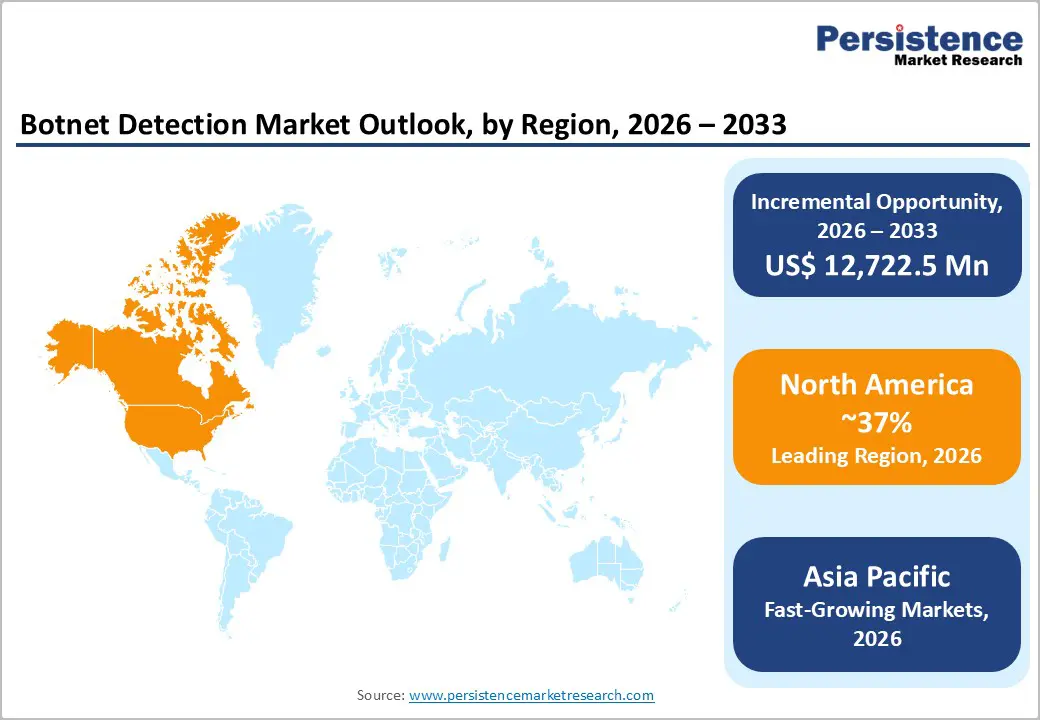
- Leading Region: North America leads with over 37% share in 2026, valued at US$ 692.9 Mn, supported by mature cybersecurity infrastructure, high digital adoption, and substantial security investments. Asia Pacific grows fastest at 42.4% CAGR, driven by rapid digital transformation, expanding digital economy, and rising regulatory mandates. Europe holds over 24% share, driven by stringent regulations like NIS2, industrial technology threats, and financial sector security investments.
| Key Insights | Details |
|---|---|
|
Botnet Detection Market Size (2026E) |
US$1,872.7 Mn |
|
Market Value Forecast (2033F) |
US$14,595.3 Mn |
|
Projected Growth (CAGR 2026 to 2033) |
34.1% |
|
Historical Market Growth (CAGR 2020 to 2025) |
25.6% |
Market Dynamics
Driver - Accelerating Botnet Attack Complexity and Frequency
Botnet attacks have rapidly evolved into highly sophisticated, multi-vector campaigns encompassing DDoS, credential stuffing, data exfiltration, scraping, and inventory hoarding, significantly elevating cyber risk for organizations. The rise of AI-powered botnets has enabled attackers to continuously adapt tactics, bypassing traditional signature-based security defenses. This has created an asymmetric threat environment where manual or rule-based detection is increasingly ineffective. Botnet detection has shifted from an optional security measure to a mission-critical requirement, driving demand for advanced solutions leveraging machine learning and behavioral analytics for real-time identification of unknown botnet threats.
Regulatory Mandate and Compliance Framework Expansion
Regulatory mandates are driving significant growth, transforming detection from a technical choice to a legal necessity. Frameworks such as the EU’s NIS2 Directive with fines up to 2% of global revenue, DORA for financial institutions, and PCI-DSS for payment data enforce strict risk management, reporting, and mitigation requirements. Global regulations including GDPR, CCPA, and emerging Asia-Pacific standards, create a baseline for mandatory botnet detection investments. This compliance-driven demand compels organizations to adopt systematic detection technologies, documented processes, and robust incident response measures, fueling market expansion.
Restraint - Implementation Complexity and Operational Friction
Implementation complexity and operational friction limit the growth. Advanced detection techniques, including deep packet inspection, behavioral analysis, and machine learning, require significant computational resources, historical threat data, and careful tuning, which can affect network performance and user experience. Signature-based systems need continuous updates, adding an ongoing operational burden without guaranteed security improvements. These challenges particularly impact SMEs, which often lack dedicated cybersecurity expertise and sophisticated IT infrastructure, restricting adoption.
Budget Constraints and Total Cost of Ownership Barriers
Budget constraints pose a major restraint for the market, especially for SMEs with limited IT budgets. Organizations must balance investments in botnet detection against other cybersecurity needs like endpoint protection, network security, and compliance. The total cost of ownership, including software licenses, deployment services, threat intelligence subscriptions, and security operations support, creates significant financial barriers. Although cloud-based solutions reduce upfront costs, recurring subscription expenses add ongoing budget pressures, particularly during economic uncertainty.
Opportunity - Convergence of Threat Intelligence and Automated Incident Response
Integration with threat intelligence and automated incident response platforms creates a strong opportunity. Organizations increasingly demand unified solutions combining real-time botnet detection, threat intelligence enrichment, and SOAR-enabled automated response, consolidating capabilities previously spread across multiple vendors. SIEM platforms enhance this by correlating botnet signals with broader threat data for better prioritization and response. Vendors offering seamless integration along with managed services capture demand from organizations without mature SOC capabilities, enabling deployment of comprehensive threat response ecosystems.
Artificial Intelligence and Machine Learning-Driven Detection Innovation
Integration of AI and machine learning in botnet detection offers a major growth opportunity, enabling platforms to identify sophisticated and zero-day attacks that traditional methods often miss. Techniques like device fingerprinting, semi-supervised learning, and intent-based behavior analysis enhance detection accuracy while reducing false positives. ML-powered predictive threat modeling allows proactive disruption of emerging botnet infrastructure. With bot traffic exceeding 50% of internet traffic, organizations increasingly adopt AI-driven solutions to safeguard performance and user experience, creating strong demand and premium pricing potential for advanced detection platforms.
Category-wise Analysis
Solution Insights
Software/platform dominates the global market, capturing more than 58% market share in 2026 with a value exceeding US$ 1,086.2 Mn, due to the increasing need for scalable, flexible platforms that integrate advanced AI, machine learning, and behavioral analytics to detect and respond to evolving bot threats in real time. It offers seamless integration with existing security stacks and cloud environments, enabling centralized visibility and continuous updates, which hardware alone cannot match. They also support real-time threat intelligence feeds and automated response workflows, meeting the urgent demand for proactive and adaptive defense across digital infrastructures.
Services demonstrate the highest growth rate at 39.4% CAGR as organizations increasingly need continuous monitoring, threat hunting, and rapid incident response to combat evolving botnet attacks. Many enterprises lack in-house cybersecurity expertise, driving demand for managed detection and response (MDR) and SOC-as-a-service offerings. Services also support custom integration, tuning, and compliance management across complex IT and IoT environments. The shift toward cloud, hybrid networks increases reliance on outsourced security services for real-time protection.
Enterprise Size Insights
Large enterprises hold over 63% market share in 2026, with a value exceeding US$ 1,179.8 Mn, due to their high exposure to large-scale, multi-vector cyberattacks across vast IT and cloud infrastructures. They manage massive volumes of network traffic, endpoints, and IoT devices, creating a strong need for advanced, real-time botnet detection solutions. Strict regulatory compliance, data protection mandates, and business continuity requirements further drive adoption. Their higher cybersecurity budgets and in-house SOC teams enable continuous investment in AI-driven and behavior-based detection platforms.
Small and medium-sized enterprises (SMEs) are expected to grow at a significant rate, with a CAGR of 31.2% as they are increasingly targeted by automated botnet attacks due to weaker security defenses. SMEs need cost-effective, easy-to-deploy detection solutions to protect customer data, ensure business continuity, and meet basic regulatory requirements. The increasing frequency and sophistication of cyberattacks make botnet detection essential for maintaining operational resilience. Subscription-based and managed security offerings make advanced detection capabilities affordable and accessible for SMEs.
Application Insights
Network security management is expected to hold more than 28% in 2026, with a value exceeding US$ 524.4 Mn, due to the critical need for real-time visibility and control over enterprise networks. Organizations require continuous traffic monitoring to identify command-and-control communication, lateral movement, and abnormal device behavior. Rising remote work, cloud adoption increases network complexity, making centralized security management essential. Compliance requirements and the need to prevent large-scale data breaches drive investment in network-level botnet detection solutions.
Threat Intelligence & Analysis is expected to grow at a CAGR of 40.6%, as organizations increasingly need proactive insights to anticipate and prevent attacks rather than just react. Businesses face rapidly evolving botnet tactics that bypass traditional defenses, making real-time threat visibility critical. Continuous analysis helps identify emerging threats, correlate attack patterns, and prioritize mitigation efforts, addressing the urgent need for faster, more accurate, and context-aware cybersecurity measures. This capability reduces downtime, financial losses, and reputational risks effectively.
Industry Insights
IT & telecom command the largest market share at over 27% in 2026 with a value exceeding US$ 505.6 Mn, driven by their need to protect massive, always-connected network infrastructures from large-scale cyberattacks. These sectors manage high volumes of internet traffic and cloud workloads, making them prime targets for botnet-driven DDoS, data theft, and service disruption. Continuous uptime requirements and strict service-level agreements push operators to deploy advanced, real-time botnet detection solutions. Rising regulatory and data-protection obligations drive sustained investment in proactive network security.
Healthcare is expected to grow at a CAGR of 41.2% due to the increasing digitization of patient records, telemedicine, and connected medical devices. Hospitals and clinics handle sensitive data, making them prime targets for botnet attacks, creating an urgent need for real-time threat detection. The rise of IoT-enabled medical equipment and remote monitoring systems further heightens vulnerability, driving the adoption of advanced botnet detection solutions. Compliance with stringent regulations like HIPAA also compels healthcare organizations to strengthen cybersecurity defenses.
Regional Insights
North America Botnet Detection Market Trends
North America holds over 37% share in 2026, reaching US$ 692.9 Mn value, reflecting the region's mature cybersecurity market, high digital adoption, and substantial security investment budgets. The United States is the dominant driver in North America, accounting for over 70% of regional spending, due to the concentration of global technology leaders, a sophisticated financial services infrastructure, and significant federal cybersecurity investments. The region's market leadership stems from established security vendor ecosystems, advanced threat intelligence infrastructure, and organizational security maturity that exceeds other global regions. The proliferation of cloud infrastructure and digital transformation initiatives across enterprises creates a continuous need for botnet detection as organizations migrate workloads to public cloud platforms.
Asia Pacific Botnet Detection Market Trends
Asia Pacific is expected to grow at the highest rate with a CAGR of 42.4%, driven by rapid digital transformation, expanding digital economy adoption, rising cybercriminal activity, and emerging cybersecurity regulations. China’s vast digital economy, extensive IoT deployment, and complex threat landscape create significant botnet detection demand, though domestic vendor preferences limit international penetration. Japan’s mature digital economy, strong regulations, and enterprise security spending favor advanced detection solutions, while India’s growing digital services and e-commerce sectors, along with evolving regulations, are accelerating botnet detection adoption across the region.
Europe Botnet Detection Market Trends
Europe is expected to hold more than 24% share by 2026, due to stringent data protection and cybersecurity regulations. The EU’s NIS2 Directive mandates risk management, rapid incident reporting, and systematic threat detection, creating compliance-driven demand for botnet detection solutions. Germany’s advanced manufacturing and industrial technology sectors face targeted operational technology threats, while the UK’s financial services industry invests heavily under FCA oversight. Vendors like Cisco capitalize on these regulations by offering solutions aligned with zero-trust principles and automated incident response, accelerating regional adoption.
Competitive Landscape
The botnet detection market is moderately consolidated, led by established global cybersecurity players alongside innovative specialists and regional providers serving specific geographies or verticals. Market leaders focus on broad product portfolios and sustained R&D investment, supported by strong competitive moats built on proprietary threat intelligence networks and long-term enterprise relationships. Differentiation is driven by high detection accuracy, automated response capabilities that reduce analyst workload, integrated security platforms creating switching costs, and robust regulatory compliance support addressing evolving global requirements.
Key Industry Developments:
- In September, CrowdStrike launched Threat AI, the industry’s first agentic threat intelligence system designed to automate complex intelligence workflows and accelerate security outcomes. As part of its new Agentic Security Workforce, Threat AI proactively hunts adversaries, reasons across threat data, and enables faster, more decisive action across the cyber kill chain.
- In March 2025, Cloudflare, Inc. launched the Cloudforce One threat events platform, delivering real-time intelligence on cyberattacks across the Internet using telemetry from its global network. The platform enables security teams to detect threats faster, respond more efficiently, and proactively understand evolving cybercriminal tactics and targeted systems.
Companies Covered in Botnet Detection Market
- Akamai Technologies, Inc.
- Imperva Inc.
- PerimeterX Inc.
- Cloudflare, Inc.
- DATADOME Group
- Symantec
- Trend Micro Inc.
- Palo Alto Networks, Inc.
- Fortinet, Inc.
- FireEye
- CrowdStrike Holdings, Inc.
- Check Point Software Technologies Ltd.
- Cisco Systems, Inc.
- Others
Frequently Asked Questions
The global botnet detection market is projected to be valued at US$1,872.7 Mn in 2026.
The need to identify and mitigate increasingly sophisticated, large-scale cyberattacks that exploit compromised devices is a key driver of the market.
The market is expected to witness a CAGR of 34.1% from 2026 to 2033.
AI- and machine learning–driven botnet detection platforms that enable real-time, behavior-based threat identification across cloud, IoT, and hybrid networks are creating strong growth opportunities.
Akamai Technologies, Inc., Imperva Inc., PerimeterX Inc., Cloudflare, Inc., DATADOME Group, Symantec, Trend Micro Inc. are among the leading key players.


