




- Food Ingredients & Additives
- Bio-Tech Flavors Market
Bio-Tech Flavors Market Size, Share, Trends, Growth, and Regional Forecast, 2026 to 2033
Bio-Tech Flavors Market by Product (Vanilla & Vanillin, Citrus Flavors, Tropical Flavors, Spice & Savory Flavors, Others), Form (Liquid, Dry), Application (Beverages, Dairy & Frozen Desserts, Bakery & Confectionery, Savory & Snacks, Nutraceuticals & Dietary Supplements, Cosmetics & Personal Care), and Regional Analysis from 2025 to 2032

Bio-Tech Flavors Market Share and Trends Analysis
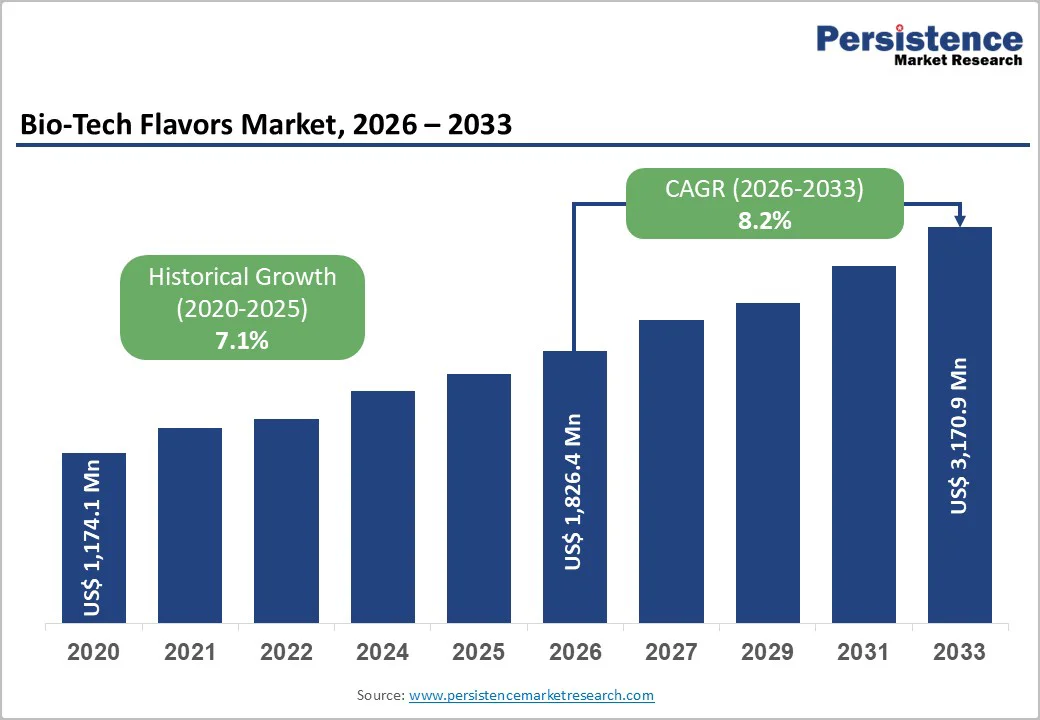
The global bio-tech flavors market size is estimated to grow from US$ 1,826.4 million in 2026 to US$ 3,170.9 million by 2033. The market is projected to record a CAGR of 8.2% during the forecast period from 2026 to 2033.
The Bio-Tech flavors landscape is shifting fast as precision fermentation, synthetic biology, and clean-label innovation converge to redefine global flavor supply chains. With regions scaling biotech infrastructure and companies accelerating molecule engineering, the market is moving into a phase of rapid technical maturity and diversified application growth.
Key Industry Highlights
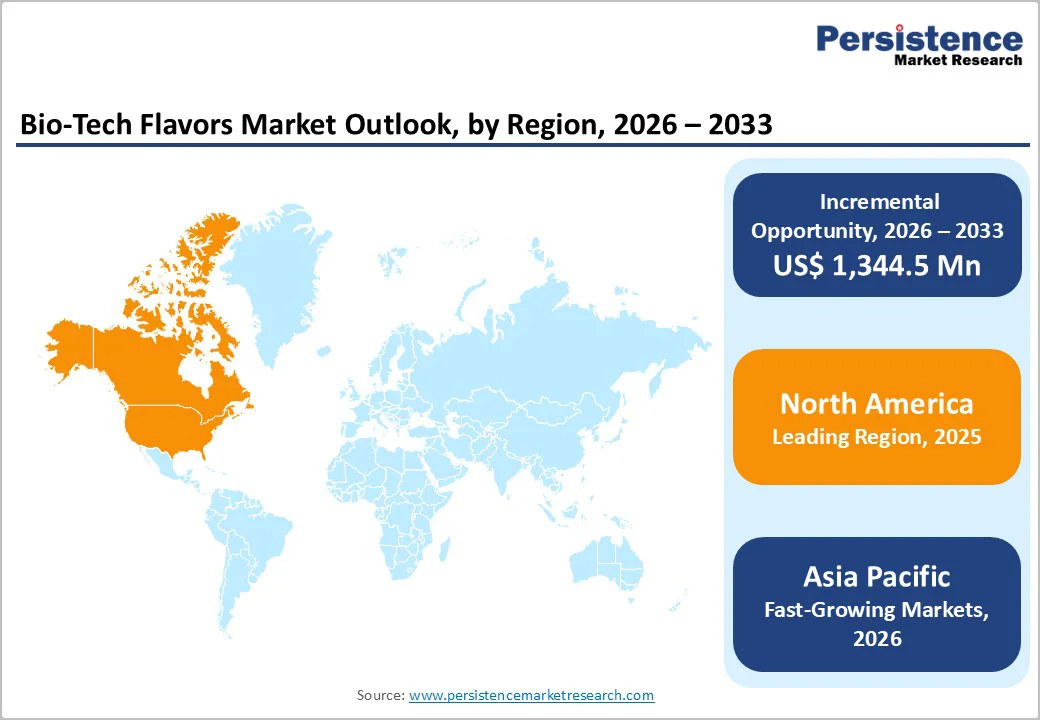
- Leading Region: North America leads the Bio-Tech Flavors market with a 39% share, supported by the rapid adoption of fermentation-derived vanillin, citrus molecules, and dairy-free flavor systems across major food and beverage categories.
- Fastest-Growing Region: Asia Pacific is expanding at a notable pace, with China, India, Japan, Indonesia, and South Korea investing heavily in microbial platforms, enzymatic pathways, and fermentation capacity to deliver consistent, sustainable flavor solutions.
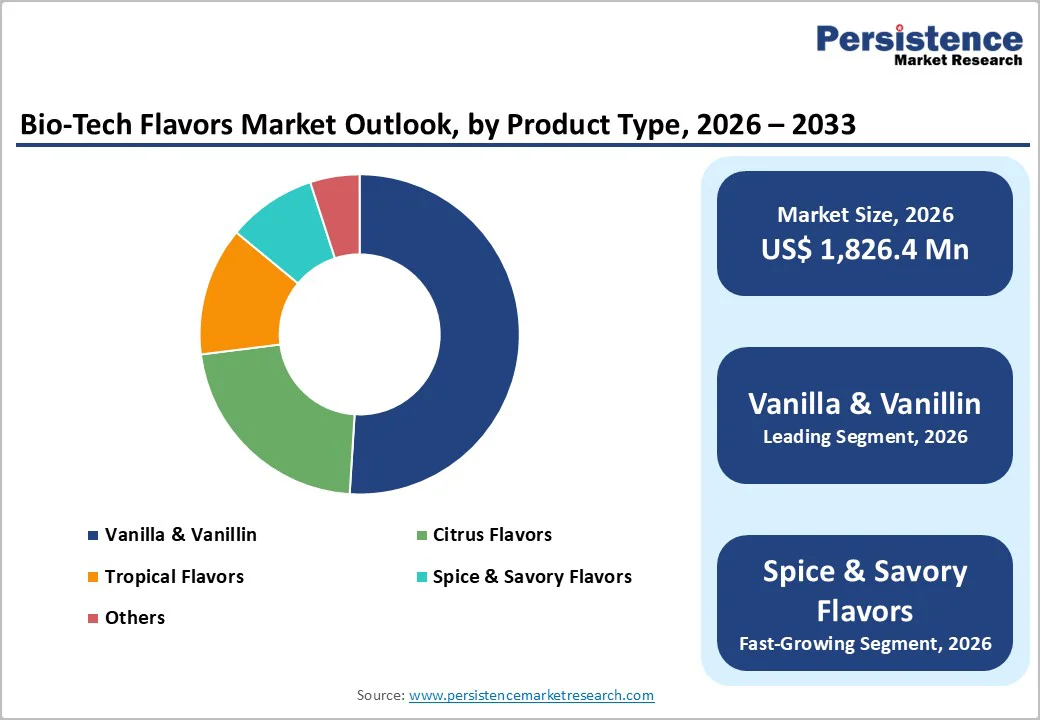
- Fastest-Growing Product Type Segment: Spice & savory flavors are the fastest-growing category, driven by demand for umami-rich, global taste profiles and biotech-derived modulators suited for plant-based meats, soups, snacks, and clean-label reformulations.
- Market Drivers: The growth of plant-based foods is intensifying the need for dairy-free flavor enhancers, prompting brands to turn to biotech solutions that improve authenticity, heat stability, and sensory depth without relying on animal-derived ingredients.
- Opportunities: Collaborations between established flavor houses and synthetic biology startups are opening new pathways for faster commercialization, reduced development risk, and broader B2B penetration across alternative dairy, beverages, and bakery.
- Key Developments: In September 2025, Thermo Fisher Scientific partnered with Startup India and DPIIT to launch the BioVerse Challenge, aiming to accelerate 500 high-potential biotech startups. In May 2025, T. Hasegawa introduced its PLANTREACT Flavor Technology, enabling authentic, meat-like taste profiles for next-generation plant-based proteins.
| Key Insights | Details |
|---|---|
| Bio-Tech Flavors Market Size (2026E) | US$ 1,826.4 Mn |
| Market Value Forecast (2033F) | US$ 3,170.9 Mn |
| Projected Growth (CAGR 2026 to 2033) | 8.2% |
| Historical Market Growth (CAGR 2020 to 2025) | 7.1% |
Market Dynamics
Driver - Growth of Plant-based foods is fueling demand for dairy-free flavor enhancers
A striking shift toward plant-forward eating is reshaping how flavor developers innovate worldwide. As consumers pivot to dairy-free yogurts, beverages, and desserts, brands face pressure to overcome muted taste profiles often associated with plant-based bases such as oats, almonds and soy. This shift is intensifying demand for biotech-derived flavor enhancers that deliver richer, more authentic dairy notes without relying on animal ingredients.
Precision fermentation and enzymatic flavor creation are becoming core tools for manufacturers seeking cleaner labels, better heat stability, and consistent sensory performance across applications. With large food companies scaling alternative dairy lines and foodservice players integrating vegan options, suppliers of biotech flavors are well positioned to grow by enabling products that taste familiar yet remain fully dairy-free.
Restraints - High R&D and fermentation infrastructure costs limit rapid adoption
A persistent bottleneck in the biotech flavors space stems from the heavy financial burden imposed by R&D intensity and fermentation capacity. Developing precise flavor molecules through microbial pathways demands specialized scientists, long experimentation cycles, and robust analytics, all of which raise upfront investment requirements.
Scaling from lab to pilot to commercial volumes adds further pressure, since fermentation lines, bioreactors, and downstream purification systems are capital-dense and require strict process control. Smaller companies often struggle to secure funding for such infrastructure, slowing their ability to compete with established players.
Even large manufacturers face long payback periods, making them cautious about shifting rapidly from traditional flavor production methods to full biotechnology-driven pipelines.
Opportunity - Collaborations between flavor houses and synthetic biology startups can accelerate commercialization pipelines
A powerful catalyst for market expansion is emerging as established flavor houses team up with synthetic biology startups to shorten the journey from molecule design to commercial launch. These partnerships combine deep formulation expertise with advanced bioengineering platforms that create precise flavor compounds with cleaner profiles and improved sustainability metrics.
Startups gain access to application labs, regulatory know-how and global distribution channels, allowing them to validate and scale innovations faster than working alone. Larger flavor companies benefit from rapid access to novel ingredients, accelerated strain optimization cycles, and early visibility into breakthrough fermentation technologies.
This collaborative model reduces technical risk, accelerates pilot testing, and positions both parties to capture rising demand for next-generation biotech flavors.
Category-wise Analysis
By Product Inisghts
Vanilla & Vanillin holds approx. 53% market share as of 2025, driven by their universal appeal, stability across applications and strong alignment with fermentation-based production routes. Bio-converted vanillin delivers consistent purity, traceability and a cleaner label narrative, making it the preferred choice for bakery, dairy, confectionery and plant-based brands seeking dependable flavor performance.
Its well-established regulatory acceptance further accelerates commercial uptake. Citrus flavors continue gaining traction as companies engineer biotech-derived limonene and related compounds to support beverage innovation and replace volatile citrus oils affected by crop fluctuations. Tropical flavors such as mango, passion fruit, and pineapple are rising as synthetic biology platforms target exotic profiles demanded in RTD beverages, functional foods and premium desserts.
Spice & Savory Flavors Insights
Spice & savory flavors are projected to grow at a CAGR of 8.7% during the forecast period, reflecting a decisive shift toward umami-rich, heat-forward and globally inspired taste profiles across modern foods. Brands are leaning on biotech pathways to reproduce complex spice volatiles with higher purity and stability compared to traditional extraction, supporting consistent flavor delivery in snacks, plant-based meats, soups and ready meals.
Consumer interest in reduced-salt formulations is pushing manufacturers to use biotech-derived savory modulators to rebuild mouthfeel and depth without compromising nutrition targets. Growth is further supported by rising demand for regional spice signatures such as smoky chili, garam blends, fermented notes and aromatic herbs as manufacturers reformulate for cleaner labels and scalable supply.
Region-wise Insights
North America Bio-Tech Flavors Market Trends
North America is the dominant market, holding a 39% share, and rapid advances in precision fermentation and clean-label flavor reformulation across the US and Canada are fueling its momentum. US food and beverage manufacturers are accelerating the adoption of biotech vanillin, citrus molecules and dairy-free flavor bases to stabilize supply chains and reduce exposure to climate-linked crop volatility.
Canada is seeing strong traction in fermentation-driven natural flavors as regulators encourage lower-emission production systems and local brands shift toward sustainable aroma molecules for beverages, bakery and plant-based foods. Across the region, companies are upgrading bioreactor capacity, forming university partnerships and scaling AI-guided strain engineering to bring new flavor compounds to market faster while meeting evolving sensory expectations.
Asia Pacific Bio-Tech Flavors Market Trends
Asia Pacific bio-tech flavors market is expected to grow at a CAGR of 8.9%, driven by fast-evolving food manufacturing ecosystems and strong investment in fermentation-based aroma innovation.
China is rapidly scaling microbial platforms to replace volatile botanical supplies and improve consistency in beverage, confectionery, and bakery applications. India is witnessing rising adoption of biotech-derived vanilla, fruit notes, and spice profiles as plant-based brands demand cleaner, cost-stable ingredients.
Japan is exploring advanced enzymatic processes to refine traditional flavor formats, achieving higher purity and a lower environmental impact. Indonesia is expanding fermentation capacity to support tropical flavor production for regional exporters, while South Korea is pushing precision-engineered flavor molecules for next-generation functional drinks and snacks. Across the region, sensory customization and sustainable inputs are shaping market direction.
Competitive Landscape
The global bio-tech flavors market reflects a moderately consolidated structure, where a small group of innovation-driven players shapes technological direction and sets quality benchmarks. Leading companies are accelerating investments in precision fermentation, metabolic engineering, and enzyme optimization to deliver cleaner, more stable flavor molecules that outperform fluctuating botanical supplies.
R&D pipelines are shifting toward bio-converted vanillin, terpene derivatives, and complex savory notes with improved sensory accuracy. Product development is heavily aligned with clean label requirements as regulators tighten scrutiny over artificial additives and demand transparent sourcing.
B2B expansion is increasing across the beverage, dairy alternatives, and bakery sectors, supported by tailored flavor systems that accommodate regional taste profiles. Regulatory approvals for novel bio-derived compounds are becoming a decisive competitive factor.
Key Industry Developments:
- In September 2025, Thermo Fisher Scientific, in partnership with Startup India and DPIIT, launched the BioVerse Challenge to accelerate biotech innovation nationwide. The program aims to fast-track 500 high-potential biotech startups across India over the next three years.
- In May 2025, T. Hasegawa unveiled its PLANTREACT Flavor Technology, designed to deliver more authentic, meat-like taste profiles in plant-based proteins. The innovation enhances depth, aroma, and cooking performance, supporting next-generation alternative protein product development.
- In March 2025, BASF Aroma Ingredients introduced two new Isobionics® biotech flavor ingredients, strengthening its position in sustainable aroma innovation. The launch showcases BASF’s push toward fermentation-derived flavors that deliver consistency, purity, and reliable supply for global food and beverage formulators.
Companies Covered in Bio-Tech Flavors Market
- Givaudan SA
- IFF
- dsm-firmenich
- Symrise AG
- Kerry Group
- Döhler GmbH
- Takasago International Corporation
- Sensient Technologies Corporation
- T. Hasegawa Co., Ltd.
- Bell Flavors & Fragrances Inc.
- Others
Frequently Asked Questions
The global Bio-Tech Flavors market is projected to be valued at US$ 1,826.4 Mn in 2026.
Rising adoption of plant-based diets is accelerating the need for dairy-free flavor solutions in the Bio-Tech Flavors market.
The global Bio-Tech Flavors market is poised to witness a CAGR of 8.2% between 2026 and 2033.
Partnerships between major flavor manufacturers and synthetic biology innovators can speed up product development and unlock faster market entry.
Major players in the global Bio-Tech Flavors market include Givaudan SA, IFF, DSM-Firmenich, Symrise AG, Kerry Group, Takasago International Corporation, Sensient Technologies Corporation, and others.


