




- Clothing, Footwear, & Accessories
- Ankle Boots Market
Ankle Boots Market Size, Share, and Growth Forecast, 2026 – 2033
Ankle Boots Market by Boots type (Chelsea Boots, Lace-Ups, Zipper Boots, Others), Product Type (Block Heel, Flat, Lace-Ups, Others), End-user (Women, Men), and Regional Analysis 2026 – 2033

Ankle Boots Market Size and Trends Analysis
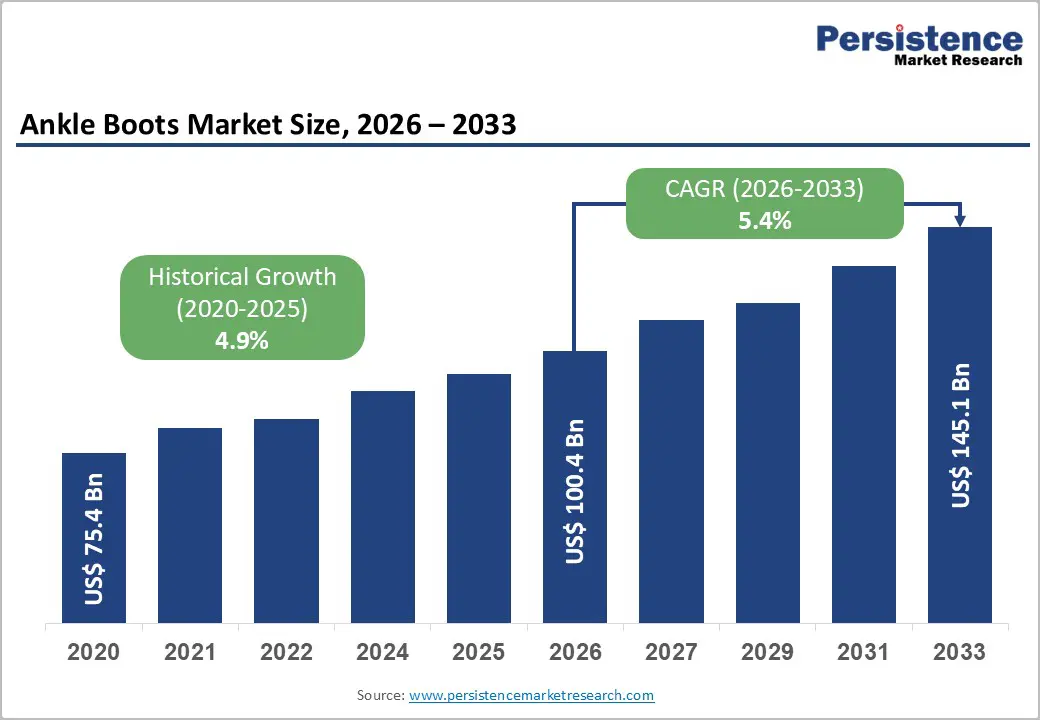
The global ankle boots market size is likely to be valued at US$100.4 billion in 2026 and is expected to reach US$145.1 billion by 2033, growing at a CAGR of 5.4% during the forecast period from 2026 to 2033, driven by rising consumer demand for versatile styles across segments. Sustainable material innovations enhance product durability while meeting regulatory expectations. E-commerce platforms accelerate accessibility among urban buyers worldwide. These channels amplify accessibility while sustainable material innovations attract eco-conscious buyers. Technology integration in cushioning systems positions manufacturers for premium differentiation. These dynamics position the market for sustained momentum amid rising disposable incomes.
Key Industry Highlights:
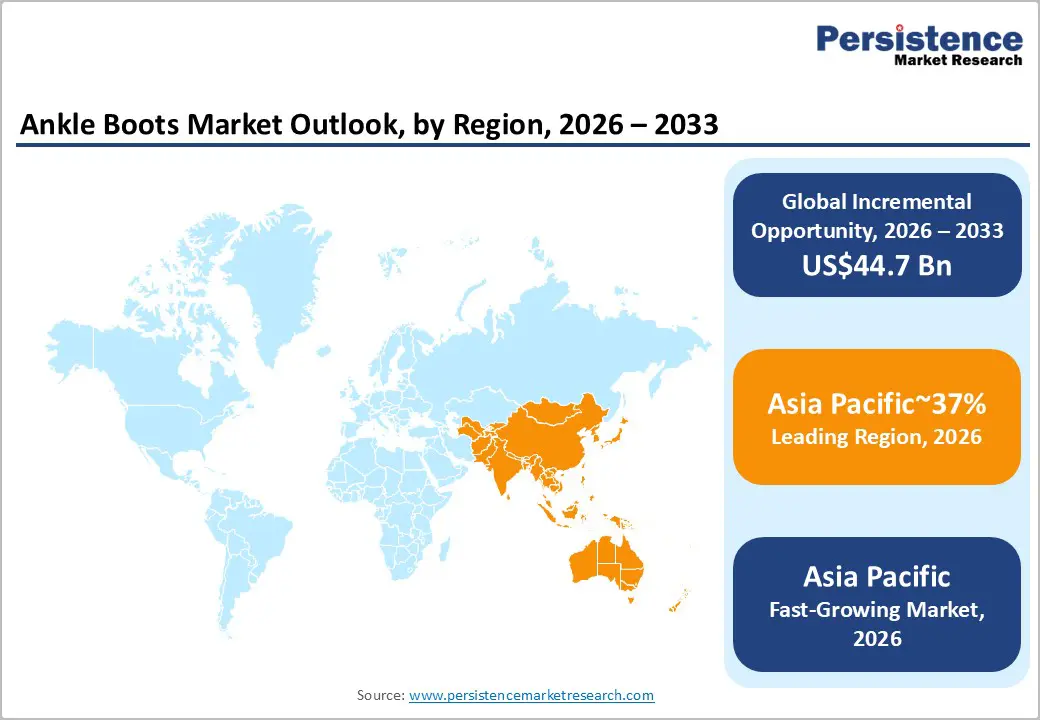
- Leading Region: Asia Pacific is projected to lead, accounting for approximately 37% share in 2026, supported by rising disposable incomes, rapid urbanization, and expanding e-commerce ecosystems that favor localized production.
- Fastest-growing Region: Asia Pacific is anticipated to grow fastest, driven by middle-class expansion, fashion influencer campaigns, and digital retail adoption that unlock first-time purchases.
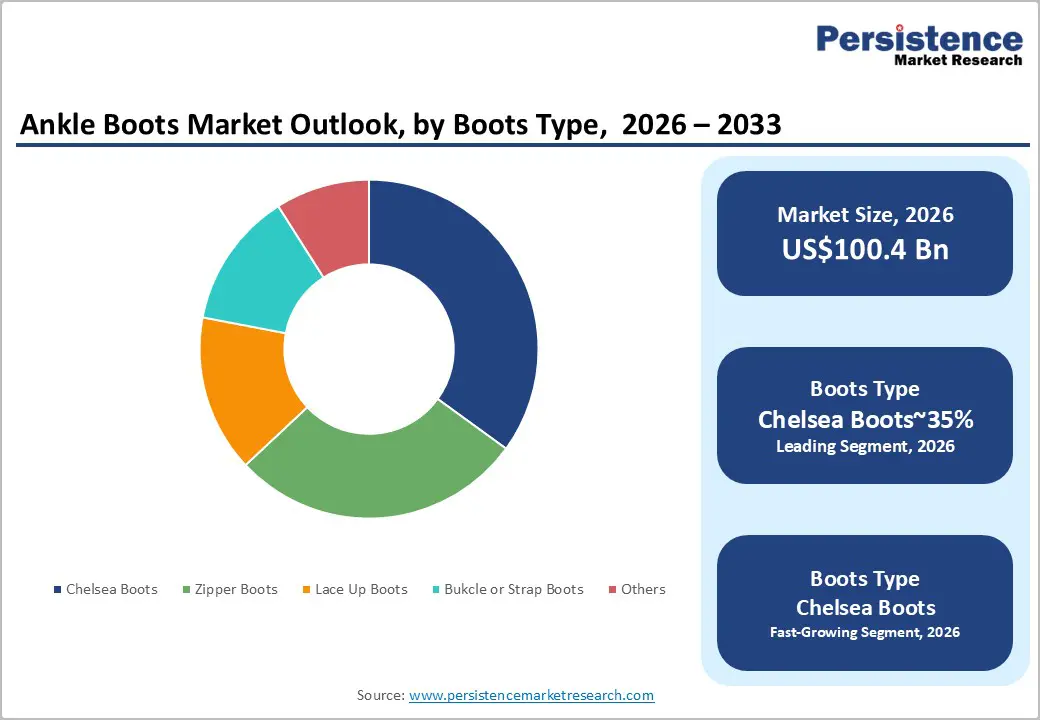
- Leading Boots Type: Chelsea boots are expected to lead, accounting for approximately 35% share in 2026, anchored by slip-on convenience, timeless appeal, and cross-occasion versatility.
- Leading Product Type: Block heel is projected to dominate, holding approximately 32% share in 2026, driven by enhanced stability, style versatility, and all-day wear comfort.
| Key Insights | Details |
|---|---|
| Ankle Boots Market Size (2026E) | US$100.4 Bn |
| Market Value Forecast (2033F) | US$145.1 Bn |
| Projected Growth (CAGR 2026 to 2033) | 5.4% |
| Historical Market Growth (CAGR 2020 to 2025) | 4.9% |
DRO Analysis
Driver Analysis – E-Commerce Expansion Unlocking Global Reach
E-commerce expansion is increasing global access for footwear consumers across regions. Digital channels reduce barriers to entry for emerging market consumers effectively. Online channels support higher sales volumes through improved accessibility and convenience. Omni-channel strategies integrate virtual try-on tools to enhance purchase confidence. Retailers use targeted promotions to improve engagement and conversion rates effectively. Market participants leverage these dynamics for scalable distribution networks. Mobile apps enable virtual try-ons that build confidence in fit and feel. Data analytics refines inventory to match seasonal trends swiftly. These dynamics enable scalable distribution and wider market penetration for brands.
Steve Madden and Cole Haan expand reach through digital-first product strategies. Platforms like Zalando use algorithms to personalize product recommendations effectively. Mobile applications support virtual trials, improving decision-making and reducing purchase friction. UGG and Frye enhance engagement through personalization and AR tools. Such integrations are set to accelerate revenue streams for digital-savvy players. Partnerships with Shopify strengthen global distribution capabilities. These digital strategies position retailers to capture demand across diverse consumer segments.
Rising Demand for Versatile Comfort Footwear in Urban Lifestyles
Growing preference for versatile comfort footwear is reshaping urban consumption patterns significantly. Consumers increasingly prioritize multi-occasion designs that balance support with aesthetic appeal. This shift accelerates the adoption of adaptable footwear across professional and casual environments. Advancements in cushioning materials enhance comfort and extend usage across diverse demographics. Product design evolution enables brands to target broader consumer segments effectively. These factors collectively strengthen demand visibility across retail and digital distribution channels. Market expansion is further supported by shifting lifestyle patterns favoring functional fashion choices. The convergence of comfort engineering and design flexibility sustains consistent category growth momentum.
Innovation in comfort technologies is influencing competitive positioning across footwear manufacturers globally. Material science improvements enable differentiation through enhanced durability and ergonomic performance. Manufacturers are aligning product development with evolving consumer expectations for all-day usability. Distribution strategies increasingly integrate digital platforms to scale accessibility across regions. Cost structures are influenced by premium materials and advanced production processes. Regulatory focus on product safety and material compliance shapes design and sourcing decisions. These dynamics reinforce sustained investment in innovation-driven product development cycles. The evolving competitive landscape continues to favor brands prioritizing comfort-led design integration.
Restraint Analysis – Geopolitical Sourcing Disruptions Elevating Cost Pressures
Geopolitical shifts in sourcing patterns are disrupting established global supply networks significantly. Trade policy changes and tariffs are increasing procurement costs across manufacturing value chains. These pressures compel manufacturers to diversify sourcing across multiple geographic regions. Fragmented supply bases introduce operational complexity and reduce economies of scale efficiency. Cost pass-through mechanisms are influencing retail pricing and demand elasticity patterns. Inventory planning becomes more dynamic as distributors respond to supply volatility risks. Production timelines face uncertainty, affecting product availability and new launch cycles. These structural disruptions collectively compress margins and challenge stable cost management frameworks.
Supply chain diversification increases logistical overhead and requires investment in supplier networks. Manufacturers must balance cost control with consistent product quality and material standards. Regulatory compliance across regions adds complexity to sourcing and procurement strategies. Transportation and warehousing costs fluctuate with geopolitical instability and trade route disruptions. Retailers adjust assortment strategies to mitigate risks associated with delayed product availability. These dynamics reshape procurement models toward resilience-focused and risk-managed structures. Technology integration in supply chain monitoring becomes critical for operational continuity assurance. Overall, cost volatility remains a persistent constraint influencing global footwear market performance.
Fast Fashion Competition Compressing Premium Footwear Margins
Rapid cycle fashion players are increasing competitive intensity within the premium footwear segment. Low-cost alternatives replicate premium designs, reducing perceived value among price-sensitive consumers. Market saturation weakens differentiation for high-quality, durable ankle boot offerings. Retailers prioritize fast-moving inventory, limiting shelf space for premium, crafted products. Consumer preference shifts toward affordability, reinforcing short lifecycle purchasing behaviors. This dynamic intensifies price competition and reduces brand-driven pricing power significantly. Margin structures weaken as premium positioning becomes harder to sustain across channels. Overall, competitive pressure from fast fashion constrains profitability and long-term brand equity.
Imitation-driven competition disrupts wholesale relationships and affects premium brand distribution strategies. Intellectual property enforcement challenges limit the effectiveness of design protection initiatives globally. Manufacturers increase spending on brand positioning and product differentiation to retain value perception. Supply chain adjustments aim to balance cost efficiency with quality preservation standards. Retail pricing strategies become more reactive due to continuous low-cost competition. Market fragmentation increases as multiple players compete across overlapping price segments. These pressures reshape competitive dynamics toward volume-driven rather than value-driven growth. Sustained margin compression remains a structural constraint within the premium footwear market.
Opportunity Analysis – Smart Insole Integration Enabling Personalized Footwear Experiences
Smart insole technology is enabling personalized comfort through embedded sensors and data systems. Advanced analytics adapt support dynamically based on individual gait and movement patterns. This capability addresses unmet demand for customized ergonomics across diverse user profiles. Integration of connectivity features enhances product functionality within premium footwear categories. Mobile interfaces provide real-time feedback, improving user engagement and usage consistency. These innovations strengthen differentiation within competitive and design-driven footwear segments. Technology-enabled comfort solutions expand application across lifestyle, wellness, and performance use cases. This convergence supports premiumization through value-added functionality and enhanced user experience.
Adoption of smart insoles reshapes product development toward data-driven design frameworks. Product pursuits from Dr. Martens with the 2976 Chelsea Boot explore similar integrations. Manufacturers invest in electronics integration alongside traditional material engineering capabilities. Cost structures evolve with the inclusion of sensors, connectivity modules, and software ecosystems. Regulatory considerations around data privacy influence the deployment of connected footwear solutions. Distribution strategies increasingly emphasize digital channels supporting connected product ecosystems. Consumer expectations shift toward measurable comfort and performance outcomes in footwear selection. Overall, smart integration creates new pathways for differentiation and long-term value creation.
Category–wise Analysis
Boots Type Insights
Chelsea boots are expected to lead, accounting for approximately a 35% share in 2026, driven by slip-on convenience and versatile styling across occasions. Adoption remains anchored in ease of wear and consistent fit across varied user preferences. Elastic gusset construction improves flexibility while supporting daily urban mobility requirements. Product strength from Dr. Martens and Clarks reinforces durability and comfort positioning. Blundstone supports resilience through material innovation aligned with sustainability trends. Consumer preference for functional and adaptable footwear sustains high volume demand across segments. Ongoing design refinements and material upgrades continue to reinforce replacement cycles and long-term adoption stability.
Chelsea boots are also expected to be the fastest-growing segment, driven by rising demand for versatile and fashion-forward everyday footwear. Growth is supported by evolving style preferences among younger consumers seeking minimalist and adaptable designs. Product innovation from Skechers and UGG enhances comfort through lightweight materials and seasonal adaptability. Digital platforms accelerate discovery, enabling rapid adoption through influencer-driven visibility and targeted campaigns. Customization features and limited edition releases strengthen consumer engagement and repeat purchases. Continuous design evolution and digital integration position this segment for accelerated expansion across global retail channels.
Product Type Insights
Block heel is anticipated to lead the market, accounting for approximately a 32% share in 2026, driven by enhanced stability and sustained comfort across extended wear cycles. Adoption remains anchored in ergonomic design that supports balanced weight distribution during daily activities. Structured silhouettes align with professional and casual styling requirements, reinforcing broad consumer acceptance. Product strength from Dr. Martens and Frye supports durability and premium material positioning. Hunter enhances functionality through traction and weather-resistant construction features. Ongoing advancements in midsole cushioning and structural design improve fatigue reduction and long-term usability. These factors collectively sustain leadership through consistent demand across diverse footwear applications.
Kitten heel is expected to be the fastest-growing segment in the industry, driven by rising preference for subtle elevation combined with enhanced mobility and comfort. Growth is supported by lightweight construction and flexible design, improving natural gait dynamics. Product innovation from Clarks and R.M. Williams enhances wearability across professional and social settings. Stella McCartney contributes through sustainable material integration and refined design aesthetics. Increasing demand for versatile footwear encourages adoption across varied occasions and consumer groups. Continuous design evolution and material innovation position this segment for accelerated expansion globally.
Regional Insights
Asia Pacific Ankle Boots Market Trends
Asia Pacific is expected to remain the leading regional market and to be the fastest growing, accounting for approximately 37% share in 2026, supported by expanding manufacturing ecosystems and rising urban consumer demand. Localized production frameworks enable cost efficiency while improving supply responsiveness across high-volume retail channels. Rapid e-commerce integration strengthens accessibility, allowing brands to scale distribution across diverse urban and semi-urban markets. Consumer preferences increasingly favor versatile and affordable footwear aligned with evolving lifestyle patterns. Sustainability trends are also influencing material choices, encouraging the adoption of eco-conscious product variants. Digital engagement, including influencer-led discovery, is expected to further accelerate product visibility and conversion rates. This convergence of manufacturing depth, digital infrastructure, and consumer scale is positioned to sustain regional dominance.
India is expected to function as the central anchor shaping Asia Pacific’s market trajectory through expanding middle-class consumption and retail infrastructure investments. Government-backed initiatives supporting leather processing and sustainable production are likely to strengthen domestic supply chains. Rapid adoption of omni-channel retail platforms is expected to enhance product accessibility across metropolitan and emerging urban clusters. Youth-driven social commerce is anticipated to accelerate demand for trend-focused and digitally promoted footwear categories. Localization strategies by global brands are expected to improve market penetration through tailored product offerings. This evolving ecosystem of policy support, digital adoption, and consumer expansion is positioned to reinforce long-term regional growth momentum.
North America Ankle Boots Market Trends
North America is expected to remain the second-largest regional market with stable growth, demand primarily anchored in premium replacement cycles and product upgrades. Established retail ecosystems and strong brand loyalty continue to sustain consistent consumption across core consumer segments. Market dynamics favor comfort-led innovation, with consumers prioritizing functionality alongside style in everyday footwear. Digital personalization and curated assortments are expected to refine purchasing patterns across seasonal cycles. Sustainability considerations, including eco-friendly materials and compliance standards, are influencing upgrade decisions among premium buyers. Integration of waterproofing technologies and weather-adaptive designs further supports steady product relevance. This combination of brand equity, retail maturity, and innovation depth is positioned to maintain stable regional demand.
The U.S. is expected to serve as the central anchor shaping North America’s market trajectory through strong consumer spending and advanced digital retail infrastructure. A well-established e-commerce ecosystem is anticipated to support seamless omnichannel engagement and personalized buying experiences. Regulatory focus on product safety and material compliance is likely to influence sourcing and manufacturing strategies. Investment in direct-to-consumer models is expected to strengthen brand-consumer relationships and improve margin structures. Consumer culture driven by fashion trends and influencer ecosystems is anticipated to sustain demand for premium and customized footwear. This alignment of digital infrastructure, regulatory clarity, and consumer behavior is positioned to reinforce long-term regional stability.
Europe Ankle Boots Market Trends
Europe is expected to remain a mature and structurally stable regional market, with demand primarily anchored in compliance-driven upgrades and premiumization cycles. Established heritage craftsmanship continues to support strong brand loyalty across high-value consumer segments. Regulatory alignment around sustainability is expected to accelerate the adoption of eco-materials and ethical production practices. Consumer preferences emphasize durability, quality, and responsible sourcing within footwear purchasing decisions. Innovation is likely to emerge from the integration of traditional design with modern material technologies. Service-led monetization, including customization and repair ecosystems, is expected to reinforce lifecycle value. This combination of regulatory structure, craftsmanship depth, and premium positioning is set to sustain stable regional demand.
The U.K. is expected to serve as the central anchor shaping Europe’s market trajectory through its strong fashion ecosystem and retail infrastructure. Cultural influence from major fashion events is anticipated to drive trend adoption across regional markets. Regulatory emphasis on sustainability and ethical sourcing is likely to influence manufacturing and supply chain strategies. Investment flows are expected to focus on premium collections and locally aligned production models. Vendor strategies are anticipated to leverage heritage branding alongside innovation in materials and design. This alignment of policy direction, fashion leadership, and consumer expectations is positioned to reinforce Europe’s long-term market stability.
Competitive Landscape
The global ankle boots market exhibits a fragmented structure where numerous fashion-oriented participants establish distinct niches through specialized styling. Leading players matter due to their influence on trend direction and strong procurement relationships with global retailers. Technology footprint from cushioning innovations sets engineering benchmarks across segments. Brand equity drives consumer loyalty and repeat purchases effectively. Product examples from Dr. Martens with the 2976 Chelsea Boot, Steve Madden, Cole Haan with the Roundhill Grand Waterproof Chelsea Boot, and Skechers with the Easy Going Chelsea Boot establish clear ecosystem benchmarks.
Horizontal differentiation emphasizes style variety while vertical differentiation focuses on premium material integration. Product tier strategies separate innovators from value-positioned competitors through targeted features. IP moats in waterproofing and cushioning protect premium players effectively. D2C evolution alongside ecosystem partnerships accelerates growth for adaptive archetypes. White-label proliferation supports mid-tier expansion. Competitive intensity heads toward a sustainability focus, with innovators gaining ground steadily.
Key Industry Developments:
- In March 2026, Dr. Martens and Kiko Kostadinov launched a "Made in England" collaboration featuring premium boot silhouettes. This partnership leverages high-end craftsmanship to elevate the ankle boot from a utility staple to a luxury collector's item, intensifying competition in the premium segment. This collaboration elevates the ankle boot category by blending heritage British craftsmanship with high-fashion avant-garde design, effectively transforming utilitarian footwear into a high-value luxury collector's item.
- In March 2026, ROMBAUT and Alicia Valdés Selbach unveiled a 100% bio-based boot for the Spring/Summer season. The release of a fully biodegradable ankle boot sets a new benchmark for circular fashion, pressuring competitors to move beyond recycled materials to fully regenerative biological inputs.
Companies Covered in Ankle Boots Market
- Dr. Martens
- Timberland
- UGG
- Clarks
- Skechers
- Steve Madden
- Cole Haan
- Blundstone
- Frye
- Hunter
- Stella McCartney
- VF Corporation
- Wolverine World Wide
- Deckers Brands
- Ariat
- BOSS
Frequently Asked Questions
The global ankle boots market size reaches US$100.4 billion in 2026 and US$145.1 billion by 2033. These figures reflect projected expansion driven by consumer and technology trends. Market participants anticipate steady progression through targeted innovations.
Versatile comfort demand accelerates urban adoption across segments. Sustainable innovations and e-commerce channels support broader accessibility. These factors position the market for sustained momentum.
The forecast CAGR stands at 5.4% from 2026 to 2033. This rate aligns with segment leadership and regional dynamics. Market participants project continued growth through innovation.
Asia Pacific leads the ankle boots market, accounting for approximately 37% share in 2026. Rising incomes and digital channels drive this position. The region is also anticipated to grow fastest.
Key players include Dr. Martens with the 2976 Chelsea Boot, Steve Madden through their Fall 2025 collections, Cole Haan with the Roundhill Grand Waterproof Chelsea Boot, and Skechers with the Easy Going Chelsea Boot. These companies establish benchmarks through product innovation and strategic moves.


