




- Biotechnology
- Micromanipulators Market
Micromanipulators Market Size, Trends, Share, Growth, and Regional Forecast, 2026 to 2033
Micromanipulators Market by Product Type (Hydraulic Micromanipulators, Electric Micromanipulators, Manual Micromanipulators), Application (Cell Micromanipulation, Industrial Micromanipulation, Other), End-user, and Regional Analysis from 2026 to 2033

Micromanipulators Market Share and Trends Analysis
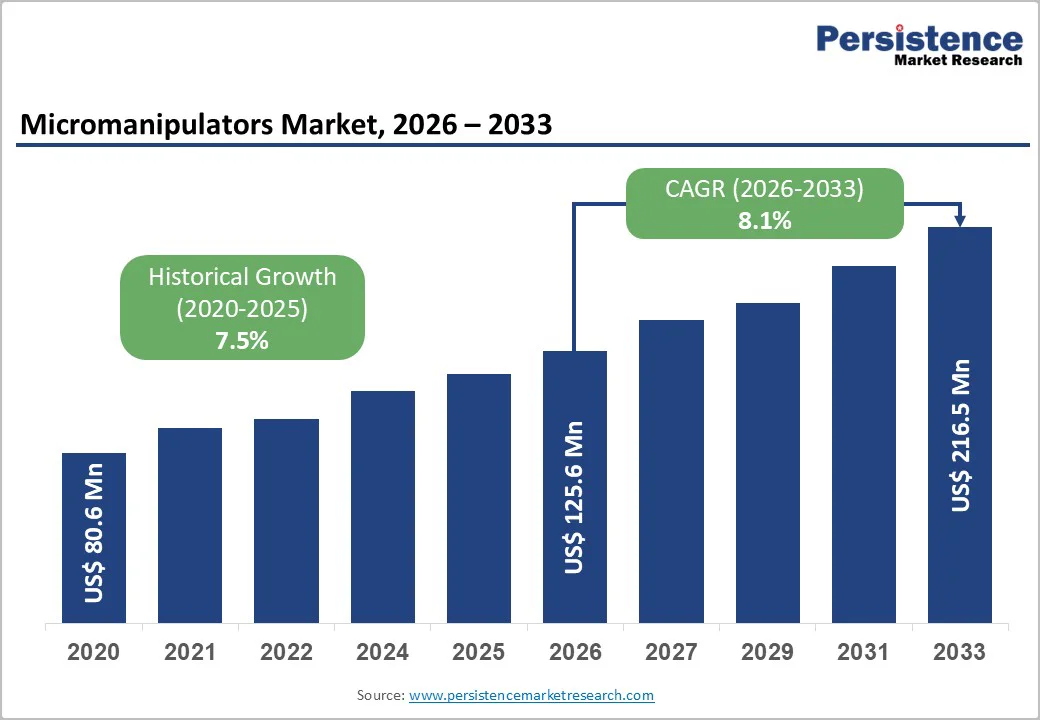
The global micromanipulators market size is estimated to grow from US$125.6 million in 2026 to US$216.5 million by 2033. The market is projected to record a CAGR of 8.1% from 2026 to 2033.
The market is growing steadily as precision handling of microscopic samples becomes essential in the life sciences, IVF, stem cell research, and semiconductor manufacturing. Demand is driven by rising adoption of electrophysiology studies, genetic engineering workflows, and advanced cell-based experiments requiring high-accuracy tools.
Key Industry Highlights
- The micromanipulators market is experiencing strong demand from cell biology, IVF, and stem cell research laboratories.
- Demand from semiconductor and microelectronics manufacturing is increasing as companies adopt micromanipulators for wafer probing, chip testing, and micro-assembly.
- Micromanipulators are becoming crucial tools in CRISPR workflows, gene editing, and cellular manipulation experiments.
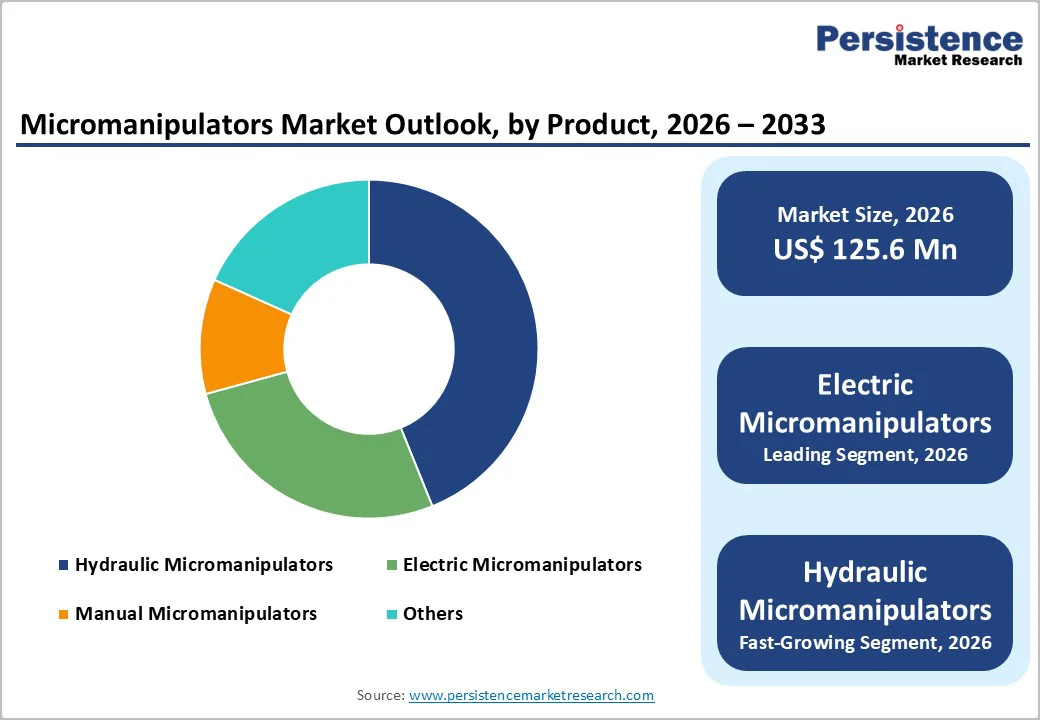
- Leading Product: Electric Micromanipulators dominate because they offer superior precision, digital control, compatibility with automation, and higher efficiency, making them preferred in IVF labs, stem cell research, electrophysiology, and semiconductor applications.
| Key Insights | Details |
|---|---|
| Micromanipulators Market Size (2026E) | US$125.6 Mn |
| Market Value Forecast (2033F) | US$216.5 Mn |
| Projected Growth (CAGR 2026 to 2033) | 8.1% |
| Historical Market Growth (CAGR 2020 to 2025) | 7.5% |
Market Dynamics
Driver - Growth in IVF & Assisted Reproductive Technologies
The growing burden of global infertility and the rapid expansion of assisted reproductive technologies (ART) are significantly increasing the use of micromanipulators in fertility centers. Techniques such as ICSI, embryo biopsy, oocyte manipulation, and pronuclear injection require extremely precise and stable tools to handle delicate reproductive cells.
As more couples seek IVF treatment and clinics adopt advanced ART techniques to improve success rates, the reliance on electric and motorized micromanipulators continues to rise. Additionally, expanding fertility infrastructure in emerging markets, increased medical tourism, and growing awareness of ART options further strengthen demand for high-accuracy micromanipulation systems worldwide.
Restraints - Competition from Automation & Robotics
Competition from automation and robotics is becoming a significant restraint for the micromanipulators market, as industries and research laboratories increasingly adopt fully automated micro-handling systems. These robotic platforms offer faster throughput, higher consistency, and reduced operator dependency compared to traditional micromanipulators.
Advanced robotic solutions integrate seamlessly with imaging, AI-based positioning, and automated workflows, enabling large-scale microinjection, cell sorting, and semiconductor handling with minimal human intervention. As automation becomes more affordable and accessible, many facilities prefer these systems for productivity and precision advantages.
This shift reduces demand for manual and semi-automated micromanipulators, especially in high-volume research and industrial environments.
Opportunity - Expansion of IVF & Fertility Centers
The rapid expansion of IVF and fertility centers worldwide is creating a major growth opportunity for the micromanipulators market. Rising infertility rates, delayed pregnancies, and greater acceptance of assisted reproductive technologies are driving higher IVF procedure volumes. Each IVF cycle requires precise micromanipulation tools for ICSI, embryo biopsy, oocyte handling, and blastocyst-based procedures.
As clinics shift toward advanced techniques like genetic screening, frozen embryo transfers, and improved embryo culture methods, demand for high-accuracy, vibration-free micromanipulators continues to increase. Emerging markets, particularly in Asia and the Middle East, are heavily investing in modern IVF labs, further accelerating the adoption of next-generation micromanipulation systems.
Category-wise Analysis
By Product Type Insights
Electric micromanipulators hold the highest market share because they provide unmatched precision, stability, and repeatability essential for modern laboratory and industrial applications. Their digitally controlled, motorized movements enable accurate positioning at micron and sub-micron levels, making them ideal for IVF, electrophysiology, cell microinjection, and semiconductor testing.
As laboratories move toward automation and high-throughput workflows, electric systems integrate easily with imaging platforms, robotic arms, and software-driven controllers. This reduces user dependency, minimizes human error, and improves procedural consistency.
Additionally, growing demand for advanced research techniques such as CRISPR, stem-cell manipulation, and microengineering further strengthens the adoption of electric micromanipulators over manual and hydraulic alternatives.
By Application Insights
Cell micromanipulation holds the highest market share because it is essential for a wide range of rapidly expanding biomedical applications, including IVF, stem-cell research, CRISPR gene editing, electrophysiology, and single-cell studies. These procedures require extreme precision, which micromanipulators uniquely provide.
With rising infertility rates, growth in assisted reproductive technologies, and increasing global investment in advanced life-science research, demand for cell manipulation tools continues to accelerate. Academic institutes, biotech companies, and clinical IVF centers routinely use micromanipulators, making this segment significantly larger than industrial uses.
Continuous innovation in genetic engineering and regenerative medicine further strengthens the dominance of cell micromanipulation.
Region-wise Insights
North America Micromanipulators Market Trends
North America remains the leading region in the micromanipulators market due to its advanced research infrastructure, strong biotechnology ecosystem, and high adoption of precision laboratory technologies. The U.S. drives most regional demand, supported by extensive IVF centers, cutting-edge stem-cell and genetic-engineering programs, and significant NIH-funded life-science research.
U.S. semiconductor and microelectronics industries further contribute to market growth through increasing use of micromanipulators in wafer probing and micro-assembly. Robust academic-industrial collaboration, rapid adoption of automated lab systems, and continuous technological innovation position North America, particularly the U.S., as the primary hub for micromanipulation technologies globally.
Asia Pacific Micromanipulators Market Trends
Asia Pacific is emerging as the fastest-growing region in the Micromanipulators Market, driven by rising biotechnology investments, expanding IVF centers, and rapid growth in semiconductor manufacturing hubs such as China, South Korea, Taiwan, and Japan.
Increasing government funding for life-science research, growing adoption of CRISPR and stem-cell technologies, and development of advanced academic institutes are fueling demand for precision micromanipulation tools. India is also seeing strong growth due to expanding fertility clinics and rising biomedical research activity.
The region’s push toward automation, coupled with cost-effective manufacturing capabilities, is accelerating the adoption of modern electric micromanipulators across both scientific and industrial applications.

Competitive Landscape
The global micromanipulators market is moderately competitive, with manufacturers focusing on precision, stability, and automation-driven innovation. Leading players compete through advanced motorized systems, improved ergonomics, and integrations with imaging, robotics, and digital control software.
Companies emphasize product reliability, multi-axis accuracy, and vibration-resistant designs to differentiate in research and industrial segments. Strategic partnerships with IVF centers, biotech labs, and semiconductor manufacturers are strengthening market positions.
Key Industry Developments:
- In October 2025, according to a study, the Open Micro Manipulator can achieve accurate sub-micro movement in three axes on a reasonable hobbyist-friendly budget.
Companies Covered in Micromanipulators Market
- Sensapex Oy
- Luigs & Neumann
- Scientifica Ltd.
- Siskiyou Corporation
- Danaher Corporation
- The Micromanipulator Company
- Narishige Co. Ltd.
- Applied Scientific Instrumentation Inc.
- World Precision Instruments Inc.
- Eppendorf AG
- Others
Frequently Asked Questions
The global micromanipulators market is projected to be valued at US$125.6 Mn in 2026.
Rising demand for precision cell manipulation in IVF, stem-cell research, electrophysiology, and genetic engineering.
The global market is poised to witness a CAGR of 8.1% between 2026 and 2033.
Expansion of CRISPR, gene-editing, and single-cell analysis requires high-precision microinjection systems.
Sensapex Oy, Luigs & Neumann, Scientifica Ltd., Siskiyou Corporation, and others.


