




- Biotechnology
- Wound Healing Assay Kits Market
Wound Healing Assay Kits Market Size, Share, and Growth Forecast, 2026 - 2033
Wound Healing Assay Kits Market by Product Type (Scratch Assay Kits, Others), Application (Cancer Research, Others), End-user (Academic and Research Institutes, Pharmaceutical and Biotechnology Companies, Others), and Regional Analysis for 2026 - 2033

Wound Healing Assay Kits Market Size and Trends Analysis
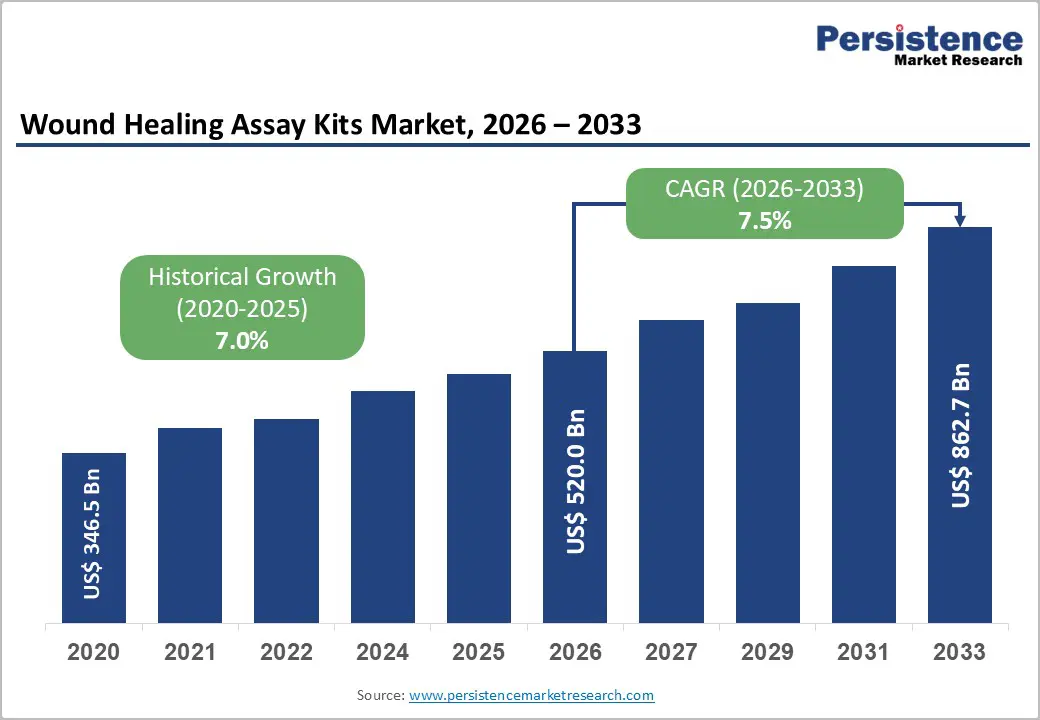
The global wound healing assay kits market size is likely to be valued at US$520.0 million in 2026 and is expected to reach US$862.7 million by 2033, growing at a CAGR of 7.5% during the forecast period from 2026 to 2033, driven by the study of cell migration, proliferation, and tissue regeneration mechanisms that are essential for understanding wound closure and repair processes.
These kits are widely used across cell biology, oncology, and regenerative medicine research to provide controlled, reproducible environments for analyzing cellular behavior without relying on animal models. Market growth is primarily driven by increasing research in cancer biology, where cell migration plays a critical role in tumor metastasis, as well as rising interest in tissue engineering and regenerative therapies aimed at accelerating healing. The expanding burden of chronic wounds, including diabetic ulcers and pressure injuries, has intensified the need for advanced laboratory models that can simulate wound healing dynamics and support therapeutic development. The integration of high-content imaging, automation, and compatibility with 3D cell culture models is also transforming the landscape by enabling more physiologically relevant and data-rich analyses.
Key Industry Highlights:
- Leading Region: North America is anticipated to be the leading region, accounting for 40% market share in 2026, driven by strong biomedical research funding, advanced innovation ecosystems, and widespread adoption of cutting-edge in vitro assay technologies.
- Fastest-growing Region: The Asia Pacific region is likely to be the fastest-growing region, supported by expanding R&D investments, growing biomedical infrastructure, and increasing adoption of cost-effective assay technologies across emerging economies.
- Leading Product Type: Scratch assay kits are projected to represent the leading product type in 2026, accounting for 60% of the revenue share, driven by their simplicity and widespread adoption in research laboratories.
- Leading Application: Cancer research is expected to be the leading application, accounting for over 45% of revenue in 2026, supported by its critical role in studying cell migration and metastasis.
| Key Insights | Details |
|---|---|
| Wound Healing Assay Kits Market Size (2026E) | US$520.0 Mn |
| Market Value Forecast (2033F) | US$862.7 Mn |
| Projected Growth (CAGR 2026 to 2033) | 7.5% |
| Historical Market Growth (CAGR 2020 to 2025) | 7.0% |
DRO Analysis
Driver - Rising Prevalence of Chronic Diseases and Cancer Research Demand
The increasing burden of chronic diseases, including diabetes, cardiovascular disorders, and cancer, is significantly intensifying the need for advanced in vitro research tools that can model cellular repair and migration processes. Chronic wounds, such as diabetic ulcers and pressure injuries, require a deeper scientific understanding of delayed-healing mechanisms, driving the adoption of wound-healing assay kits in laboratory settings. In oncology, these assays are extensively used to study tumor cell migration, invasion, and metastasis, which are critical aspects of cancer progression.
The expansion of cancer research programs worldwide is accelerating the use of wound healing assays for drug screening and therapeutic evaluation. Researchers increasingly rely on these kits to test the efficacy of anti-cancer compounds in inhibiting cell motility and metastasis-related pathways. The rising focus on precision medicine amplifies this demand, as tailored therapies require detailed cellular-level insights. Academic institutions and pharmaceutical companies are continuously investing in such assays to support high-quality research outputs, ensuring consistent growth in their adoption across both basic and applied biomedical research environments.
Technological Advancements in Assay Formats
Continuous advancements in assay technologies are transforming the capabilities of wound healing assay kits, making them more efficient, accurate, and user-friendly. Traditional manual scratch assays are increasingly being complemented or replaced by automated systems that offer higher precision and reproducibility. Innovations such as label-free monitoring and impedance-based techniques enable real-time tracking of cell migration without the need for dyes or markers, reducing experimental variability.
The integration of advanced imaging systems and software analytics has enhanced the depth of data obtained from these assays. High-content imaging allows researchers to capture detailed cellular behavior over time, while automated analysis tools reduce manual intervention and errors. The compatibility of these kits with three-dimensional cell culture models enhances their relevance by providing more physiologically accurate conditions. Such technological progress aligns with the broader shift toward quantitative and data-driven biology, strengthening the role of advanced assay formats in modern research workflows.
Restraint - Standardization and Reproducibility Challenges
Variability in experimental protocols and differences in assay execution remain key challenges that affect the reliability of wound-healing assay results. Factors such as inconsistent scratch formation, variations in cell density, and differences in incubation conditions can lead to discrepancies in outcomes across laboratories. This lack of standardization limits data comparability, making it difficult for researchers to draw consistent conclusions or replicate findings.
Efforts to improve reproducibility are ongoing, but the diversity of experimental setups remains a challenge. Even with commercially available kits, user-dependent variations can influence results, particularly in manual assays. This challenge is more pronounced in academic research settings, where standardized protocols are not always strictly followed. The need for robust validation and consistent methodology is therefore critical, as reproducibility issues can hinder the broader adoption of these assays in regulated environments such as drug development and clinical research.
Complex Regulatory and Validation Requirements
The use of wound healing assay kits in pharmaceutical and clinical research requires adherence to stringent regulatory and validation standards. Ensuring that assay results meet regulatory authorities' expectations involves extensive documentation, validation procedures, and quality control measures. These requirements can increase the time and cost associated with adopting new assay technologies, particularly for companies aiming to integrate them into drug development pipelines.
Validation of assay performance across different cell types and experimental conditions can be resource-intensive. Laboratories must demonstrate that the assays produce reliable and reproducible results under various scenarios, which can be a time-consuming process. Smaller research organizations and startups face challenges in meeting these requirements due to limited resources. This creates a barrier to entry and can restrict the widespread adoption of advanced assay systems, despite their potential to improve research outcomes and efficiency.
Opportunity - Expansion into Tissue Engineering and Regenerative Medicine Platforms
The rapid growth of tissue engineering and regenerative medicine presents significant opportunities for the application of wound healing assay kits. These fields focus on developing biomaterials, engineered tissues, and cell-based therapies that require thorough evaluation of cell migration and integration. Wound healing assays play a crucial role in assessing how cells interact with scaffolds and regenerate damaged tissues, making them essential tools in preclinical research.
The shift toward three-dimensional culture models and organ-on-chip technologies is expanding the scope of these assays. Researchers are seeking methods that accurately replicate in vivo conditions, and wound-healing kits are evolving to meet these requirements. This creates opportunities for manufacturers to develop specialized kits tailored for regenerative applications. As investment in these areas continues to grow, the integration of wound-healing assays into tissue-engineering workflows is becoming increasingly prominent, supporting innovation and clinical translation.
Integration with AI-Driven Image Analysis and Digital Pathology
The integration of artificial intelligence and digital pathology tools with wound healing assays is opening new avenues for data analysis and interpretation. AI-driven image analysis enables automated detection and quantification of cell migration patterns, reducing the need for manual measurements and minimizing human error. This enhances the accuracy and consistency of results, particularly in large-scale studies where high volumes of data need to be processed efficiently. The adoption of such technologies is transforming traditional workflows into more streamlined and data-centric processes.
Digital platforms enable real-time monitoring and remote analysis of assay results, facilitating collaboration among researchers at different locations. Machine learning algorithms can identify subtle patterns in cellular behavior that may not be readily detected by conventional methods, providing deeper insights into wound-healing mechanisms. This integration not only improves research efficiency but also supports the development of predictive models for drug response and tissue regeneration.
Category-wise Analysis
Product Type Insights
Scratch assay kits are expected to lead the wound healing assay kits market, accounting for approximately 60% of revenue in 2026, driven by their simplicity, affordability, and widespread use in academic and early-stage research environments. These assays are commonly used to study basic cell migration and wound closure mechanisms, making them a standard tool in laboratories with limited access to advanced instrumentation. Their manual format offers flexibility in experimental design, supporting exploratory studies across cell biology and oncology. For example, their routine use in university-based cancer research labs, where researchers evaluate how tumor cells migrate under different treatment conditions.
Electric cell-substrate impedance sensing (ECIS) assay kits are likely to represent the fastest-growing segment, supported by increasing demand for real-time, label-free monitoring of cell behavior. These systems provide continuous and highly reproducible data, making them suitable for high-throughput pharmaceutical screening and advanced research applications. Their ability to minimize operator variability and deliver quantitative insights aligns with the growing focus on precision and automation in life sciences. For example, their adoption by pharmaceutical companies to assess drug effects on cell migration dynamics during preclinical testing.
Application Insights
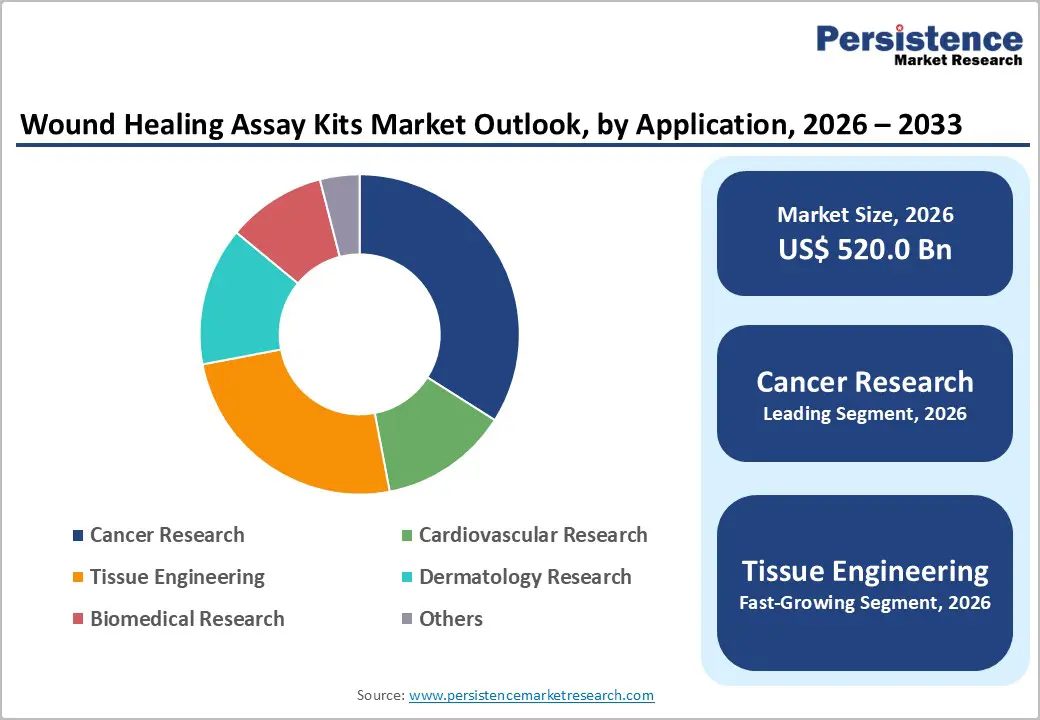
Cancer research is projected to lead the market, capturing around 45% of the revenue share in 2026, supported by the increasing focus on metastasis research, rising oncology research funding, and the growing use of wound-healing assays to evaluate anti-cancer drug efficacy and cell migration behavior. These assays play a crucial role in evaluating how cancer cells migrate and respond to therapeutic compounds, making them essential in oncology research workflows. The strong focus on anti-cancer drug development and increasing funding for oncology studies support this dominance. For example, their use in screening anti-metastatic drugs, where researchers analyze how compounds inhibit the movement of cancer cells in controlled environments.
Tissue engineering is likely to be the fastest-growing application, driven by rapid advancements in regenerative medicine and the increasing use of three-dimensional cell culture models. These assays are critical for assessing cell integration, scaffold compatibility, and the efficiency of tissue regeneration in engineered constructs. The rising interest in developing functional tissue replacements and organ models is accelerating their adoption in this field. For example, their use in evaluating cell migration within biomaterial scaffolds designed for skin regeneration.
Regional Insights
North America Wound Healing Assay Kits Market Trends
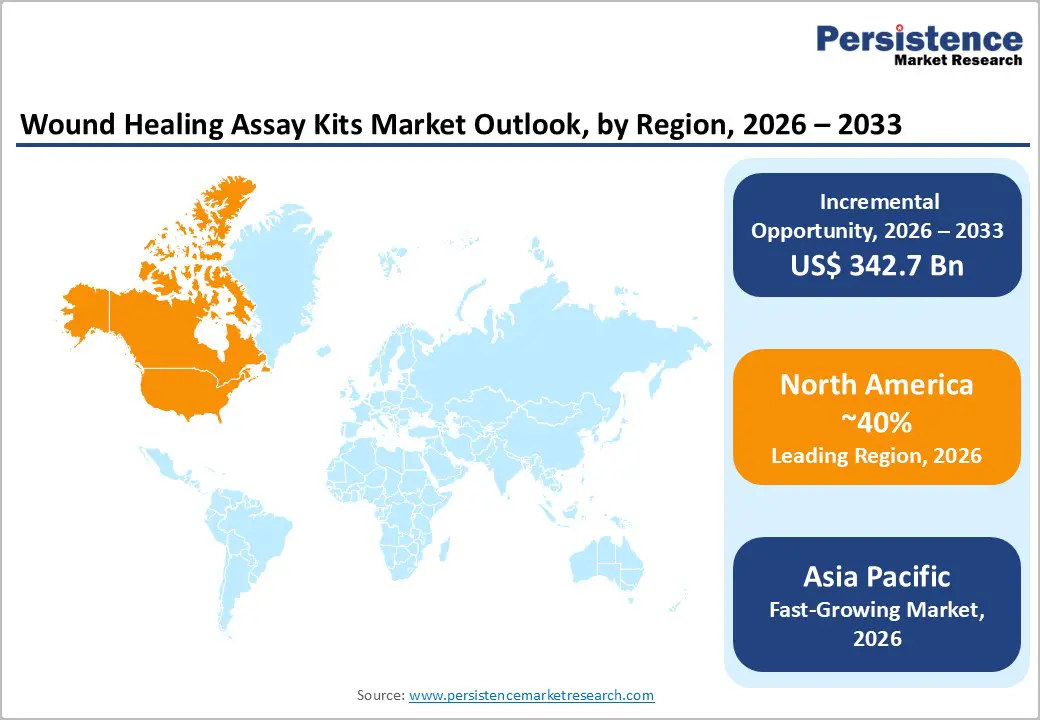
North America is anticipated to be the leading region, accounting for a market share of 40% in 2026, driven by its highly advanced biomedical research ecosystem, strong funding support, and early adoption of innovative technologies. The region shows a clear trend toward automation, high-throughput screening, and integration of digital analytics tools, which enhance data accuracy and reproducibility in cell migration studies. Increasing focus on cancer research, drug discovery, and regenerative medicine accelerates the demand for sophisticated assay formats. Strong collaboration between academic institutions and pharmaceutical companies supports continuous product innovation and validation.
The presence of well-established life science companies also strengthens market maturity and accessibility. The region is also witnessing the adoption of advanced assay systems developed by companies such as Thermo Fisher Scientific Inc., which offers high-content imaging and automated cell analysis platforms widely used in migration and wound healing studies. These solutions enable researchers to generate real-time, quantitative insights, supporting precision medicine and drug development initiatives.
Europe Wound Healing Assay Kits Market Trends
Europe is likely to be a significant market for wound healing assay kits, due to strong government support, well-established healthcare systems, and increasing investments in regenerative medicine research. The region is witnessing a steady shift toward advanced assay technologies, particularly those compatible with 3D cell culture and tissue engineering applications. Academic and industrial collaborations play a significant role in driving innovation, while regulatory frameworks ensure high standards for assay validation and reproducibility.
Growing awareness of chronic wound conditions and the need for improved therapeutic solutions continue to support demand across research institutions. Companies, such as Abcam plc, offer advanced assay solutions that emphasize precision and reproducibility, for example, providing a wide range of cell-based assay kits for studying migration and wound-healing processes. These products are widely used in academic and pharmaceutical research for their reliability and compatibility with modern laboratory workflows.
Asia Pacific Wound Healing Assay Kits Market Trends
The Asia Pacific region is likely to be the fastest-growing region, driven by expanding research infrastructure, rising healthcare expenditure, and increasing government support for biotechnology and life sciences innovation. Countries such as China and India are investing heavily in academic research, clinical studies, and pharmaceutical development, leading to greater adoption of wound-healing assay kits. The region is also witnessing a trend toward cost-effective manufacturing and wider accessibility of research tools, making advanced assays more available to a broader range of institutions.
Another important trend is the growing presence of regional players expanding their footprint in the Asia Pacific, including companies, for example, Qiagen N.V., which supports research applications through advanced molecular and cell analysis solutions. These companies are leveraging regional manufacturing advantages and partnerships to enhance distribution and affordability. Increasing adoption of automated and label-free assay technologies, along with rising demand for personalized medicine and regenerative therapies, is positioning Asia Pacific as a key growth engine in the market.
Competitive Landscape
The global wound healing assay kits market exhibits a moderately fragmented structure, driven by the presence of multiple regional players competing on innovation, product quality, and technological advancements. The market is characterized by continuous product development, with companies focusing on improving assay sensitivity, reproducibility, and compatibility with advanced research models such as 3D cell cultures and automated platforms. Increasing demand from the pharmaceutical and biotechnology sectors is intensifying competition, while high entry barriers due to regulatory requirements and capital investments limit new entrants.
These players compete through strategic initiatives such as mergers, acquisitions, partnerships, and continuous R&D investments aimed at launching advanced and user-friendly assay kits. Companies are increasingly differentiating themselves by integrating automation, label-free technologies, and digital analysis tools to enhance data accuracy and throughput. Pricing strategies, distribution networks, and strong collaborations with academic and research institutions influence competitive positioning.
Key Industry Developments:
- In February 2026, Covaris launched the truCOVER® Total RNA Library Prep Kit at SLAS 2026, designed to improve reproducibility and workflow efficiency in cell-based and molecular assays, supporting advanced research applications including cell behavior and wound healing studies.
- In December 2025, MPM Medical launched new collagen-based at-home wound care kits along with a proprietary digital portal, aimed at improving patient compliance, expanding access to post-operative care, and enabling healthcare providers to deliver continued treatment outside clinical settings.
- In May 2025, Nordic Bioscience launched a novel Endotrophin assay designed to quantify a key collagen-derived biomarker, enabling improved assessment of fibro-inflammatory activity, wound healing processes, and disease progression for enhanced risk stratification and precision medicine applications.
Companies Covered in Wound Healing Assay Kits Market
- Merck KGaA
- Abcam plc
- Bio-Rad Laboratories Inc.
- Thermo Fisher Scientific Inc.
- Promega Corporation
- Cell Biolabs Inc.
- BioVision Inc.
- Cell Signaling Technology Inc.
- Cayman Chemical Company
- BD Biosciences
- STEMCELL Technologies Inc.
- Abnova Corporation
- Essen BioScience
- MilliporeSigma
- Qiagen N.V.
- Santa Cruz Biotechnology Inc.
- Bio-Techne Corporation
Frequently Asked Questions
The global wound healing assay kits market is projected to reach US$520.0 million in 2026.
The wound healing assay kits market is driven by increasing demand for cell migration studies in cancer research, regenerative medicine, and drug discovery, along with advancements in in vitro assay technologies.
The wound healing assay kits market is expected to grow at a CAGR of 7.5% from 2026 to 2033.
Key market opportunities lie in expanding applications in tissue engineering and regenerative medicine, along with the integration of AI-driven imaging and advanced 3D cell culture technologies for enhanced analysis.
Merck KGaA, Abcam plc, Bio-Rad Laboratories Inc., Thermo Fisher Scientific Inc., and Promega Corporation are the leading players.


