




- Biotechnology
- Bubble Column Bioreactors Market
Bubble Column Bioreactors Market Size, Share, and Growth Forecast, 2026 - 2033
Bubble Column Bioreactors Market By Reactor Type (Vertical Bubble Column Bioreactors, Single-Use Bubble Column Bioreactors, Others), Operation Mode (Batch, Continuous, Others), Application (Pharmaceuticals/Biopharmaceutical Production, Research and Development, Others), End User and Regional Analysis for 2026 - 2033

Bubble Column Bioreactors Market Size and Trends Analysis
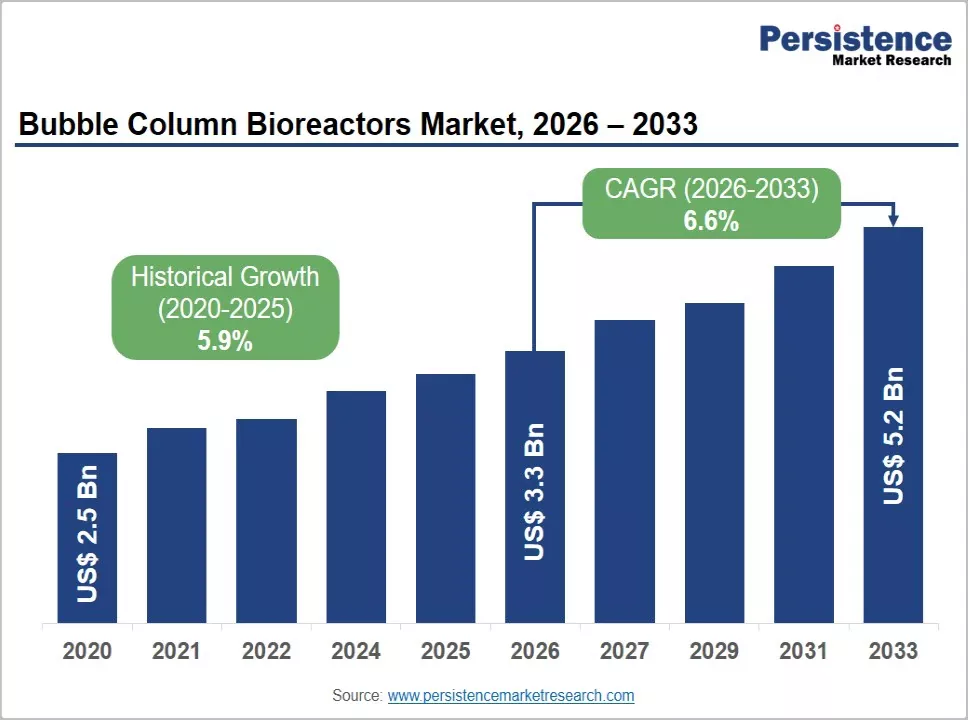
The global bubble column bioreactors market size is likely to be valued at US$3.3 billion in 2026 and is expected to reach US$5.2 billion by 2033, growing at a CAGR of 6.6% between 2026 and 2033.
Market expansion is supported by rising biologics and vaccine manufacturing, wider use of low-shear pneumatic mixing in cell culture and fermentation, and policy-backed investment in industrial biomanufacturing. Demand remains concentrated in pharmaceutical production and research settings, where simple mechanical design and scalable gas-liquid mass transfer are important selection criteria.
Key Industry Highlights
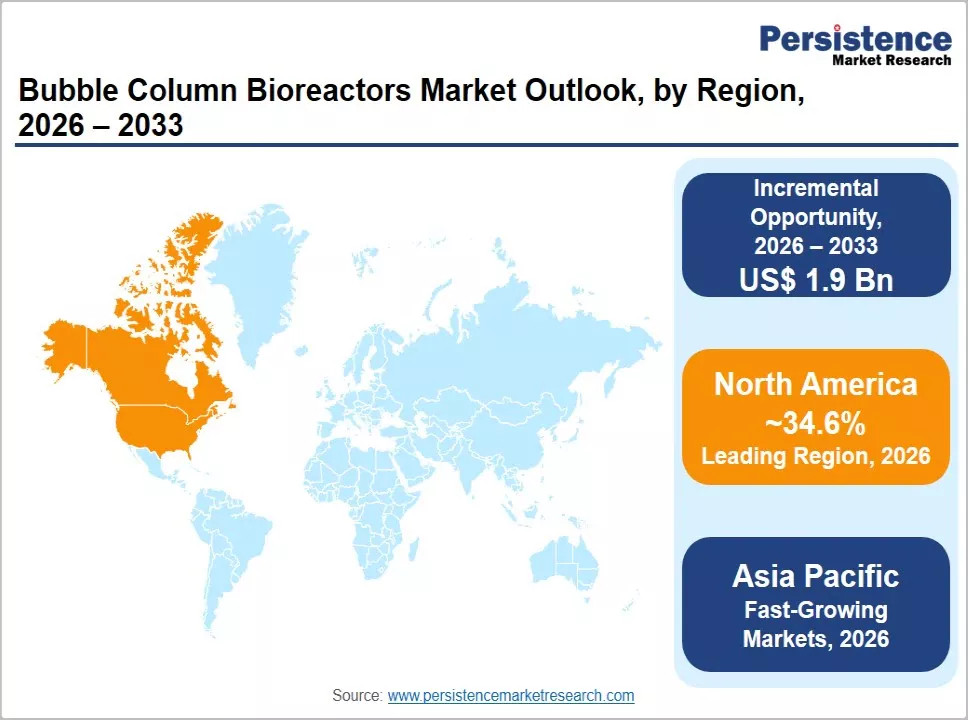
- Leading Region: North America is projected to lead with 34.6% market share, supported by a dense biopharmaceutical manufacturing base, an established regulatory framework, and the presence of major bioprocess equipment suppliers.
- Fastest-growing Region: Asia Pacific is expected to record the fastest growth, driven by expanding biologics and biosimilar manufacturing, government biomanufacturing programs such as India’s BioE3 policy, and rising contract manufacturing capacity.
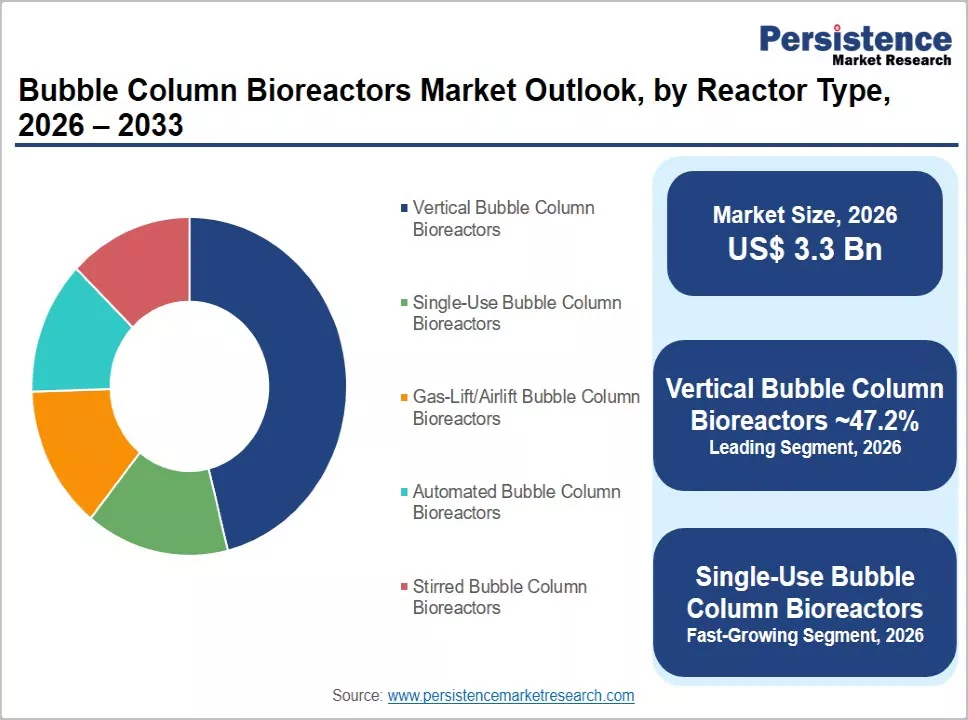
- Dominant Reactor Type: Vertical Bubble Column Bioreactors dominate with an estimated 47.2% market share, reflecting the large installed base of conventional vertical designs.
- Leading Application: Pharmaceuticals/Biopharmaceutical Production leads with an estimated 41.7% market share, supported by demand for vaccines, recombinant proteins, and biologics.
DRO Analysis
Drivers - Expanding Biologics Pipelines and Rising Demand for Scalable, Low-Shear Bioproduction
Biologics continue to shape pharmaceutical development and manufacturing demand. The U.S. FDA’s Center for Drug Evaluation and Research (CDER) approved 46 novel drugs and 18 biosimilars in 2025, and combined with the Center for Biologics Evaluation and Research, the agency recorded 58 novel approvals. In 2024, 16 of CDER’s 50 novel approvals (32%) were biologics, according to DCAT Value Chain Insights. Each approval requires upstream capacity for cell culture or fermentation. Bubble column and airlift systems remain among the most established pneumatic formats for animal cell culture, using gas bubbles for both aeration and mixing without mechanical agitators. The market impact is sustained equipment demand for process development, clinical supply, and commercial production, particularly where lower shear and simpler hardware reduce operating complexity.
Policy-Backed Growth in Industrial Biomanufacturing and Sustainable Bioprocessing
Governments are building biomanufacturing capacity beyond therapeutics, broadening the application base for bubble column systems in biofuels, biochemicals, wastewater treatment, and food fermentation. India’s Union Cabinet approved the BioE3 (Biotechnology for Economy, Environment and Employment) Policy on August 24, 2024, to support biomanufacturing hubs, biofoundries, and Bio-AI hubs across six thematic sectors, including bio-based chemicals, enzymes, and biofuels. An Indian parliamentary reply summarized in July 2026 reported more than 270 projects recommended for funding and 17 shared biofoundry and biomanufacturing facilities supported. These programs create demand for pilot- and demonstration-scale reactors, where simple construction and efficient gas-liquid contact favor bubble columns. The impact is greater diversification of end-use demand and a more resilient revenue base.
Restraint - Hydrodynamic Limitations, Scale-Up Complexity, and Competition from Stirred-Tank Platforms
Bubble column bioreactors rely on gas sparging for both oxygen transfer and mixing, which creates process constraints. Bursting bubbles at the liquid surface can damage shear-sensitive mammalian cells, foam formation can limit working volume, and antifoam agents may add downstream purification requirements. Mixing in viscous or high-density cultures is also less controllable than in agitated vessels, which complicates scale-up. Stirred-tank designs remain the reference platform in single-use bioprocessing, with ResearchAndMarkets reporting that stirred-tank single-use systems dominated that market in 2019. Manufacturers therefore require additional process characterization and comparability data before adopting bubble column formats for commercial biologics, extending qualification timelines and limiting penetration in high-density mammalian cell culture.
Opportunities - Single-Use, Continuous, and Perfusion-Compatible Formats Create New Technology Pathways
Single-use and continuous operating formats offer an opportunity to address flexibility and cost pressures in biomanufacturing. The ICH Q13 guideline on continuous manufacturing, finalized in November 2022, provides a harmonized regulatory reference for continuous processes. Suppliers are extending single-use platforms across scales: Cellexus offers purely airlift single-use bioreactors from 1.5 to 50 liters, and PBS Biotech launched its MiniPRO multi-parallel system in December 2025 for cell therapy process development. These developments point to growing demand for pre-sterilized, automation-ready systems that reduce cleaning validation and changeover time. The commercial opportunity centers on bubble column designs that deliver reproducible oxygen transfer, closed-system operation, and compatibility with perfusion or fed-batch strategies at laboratory and pilot scale.
Asia Pacific Creates Opportunities through Manufacturing Investment and Policy Support
Asia Pacific combines expanding biologics and biosimilar production with government-supported bioeconomy programs. India’s BioE3 framework supports biofoundries and biomanufacturing hubs, while China’s 2024 Government Work Report identified biomanufacturing among emerging industries. Suppliers are localizing: Thermo Fisher expanded Bioprocess Design Centers in Hyderabad, Incheon, and Singapore in December 2025, and Sartorius announced a new production line at its Bengaluru facility in March 2025. In the United States, the BIOSECURE Act, enacted on December 18, 2025, restricts federal contracting with designated biotechnology companies of concern and may encourage drug developers to diversify manufacturing partners across regions. Manufacturers with regional service networks, localized production, and training programs are positioned to capture this demand.
Category-wise Analysis
Reactor Type Insights
Vertical bubble column bioreactors are anticipated to account for an estimated 47.2% of the market share. Conventional vertical designs hold the largest installed base because they combine simple construction, the absence of moving mechanical parts, lower energy requirements, and well-understood gas-liquid mass transfer behavior. Peer-reviewed literature notes that conventional bubble column and airlift systems remain among the most familiar and experienced bioreactor formats. These characteristics support use across microbial fermentation, algal cultivation, wastewater treatment, and animal cell culture. Examples include laboratory-scale glass columns used for process screening and larger custom columns installed in industrial fermentation and effluent treatment. The principal limitation is dependence on sparging for mixing, which narrows suitability for shear-sensitive or high-viscosity cultures.
Single-use bubble column bioreactors are projected to expand, making them the fastest-growing reactor type. Growth is supported by pre-sterilized disposable liners, reduced cleaning validation, and faster changeover in multiproduct facilities, benefits that align with demand from contract manufacturers and cell and gene therapy developers. Cellexus markets purely airlift single-use bioreactors from 1.5 to 50 liters, illustrating this shift toward disposable pneumatic systems. Gas-lift/airlift, automated, and stirred bubble column configurations also contribute by addressing mixing and process-control limitations. Adoption at larger volumes will depend on extractables and leachables data, supply continuity for film and bag components, and demonstrated oxygen transfer at scale.
Application Insights
Pharmaceuticals/biopharmaceutical production is anticipated to account for an estimated 41.7% of the market share. Demand is driven by vaccines, recombinant proteins, and biologics, where upstream cell culture and microbial fermentation require scalable aeration. FDA’s approval of 46 novel drugs and 18 biosimilars in 2025 illustrates the pipeline that feeds manufacturing demand. Manufacturers value low mechanical shear, closed operation, and compatibility with single-use assemblies. Challenges include regulatory scrutiny of process comparability and the established position of stirred-tank bioreactors in large-scale mammalian cell culture, which keeps bubble column adoption concentrated in selected modalities and development settings.
Research and development is projected to be the fastest-growing application. Growth is supported by personalized medicine, cell and gene therapy research, and expanding biotechnology R&D activity, all of which require flexible small-volume reactors for strain screening, media optimization, and early process development. Bench-scale bubble column and airlift reactors allow low-cost evaluation of oxygen transfer and mixing before scale-up. Process development and scale-up, wastewater treatment, biofuels and biochemicals, and food, beverage, and nutraceutical production provide additional demand. India’s BioE3 policy, which funds shared biofoundry and biomanufacturing infrastructure, illustrates how public programs expand pilot-scale capacity for this work.
Regional Insights
North America Bubble Column Bioreactors Market Trends
North America leads the global market with an estimated 34.6% share, supported by a dense biopharmaceutical manufacturing base, specialist contract manufacturers, major bioprocess equipment suppliers, and an established regulatory environment. Thermo Fisher Scientific, Cytiva (Danaher), Repligen, ABEC, and Parker Hannifin are headquartered in the region, which shortens supply chains and supports early adoption of new designs. Regional growth is expected to center on the replacement of stainless-steel installations with single-use and automated systems.
U.S. Bubble Column Bioreactors Market Trends
The U.S. is the principal North American market, supported by the world’s largest concentration of biologics developers and the FDA’s established review framework. CDER approved 46 novel drugs and 18 biosimilars in 2025, and combined CDER and CBER novel approvals reached 58, sustaining demand for upstream capacity. Regulatory expectations for process validation, contamination control, and data integrity favor suppliers that provide qualified, documented systems.
Policy is also reshaping sourcing. The BIOSECURE Act, enacted as Section 851 of the FY2026 National Defense Authorization Act on December 18, 2025, restricts federal contracting and grants involving biotechnology companies of concern, with the Office of Management and Budget required to publish a list by December 18, 2026. This may support domestic and allied-region capacity additions. In September 2025, Thermo Fisher completed its approximately US$4.0 billion acquisition of Solventum’s Purification & Filtration business, strengthening its bioproduction portfolio.
Europe Bubble Column Bioreactors Market Trends
Europe is a major market because of its concentration of bioprocess equipment manufacturers, established biopharmaceutical hubs, and a harmonized regulatory framework coordinated through the European Medicines Agency. The revised EU GMP Annex 1 on sterile medicinal product manufacturing, applicable since August 25, 2023, reinforces contamination-control expectations and supports adoption of closed and single-use systems. Sartorius (Göttingen), Merck KGaA (Darmstadt), Eppendorf (Hamburg), Getinge (Gothenburg), and Infors HT (Bottmingen) anchor regional supply. Investment is directed toward single-use consumables, automation, and sustainability.
Germany Bubble Column Bioreactors Market Trends
Germany is the largest European market, anchored by Sartorius, Merck KGaA, and Eppendorf, together with a large pharmaceutical and academic research base. Sartorius’ Bioprocess Solutions division reported 2024 sales of approximately €2,690.2 million, illustrating the scale of German-headquartered bioprocess suppliers. Demand for bubble column systems is concentrated in research institutions, contract manufacturers, and industrial biotechnology.
U.K. Bubble Column Bioreactors Market Trends
The U.K. combines academic bioprocess research, cell and gene therapy manufacturing capability, and a distinct post-Brexit regulatory pathway under the MHRA. Cellexus, based in Dundee, Scotland, manufactures single-use airlift bioreactors from 1.5 to 50 liters and exports to customers in multiple regions. The Cell and Gene Therapy Catapult supports process development for advanced therapies, creating demand for flexible small-scale and single-use reactors.
Asia Pacific Bubble Column Bioreactors Market Trends
Asia Pacific is the fastest-growing region in the bubble column bioreactors market. Growth is supported by expanding biologics and biosimilar manufacturing, a growing contract manufacturing sector, government bioeconomy programs, and increasing local production of bioprocess equipment. Industrial fermentation, biofuels, and wastewater treatment add demand where low capital cost favors bubble column designs. Investment priorities include shared biomanufacturing infrastructure, workforce training, and localization of consumables.
China Bubble Column Bioreactors Market Trends
China combines large biopharmaceutical and contract manufacturing capacity with government prioritization of biomanufacturing, which the 2024 Government Work Report identified among emerging industries. Domestic equipment makers and international suppliers compete on automation, single-use quality, and service. The U.S. BIOSECURE Act introduces regulatory uncertainty for Chinese contract manufacturers serving U.S. customers, because designated companies of concern will face federal contracting restrictions, with the initial list due by December 18, 2026. Industrial fermentation and wastewater treatment further support demand.
Japan Bubble Column Bioreactors Market Trends
Japan is a mature market characterized by advanced regenerative medicine research, rigorous PMDA oversight, and a strong fermentation heritage in food, amino acids, and enzymes. Demand centers on research institutions, contract manufacturers, and industrial fermentation producers. Government support for domestic vaccine and biopharmaceutical manufacturing capacity encourages investment in flexible, single-use and automated systems, although adoption depends on rigorous qualification.
Competitive Landscape
The global bubble column bioreactors market is relatively fragmented at the bubble column level, while the broader single-use bioreactor market is more consolidated. In that broader market, Sartorius, Danaher (Cytiva), Thermo Fisher Scientific, and Merck KGaA collectively hold an estimated 70%–75% of revenue, according to MarketsandMarkets figures cited by IntuitionLabs. Eppendorf, Getinge, Repligen, ABEC, Parker Hannifin, Corning, Infors HT, PBS Biotech, and Cellexus complete a competitive field spanning integrated platforms and specialist pneumatic systems. Individual company market-share percentages are not presented because consistent audited revenue data for the bubble column segment are unavailable.
Market participants are emphasizing single-use platforms, automation and digital integration, scale-range extension, and regional manufacturing and service capacity. Leaders differentiate through validated consumables, global service networks, and integrated upstream and downstream portfolios, while smaller companies focus on specialized airlift and perfusion-compatible designs. Emerging business models include consumables-linked revenue, digital process analytics, and customer design centers that shorten process transfer.
Key Industry Developments
- In December 2025, Thermo Fisher Scientific expanded its Bioprocess Design Centers in Hyderabad, Incheon, and Singapore, strengthening regional process development support for biopharmaceutical customers in Asia Pacific.
- In September 2025, Thermo Fisher Scientific completed its acquisition of Solventum’s Purification & Filtration business for approximately US$4.0 billion in cash. The business was expected to generate about US$750 million of revenue in 2025 and extends Thermo Fisher’s bioproduction filtration portfolio.
Companies Covered in Bubble Column Bioreactors Market
- Sartorius AG
- Thermo Fisher Scientific Inc.
- Cytiva (Danaher Corporation)
- Merck KGaA (MilliporeSigma)
- Eppendorf SE
- Getinge AB
- Repligen Corporation
- ABEC, Inc.
- Parker Hannifin Corporation
- Corning Incorporated
- Infors HT
- PBS Biotech, Inc.
- Cellexus
Frequently Asked Questions
The global bubble column bioreactors market is likely to be valued at US$3.3 billion in 2026.
The global bubble column bioreactors market is expected to reach US$5.2 billion by 2033.
Key trends include the shift to single-use and gas-lift/airlift designs, growing interest in continuous and perfusion-compatible operation, automation and digital process monitoring, and policy-backed expansion of biomanufacturing capacity in Asia Pacific.
By reactor type, vertical bubble column bioreactors are the leading segment, accounting for an estimated 47.2% of the market share. By application, pharmaceuticals/biopharmaceutical production leads with an estimated 41.7%.
The market is projected to grow at a CAGR of 6.6% between 2026 and 2033, compared with a historical CAGR of 5.9%.
Major players include Sartorius, Thermo Fisher Scientific, Cytiva (Danaher), Merck KGaA, Eppendorf, Getinge, Repligen, and ABEC.


