




- Automotive
- Ventilated Seats Market
Ventilated Seats Market Size, Share, and Growth Forecast, 2026 – 2033
Ventilated Seats Market by Technology Type (Active, Passive), Propulsion (ICE, Hybrid, Electric), Vehicle (Passenger Vehicles, Commercial Vehicles), and Regional Analysis for 2026 – 2033

Ventilated Seats Market Size and Trends Analysis
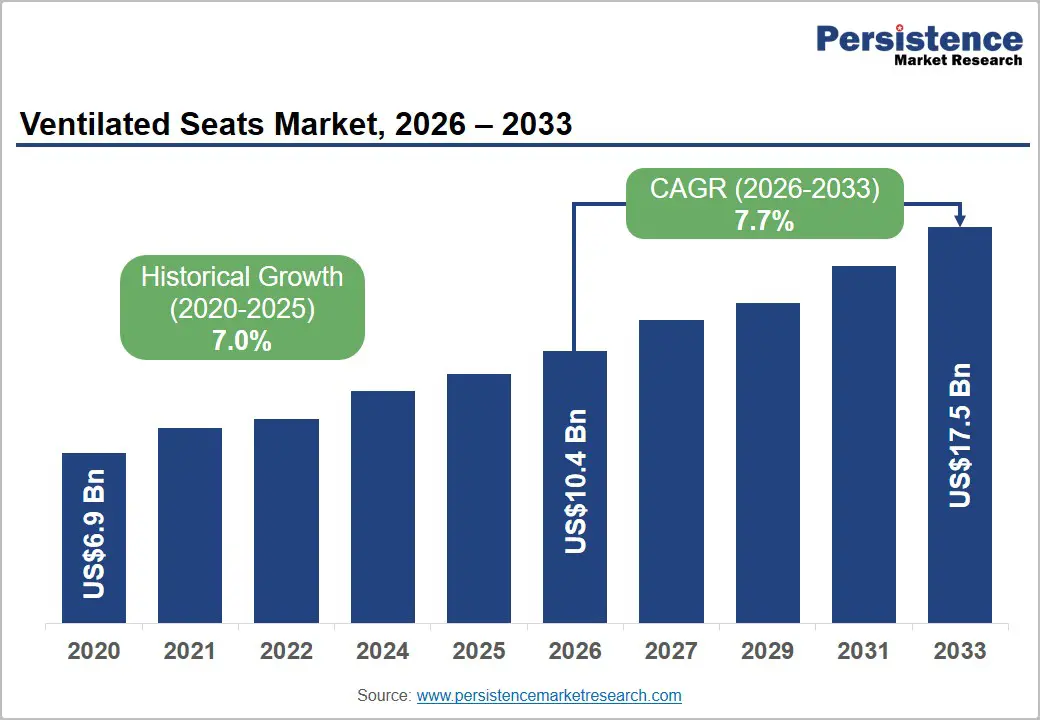
The global ventilated seats market size is likely to be valued at US$10.4 billion in 2026 and is expected to reach US$17.5 billion by 2033, growing at a CAGR of 7.7% during the forecast period from 2026 to 2033, driven by the rising integration of comfort and thermal management systems in modern vehicles, especially SUVs, premium passenger cars, and electric vehicles.
Demand is increasing as OEMs shift toward enhanced cabin experience and smart seating technologies. Growth is further supported by the rapid electrification of vehicles, where seat-level cooling helps optimize overall HVAC load and energy efficiency. This is reinforced by the increasing adoption of compact, energy-efficient ventilation modules integrated directly into seat structures to improve occupant comfort. OEMs are also optimizing seat designs with improved airflow distribution to ensure consistent cooling performance across different vehicle segments.
Key Industry Highlights:
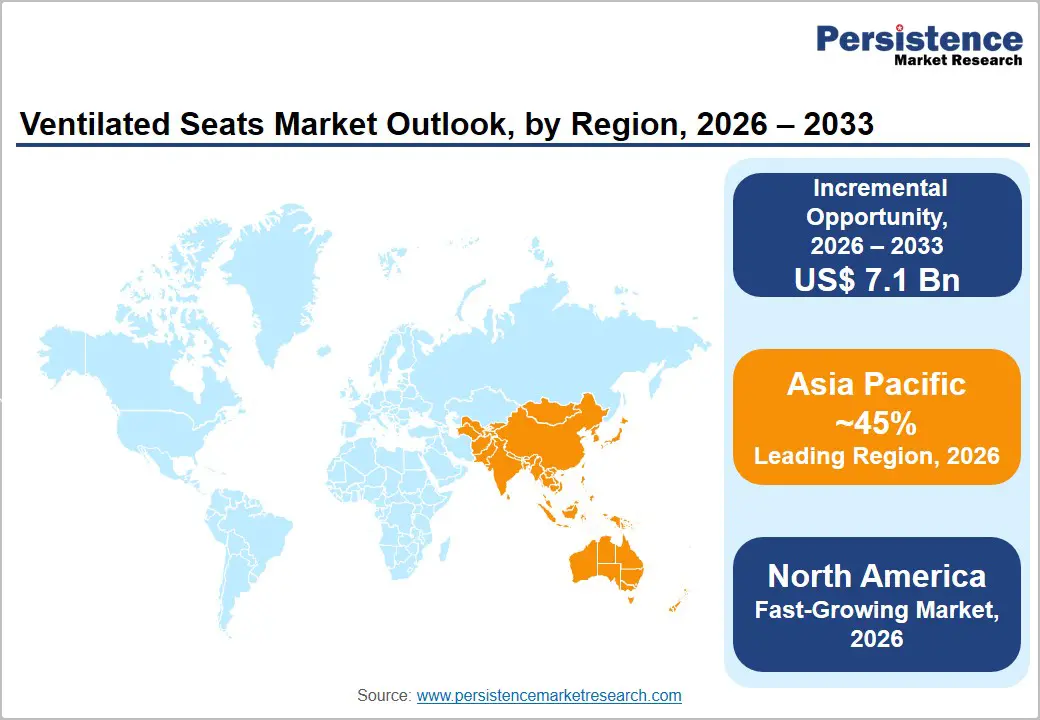
- Leading Region: Asia Pacific is anticipated to be the leading region, accounting for a market share of 45% in 2026, driven by rapid vehicle production growth, strong automotive manufacturing ecosystems, and rising disposable incomes.
- Fastest-growing Region: North America is likely to be the fastest-growing region, supported by robust demand for premium comfort features, widespread adoption of SUVs and pickup trucks, and the increasing integration of advanced seating technologies.
- Leading Technology Type: The active segment is projected to represent the leading technology type in 2026, accounting for 60% of the revenue share, due to strong airflow efficiency, higher adoption in premium vehicles, and superior cooling performance compared to passive systems.
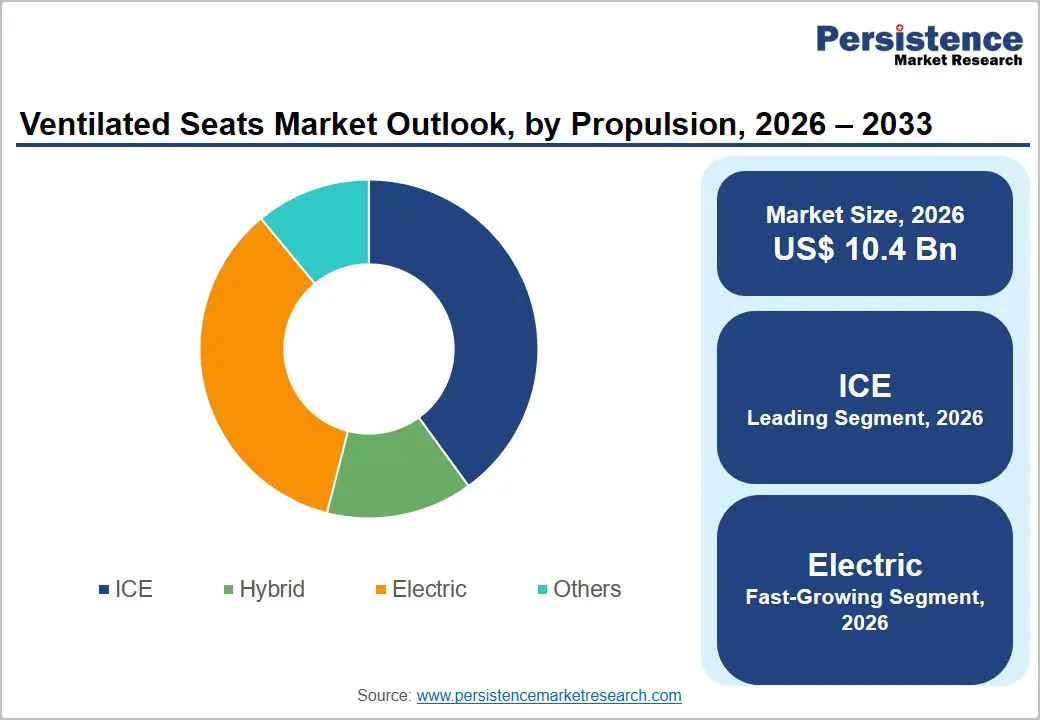
- Leading Propulsion: ICE is anticipated to be the leading propulsion, accounting for over 65% of the revenue share in 2026, supported by its large existing fleet base and continued high production volumes in emerging markets.
- Key Opportunity: Key market opportunity in the ventilated seats market is the rapid expansion of advanced thermal comfort systems across passenger, electric, and commercial vehicles, driven by global automotive premiumization and rising demand for energy-efficient in-cabin technologies.
DRO Analysis
Driver - Rising Demand for Vehicle Comfort and Luxury Features
The ventilated seats market is strongly driven by the rising consumer demand for enhanced in-cabin comfort, especially in passenger cars, SUVs, and premium vehicles. Automakers are increasingly integrating seat ventilation systems to improve thermal comfort, reduce sweating, and enhance the long-distance driving experience. The growing urbanization and rising disposable incomes are pushing buyers toward comfort-oriented features rather than basic functionality.
Ventilated seats are now becoming a key differentiator for OEMs aiming to improve customer satisfaction and brand positioning in both developed and emerging automotive markets. This driver is strengthened by the rapid shift toward electric vehicles, where cabin experience becomes more important due to reduced engine noise and improved interior focus.
Consumers now expect advanced comfort technologies as standard or semi-standard features even in mid-range vehicles. Automakers are responding by expanding ventilated seat offerings across multiple vehicle platforms. The trend of vehicle premiumization is also encouraging Tier-1 suppliers to innovate lightweight, energy-efficient, and compact ventilation modules.
Restraint - High Integration Complexity and Structural Challenges in Mass-Market Vehicles
Incorporating fans, ducts, wiring, and airflow channels requires precise engineering, increasing manufacturing difficulty and production cost. In mass-market vehicles, cost sensitivity limits widespread adoption, as OEMs must balance comfort features with affordability. Additionally, integrating ventilation systems without compromising seat durability, safety standards, and ergonomics presents engineering challenges.
Another key challenge is the added weight and energy consumption associated with ventilated seat systems, particularly in electric vehicles, where efficiency is critical. Improper integration can affect airflow performance and reduce system reliability over time. Maintenance complexity and potential failure of small electronic components also increase lifecycle concerns for manufacturers and end-users.
Opportunity - Premiumization and Commercial Applications
The ventilated seats market presents strong opportunities driven by automotive premiumization trends, where consumers increasingly demand luxury-like comfort features across all vehicle segments. OEMs are expanding ventilated seat offerings beyond premium cars into mid-range SUVs and sedans, creating new growth avenues. Rising competition among automakers is pushing differentiation through advanced interior comfort systems.
Growing EV adoption creates opportunities for energy-efficient seat cooling technologies that reduce HVAC load. Emerging markets in Asia Pacific and the Middle East are particularly attractive due to rising incomes and extreme climatic conditions that increase demand for cooling comfort systems. Opportunities exist in commercial vehicle applications, including long-haul trucks, buses, and fleet vehicles, where driver comfort directly impacts productivity and safety.
Fleet operators are increasingly investing in ergonomic seating systems to reduce fatigue during long operating hours. Technological advancements such as smart ventilation, sensor-based climate control, and integrated heating-cooling systems are opening new innovation pathways. Aftermarket upgrades and customization trends also support additional revenue streams.
Category-wise Analysis
Technology Type Insights
Active ventilated seats are expected to lead, accounting for 60% of revenue in 2026, due to their superior cooling performance and strong adoption in premium and SUV segments. These systems use integrated fans or blowers to actively circulate air through seat cushions and backrests, ensuring effective thermal comfort even in high-temperature regions. A notable example includes their widespread integration in premium SUV platforms such as the Toyota Land Cruiser and similar luxury-oriented models, where advanced comfort features are a key selling point.
Passive ventilated seats are likely to represent the fastest-growing segment, supported by their lower cost structure, simpler design, and energy-efficient operation. Unlike active systems, they rely on breathable materials and natural airflow pathways, making them more suitable for mid-range and mass-market vehicles. For example, their increasing adoption in compact sedan platforms from manufacturers such as Hyundai and Kia, where cost optimization and efficiency are critical.
Propulsion Insights
ICE vehicles are projected to lead the market, capturing around 65% of the revenue share in 2026, supported by their large installed base and continued dominance in vehicle production, particularly in emerging economies. For instance, the BMW X5 offers ventilated front seats in multiple ICE-powered variants and demonstrates the strong adoption of advanced seating comfort technologies in premium internal-combustion vehicles.
Electric vehicles are expected to be the fastest-growing propulsion segment as manufacturers increasingly incorporate ventilated seats to enhance passenger comfort and optimize thermal management. By providing localized seat cooling, these systems help reduce reliance on the vehicle's HVAC system, improving overall energy efficiency and supporting extended driving range. This trend is reflected in models such as the Tesla Model Y and other modern EV platforms, where advanced seating comfort features are becoming increasingly common.
Vehicle Type Insights
Passenger vehicles are expected to lead, accounting for 70% of revenue in 2026, due to high production volumes and strong consumer demand for comfort features in cars, SUVs, and sedans. OEMs increasingly offer ventilated seats as part of premium trims to enhance driving comfort and cabin experience. For example, the Mercedes-Benz S-Class, where ventilated seats have long been offered as a key premium comfort feature, demonstrates the strong adoption of advanced seating technologies within the passenger vehicle segment.
Commercial vehicles are likely to represent the fastest-growing segment, supported by increasing focus on driver comfort, safety, and fatigue reduction in long-haul operations. Fleet operators and logistics companies are investing in improved seating systems to enhance productivity and reduce driver stress during extended travel hours. A notable example includes their growing adoption in long-distance trucking platforms such as the Volvo FH series and similar heavy-duty vehicles equipped with advanced driver comfort systems.
Regional Insights
North America Ventilated Seats Market Trends
North America is likely to be the fastest-growing region, supported by strong consumer demand for premium comfort features, high penetration of SUVs and pickup trucks, and continuous integration of advanced seating technologies. A notable example includes Gentherm Incorporated, which continues to expand its automotive thermal comfort portfolio, supplying advanced climate-controlled seating technologies to major North American vehicle manufacturers.
U.S. Ventilated Seats Market Trends
The U.S. is expected to dominate the regional market, accounting for approximately 80% of the market share in 2026. Growth is driven by rising consumer demand for comfort-oriented vehicle features across SUVs, crossovers, and pickup trucks. Premium seating technologies are increasingly being adopted beyond the luxury vehicle segment, while the growing production of electric vehicles is driving demand for energy-efficient seat-level climate control solutions. Additionally, automakers are placing greater emphasis on enhancing the in-cabin experience as a key competitive differentiator.
Canada Ventilated Seats Market Trends
Canada is likely to be a significant market for ventilated seats, holding approximately 20% of the market share in 2026, supported by strong sales of premium SUVs and crossover vehicles. Automakers are expanding the availability of ventilated seating across a wider range of vehicle models. The country's growing EV market is also contributing to the adoption of advanced seat climate technologies. Consumers increasingly value year-round comfort systems combining heating and ventilation functions. Automotive dealers are reporting higher interest in premium interior packages.
Europe Ventilated Seats Market Trends
Europe is likely to be a significant market for ventilated seats, due to strong automotive engineering capabilities, premium vehicle manufacturing, and rapid electrification initiatives. Vehicle manufacturers are increasingly incorporating advanced comfort systems as part of broader smart interior strategies. For example, Continental AG develops advanced interior and occupant comfort technologies, supporting next-generation vehicle platforms.
U.K. Ventilated Seats Market Trends
The U.K. is expected to be a significant market for ventilated seats, accounting for an estimated 15% of the European market share in 2026. Growth is driven by increasing consumer preference for comfort and premium vehicle features, along with the rising popularity of SUVs and crossovers, which is supporting the adoption of advanced seating technologies. The country's ongoing transition to electric vehicles is creating opportunities for innovative thermal management solutions, while automakers continue to enhance cabin comfort across multiple vehicle segments. Strong consumer interest in premium interior packages is expected to further support market growth.
Germany Ventilated Seats Market Trends
Germany is anticipated to dominate the regional market, accounting for around 37% of the Europe market share in 2026, due to its strong automotive manufacturing base. Premium vehicle producers continue integrating advanced comfort technologies into new models. Consumer demand for luxury interior features remains high. Electrification initiatives are accelerating the development of energy-efficient seating systems. Automotive suppliers are investing heavily in smart seating innovations.
Asia Pacific Ventilated Seats Market Trends
The Asia Pacific region is anticipated to lead, accounting for approximately 45% of the global market share in 2026. The region's growth is driven by high vehicle production volumes, an expanding middle-class population, and increasing demand for advanced comfort features. Rising consumer purchasing power is further accelerating the adoption of premium vehicle technologies across various automotive segments. A notable example is Toyota Boshoku Corporation, which continues to develop advanced seating systems that integrate enhanced comfort, ergonomics, and thermal management capabilities for automotive manufacturers.
China Ventilated Seats Market Trends
China is projected to dominate, holding around 30% of the regional market share in 2026, due to its extensive automotive production capacity. Consumer demand for premium vehicle features continues to increase across domestic and international brands. The country's leadership in electric vehicle manufacturing is accelerating the adoption of advanced seat climate technologies. Automakers are rapidly expanding feature availability across mid-range and premium vehicle segments.
India Ventilated Seats Market Trends
India is expected to emerge as a significant market, accounting for approximately 22% of the Asia Pacific market share in 2026. Growth is driven by increasing consumer preference for premium comfort features and the rising popularity of SUVs across urban and semi-urban markets. Automakers are expanding the availability of ventilated seats across a wider range of vehicle models, while the country's hot climatic conditions continue to drive consumer demand for seat cooling technologies.
Competitive Landscape
The global ventilated seats market exhibits a moderately fragmented structure, driven by the presence of established automotive seating manufacturers, thermal management technology providers, and specialized component suppliers serving OEMs. Market competition is shaped by continuous innovation in seat ventilation systems, increasing integration of comfort technologies, and growing demand for advanced vehicle interiors across passenger and commercial vehicle segments.
With key leaders including Adient plc, Lear Corporation, FORVIA Faurecia, Magna International Inc., and Gentherm Incorporated, the market continues to witness investments in advanced seating architectures and occupant comfort innovations. These players compete through product innovation, strategic partnerships with vehicle manufacturers, expansion of production capabilities, and development of integrated heating, ventilation, and climate-control seating systems.
Key Industry Developments:
- In February 2025, Lear Corporation announced the integration of its ComfortMax Seat technology into select General Motors vehicles. The solution incorporates heating and ventilation technologies directly into the seat trim cover, enabling faster heating and ventilation response while improving thermal comfort and manufacturing efficiency.
Companies Covered in Ventilated Seats Market
- Adient PLC
- Lear Corporation
- Faurecia SE
- Magna International Inc.
- Toyota Boshoku Corporation
- TS Tech Co., Ltd.
- Hyundai Transys Inc.
- NHK Spring Co., Ltd.
- Gentherm Incorporated
- Continental AG
- Dura Automotive Systems
- Brose Sitech Sp. Z o.o.
Frequently Asked Questions
The global ventilated seats market is projected to reach US$10.4 billion in 2026.
The ventilated seats market is driven by increasing demand for enhanced in-cabin comfort, growing vehicle premiumization, and rising adoption of advanced seating technologies in passenger and electric vehicles.
The ventilated seats market is expected to grow at a CAGR of 7.7% from 2026 to 2033.
Key opportunities in the ventilated seats market include penetration into mid-range vehicles, EV-driven thermal comfort demand, and expansion in commercial fleet applications.
Adient PLC, Lear Corporation, Faurecia SE, Magna International Inc., and Toyota Boshoku Corporation are the leading players.


