




- Nutraceuticals & Functional Foods
- Psyllium Products Market
Psyllium Products Market Size, Trends, Share, and Growth Forecast, 2026 - 2033
Psyllium Products Market by Product Type (Seed, Husk, Whole, Powder), Form (Powder, Capsules, Granules), Nature (Organic, Conventional), and Regional Analysis for 2026 - 2033

Psyllium Products Market Share and Trends Analysis
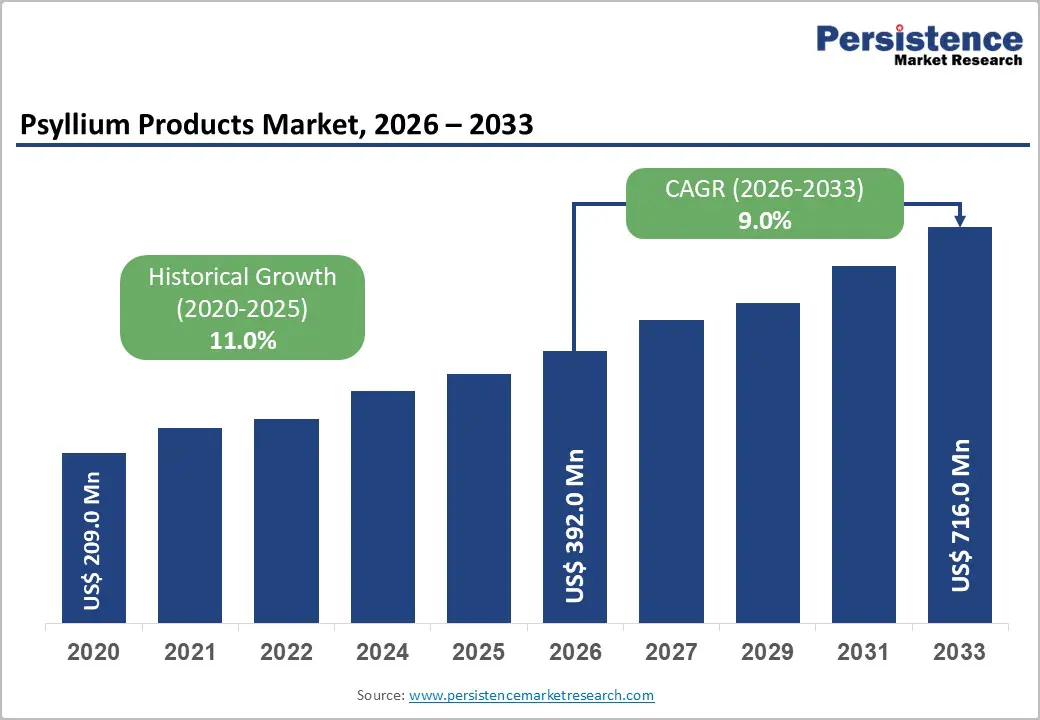
The global psyllium products market size is likely to be valued at US$ 392.0 million in 2026 and is projected to reach US$716.0 million by 2033, growing at a CAGR of 9.0% during the forecast period 2026 - 2033.
The market is experiencing sustained expansion, driven by accelerating consumer demand for dietary fiber, natural laxatives, and functional food ingredients. Rising incidences of lifestyle-related disorders, including type 2 diabetes, cardiovascular disease, and irritable bowel syndrome (IBS), have materially elevated the clinical and nutritional relevance of psyllium husk and its derivatives. Regulatory endorsements from agencies such as the U.S. FDA and the European Food Safety Authority (EFSA) have further legitimized psyllium's role in cholesterol management and digestive health.
Key Industry Highlights
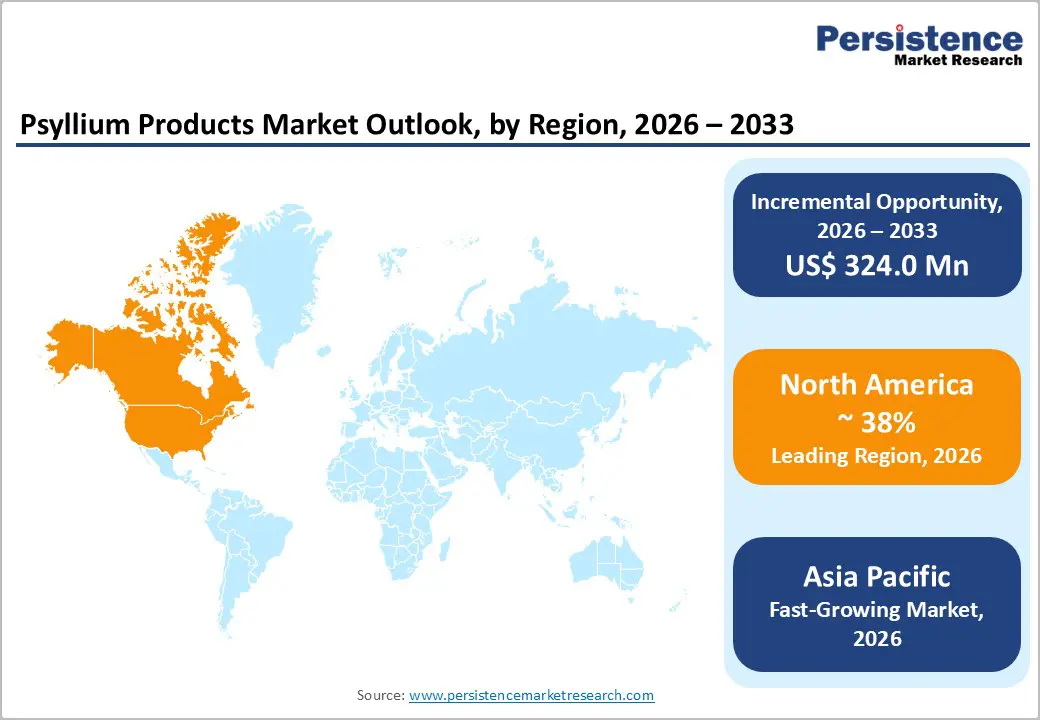
- Dominant Region: North America is expected to command about a 38% market share in 2026, supported by a mature dietary supplement sector and strong regulatory oversight.
- Fastest-growing Region: The Asia Pacific market is the fastest-growing during the forecast period, driven by expanding consumer awareness of digestive health and functional foods.
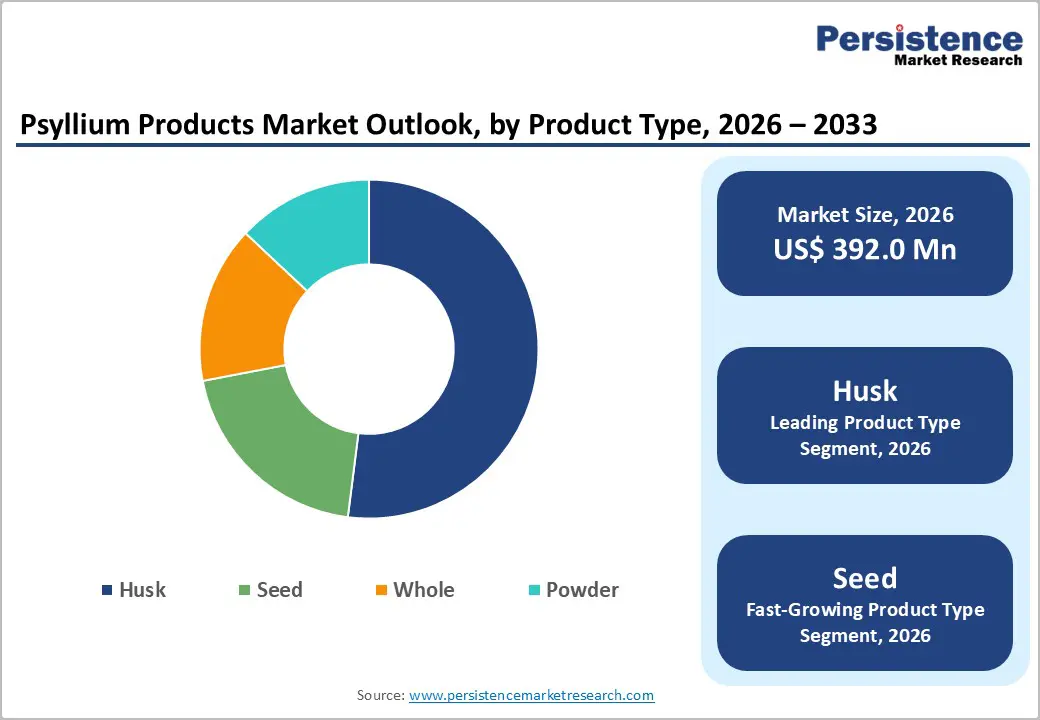
- Leading & Fastest-growing Product Type: Husk currently dominates the product type segment, commanding approximately 52% of total market revenue; seed is likely to be the fastest-growing segment during the 2026 - 2033 forecast period.
- Leading & Fastest-growing Form: Powder represents the dominant segment, capturing approximately 60% of market revenue share in 2026; capsules are expected to be the fastest-growing segment over the 2026 - 2033 forecast period.
- Market Drivers: Growing awareness of the gut microbiome's role in digestion, immunity, and overall well-being highlights its critical importance.
- Market Opportunities: Consumers are increasingly drawn to organic and clean-label foods, seeking ingredients viewed as natural, safe, and sustainable.
| Key Insights | Details |
|---|---|
| Psyllium Products Market Size (2026E) | US$392.0 Mn |
| Market Value Forecast (2033F) | US$716.0 Mn |
| Projected Growth (CAGR 2026 to 2033) | 9.0% |
| Historical Market Growth (CAGR 2020 to 2025) | 11.0% |
Market Factors - Growth, Barriers, and Opportunity Analysis
Rise in Awareness of Digestive Health in Consumers
Awareness of gut microbiome health is growing as people recognize its role in digestion, immunity, and overall well-being. Consumers are increasingly seeking foods that support digestive function while fitting into daily routines without complexity. This shift is driving interest in functional ingredients that are delivering both nutritional and physiological benefits. Psyllium husk is emerging as a preferred option because it provides soluble fiber that aids bowel regularity and supports gut bacteria. Food and beverage manufacturers are responding by incorporating these ingredients into convenient formats, thereby improving accessibility and encouraging consistent consumption habits.
Consumer behavior is continuing to evolve as individuals are prioritizing preventive health and informed dietary choices. Psyllium-based formulations are gaining traction because they can be easily integrated into daily diets without major lifestyle changes. The digestive health supplement sector is expanding as companies are introducing innovative delivery formats and cleaner labels. This momentum is strengthening psyllium husk's position as a practical solution, and it will have established itself as a staple ingredient in future health-focused product development.
Expansion of the Functional Food and Nutraceuticals Sector
The nutraceutical industry is expanding as consumers are choosing products that support health beyond basic nutrition. Companies are integrating functional ingredients into everyday foods such as cereals, health bars, dietary supplements, and meal replacement options to meet this demand. Psyllium is gaining attention because it delivers soluble fiber along with functional benefits that improve texture and consistency. Its natural gelling properties help manufacturers create products that maintain structure while enhancing digestive support. Product developers are also reformulating existing offerings to include fiber-rich components, which is increasing the relevance of psyllium across multiple categories. This transition reflects a broader shift toward foods that combine convenience with measurable health benefits.
Institutions such as the Food and Agriculture Organization (FAO) are promoting plant-based dietary fibers as essential for improving nutrition quality and addressing imbalances in modern diets. This guidance is influencing manufacturers to focus on ingredients that align with sustainability and health priorities. Psyllium fits well within this framework because it is plant-derived and adaptable across formulations. Companies are accelerating innovation by introducing cleaner labels and simplified ingredient lists, which is strengthening consumer trust. As awareness deepens, psyllium-based solutions will have secured a stronger presence in future product pipelines and will support long-term dietary improvement strategies.
Intense Competition from Alternative Fiber Sources
Psyllium is facing rising competition from alternative dietary fiber sources, such as inulin, beta-glucan, pectin, and chicory root fiber, which are gaining wider acceptance in functional food development. These ingredients offer distinct advantages in formulation, including improved solubility, neutral taste, and broader compatibility across food categories. Manufacturers are selecting fibers that meet specific product requirements, thereby reducing reliance on any single ingredient. Some alternatives are enabling easier processing in beverages and ready-to-eat products, where texture and clarity are critical. This shift is encouraging product developers to diversify ingredient portfolios, putting pressure on psyllium to maintain its relevance in evolving applications.
Retail environments are becoming more competitive as a wide range of fiber supplements is reaching consumers through various channels. Regions such as North America and Europe are witnessing expanding product assortments, which are increasing choice and influencing purchasing decisions. Psyllium is holding a strong position due to its established digestive benefits, yet brands are introducing blends that combine different fibers to enhance appeal. As competition is intensifying, psyllium will need stronger differentiation through innovation and targeted health positioning.
Potential Adverse Effects and Consumer Perception
Psyllium is recognized as a safe dietary fiber, yet it can cause gastrointestinal side effects such as bloating, gas, and, in rare cases, intestinal obstruction when consumed without sufficient water. Consumers experience discomfort when dosage instructions are not carefully followed, which influences perception and satisfaction. Negative experiences are spreading through word of mouth, and first-time users are particularly cautious when choosing products that promise digestive benefits. Brands are noticing that unclear guidance on preparation and intake is reducing repeat purchases, which is affecting overall market momentum.
Clear communication and education around proper usage are becoming essential strategies to maintain trust and encourage consistent consumption. Regulatory authorities in multiple regions are requiring cautionary labeling on psyllium products, and these warnings are shaping consumer confidence. Packaging and marketing are increasingly focusing on safe-use instructions, including water intake and gradual incorporation into the diet. As understanding improves, consumers will have developed safer habits and greater confidence in psyllium products. Companies are adapting by offering user-friendly formats and educational content, ensuring that first-time buyers have a positive experience and are motivated to continue incorporating psyllium into their daily routines.
Organic and Clean-Label Product Development
Consumer interest in organic and clean-label food products continues to grow as people seek ingredients perceived as natural, safe, and environmentally responsible. Organic psyllium husk is meeting this demand by providing a dietary fiber source that is cultivated without synthetic fertilizers or pesticides. Its cultivation practices are resonating with consumers who are prioritizing transparency and sustainability in their food choices. This trend is encouraging food manufacturers to explore organic options, which are helping create products that maintain label simplicity while offering proven digestive health benefits. Organic psyllium enables brands to differentiate themselves in a crowded market and justify higher pricing by aligning with consumer values.
Companies that invest in certified organic psyllium supply chains gain a strategic advantage in high-value channels such as premium retail and direct-to-consumer platforms. These investments are facilitating consistent quality and traceability, which are strengthening consumer trust and brand loyalty. Regions such as North America and Western Europe are seeing strong adoption of organic formulations, and manufacturers integrating psyllium into clean-label products are expanding their market presence. As awareness of organic fiber deepens, psyllium will become a preferred ingredient in digestive health solutions, supporting both commercial growth and evolving consumer expectations for natural, responsibly sourced ingredients.
Application in Plant-Based and Gluten-Free Food Products
Psyllium husk is becoming an essential ingredient in gluten-free baking because it provides structure and improves texture in breads, pastas, and other baked goods. Gluten-free formulations often struggle to maintain elasticity and moisture, and psyllium offers a natural solution that enhances product quality without relying on synthetic additives. Consumers following plant-based or gluten-free diets are seeking options that are both nutritious and enjoyable. By supporting softness, chewiness, and shelf life, psyllium is helping manufacturers deliver products that meet these expectations. Its versatility enables integration into a wide range of applications, from traditional baked goods to innovative snack formats, supporting broader adoption in the food industry.
Food technology companies are actively experimenting with psyllium in next-generation plant-based formulations to develop offerings that are appealing and functional. Its water-binding and gelling properties enable creators to produce products that retain moisture and structure, while also providing dietary fiber benefits. The increasing popularity of gluten-free and plant-forward lifestyles is encouraging brands to innovate and differentiate through high-quality ingredients. As research and development continue, psyllium will have secured a central role in functional and specialty foods. Companies that leverage their functional properties while emphasizing natural, clean-label formulations will strengthen consumer trust and expand market opportunities in the health-focused food segment.
Category-wise Analysis
Product Type Insights
Husk currently dominates the product type segment, accounting for approximately 52% of total market revenue, driven by its extensive use in dietary supplements, over-the-counter (OTC) laxatives, and functional food formulations. Strong institutional demand is sustaining market growth, while established supply chains ensure reliable availability. Broad regulatory acceptance across multiple regions is enabling manufacturers to innovate with psyllium in diverse product categories, making it a preferred choice for companies aiming to combine functional benefits with consumer trust.
Seed is likely to be the fastest-growing segment during the 2026 - 2033 forecast period. The segment is gaining attention for pharmaceutical-grade formulations and as a source for husk extraction. Researchers are focusing on the seeds’ mucilage content and exploring its potential for controlled-release drug delivery systems, which is driving increased investment from institutions. Collaboration between agricultural producers and pharmaceutical companies is enhancing seed varieties to improve mucilage yield and processing efficiency. These efforts are supporting the development of high-quality raw materials that meet industry standards. Psyllium seeds are establishing themselves as a critical ingredient in both functional supplements and advanced pharmaceutical applications.
Form Insights
Powder represents the dominant segment, capturing approximately 60% of market revenue share in 2026, due to its widespread favor among dietary supplement brands, pharmaceutical manufacturers, and food developers, as it offers versatility, precise dosing, and easy integration into multiple delivery formats such as capsules, sachets, and ready-to-mix beverages. Its stable shelf life ensures consistent quality, while bulk distribution provides cost efficiency for large-scale operations. These advantages are supporting its strong adoption across global markets and making it a reliable choice for companies aiming to combine functionality with convenience. Powdered psyllium continues to solidify its position as a key ingredient in health-focused products worldwide.
Capsules are expected to be the fastest-growing segment over the 2026 - 2033 forecast period. Rising consumer demand for convenient, pre-measured supplementation is fueling the popularity of psyllium capsules. Capsules address common concerns with powdered psyllium, such as texture and taste when mixed with water, which often limit its regular use. The growing nutraceutical capsule market is supporting increased adoption, and psyllium is benefiting from this trend. Manufacturers are adopting advanced encapsulation technologies to enhance bioavailability and maintain long-term stability, ensuring consistent quality. These innovations are making psyllium capsules more appealing to health-conscious consumers who are seeking effective, easy-to-use digestive wellness solutions.
Regional Insights
North America Psyllium Products Market Trends
North America is set to command a significant portion of the psyllium products market share at approximately 38% in 2026. The region benefits from a mature dietary supplement sector, strong regulatory oversight by the U.S. Food and Drug Administration (FDA), and high healthcare spending per person. Consumers are increasingly seeking solutions for digestive health, supported by awareness of conditions such as irritable bowel syndrome (IBS). Psyllium is emerging as a preferred option because it offers reliable bowel regularity and cholesterol management benefits. The combination of established distribution channels and trusted brand recognition is encouraging continued adoption across multiple product formats, including powders, capsules, and ready-to-mix supplements.
The North American market growth is reinforced by a rise in lifestyle-related health concerns and expanding e-commerce channels for health and wellness products. Innovation is thriving as companies such as Metamucil (Procter & Gamble) and Konsyl Pharmaceuticals are introducing advanced formulations to meet evolving consumer preferences. FDA-authorized health claims are providing a commercial advantage to established brands, helping them strengthen trust and maintain leadership. Clinical research on psyllium’s therapeutic benefits is also advancing, supporting evidence-based marketing and product development. As these trends continue, North America will have solidified its position as a primary driver of global psyllium adoption and innovation, setting standards for both regulatory compliance and consumer engagement in digestive health solutions.
Europe Psyllium Products Market Trends
Europe is emerging as a significant market for psyllium products, with countries such as Germany, the United Kingdom, France, and Spain leading regional demand. Germany is driving adoption through its strong herbal medicine and natural health product culture, making pharmacies and health food retailers key distribution channels. Consumers are seeking trusted solutions for digestive health, and psyllium is providing reliable benefits that align with natural wellness trends. The European Union’s (EU) strict food supplement and pharmaceutical regulations are ensuring high-quality standards, which is building consumer confidence. These regulations are creating higher entry barriers for smaller manufacturers, encouraging established brands to strengthen their presence through compliance and product innovation.
Regulatory harmonization under the European Food Safety Authority (EFSA) is enabling consistent approval of health claims across member states, supporting pan-European marketing strategies for psyllium. The United Kingdom has maintained alignment with EFSA’s health claim framework following Brexit, ensuring continuity for brands operating in the market. Rising interest in organic-certified psyllium in France and Nordic countries is creating opportunities for premium products. Companies are responding with formulations that combine clean-label positioning with functional benefits, enhancing brand differentiation. Consumer awareness and regulatory support continue advancing, and Europe will have established itself as a stable and high-value market for psyllium products, fostering innovation and long-term growth in the digestive health sector.
Asia Pacific Psyllium Products Market Trends
Asia Pacific is anticipated to emerge as the fastest-growing psyllium products market, driven by expanding consumer awareness of digestive health and functional foods. India is leading the region as both the largest producer and exporter of psyllium while also experiencing rapid growth in domestic consumption. China is fueling demand through its expanding nutraceutical and functional food sectors, supported by a large aging population seeking digestive wellness solutions. Japan presents a unique opportunity with its sophisticated functional food market, where the Foods for Specified Health Use (FOSHU) regulatory framework is facilitating approval of psyllium-based products. Across ASEAN markets such as Indonesia, Vietnam, and Thailand, urbanization and rising health consciousness among middle-class consumers are creating new opportunities for market expansion.
Manufacturing advantages in India and China are supporting competitive pricing for export-oriented psyllium products, making the region a key supplier for global markets. Investments in agricultural processing infrastructure are improving the quality and consistency of psyllium yields, enabling a broader range of dietary supplement and functional food formulations. Companies are focusing on developing products that combine affordability with health benefits, which is driving adoption across multiple consumer segments. Production capabilities and regulatory support continue to advance, and the Asia Pacific will have established itself as a strategic growth hub for psyllium, supporting both domestic consumption and international supply chains.
Competitive Landscape
The global psyllium products market structure is moderately consolidated, dominated by leading players such as Procter & Gamble, Konsyl Pharmaceuticals, NOW Foods, Psyllium Labs Inc., and Enovate Biolife. These players collectively capture 35-40% of the market share. The competitive landscape for psyllium is being shaped by several critical factors. Companies with strong control over their supply chains are ensuring consistent quality and reliable availability of raw materials. Organic certification capabilities are enabling brands to cater to health-conscious and clean-label consumers. Product innovation is driving differentiation, with new formulations and delivery formats enhancing functionality and convenience. Additionally, the breadth of distribution networks across pharmaceutical, nutraceutical, and retail channels determines market reach and accessibility. Organizations that are excelling in these areas are strengthening their market position and long-term growth prospects.
Key Developments:
- In April 2025, Procter & Gamble (P&G) is investing INR 2,500 crore to establish a manufacturing facility in Sanand, Gujarat, focused on producing high-quality psyllium husk-based laxative products. This move leverages Gujarat's dominance in psyllium husk production (nearly 90% of India's output) to support P&G's established digestive health brand, which previously imported the ingredient from the region.
- In September 2025, India and Australia signed a Mutual Recognition Arrangement (MRA) on September 24, 2025, to streamline trade in organic products like unprocessed plant items (e.g., psyllium husk, rice, and coconut milk), processed foods, and wine by recognizing each other's certification standards.
Companies Covered in Psyllium Products Market
- Procter & Gamble
- Konsyl Pharmaceuticals
- NOW Foods
- Psyllium Labs Inc.
- Enovate Biolife
- Satnam Psyllium Industries
- Jyot Overseas Pvt. Ltd.
- Virdhara International
- Isabella Fibre
- Acacia Fibre
- Bio Harvest Ltd.
- Himalaya Wellness
- Nordic Naturals
- Garden of Life
- Charkit Chemical Company
Frequently Asked Questions
The psyllium products market is projected to reach US$392.0 Mn in 2026.
The market is driven by rising consumer demand for natural fiber supplements, digestive health solutions, plant-based ingredients, and gluten-free products amid growing wellness awareness and aging populations.
The psyllium products market is poised to witness a CAGR of 9.0% from 2026 to 2033.
Major opportunities lie in Expansion into functional foods & beverages, organic & clean-label segments, novel delivery formats, and emerging markets via regulatory health claim support.
Procter & Gamble, Konsyl Pharmaceuticals, NOW Foods, Psyllium Labs Inc., and Enovate Biolife are some key players.


