




- Hardware & Software IT Services
- Professional Services Automation Software Size, Share, and Growth Forecast 2026 - 2033
Professional Services Automation Software Size, Share, and Growth Forecast 2026 - 2033
Professional Services Automation Software Market by Application (Consulting Firms, Marketing & Communication Firms, Technology Companies, Architecture & Construction Firms, Research Firms, Accounting Firms), Deployment (Cloud, On-Premise), and Regional Analysis, 2026 - 2033

Professional Services Automation Software Market Size and Trend Analysis
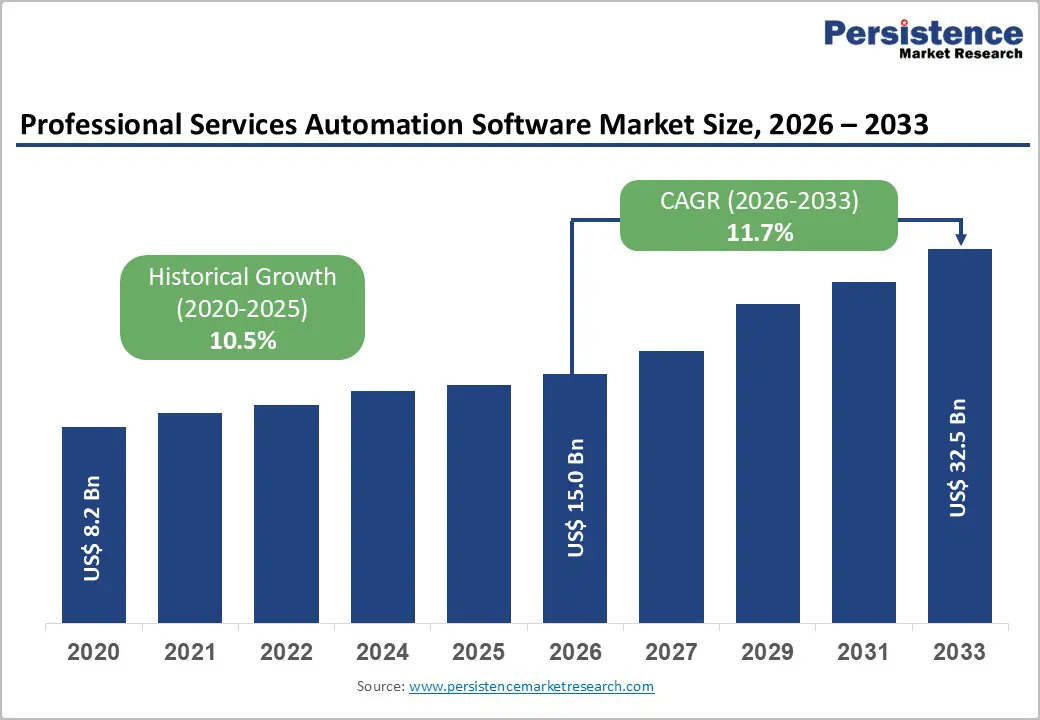
The global Professional Services Automation Software market size is expected to be valued at US$ 15.0 billion in 2026 and projected to reach US$ 32.5 billion by 2033, growing at a CAGR of 11.7% between 2026 and 2033.
The market is expanding as organizations increasingly adopt digital tools to improve project management, resource planning, and operational efficiency. Professional services firms are focusing on automation to manage complex service delivery while maintaining productivity and profitability. Cloud-based platforms and integrated analytics are improving workflow visibility and billing accuracy. Additionally, the shift toward hybrid and remote work environments is accelerating the adoption of collaborative automation solutions that support distributed teams and enhance client engagement.
Key Industry Highlights:
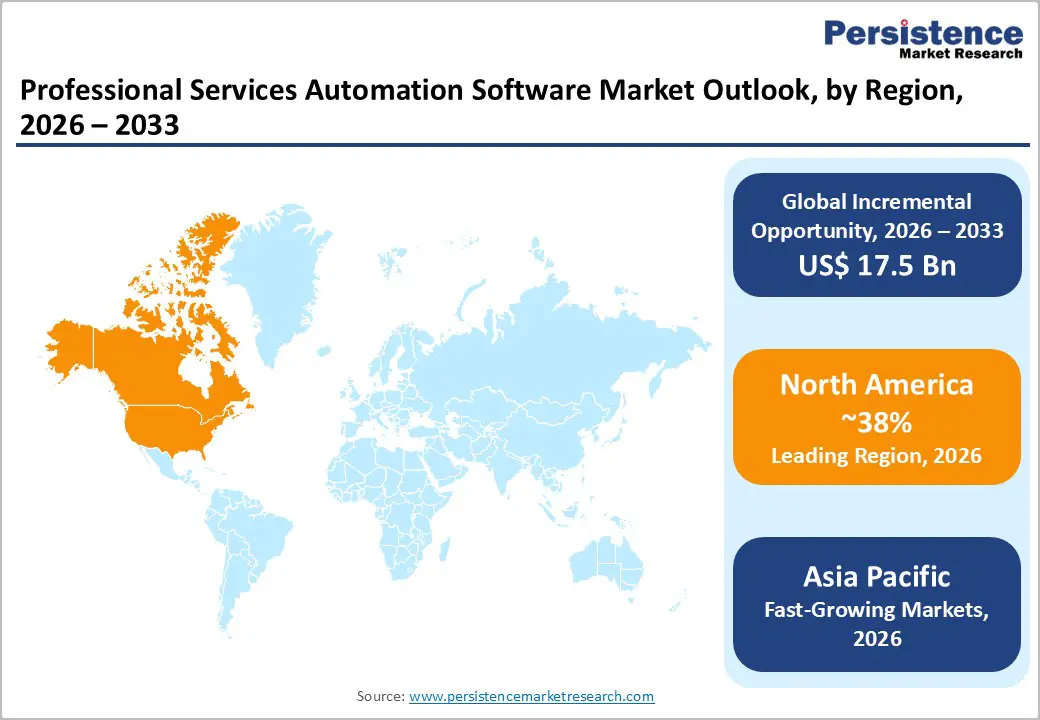
- Leading Region: North America leads with 38% share, driven by strong enterprise software adoption and a mature professional services ecosystem.
- Fastest Growing Region: Asia Pacific is the fastest-growing region, supported by expanding IT services, outsourcing industries, and rapid digital transformation.
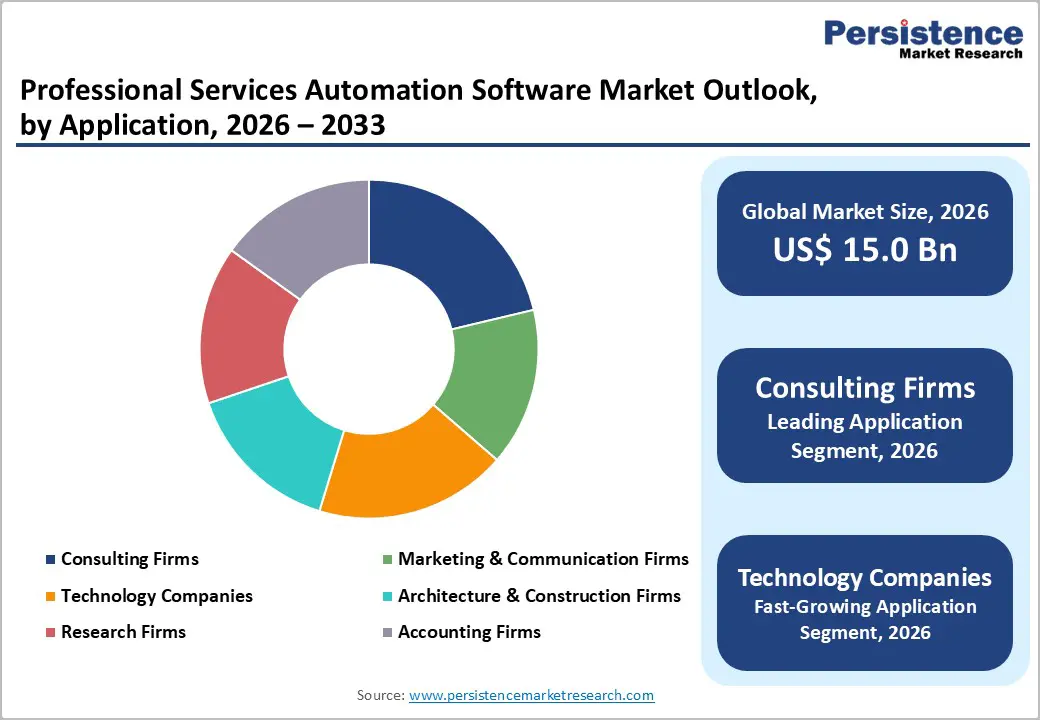
- Leading Application: Consulting Firms lead with 35% share, as PSA tools help manage complex projects, billing, and resource allocation.
- Leading Deployment: Cloud dominates with 62% share, due to scalability, remote access, and faster implementation.
- Opportunity: AI-enhanced analytics improve forecasting accuracy and support predictive resource planning for service firms.
| Key Insights | Details |
|---|---|
|
Professional Services Automation Software Size (2026E) |
US$ 15.0 billion |
|
Market Value Forecast (2033F) |
US$ 32.5 billion |
|
Projected Growth CAGR (2026-2033) |
11.7% |
|
Historical Market Growth (2020-2025) |
10.5% |
Market Dynamics
Drivers - Increasing Pressure on Professional Services Firms to Improve Operational Efficiency and Resource Utilization
Firms across consulting, accounting, and advisory sectors are under constant pressure to deliver projects faster while controlling operational costs, which is accelerating the adoption of Professional Services Automation software. Many organizations report that inefficient resource allocation remains a major operational challenge, often resulting in project delays and reduced productivity across teams and departments.
Automation platforms help address these challenges by enabling real-time project tracking, resource planning, and predictive scheduling. These capabilities reduce project overruns, minimize idle workforce time, and improve utilization rates. As organizations seek greater transparency and efficiency in project execution, PSA solutions are increasingly viewed as essential tools for optimizing service delivery and improving overall operational performance.
Growing Focus on Digital Transformation and Data-Driven Decision Making Across Service Organizations
The rapid shift toward digital transformation is significantly driving demand for Professional Services Automation software as firms adopt technology to improve decision-making and operational visibility. Organizations are increasingly integrating analytics, automation, and intelligent reporting tools to streamline project oversight and enhance forecasting accuracy across multiple service engagements.
PSA platforms provide centralized dashboards that consolidate operational data, helping managers track project performance, billing, and resource allocation more efficiently. Automated workflows also reduce administrative workload and accelerate reporting processes. As businesses continue prioritizing scalable digital infrastructure, these solutions are helping transform traditional service operations into more agile, data-driven, and collaborative environments.
Restraint - Concerns Regarding Data Security Risks and Complex System Integration with Legacy Infrastructure
Data security concerns continue to restrain the adoption of Professional Services Automation software, particularly in highly regulated sectors such as accounting and financial consulting. Organizations remain cautious about migrating sensitive operational and client data to cloud environments due to the growing risk of cyberattacks and potential data breaches.
In addition, integrating PSA platforms with existing legacy systems often requires significant customization and technical expertise. Many enterprises rely on older infrastructure that is not easily compatible with modern automation solutions. This integration complexity can extend implementation timelines and delay operational benefits, leading risk-averse organizations to postpone adoption.
Significant Implementation Costs and Operational Complexity Limiting Adoption Among Smaller Firms
High implementation costs and operational complexity remain key barriers, particularly for small and mid-sized professional service firms with limited technology budgets. Deploying a PSA platform often involves software licensing, infrastructure upgrades, customization, and employee training, which collectively increase the overall investment required for successful implementation.
Organizations may also face challenges in adapting internal workflows and processes to align with new automation systems. Custom configurations, data migration, and change management efforts can create additional operational strain. These factors discourage smaller firms from rapid adoption and often result in slower market penetration compared with larger enterprises that already possess advanced IT capabilities.
Opportunities - Integration of Artificial Intelligence and Advanced Analytics Enhancing Resource Planning and Forecasting Capabilities
The integration of artificial intelligence into Professional Services Automation software is creating significant opportunities for deeper operational insights and improved resource management. AI-enabled platforms can analyze large volumes of project and workforce data, allowing organizations to improve forecasting accuracy and make better decisions regarding staffing, scheduling, and workload distribution.
Machine learning capabilities also enable predictive resource allocation, helping firms anticipate project demands and optimize team performance. These technologies support improved planning, reduced project risks, and stronger client outcomes. As professional services firms increasingly invest in intelligent automation, AI-driven analytics is expected to become a major differentiator in developing next-generation PSA solutions.
Rising Adoption of Hybrid and Remote Work Models Driving Demand for Cloud-Based Collaboration Platforms
The expansion of hybrid and remote work environments is creating strong demand for cloud-based Professional Services Automation platforms that support distributed teams. Service organizations increasingly require tools that allow employees to collaborate, track project progress, and manage resources effectively regardless of geographic location.
Cloud-enabled PSA systems provide real-time access to project data, communication tools, and performance dashboards, helping teams remain productive in flexible work environments. These capabilities are particularly valuable for industries that rely on cross-functional collaboration and client engagement. As hybrid work structures continue to expand globally, organizations are increasingly adopting cloud automation platforms to maintain operational continuity and workforce productivity.
Category-wise Analysis
Application Insights
Consulting firms dominate the professional services automation software market, accounting for 35% market share in 2025. Their leadership stems from the need to manage complex consulting engagements, multiple client projects, and detailed resource allocation. PSA platforms help consulting organizations streamline project tracking, workforce planning, and billing management. High-value advisory services require integrated systems that connect project management, client relationships, and financial operations, enabling consulting firms to improve efficiency and deliver projects more effectively.
Technology companies are emerging as the fastest-growing application segment as digital service providers increasingly adopt automation tools to manage expanding project portfolios. These organizations frequently handle software development, IT services, and system integration projects that require coordinated collaboration and resource planning. PSA platforms enable better workflow visibility, improve team productivity, support faster delivery cycles, and help technology firms manage distributed teams and complex client engagements.
Deployment Insights
Cloud deployment leads the professional services automation software market with a 62% share in 2025, driven by its scalability, accessibility, and lower infrastructure requirements. Cloud-based PSA platforms allow organizations to access project data remotely, deploy systems faster, and maintain continuous updates without major internal IT management. Many enterprises prefer cloud solutions because they support flexible workloads and improve collaboration across geographically dispersed teams.
On-premise deployment is emerging as the fastest-growing segment as certain organizations prioritize stronger control over data security and system customization. Industries handling highly sensitive operational or financial information often prefer on-site infrastructure to maintain strict governance and compliance. On-premise solutions also allow deeper integration with legacy enterprise systems, making them suitable for companies with complex operational environments and specific regulatory requirements.
Regional Insights
North America Professional Services Automation Software Market Trends
North America leads the Professional Services Automation Software market, accounting for about 38% of the global share. The region benefits from a well-established professional services ecosystem, particularly in the United States, which hosts millions of consulting, accounting, and technology service professionals. Strong regulatory frameworks and strict compliance requirements encourage firms to adopt automation platforms that improve transparency, reporting accuracy, and operational efficiency across complex service engagements.
The region also remains a global innovation hub for enterprise software development. Major technology clusters, including those in the United States, continue to drive advancements in cloud computing, analytics, and automation tools. The presence of leading software vendors and early adoption of digital transformation strategies enable organizations across North America to integrate PSA platforms into their service delivery models rapidly.
Europe Professional Services Automation Software Market Trends
Europe is experiencing steady expansion in the Professional Services Automation Software market and is projected to grow at a CAGR of around 10.8% during the forecast period. Countries such as the United Kingdom and Germany play a key role in driving adoption due to strong consulting, financial services, and engineering sectors. Increasing regulatory requirements and digital policy initiatives across the region are encouraging organizations to adopt automation tools for improved compliance and operational visibility.
The demand for PSA platforms is also supported by the region’s strong focus on digitalization and enterprise modernization. Businesses are increasingly investing in integrated software systems that streamline project management, resource allocation, and client engagement. As companies across Europe expand their digital capabilities, PSA solutions are becoming essential for managing complex professional service operations.
Asia Pacific Professional Services Automation Software Market Trends
Asia-Pacific accounts for approximately 28% of the global Professional Services Automation Software market and continues to expand rapidly, driven by growth in IT services, consulting, and digital transformation initiatives. Countries such as India, China, and Japan are major contributors, supported by large technology service sectors and increasing adoption of cloud-based enterprise solutions across both large enterprises and emerging service providers.
The region is also witnessing rapid expansion in outsourcing, software development, and managed services industries, which require efficient project coordination and workforce management. Growing foreign investment, expanding digital infrastructure, and the shift toward cloud-based collaboration tools are encouraging organizations to adopt PSA platforms to improve service delivery and operational efficiency across diverse, geographically distributed teams.
Competitive Landscape
The professional services automation software market is characterized by a moderately consolidated competitive environment, with established vendors competing alongside numerous niche solution providers. Market participants focus on strengthening product capabilities to address the evolving needs of professional service organizations, particularly in areas such as project management, workforce planning, and financial automation. Continuous innovation and strategic collaborations remain central to maintaining competitive positioning.
Vendors are increasingly investing in advanced technologies such as artificial intelligence, predictive analytics, and mobile-friendly platforms to enhance user experience and operational insights. Integration capabilities with enterprise systems, including ERP and CRM platforms, are becoming key differentiators. Additionally, flexible pricing models and scalable cloud-based solutions are encouraging broader adoption among small and mid-sized professional service firms.
Key Developments:
- In June 2025, Salesforce enhanced its Professional Services Automation capabilities by introducing generative AI features designed to automate reporting and performance insights, enabling service teams to generate faster project summaries, improve decision-making, and reduce manual effort across project management and client engagement workflows.
- In March 2024, Oracle introduced an upgraded version of its NetSuite cloud-based PSA platform with enhanced multi-entity billing capabilities, enabling organizations managing multiple subsidiaries and international operations to streamline financial management, improve billing accuracy, and simplify complex project accounting.
- In November 2024, Microsoft expanded the capabilities of its Dynamics 365 PSA solution by adding real-time collaboration tools, enabling project teams to communicate more effectively, share updates instantly, and coordinate tasks across distributed work environments while improving project visibility and delivery efficiency.
Companies Covered in Professional Services Automation Software Size, Share, and Growth Forecast 2026 - 2033
- Microsoft Corporation
- SAP SE
- Oracle Corporation
- Deltek, Inc.
- Autotask Corporation (by Datto)
- Upland Software, Inc.
- ConnectWise, Inc.
- FinancialForce.com, Inc.
- Planview (Changepoint)
- Clarizen, Inc.
- BigTime Software
- Replicon
- Accelo Ltd.
- Wrike (Citrix)
- Avaza Ltd.
Frequently Asked Questions
The global Professional Services Automation Software market is projected to reach US$ 15.0 billion in 2026.
Rising need for operational efficiency and resource optimization across consulting, accounting, and technology service firms.
North America leads with 38% share, supported by strong enterprise software adoption and a mature professional services sector.
Integration of AI-enhanced analytics that improves forecasting accuracy and resource planning for service organizations.
Key market players include Microsoft Corporation, SAP SE, Oracle Corporation, Deltek, Inc., and Autotask Corporation.


