




- Hardware & Software IT Services
- AI for Customer Service Market
AI for Customer Service Market Size, Share, and Growth Forecast 2026 - 2033
AI for Customer Service Market by Product Type (Chatbots and Virtual Assistants, AI-Driven Ticketing System), Deployment (Cloud, On-Premise), Customer Interaction Channel (Text and Email), End-user, and Regional Analysis, 2026 - 2033

AI for Customer Service Market Size and Trends Analysis
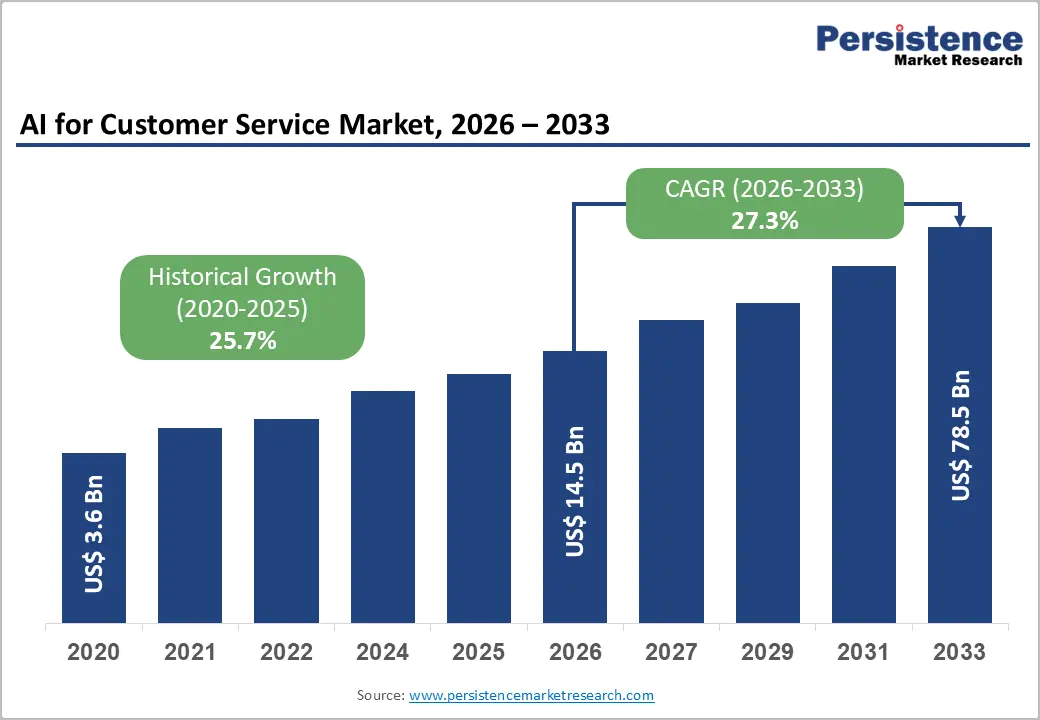
The global AI for customer service market size is likely to be valued at US$14.5 billion in 2026 and is predicted to reach US$78.5 billion by 2033, growing at a CAGR of 27.3% during the forecast period from 2026 to 2033, driven by rising demand for real-time and 24/7 customer support across digital channels. Increasing enterprise focus on cost optimization through automation of repetitive service tasks is also projected to propel growth.
Key Industry Highlights:
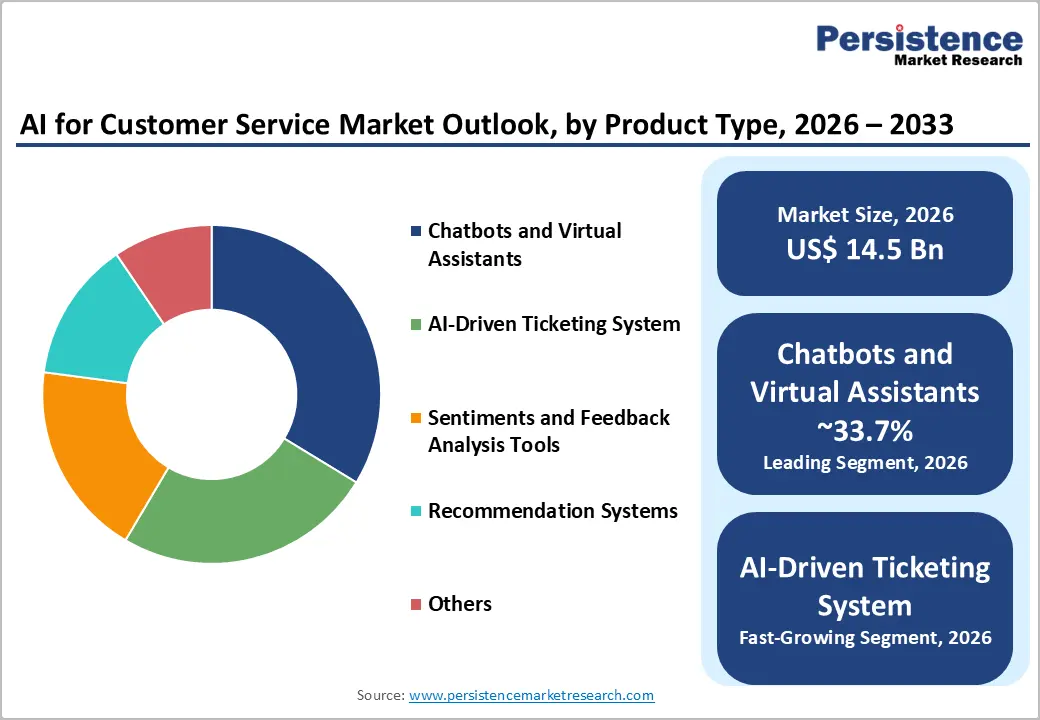
- Leading Product Type: Chatbots and virtual assistants, approximately 33.7% share in 2026, as enterprises are prioritizing always-on and low-cost customer interaction tools that can autonomously resolve high volumes of repetitive queries.
- Dominant End-user: BFSI, nearly 25.3% of share in 2026, because AI helps in drastically reducing response time as well as maintaining accuracy and compliance.
- Latest Partnership: In January 2025, HCLTech announced the expansion of its strategic partnership with Microsoft to transform customer service experiences with generative AI and cloud-based contact center solutions.
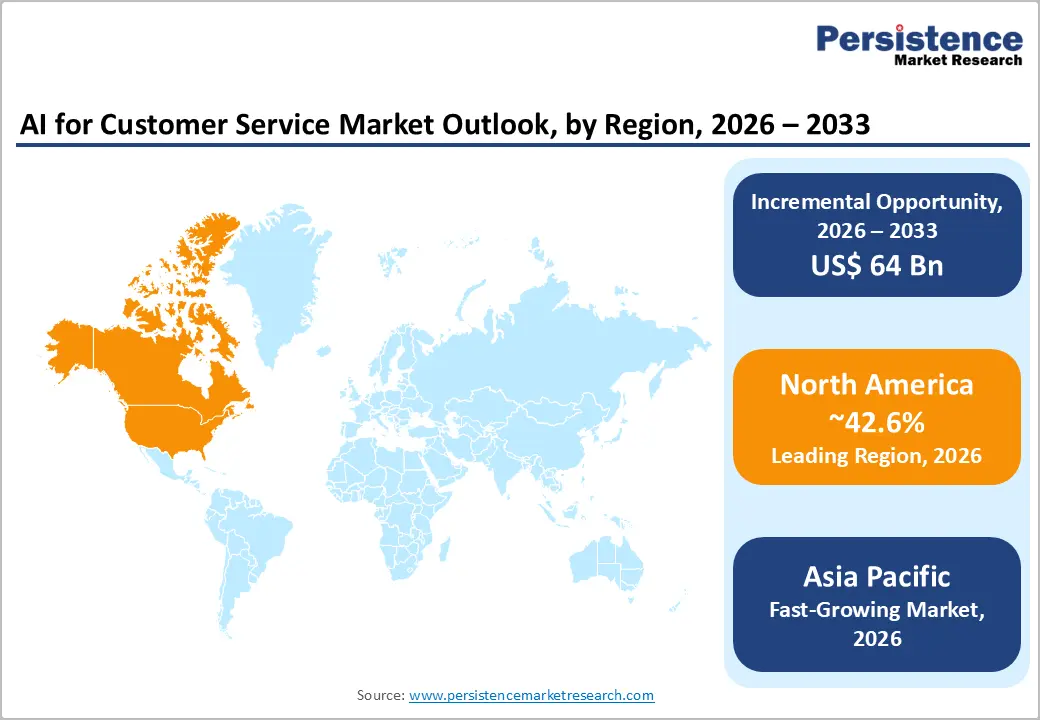
- Leading Region: North America, with about 42.6% share in 2026, owing to the presence of leading cloud providers and high enterprise AI spending.
- Fast-growing Region: Asia Pacific, backed by large multilingual customer bases and rising fintech as well as e-commerce networks.
DRO Analysis
Driver - Rising E-Commerce Activity to Spur Demand
The exponential growth of online shopping has created a volume of customer queries that human agents simply cannot handle alone. Order tracking, returns, payment issues, and product questions flood in around the clock. Customers expect instant answers. During peak shopping periods, the pressure is even higher.
Alibaba's AI chatbots handle over 2 million customer sessions per day during peak seasons, addressing 75% of all online customer queries. It helps in saving the company more than nearly US$147 million annually in customer service costs. As e-commerce expands into new geographies and product categories, AI is becoming the only scalable way to keep up with rising customer expectations.
Shrinking Costs per Interaction to Propel Wide AI Adoption
One of the prominent reasons businesses are switching to AI customer service is the dramatic drop in cost per interaction. A human agent handles a routine query at US$20 to US$25. A chatbot handles the same query at US$0.50 to US$0.70. This gap makes the business case hard to ignore. For example, Vodafone, after deploying its AI virtual agent TOBi across its markets, saw a 70% reduction in cost-per-chat. It brought the cost of serving customers via AI to less than one-third of what live chat used to cost.
According to Freshworks' 2025 CX benchmark, AI agents now deflect over 45% of incoming customer queries, with retail and travel companies seeing deflection rates above 50%. Beyond direct savings, AI also reduces agent burnout by taking over repetitive tasks. It further helps lower staff turnover, another key hidden cost for contact centers.
Restraint - Lack of Empathy in Sensitive Situations
AI can resolve a return request in seconds, but it struggles when a customer is distressed, grieving, or facing a serious financial problem. These situations call for genuine human understanding, something AI cannot replicate. A 2025 global research study found that over 56% of professionals across design, creative, and tech industries identified AI with no empathy as the most prominent obstacle to integrating humans and AI in customer support.
A 2026 peer-reviewed study published in Sociology Lens (Wiley) concluded that AI cannot directly substitute the subtle emotional connection provided by humans. It called for the development of hybrid models that blend AI efficiency with human empathy. The consequences are measurable. Klarna's experience is a well-cited example. After routing payment disputes and sensitive financial conversations through full AI automation, the company saw CSAT scores decline and eventually began rehiring human agents for complex cases.
Opportunity - Smart Language Models to Open New Possibilities for AI Support
Earlier chatbots relied mainly on keyword matching, whereas modern Natural Language Processing (NLP) models can interpret customer intent, tone, and context more effectively. This advancement has significantly improved the capabilities of AI in customer service. Solutions such as IBM Watson NLP have demonstrated high accuracy in identifying customer emotions, enabling systems to tailor responses in real time based on customer sentiment.
According to IBM's Institute for Business Value, today's customer service AI uses NLP to understand intent, perform real-time sentiment analysis, and adapt responses based on context and interaction history. The gains in multilingual capability are equally significant. Google's Universal Speech Model now supports over 400 languages, including low-resource languages such as Amharic and Assamese. Hence, AI support can now reach customers in markets that were previously too linguistically fragmented to serve.
Generative AI to Create Opportunities in Personalization and Proactive Service
Generative AI has moved customer service beyond scripted replies. It can now craft unique and context-aware responses based on a customer's purchase history, live behavior, and emotional state. According to IBM's Institute for Business Value, 66% of global customer service managers are already using generative AI to increase personalization in customer interactions. The impact goes beyond just responses. According to IBM's research, organizations that have reached mature AI adoption in customer service reported 17% higher customer satisfaction compared to less advanced peers.
Generative AI also enables proactive service, identifying potential problems before a customer even reaches out. For instance, IBM collaborated with a Germany-based media company to deploy a generative AI assistant for customer service and product recommendations. It resulted in customers receiving personalized product suggestions during their service interactions. This ability to blend resolution with personalization in a single interaction represents a meaningful shift in how support creates business value.
Category-wise Analysis
Product Type Insights
Chatbots and virtual assistants are anticipated to lead with a share of approximately 33.7% in 2026. These are the go-to tools for businesses that need to handle large volumes of customer queries without expanding their teams. They handle routine inquiries efficiently, are available 24/7, and provide instant responses across channels. As generative AI gets built into these tools, conversations are becoming more natural and context-aware, further widening the gap between chatbots and other product types.
The AI-driven ticketing system segment is estimated to be the fastest-growing in 2026. Traditional ticketing systems rely heavily on manual effort. Agents must read, categorize, prioritize, and route every inbound request. This process is slow, inconsistent, and expensive. AI-driven ticketing systems fix this by automating triage from the moment a ticket arrives. According to Salesforce, around 82% of service representatives report an increase in customer demands, making manual ticket management unsustainable.
End-user Insights
The Banking, Financial Services, and Insurance (BFSI) segment is predicted to dominate with around 25.3% of the share in 2026. The industry deals with an unusually high volume of repetitive, high-stakes customer interactions. These include balance enquiries, fraud alerts, claims status, and loan queries. These are exactly the kind of structured and rule-bound requests that AI handles well. For example, Bank of America's AI-supported virtual assistant, Erica, has handled over 2.5 billion interactions and serves 20 million active users.
The retail and e-commerce segment is expected to remain in the second position in 2026. Online retail generates customer service demand at a pace that no human team can sustain alone. It is evident in order tracking, returns, product questions, and promotional offers. In retail, chatbots achieve conversion rates as high as 70%, directly reducing cart abandonment by answering pre-purchase questions instantly. As shopping continues to shift online across more product categories and geographies, demand for AI-based retail support will likely increase.
Regional Insights
North America AI for Customer Service Market Trends
In 2026, North America is predicted to dominate with a share of around 42.6%. This growth is attributed to increasing enterprise adoption, mature AI infrastructure, and significant research and development investment. The region is also home to the companies building the tools, including Microsoft, Google, IBM, Salesforce, and AWS. This means North America-based enterprises get early access to new capabilities and can deploy them faster than companies in other regions. Industries such as finance, retail, and healthcare are all constantly adopting generative AI for customer engagement.
U.S. AI for Customer Service Market Trends
The U.S. is the engine of North America's dominance and shows no signs of slowing. Adoption of AI support solutions is broad across sectors such as BFSI, retail, healthcare, and telecommunications. Around 65% of businesses in the country highlight customer loyalty improvements due to AI-assisted personalization, while 59% report reduced costs from automation. The U.S. is also uniquely positioned as both a consumer and creator of AI customer service technology. It produces the platforms that the rest of the world deploys. Hence, continued domestic investment translates directly into global market influence.
Asia Pacific AI for Customer Service Market Trends
Asia Pacific is anticipated to be the fastest-growing market over the forecast period. It stands out as several of its largest economies are going through digital transformation simultaneously. The region's ongoing technology adoption, large consumer bases, and increasing demand for improved customer experiences are propelling growth. India and China are the key countries augmenting this trend. Mobile-first behavior has also pushed adoption. In mobile-first economies across Asia Pacific, conversational AI for e-commerce on messaging apps has led to a 30% improvement in handling high-volume inquiries.
China AI for Customer Service Market Trends
China's growth is backed by both government mandate and the expansion of its consumer economy. Under the New Generation Artificial Intelligence Development Plan, the country aims to build a US$150 billion AI industry by 2030, as outlined by the Ministry of Science and Technology. In 2023 alone, over US$25 billion was allocated to AI start-ups and research & development centers. Corporate AI adoption in customer service is already advanced. In China, over 80% of decision-makers reported using Generative AI by July 2024, and tech giants such as Alibaba, Baidu, and Tencent have embedded AI deeply into their customer-facing platforms.
India AI for Customer Service Market Trends
India is considered one of the world's most prominent consumers of AI customer service tools. Its US$54 billion BPO sector is being constantly transformed by AI and Agentic AI, with companies such as WNS reporting that 5% of their FY25 revenue came directly from GenAI-backed solutions. The country’s internet user base, which now exceeds 954 million subscribers according to government data, creates a massive domestic demand for AI-supported digital services. This suggests strong grassroots familiarity that is anticipated to propel both enterprise deployment and consumer acceptance of AI-based customer interactions.
Europe AI for Customer Service Market Trends
Europe's market is growing at a measured but consistent pace. Growth is supported by digital transformation across public and private sectors, with enterprises in Germany, France, and the U.K. deploying AI to simplify multilingual support and boost service efficiency. GDPR and the EU AI Act have pushed companies to adopt transparent and auditable AI systems, which build consumer trust over time. According to the European Parliament, AI-driven chatbots are now handling over 70% of customer inquiries in leading retail companies.
Germany AI for Customer Service Market Trends
Germany is Europe's most commercially significant market, propelled by its industrial strength and a rapidly growing AI start-up network. According to the German Federal Ministry for Economic Affairs, over 60% of domestic companies have integrated AI into their operations. The country ranked third in Europe as a top location for the AI start-up industry in 2024. It was driven by a 244% surge in AI funding in 2023 and a superior innovative landscape with 463 AI start-ups. Berlin and Munich are now recognized innovation hubs with companies such as Siemens and global AI players investing heavily.
U.K. AI for Customer Service Market Trends
The U.K. is emerging as a key contender, mainly in financial services and retail. According to the Bank of England and the Financial Conduct Authority (FCA), 75% of U.K. financial services firms are already using AI, with the median number of AI use cases expected to rise from 9 to 21 over the next few years. The regulatory environment is shifting to support quick and safe innovation. The FCA's Supercharged Sandbox and AI Live Testing initiatives allow firms to experiment with AI in controlled scenarios.
Competitive Landscape
The global AI for customer service market is highly fragmented, but consolidation is gradually increasing as leading CRM and CX vendors acquire niche AI start-ups. Established companies such as Salesforce, Zendesk, Microsoft, Google, Freshworks, and Intercom are using their existing CRM interfaces, customer databases, and workflow automation capabilities to strengthen their positions. These firms are embedding AI agents, copilots, and autonomous ticket resolution systems into their service suites instead of providing standalone chatbots.
AI-native firms such as Decagon, Sierra, Forethought, and Kore.ai are competing through autonomous AI agents that can independently resolve tickets, summarize conversations, trigger workflows, and escalate complex cases. Many of these companies are attracting enterprise clients as they deliver faster deployment and more specialized AI reasoning models than old CX platforms.
Key Industry Developments:
- In October 2025, Salesforce added voice capabilities to its Agentforce platform. It enables clients to go beyond text when using AI agents to respond to customer questions. The feature integrates with corporate phone systems from Amazon, Five9, Genesys, NICE, and Ericsson's Vonage.
- In August 2025, NICE announced an extended strategic partnership with Salesforce to deliver AI-based customer experiences through a deep integration between NICE CXone Mpower and Salesforce Service Cloud. The companies extended their existing collaboration to enable Bring Your Own Contact Center.
- In March 2026, Zendesk entered into a definitive agreement to acquire Forethought, an agentic AI platform. The deal was designed to extend Zendesk's AI agent capabilities on its Resolution Platform across all service channels and platforms, with a focus on self-improving AI agents that learn from every interaction.
Companies Covered in AI for Customer Service Market
- Atlassian
- AWS
- IBM
- Microsoft
- OpenAI
- Salesforce
- SAP
- Servicenow
- Sprinklr
- Zendesk
Frequently Asked Questions
The global AI for customer service market is projected to reach US$14.5 billion in 2026.The global AI for customer service market is projected to reach US$14.5 billion in 2026.
The AI for customer service market is expected to reach US$78.5 billion by 2033.
A shift toward autonomous AI agents capable of end-to-end query resolution and the surging adoption of generative AI copilots are a few key market trends.
BFSI is expected to be the leading end user with a share of nearly 25.3% in 2026, spurred by its early adoption of AI-backed automation to manage high-value customer relationships.
The AI for customer service market is expected to grow at a CAGR of 27.3% from 2026 to 2033.
Atlassian, AWS, Google, IBM, and Microsoft are a few key market players.


