




- Medical Devices
- Global PICC Tip Placement Systems Market
Global PICC Tip Placement Systems Market Size, Share, Growth, and Regional Forecast, 2026 to 2033
Global PICC Tip Placement Systems Market by Product (Tip Location Systems and Accessories), by Technology (ECG Tip Confirmation, ECG with Magnetic Tracking, and ECG and Intravascular Dopplers) by End User (Hospitals, Diagnostic Imaging Centers, and Academic and Research Institutions), and Regional Analysis from 2026 to 2033.

PICC Tip Placement Systems Market Size and Trend Analysis
Global demand for PICC tip placement systems is rising steadily, driven by increasing adoption of minimally invasive vascular access procedures, growing investments in outpatient and hospital-based infusion services, and a strong focus on patient safety, procedural accuracy, and workflow efficiency. Rising prevalence of chronic diseases, cancer, cardiovascular disorders, and long-term intravenous therapies has significantly increased demand for reliable ECG- and magnetic tracking–based PICC tip placement systems. Expansion of hospitals, ambulatory surgical centers, outpatient infusion clinics, and clinical research facilities, combined with higher training initiatives and improved access to advanced placement technologies, is accelerating market growth. Continuous innovation in system design, including compact devices, automated guidance, real-time ECG monitoring, and integration with digital workflow platforms, is enhancing placement accuracy, operational efficiency, and safety. Additionally, growing adoption of outpatient infusion therapy, bedside PICC placement, decentralized vascular access models, and rising awareness of procedure safety are further propelling market expansion globally.
Key Industry Highlights
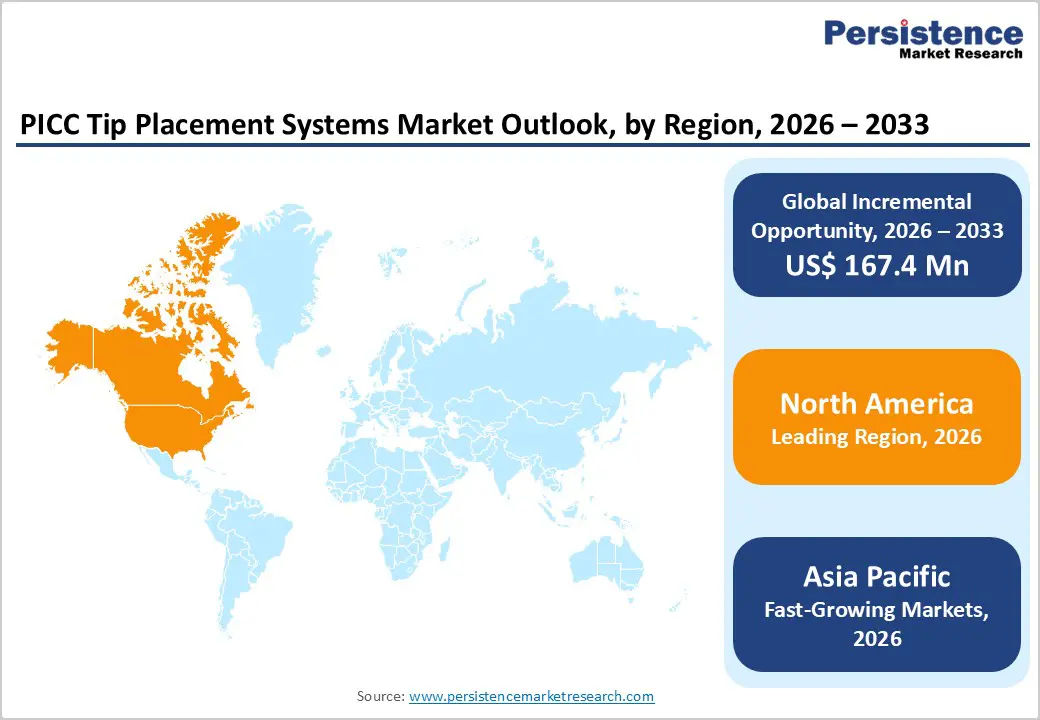
- Leading Region: North America holds the largest share at 47.8%, supported by a mature healthcare ecosystem, high penetration of vascular access technologies, strong presence of PICC system manufacturers, robust R&D funding, favorable regulatory frameworks, and early adoption of advanced hospital-based infusion services.
- Fastest-Growing Region: Asia Pacific is expanding fastest due to rapid healthcare infrastructure development, increasing chronic disease prevalence, rising outpatient infusion services, and growing government and private investment in vascular access technologies.
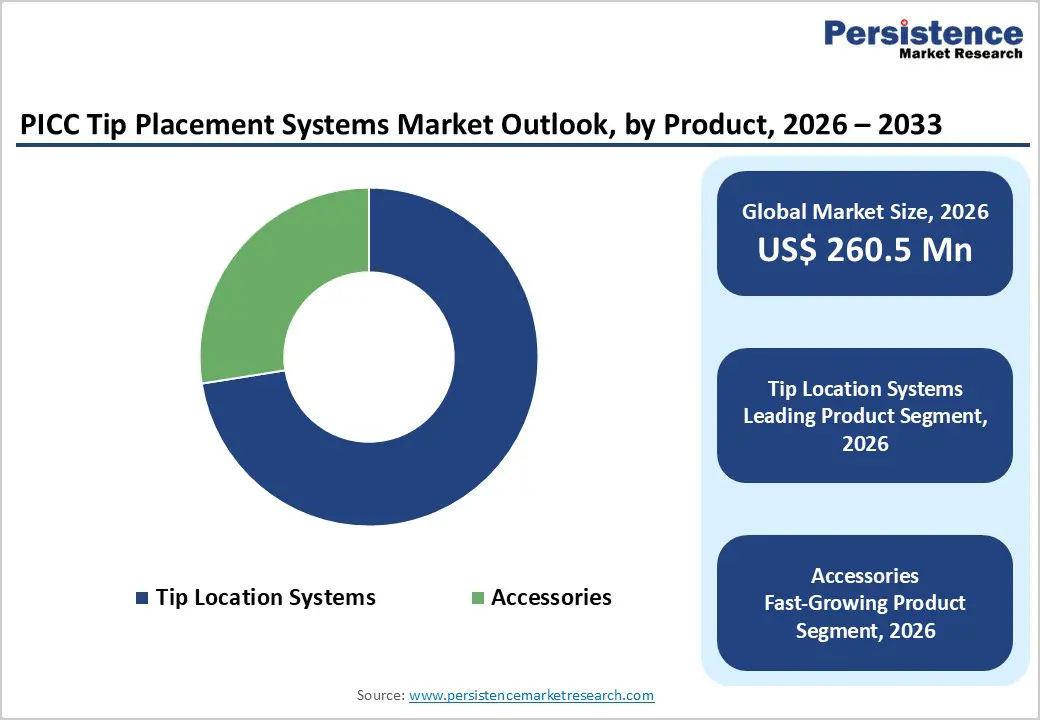
- Leading Product Segment: Tip location systems dominate the market due to their cost efficiency, compact design, and widespread use in routine bedside PICC placement procedures.
- Fastest-Growing Product Segment: Accessories systems are expanding rapidly as demand increases for integrated catheter solutions, ECG cables, and advanced placement support tools.
- Leading Technology Segment: ECG tip confirmation remains the top application due to high utilization for safe, real-time PICC placement in hospitals and outpatient care.
- Fastest-Growing Technology Segment: ECG with magnetic tracking is scaling quickly as rising focus on early, accurate vascular access and advanced procedural guidance drives adoption.
| Key Insights | Details |
|---|---|
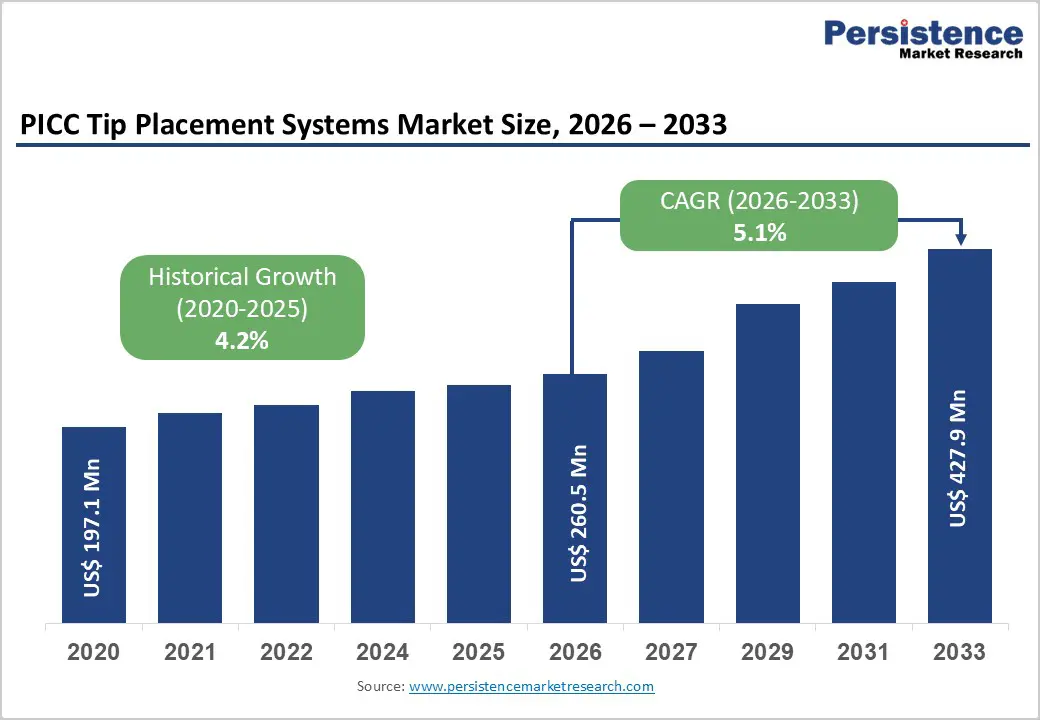
| PICC Tip Placement Systems Market Size (2026E) | US$ 260.5 Mn |
| Market Value Forecast (2033F) | US$ 427.9 Mn |
| Projected Growth (CAGR 2026 to 2033) | 5.1% |
| Historical Market Growth (CAGR 2020 to 2025) | 4.2% |
Market Dynamics
Driver – Rising Demand for Accurate Vascular Access, Minimally Invasive Procedures, and Outpatient Care
The global PICC tip placement systems market is being driven by increasing demand for precise and safe vascular access across hospitals, ambulatory surgical centers, and outpatient infusion facilities. Rising incidence of chronic diseases, cancer, cardiovascular disorders, and long-term intravenous therapies has intensified the need for accurate PICC catheter placement to reduce complications such as malposition, thrombosis, and infection. ECG-guided and magnetic tracking tip placement technologies allow real-time, minimally invasive guidance, eliminating repeated imaging, reducing radiation exposure, and improving procedural efficiency. Widespread adoption of outpatient infusion therapy and home-based care models further amplifies the requirement for reliable bedside placement systems.
Continuous technological advancements in tip location sensors, compact system designs, automated guidance, and integration with digital workflow platforms are enhancing operational efficiency, reducing procedure time, and increasing patient safety. In addition, hospitals and specialized infusion centers are increasingly investing in these systems to optimize staff utilization, improve patient throughput, and comply with standardized vascular access protocols. Rising awareness among clinicians and patients about procedure safety, combined with regulatory support for non-radiative guidance methods, strengthens market demand, positioning the PICC tip placement systems market for sustained global expansion.
Restraints – Growth in Outpatient Care, Integration of Advanced Technologies, and Emerging Market Expansion
The high initial investment, operational requirements, and procedural complexity restraint market growth. Advanced systems, particularly those integrating ECG with magnetic tracking, require significant capital expenditure for procurement, installation, and infrastructure adaptation, including bedside monitors, catheter accessories, and digital workflow integration. Smaller hospitals, outpatient centers, and clinics in emerging regions may struggle with upfront costs, limiting market penetration. In addition, successful implementation depends on skilled clinical staff trained in vascular access protocols, ECG interpretation, and device operation, which can increase operational overhead and training timelines. Standardizing procedures across departments and maintaining consistent quality also require ongoing staff education and process management. Regulatory compliance adds another layer of complexity, as hospitals must adhere to patient safety guidelines, device usage standards, and documentation protocols, which vary across countries. Procedural workflow challenges, integration with existing clinical IT systems, and periodic maintenance of tip placement devices further increase operational demands. These factors collectively create barriers to adoption, particularly in resource-limited settings, slowing the expansion of PICC tip placement systems outside mature healthcare markets.
Opportunity – Expansion of Theranostics, Compact Cyclotron Adoption, and Emerging Market Infrastructure Development
Expansion into outpatient care, adoption of compact and advanced devices, and increasing healthcare investments in emerging regions are creating significant opportunities. The rise of home infusion therapy, oncology outpatient centers, and long-term intravenous care programs is driving demand for bedside, minimally invasive, and reliable catheter placement solutions. Technological innovations, such as integration of ECG with magnetic tracking, automated tip confirmation algorithms, and digital monitoring platforms, enhance procedural accuracy, reduce placement errors, and optimize staff efficiency. Compact and portable PICC placement systems are lowering entry barriers for smaller hospitals and diagnostic clinics, enabling broader adoption across diverse care settings.
Emerging economies in Asia Pacific, Latin America, and the Middle East are investing heavily in healthcare infrastructure, vascular access training programs, and clinical capacity expansion, creating untapped markets. Strategic partnerships between manufacturers, hospitals, and training organizations are facilitating adoption through education, workflow integration, and technical support. Additionally, growing emphasis on patient safety, operational efficiency, and standardized vascular access protocols encourages widespread deployment. Combined, these trends position the PICC tip placement systems market for robust long-term growth and increasing global penetration, with opportunities to expand into outpatient, remote care, and emerging healthcare markets.
Category-wise Analysis
By Product, Tip Location Systems Lead Due to Cost Efficiency and High Clinical Adoption
The tip location systems segment is projected to dominate the global PICC tip placement systems market in 2026, accounting for nearly 72.5% of total revenue. This leadership is driven by the widespread use of tip location systems for precise PICC catheter placement, which ensures patient safety, minimizes procedural complications, and optimizes vascular access workflows. Hospitals and ambulatory surgical centers favor these systems due to their compact design, cost efficiency, and compatibility with standard ECG-based tip confirmation technologies. The segment benefits from continuous technological improvements, including enhanced signal processing, automation, and energy-efficient designs, which increase placement accuracy and reduce procedural time. Rising adoption in oncology, critical care, and outpatient settings, coupled with growing demand for minimally invasive procedures, further reinforces its dominance. In addition, advancements in integration with catheter accessories and digital workflow systems enhance operational reliability and ease of use, sustaining the tip location systems segment’s leadership in the global market.
By Technology, ECG Tip Confirmation Leads on Rising Clinical Demand for Safe and Accurate Placement
The ECG tip confirmation segment is expected to capture approximately 75.0% of market revenue in 2026, driven by its proven accuracy in PICC tip placement and increasing preference in hospitals for safe, non-radiative guidance methods. This technology allows real-time monitoring of catheter advancement, reducing the need for repeated imaging and ensuring precise positioning at the cavoatrial junction. Adoption is especially high in oncology, cardiology, and critical care units, where reliable vascular access is essential for chemotherapy, long-term infusions, and intravenous therapies. Continuous innovation in ECG signal detection, compatibility with magnetic tracking modules, and automated placement guidance further enhance clinical efficiency and reduce procedural risk. Hospitals and surgical centers increasingly rely on ECG tip confirmation to optimize patient throughput and reduce operational costs, positioning this technology as the dominant segment. Growing awareness of patient safety standards, coupled with regulatory endorsement for ECG-guided PICC placement, ensures sustained leadership of this technology in the market.
By End User, Hospitals Lead Due to Advanced Infrastructure and High Patient Volume
Hospitals are projected to account for nearly 64.0% of global PICC tip placement systems market revenue in 2026. This leadership is driven by their advanced clinical infrastructure, availability of skilled vascular access teams, and capacity to manage high patient volumes requiring long-term intravenous therapy. Large hospitals and tertiary care centers increasingly invest in integrated PICC placement systems to ensure procedural efficiency, improve patient outcomes, and reduce complications. Hospitals benefit from established protocols, reimbursement frameworks, and involvement in clinical research and academic collaborations, all of which facilitate adoption of advanced PICC technologies. Integration with digital workflow solutions, automated documentation, and compatibility with a range of catheter accessories further enhance operational efficiency. The presence of specialized departments such as oncology, intensive care, and cardiology increases the demand for accurate and reliable PICC placement systems. Continuous investment in hospital-based vascular access services and training programs supports sustained market leadership for this end-user segment.
Region-wise Insights
North America PICC Tip Placement Systems Market Trends
North America is expected to maintain a leading position in the global PICC tip placement systems market, accounting for approximately 47.8% of total market value in 2026, primarily driven by the United States. The region benefits from a mature healthcare ecosystem with advanced hospital networks, high adoption of vascular access technologies, and widespread use of ECG-guided PICC placement systems. A dense concentration of tertiary care hospitals, ambulatory surgical centers, and research institutions supports sustained demand for these systems. Robust R&D funding, favorable reimbursement policies, and streamlined regulatory pathways accelerate adoption of advanced PICC technologies. The region also leads in innovation, including hybrid systems integrating ECG and magnetic tracking for enhanced placement accuracy.
Public–private partnerships, government initiatives promoting outpatient infusion services, and ongoing clinical trials reinforce regional leadership. Furthermore, North America’s emphasis on patient safety, workflow optimization, and operational efficiency through digital documentation and automated placement solutions enhances clinical adoption. Expansion of outpatient and home healthcare facilities continues to fuel demand, positioning the region as the most mature and revenue-dominant market for PICC tip placement systems.
Europe PICC Tip Placement Systems Market Trends
The Europe PICC tip placement systems market is projected to grow steadily, supported by strong healthcare systems, high adoption of vascular access technologies, and advanced academic research initiatives. Key countries such as Germany, France, the U.K., Italy, and the Nordic region are major contributors, owing to well-established hospital networks and outpatient infusion centers. European hospitals and clinics are actively investing in next-generation ECG-based tip placement systems, automated workflow integration, and energy-efficient catheterization solutions. Regulatory harmonization across the European Union facilitates cross-border collaboration, standardized clinical protocols, and distribution of catheter accessories, enabling efficient market expansion.
Public funding and academic-industry partnerships support clinical trials, R&D, and adoption of minimally invasive PICC placement technologies. Rising focus on early diagnosis, critical care, oncology, and cardiovascular therapies drives system utilization. Europe’s emphasis on cost-effective care, integration of digital health platforms, and growing outpatient infusion services supports moderate yet consistent market growth. Strategic collaborations between manufacturers and healthcare providers further enhance adoption and operational efficiency in the regional market.
Asia Pacific PICC Tip Placement Systems Market Trends
The Asia Pacific PICC tip placement systems market is expected to register the fastest CAGR of around 7.0% between 2026 and 2033, driven by rapid expansion of healthcare infrastructure and increasing demand for advanced vascular access solutions. Countries such as China, India, Japan, South Korea, and Southeast Asian nations are witnessing substantial growth in hospital networks, outpatient infusion centers, and adoption of ECG-guided PICC placement technologies. Government initiatives promoting early cancer detection, infusion therapy modernization, and domestic manufacturing of catheter systems accelerate market adoption.
Rising prevalence of chronic diseases, oncology cases, and neurological conditions, coupled with increasing awareness of early intervention, fuels demand. Local manufacturing capabilities, cost-efficient systems, and strategic partnerships with global players improve accessibility across urban and semi-urban healthcare facilities. Expansion of private diagnostic centers, increasing clinical research activities, and favorable reimbursement coverage further strengthen demand. Rapid adoption of digital health platforms, procedural automation, and workflow integration positions Asia Pacific as the most dynamic and high-growth region in the global PICC tip placement systems market.
Market Competitive Landscape
The global PICC tip placement systems market is highly competitive, with strong participation from BD, AngioDynamics, Vygon (UK) Ltd, Teleflex Incorporated, and Siemens Healthineers AG. These companies leverage established global distribution networks, advanced tip placement technologies, integrated catheter solutions, and long-standing relationships with hospitals, ambulatory surgical centers, and catheterization labs to strengthen their market positions.
Key players are increasingly focused on developing compact and user-friendly PICC tip placement systems, improving procedural accuracy, operational efficiency, and ease of use, and expanding applications across critical care, oncology, and outpatient settings. Strategic priorities include portfolio expansion through R&D and strategic acquisitions, lifecycle upgrades of existing systems, cost optimization via modular and energy-efficient designs, and strengthening partnerships with healthcare providers and vascular access specialists to enhance access, adoption, and bedside placement efficiency.
Key Industry Developments:
- In October 2025, BD India introduced the Sherlock 3CG+ system to improve the efficiency of PICC line placement in cancer patients. The system is designed to provide real-time ECG-guided guidance, minimizing placement errors and reducing procedure time. It also enhances patient safety and workflow efficiency in hospitals and outpatient infusion centers.
- In July 2025, Piccolo Medical, Inc. announced that it obtained FDA 510(k) clearance to commercialize its next-generation SmartPICC stylet and PM2+ system for PICC placement. The system offers enhanced real-time tip confirmation and improved procedural accuracy, aiming to reduce complications and improve patient outcomes. It is expected to streamline workflow in hospitals and outpatient infusion centers, supporting safer and more efficient PICC line insertions.
- In October 2024, Teleflex Incorporated, a leading global medical technology provider, announced the launch of two new devices in Canada aimed at improving PICC insertion procedures and minimizing complications. The next-generation Arrow™ VPS Rhythm™ DLX Device and NaviCurve™ Stylet are designed to work in tandem, providing vascular access professionals with more efficient, accurate, and predictable PICC placements.
Companies Covered in Global PICC Tip Placement Systems Market
- BD
- AngioDynamics
- Vygon (UK) Ltd
- Teleflex Incorporated
- Siemens Healthineers AG
- 3M Company
- Koninklijke Philips N.V.
- GE HealthCare
- Technical Cable
- Cardinal Health Inc.
- B.Braun SE
- Medline
- Others
Frequently Asked Questions
The global PICC tip placement systems market is projected to be valued at US$ 260.5 Mn in 2026.
Rising demand for accurate, real-time PICC tip placement and growing adoption of minimally invasive vascular access procedures drive the global PICC tip placement systems market.
The global PICC tip placement systems market is poised to witness a CAGR of 5.1% between 2026 and 2033.
Expansion of outpatient vascular access services and adoption of advanced ECG‑based and magnetic tracking technologies present key growth opportunities in the global PICC tip placement systems market.
BD, AngioDynamics, Vygon (UK) Ltd, Teleflex Incorporated, and Siemens Healthineers AG are some of the key players in the PICC tip placement systems market.


