Pallets Market Size, Share, Trends, and Growth Forecast 2026 - 2033

Pallets Market by Material Type (Wood Pallets, Plastic Pallets, Metal Pallets, Composite Pallets, and Corrugated Pallets), Structural Design (Stringer Pallets, and Block Pallets), End-user (Food & Beverage, Pharmaceuticals, Chemicals, Retail, Agriculture, Electronics, Construction, and Others), and Regional Analysis for 2026 - 2033

ID: PMRREP3409
Calendar

February 2026

197 Pages

Author : Likhit Meshram

Pallets Market Size and Trend Analysis

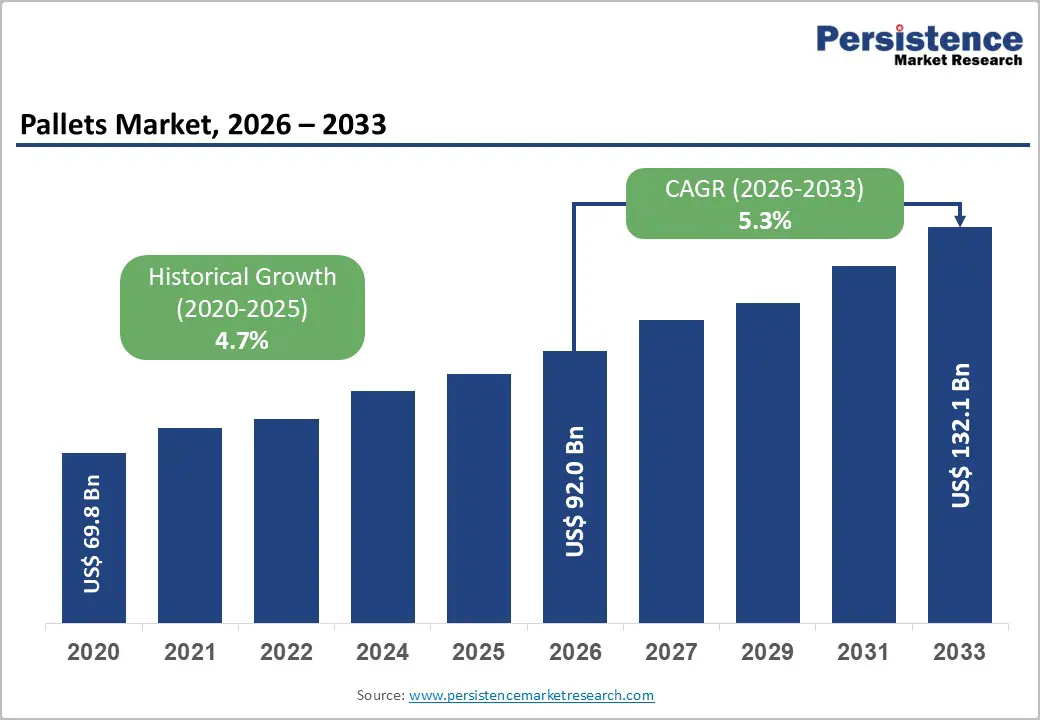
The global pallets market size is likely to be valued at US$ 92 Bn in 2026, and is estimated to reach US$132.3 Bn by 2033, growing at a CAGR of 5.3% during the forecast period 2026-2033. This expansion is underpinned by rising demand for automation in hazardous mining environments, persistent labor shortages, and the need to improve operational efficiency and safety across both open-pit and underground mines.

Key Industry Highlights:

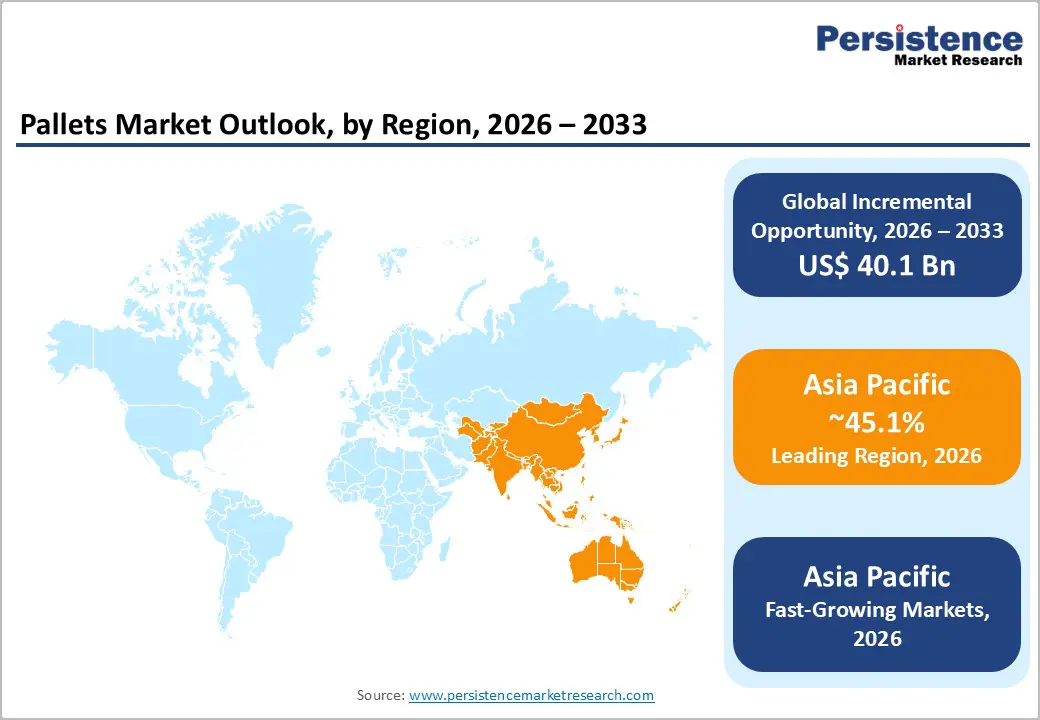
  • Leading region: The Asia-Pacific region leads the global pallet market with approximately 45.1% share, driven by rapid industrialization, export-oriented manufacturing growth, expanding logistics infrastructure, and booming e-commerce activities in China and India.
  • Fastest-Growing Region: Asia-Pacific is also the fastest-growing region, supported by government logistics initiatives, rising warehouse investments, sustainability-focused pallet adoption, and increasing cross-border trade and cold-chain expansion.
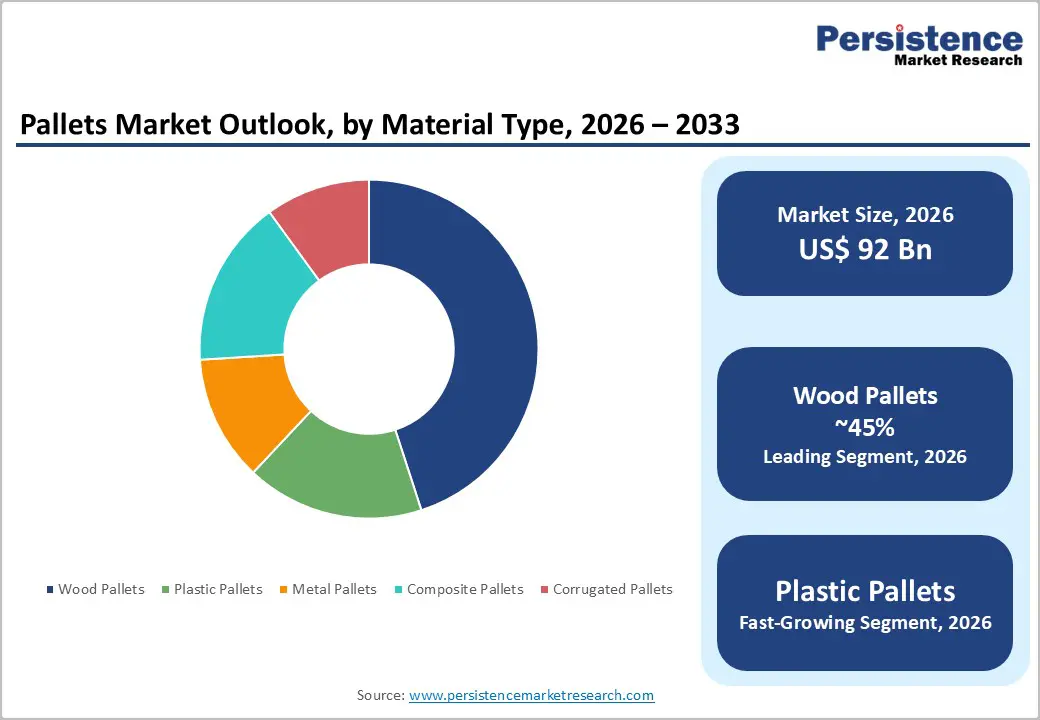
  • Dominant Segment: Wood pallets dominate the material type, accounting for roughly 45% of revenue, supported by cost efficiency, durability, ease of repair, broad industry acceptance, and the increasing use of sustainably sourced, ISPM-15-compliant products.
  • Fastest-Growing Segment: Plastic pallets are the fastest-growing segment, fueled by hygiene requirements, moisture and chemical resistance, recyclability, RFID integration, and rising demand from pharmaceuticals, food safety, e-commerce, and automated warehouses.
  • Key Market Opportunity: The growing adoption of smart, sustainable pallets that integrate RFID, recyclable materials, and cold-chain compatibility presents significant opportunities across pharmaceuticals, food logistics, automated warehousing, and cross-border trade networks.
Key Insights Details

Pallets Market Size (2026E)

US$ 92 Billion

Market Value Forecast (2033F)

US$ 132.1 Billion

Projected Growth CAGR (2026–2033)

4.7%

Historical Market Growth (2020–2025)

5.3%

Market Dynamics

Market Growth Drivers

Surging International Trade Volumes to Boost the Demand for Pallets

The massive expansion in international trade is a pivotal driver of growth in the pallets market, directly increasing demand for efficient, standardized load carriers to enable cross-border supply chains. According to UN Trade and Development (UNCTAD), global trade rose by an estimated US$300 Bn in the first half of 2025 alone, growing around 1.5% to 2% quarterly, signaling a sustained increase in trade volume despite geopolitical uncertainties.

This has compelled manufacturers and logistics providers to deploy robust packaging solutions that ensure product safety, comply with regulations such as ISPM-15, and establish a streamlined system of cargo handling across complex, multimodal transport networks.

Moreover, tariff fluctuations and trade policy uncertainty, which rose to record levels in 2025 due to tariff hikes announced by the U.S., have prompted companies to diversify their supply chains and adopt pallet solutions that are adaptable to shifting logistics demands.

Market Restraints

Volatility in Raw Material Prices and Availability Constraints Hampers Growth

The pronounced volatility in raw material prices, particularly lumber, which is likely to increase production costs and narrow profit margins, remains the primary constraint on market growth. Wooden pallets are especially vulnerable to fluctuating lumber prices, which have ballooned over the past year amid tightening forest resource regulations and supply chain disruptions.

For example, the Regulation on Deforestation-free Products of the European Union (EU), which came into force in 2023, aims to ensure that a set of key products traded and consumed in the EU and globally no longer contribute to deforestation and forest degradation.

These policy changes will inevitably close lucrative markets and trigger cost spikes, which will ultimately be passed on to consumers, leading to demand suppression in price-sensitive sectors such as agriculture and manufacturing. Other regulatory compliance issues related to phytosanitary standards and sustainability requirements are also expected to impose additional costs and operational complexities, thereby erecting another barrier to market growth.

Market Opportunities

Automation and E-commerce Boom to Generate Unprecedented Opportunities in the Pallet Market

The explosive growth of e-commerce, coupled with accelerated automation in warehousing and logistics, presents a significant growth opportunity for market players. According to a recent study, around 20% of global sales are made from online purchases.

Moreover, the U.S. International Trade Administration (ITA) estimates that the global B2B e-commerce market will grow at a 14.5% CAGR through 2026. In light of these projections, warehouses must equip themselves to handle substantially higher stock-keeping units (SKUs) and fulfilment volumes, which will create significant demand for efficient pallet-based solutions to streamline storage, reduce handling time, and enhance supply chain agility.

The development and release of stackable, standardized wooden and plastic pallets, designed to be compatible with robotics and automated guided vehicles (AGVs), further accelerate this trend by reducing costly breakdowns and maximizing operational throughput.

For instance, in May 2025, at the AUTOMATE exhibition in North America, SEER Robotics introduced the SPT-1000, a smart pallet truck designed for closed-pallet handling, featuring an innovative E-type structure enhanced with AI deep learning. Simultaneously, sustainability imperatives have shifted preferences toward reusable, recyclable pallets, integrating cost efficiency with circular economy goals and opening new market frontiers.

Category-wise Analysis

Material Type Insights

Wood pallets are predicted to command approximately 45% of the pallets market revenue share among materials, due to their cost-effectiveness, durability, widespread availability, and a strong foothold across industries such as manufacturing and pharmaceuticals.

The dominance of this segment is further underpinned by their biodegradability quotient and ease of repair, with major providers such as CHEP and PalletOne emphasizing sustainable sourcing in accordance with various environmental regulations.

Market undercurrents also indicate increasing adoption of sustainably sourced wood and heat-treated pallets that comply with ISPM-15 standards for international trade. In contrast, the resurgence of softwood pallets highlights the importance of cost optimization without compromising durability.

The plastic pallets segment is likely to report the highest CAGR through 2033, driven by their resistance to moisture, chemicals, and decay, making them indispensable in hygiene-sensitive sectors such as pharmaceuticals and food safety.

The increasing emphasis on sustainability will also increase demand for recyclable and reusable plastic pallets with RFID tracking, serving the growing e-commerce and cold-chain logistics sectors. Industry shifts in North America and Europe indicate increased investment in lightweight, durable plastic pallets that integrate seamlessly with automated warehousing systems, thereby overcoming the functional limitations of wood pallets.

End-user Insights                   

The food & beverage segment is projected to account for approximately 38.0% of revenue in 2025. Stringent food safety regulations worldwide, which necessitate pallets that ensure hygiene, pest control, and contamination prevention, are the primary factors driving this industry’s dominance.

Pallets in this sector are increasingly made from hygienic materials such as plastic or certified heat-treated wood compliant with ISPM-15 standards. The exponential growth in global food trade and the rapid expansion of e-commerce food and beverage delivery services have amplified the demand for pallets.

For instance, the 2024 investment by DS Smith Plc of €6 Mn (US$6.45 Mn) in the Netherlands to expand pallet production to meet sustainable packaging needs is indicative of the growing trend toward eco-friendly and protective pallet solutions specific to the food industry.

Pharmaceuticals are projected to be the fastest-growing, driven by substantial demand for sterile, contamination-free transport solutions in a tightly regulated sector. The proliferation of personalized medicine, biologics, and cold-chain pharmaceuticals is driving the adoption of advanced pallets made from recyclable plastic and composite materials, which offer high durability and hygiene.

The unforeseen expansion of the pharmaceutical logistics sector, particularly since COVID-19, has transformed pallets into vital enablers of the safe storage and transport of critical medicines, medical instruments, and devices.

The application of RFID technology and IoT-enabled pallets in pharma supply chains will further improve traceability, minimize risks, and ensure compliance with evolving global health standards.
Regional Insights

Asia Pacific Pallets Market Trends

Asia Pacific is set to dominate with around 45.1% of the pallet market share in 2026, while also registering the highest CAGR through 2033. The regional market is propelled by an unprecedented rate of industrialization, export-oriented manufacturing policies, and rapidly expanding e-commerce and retail sectors.

China and India are leading the charge, with government initiatives such as India's PM Gati Shakti and the expansion of logistics corridors in China, enhancing warehouse and supply chain infrastructure, aiding the demand for pallets in the region.

The adoption of sustainable wooden pallets by market players in the Asia Pacific, on account of their cost-effectiveness, combined with a noticeable shift toward reusable plastic pallets to meet export standards, is a significant trend. The market here also benefits from strategic investments, such as Morgan Stanley India's US$25 Mn infusion in LEAP India in 2021 for strengthening portfolio assets.

North America Pallets Market Trends

North America is likely to account for approximately 30.5% of the market in 2025, driven by mature logistics networks, widespread warehouse automation, and stringent regulatory mandates governing pallet standards and recycling. The U.S. plays a critical role, with giants such as Amazon and Home Depot driving the demand for RFID-enabled smart pallets to optimize last-mile delivery and inventory management.

The emphasis of the Build America, Buy America Act on sourcing materials from the U.S. and localizing production can also prove beneficial for domestic pallet manufacturers. With sustainability efforts gaining momentum across industries, powered by technological innovation and regulatory enforcement, North America will continue to occupy an influential place in the market throughout the foreseeable future.

Europe Pallets Market Trends

Increasingly stringent environmental policies and an unwavering commitment to circular economy principles are expected to enable Europe to account for approximately 19.0% of the pallets market in 2025. The regulations of the EU are likely to push sustainable usage of pallets by companies operating in the region, with an even greater emphasis on recycled plastics and wood from certified sources.

Market growth in this region is primarily driven by consistently high demand for compliant and durable pallets from the region’s robust food & beverage, automotive, and pharmaceutical sectors. Players in the regional market are also ramping up investments in smart pallet systems with real-time tracking that support regulatory adherence and operational efficiency.
Competitive Landscape

The global pallets market is characterized by a relentless pursuit of innovation, sustainability, and technological integration, which collectively drive differentiation in a moderately fragmented industry. Market leaders are leveraging advanced IoT-enabled trackers and RFID technologies to enhance pallet utilization, real-time tracking, and supply chain transparency. The growing demand for eco-friendly and reusable pallets is stimulating partnerships and investments in green manufacturing.

Simultaneously, price competitiveness and product customization remain central expansion strategies, with regional specialists exploiting niche timber segments or bio-composite alternatives to combat raw material price volatility and meet evolving regulatory standards. The advent of automation in warehousing and the rising push for circular economy models have led to an industry-wide movement toward pallet pooling and lifecycle extension, which reduces costs and carbon footprints.

Key Market Developments

  • In August 2025, ACL Airshop partnered with IndiGo to deliver standardized pallet management, maintenance, and advanced tracking services, marking ACL’s entry into India and boosting IndiGo’s fleet efficiency and visibility.
  • In July 2025, Coca-Cola Vietnam piloted its “NetZero Pallet”, a carbon-negative, non-toxic pallet made from agricultural waste such as coconut fibre and coffee husk, in its automated warehouse. This initiative sequesters up to 34 kg of CO2 per pallet and, if scaled, could save 10 million trees, recycle 2 million tons of waste, store 7 million tons of CO2, and support over 600,000 farmers.
  • In April 2025, Cold Chain Technologies (CCT) launched the CCT Tower Elite, a reusable 1,600 L temperature-controlled pallet shipper compatible with EU and U.S. pallets. Offering 120-hour temperature stability (-60 °C to +20 °C) without external power, it features IoT-enabled tracking and is the lightest solution in its class for global pharma shipments.

Companies Covered in Pallets Market

  • DS Smith Plc
  • Smurfit Kappa Group
  • Conitex Sonoco
  • Oji Holdings Corporation
  • Multi-wall Packaging
  • KraftPal Technologies
  • Europal Packaging
  • Tat Seng Packaging
  • Dopack
  • Interpal Industries
  • PhengHoon Honeycomb
  • Mabuchi Singapore
  • The Alternative Pallet Company
  • Kimmo (Pty) Ltd
  • Brambles Ltd (CHEP)
  • PalletOne, Inc.
  • PECO Pallet, Inc.
Frequently Asked Questions

The Pallets Market is estimated at US$ 92 Billion in 2026 and is projected to reach US$ 132.1 Billion by 2033, expanding at a CAGR of 5.3% during the forecast period from 2026 to 2033.

The surge in international trade volumes is driving the market by increasing demand for efficient, standardized load carriers to support cross-border supply chains.

Wood pallets dominate material type with roughly 45% revenue share, supported by cost efficiency, durability, easy repairability, wide industry acceptance, and increasing use of sustainably sourced, ISPM-15 compliant products.

Asia Pacific leads the global pallet market, driven by rapid industrialization, export manufacturing growth, expanding logistics infrastructure, and booming e-commerce activities across China and India.

The sensational rise of e-commerce and the accelerated automation in warehousing and logistics are the key market opportunities.

Leading companies include DS Smith Plc, Smurfit Kappa Group, and Conitex Sonoco.
Global Pallets Market Report Scope
Report Attribute Details

Historical Data/Actuals

2020 - 2025

Forecast Period

2026 - 2033

Market Analysis Units

Value: US$ Bn, Volume: Units

Geographical Coverage

  • North America
  • Europe
  • East Asia
  • South Asia and Oceania
  • Latin America
  • Middle East and Africa

Segmental Coverage

  • Material Type
  • Structural Design
  • End-user 

Competitive Analysis

  • DS Smith Plc
  • Smurfit Kappa Group
  • Conitex Sonoco
  • Oji Holdings Corporation
  • Multi-wall Packaging
  • KraftPal Technologies
  • Europal Packaging
  • Tat Seng Packaging
  • Dopack
  • Interpal Industries
  • PhengHoon Honeycomb
  • Mabuchi Singapore
  • The Alternative Pallet Company
  • Kimmo (Pty) Ltd
  • Brambles Ltd (CHEP)
  • PalletOne, Inc.
  • PECO Pallet, Inc.

Report Highlights

  • Market Forecast and Trends
  • Competitive Intelligence & Share Analysis
  • Growth Factors and Challenges
  • Strategic Growth Initiatives
  • Pricing Analysis
  • Future Opportunities and Revenue Pockets
  • Market Analysis Tools
Market Segmentation

By Material Type

  • Wood Pallets
  • Plastic Pallets
  • Metal Pallets
  • Composite Pallets
  • Corrugated Pallets

By Structural Design

  • Stringer Pallets
  • Block Pallets

By End-user

  • Food & Beverage
  • Pharmaceuticals
  • Chemicals
  • Retail
  • Agriculture
  • Electronics
  • Construction
  • Others

By Regions

  • North America
  • Europe
  • East Asia
  • South Asia & Oceania
  • Latin America
  • Middle East & Africa

Related Reports

  1. Executive Summary
    1. Global Pallets Market  Snapshot 2026 and 2033
    2. Market Opportunity Assessment, 2026-2033, US$ Bn
    3. Key Market Trends
    4. Industry Developments and Key Market Events
    5. Demand Side and Supply Side Analysis
    6. PMR Analysis and Recommendations
  2. Market Overview
    1. Market Scope and Definitions
    2. Value Chain Analysis
    3. Macro-Economic Factors
      1. Global GDP Outlook
      2. Global Food & Beverage Industry Overview
    4. Forecast Factors – Relevance and Impact
    5. COVID-19 Impact Assessment
    6. PESTLE Analysis
    7. Porter's Five Forces Analysis
    8. Geopolitical Tensions: Market Impact
    9. Regulatory and Technology Landscape
  3. Market Dynamics
    1. Drivers
    2. Restraints
    3. Opportunities
    4. Trends
  4. Price Trend Analysis, 2020 – 2033
    1. Region-wise Price Analysis
    2. Price by Segments
    3. Price Impact Factors
  5. Global Pallets Market  Outlook: Historical (2020 – 2025) and Forecast (2026 – 2033)
    1. Key Highlights
    2. Global Pallets Market  Outlook: Material Type
      1. Introduction/Key Findings
      2. Historical Market Size (US$ Bn) and Volume (Units) Analysis by Material Type, 2020-2025
      3. Current Market Size (US$ Bn) and Volume (Units) Forecast, by Material Type, 2026-2033
        1. Wood Pallets
        2. Plastic Pallets
        3. Metal Pallets
        4. Composite Pallets
        5. Corrugated Pallets
      4. Market Attractiveness Analysis: Material Type
    3. Global Pallets Market  Outlook: Structural Design
      1. Introduction/Key Findings
      2. Historical Market Size (US$ Bn) and Volume (Units) Analysis by Structural Design, 2020-2025
      3. Current Market Size (US$ Bn) and Volume (Units) Forecast, by Structural Design, 2026-2033
        1. Stringer Pallets
        2. Block Pallets
      4. Market Attractiveness Analysis: Structural Design
    4. Global Pallets Market  Outlook: End-user
      1. Introduction/Key Findings
      2. Historical Market Size (US$ Bn) and Volume (Units) Analysis by End-user , 2020-2025
      3. Current Market Size (US$ Bn) and Volume (Units) Forecast, by End-user , 2026-2033
        1. Food & Beverage
        2. Pharmaceuticals
        3. Chemicals
        4. Retail
        5. Agriculture
        6. Electronics
        7. Construction
        8. Others
      4. Market Attractiveness Analysis: End-user
  6. Global Pallets Market  Outlook: Region
    1. Key Highlights
    2. Historical Market Size (US$ Bn) and Volume (Units) Analysis by Region, 2020-2025
    3. Current Market Size (US$ Bn) and Volume (Units) Forecast, by Region, 2026-2033
      1. North America
      2. Europe
      3. East Asia
      4. South Asia & Oceania
      5. Latin America
      6. Middle East & Africa
    4. Market Attractiveness Analysis: Region
  7. North America Pallets Market  Outlook: Historical (2020 – 2025) and Forecast (2026 – 2033)
    1. Key Highlights
    2. Pricing Analysis
    3. North America Market Size (US$ Bn) and Volume (Units) Forecast, by Country, 2026-2033
      1. U.S.
      2. Canada
    4. North America Market Size (US$ Bn) and Volume (Units) Forecast, by Material Type, 2026-2033
      1. Wood Pallets
      2. Plastic Pallets
      3. Metal Pallets
      4. Composite Pallets
      5. Corrugated Pallets
    5. North America Market Size (US$ Bn) and Volume (Units) Forecast, by Structural Design, 2026-2033
      1. Stringer Pallets
      2. Block Pallets
    6. North America Market Size (US$ Bn) and Volume (Units) Forecast, by End-user , 2026-2033
      1. Food & Beverage
      2. Pharmaceuticals
      3. Chemicals
      4. Retail
      5. Agriculture
      6. Electronics
      7. Construction
      8. Others
  8. Europe Pallets Market  Outlook: Historical (2020 – 2025) and Forecast (2026 – 2033)
    1. Key Highlights
    2. Pricing Analysis
    3. Europe Market Size (US$ Bn) and Volume (Units) Forecast, by Country, 2026-2033
      1. Germany
      2. Italy
      3. France
      4. U.K.
      5. Spain
      6. Russia
      7. Rest of Europe
    4. Europe Market Size (US$ Bn) and Volume (Units) Forecast, by Material Type, 2026-2033
      1. Wood Pallets
      2. Plastic Pallets
      3. Metal Pallets
      4. Composite Pallets
      5. Corrugated Pallets
    5. Europe Market Size (US$ Bn) and Volume (Units) Forecast, by Structural Design, 2026-2033
      1. Stringer Pallets
      2. Block Pallets
    6. Europe Market Size (US$ Bn) and Volume (Units) Forecast, by End-user , 2026-2033
      1. Food & Beverage
      2. Pharmaceuticals
      3. Chemicals
      4. Retail
      5. Agriculture
      6. Electronics
      7. Construction
      8. Others
  9. East Asia Pallets Market  Outlook: Historical (2020 – 2025) and Forecast (2026 – 2033)
    1. Key Highlights
    2. Pricing Analysis
    3. East Asia Market Size (US$ Bn) and Volume (Units) Forecast, by Country, 2026-2033
      1. China
      2. Japan
      3. South Korea
    4. East Asia Market Size (US$ Bn) and Volume (Units) Forecast, by Material Type, 2026-2033
      1. Wood Pallets
      2. Plastic Pallets
      3. Metal Pallets
      4. Composite Pallets
      5. Corrugated Pallets
    5. East Asia Market Size (US$ Bn) and Volume (Units) Forecast, by Structural Design, 2026-2033
      1. Stringer Pallets
      2. Block Pallets
    6. East Asia Market Size (US$ Bn) and Volume (Units) Forecast, by End-user , 2026-2033
      1. Food & Beverage
      2. Pharmaceuticals
      3. Chemicals
      4. Retail
      5. Agriculture
      6. Electronics
      7. Construction
      8. Others
  10. South Asia & Oceania Pallets Market  Outlook: Historical (2020 – 2025) and Forecast (2026 – 2033)
    1. Key Highlights
    2. Pricing Analysis
    3. South Asia & Oceania Market Size (US$ Bn) and Volume (Units) Forecast, by Country, 2026-2033
      1. India
      2. Southeast Asia
      3. ANZ
      4. Rest of SAO
    4. South Asia & Oceania Market Size (US$ Bn) and Volume (Units) Forecast, by Material Type, 2026-2033
      1. Wood Pallets
      2. Plastic Pallets
      3. Metal Pallets
      4. Composite Pallets
      5. Corrugated Pallets
    5. South Asia & Oceania Market Size (US$ Bn) and Volume (Units) Forecast, by Structural Design, 2026-2033
      1. Stringer Pallets
      2. Block Pallets
    6. South Asia & Oceania Market Size (US$ Bn) and Volume (Units) Forecast, by End-user , 2026-2033
      1. Food & Beverage
      2. Pharmaceuticals
      3. Chemicals
      4. Retail
      5. Agriculture
      6. Electronics
      7. Construction
      8. Others
  11. Latin America Pallets Market  Outlook: Historical (2020 – 2025) and Forecast (2026 – 2033)
    1. Key Highlights
    2. Pricing Analysis
    3. Latin America Market Size (US$ Bn) and Volume (Units) Forecast, by Country, 2026-2033
      1. Brazil
      2. Mexico
      3. Rest of LATAM
    4. Latin America Market Size (US$ Bn) and Volume (Units) Forecast, by Material Type, 2026-2033
      1. Wood Pallets
      2. Plastic Pallets
      3. Metal Pallets
      4. Composite Pallets
      5. Corrugated Pallets
    5. Latin America Market Size (US$ Bn) and Volume (Units) Forecast, by Structural Design, 2026-2033
      1. Stringer Pallets
      2. Block Pallets
    6. Latin America Market Size (US$ Bn) and Volume (Units) Forecast, by End-user , 2026-2033
      1. Food & Beverage
      2. Pharmaceuticals
      3. Chemicals
      4. Retail
      5. Agriculture
      6. Electronics
      7. Construction
      8. Others
  12. Middle East & Africa Pallets Market  Outlook: Historical (2020 – 2025) and Forecast (2026 – 2033)
    1. Key Highlights
    2. Pricing Analysis
    3. Middle East & Africa Market Size (US$ Bn) and Volume (Units) Forecast, by Country, 2026-2033
      1. GCC Countries
      2. South Africa
      3. Northern Africa
      4. Rest of MEA
    4. Middle East & Africa Market Size (US$ Bn) and Volume (Units) Forecast, by Material Type, 2026-2033
      1. Wood Pallets
      2. Plastic Pallets
      3. Metal Pallets
      4. Composite Pallets
      5. Corrugated Pallets
    5. Middle East & Africa Market Size (US$ Bn) and Volume (Units) Forecast, by Structural Design, 2026-2033
      1. Stringer Pallets
      2. Block Pallets
    6. Middle East & Africa Market Size (US$ Bn) and Volume (Units) Forecast, by End-user , 2026-2033
      1. Food & Beverage
      2. Pharmaceuticals
      3. Chemicals
      4. Retail
      5. Agriculture
      6. Electronics
      7. Construction
      8. Others
  13. Competition Landscape
    1. Market Share Analysis, 2025
    2. Market Structure
      1. Competition Intensity Mapping
      2. Competition Dashboard
    3. Company Profiles
      1. DS Smith Plc
        1. Company Overview
        2. Product Portfolio/Offerings
        3. Key Financials
        4. SWOT Analysis
        5. Company Strategy and Key Developments
      2. Smurfit Kappa Group
      3. Conitex Sonoco
      4. Oji Holdings Corporation
      5. Multi-wall Packaging
      6. KraftPal Technologies
      7. Europal Packaging
      8. Tat Seng Packaging
      9. Dopack
      10. Interpal Industries
      11. PhengHoon Honeycomb
      12. Mabuchi Singapore
      13. The Alternative Pallet Company
      14. Kimmo (Pty) Ltd
      15. Brambles Ltd (CHEP)
  14. Appendix
    1. Research Methodology
    2. Research Assumptions
    3. Acronyms and Abbreviations

Research Methodology Framework for Market Research Excellence

At Persistence Market Research, we implement a comprehensive, validated, and multi-dimensional approachto market analysis that delivers actionable insights across complex market landscapes. Our methodology combines the analytical rigor of leading consulting firms with innovative research techniques, ensuring robust market assessments that guide strategic decision-making with confidence.

Core Research Philosophy

Our methodology is built on four foundational pillars:

Research Philosophy Image

At Persistence Market Research, our methodology is designed to transcend conventional market studies by combining analytical rigor, multi-source validation, and future-focused insights.

We integrate advanced research frameworks, robust data collection strategies, cutting-edge analytics, and innovative technologies to deliver a 360-degree view of complex markets.

We integrate advanced research frameworks, robust data collection strategies, cutting-edge analytics, and innovative technologies to deliver a 360-degree view of complex markets.

Each stage spanning from strategic scoping and hypothesis-building to competitive intelligence, quality validation, and actionable recommendations is engineered to provide clients with unmatched clarity, precision, and confidence in decision-making.

By embedding innovation and technology at the core, our approach ensures that insights are not only comprehensive but also predictive, empowering businesses to seize opportunities, mitigate risks, and achieve sustainable growth

Research Philosophy Image

Capturing Key Information and Events

During this phase, key research objectives focus on essential information and data points for assessing the market, including:

Research Philosophy Image

TAM-SAM-SOM Framework Implementation

We employ both top-down and bottom-up approaches to ensure accurate market sizing.

Top-Down Market SizingBottom-Up Market Sizing
Universe Definition: Total global/regional market identificationUnit Economics: Average transaction values, purchase frequencies, customer lifecycle
Segmentation Filters: Geographic, demographic, and behavioral constraintsCustomer Segmentation: Detailed buyer persona development and sizing
Market Share Analysis: Competitive landscape assessment and share allocationPenetration Analysis: Market penetration rates by segment and geography
Growth Rate Application: Historical trends and forward-looking growth assumptionsScaling Methodology: Extrapolation techniques with confidence intervals

Validation & Cross-Verification

  • Triangulation: Comparing top-down and bottom-up results for consistency
  • Sensitivity Analysis: Testing key assumptions and parameter variations
  • Peer Benchmarking: Comparison with analogous markets and industry benchmarks
  • Expert Review: External validation through industry specialist consultation

Research Philosophy Image

Forecasting & Projection Modeling

Our proprietary forecasting models incorporate multiple variables and scenarios.

Forecasting Components

  • Historical Trend Analysis: 10-year historical growth patterns and cyclical variations
  • Driver-Based Modeling: Economic indicators, demographic shifts, technology adoption
  • Scenario Planning: Base case, optimistic, and conservative projections
  • Monte Carlo Simulations: Probability-weighted outcomes and risk assessments

Model Validation

  • Back-Testing: Historical accuracy assessment over 3–5-year periods
  • Cross-Validation: Multiple modeling approaches for result comparison
  • External Benchmarking: Comparison with established market forecasts
  • Continuous Calibration: Quarterly model updates based on new data

Comprehensive Data Collection Strategy

Our secondary research phase establishes a robust knowledge base utilizing diverse, credible sources.

Secondary Data Sourcess

  • Industry Publications & Reports
  • Government & Regulatory Data
  • Financial Intelligence (filings & reports)
  • Academic Research & Digital Intelligence

Quality Assurance Protocol

  • Source credibility assessment and publication date validation
  • Data consistency checks across multiple sources
  • Bias identification and neutralization techniques
  • Information gap tracking for primary research prioritization

Research Philosophy Image

Primary Research Excellence

Our primary research methodology employs best-in-class techniques to capture unique market insights.

Quantitative Research Methods

  • Large-Scale Surveys: Statistically representative samples with 95% confidence intervals
  • Survey Methodology: Multi-channel deployment (online, telephone, in-person)
  • Question Architecture and Response Optimization

Qualitative Research Methods

  • Executive Interviews
  • Focus Groups
  • Expert Consultations

Quality Assurance & Validation Framework

Multi-Stage Validation Process

  • Source Verification and Consistency Testing
  • Outlier Detection and Bias Assessment
  • Peer Review Process and External Validation
  • Sensitivity Analysis and Confidence Intervals

Research Philosophy Image

Methodology Validation & Credibility

Our research methodology has been extensively validated through:

  • Academic Partnerships: Collaborations with top-tier business schools and research institutions
  • Client Success Stories: Documented case studies demonstrating research impact and ROI
  • Continuous Benchmarking: Performance comparison with leading global research firms

This comprehensive methodology framework positions Persistence Market Research at the forefront of market intelligence, combining the analytical sophistication of top-tier consulting firms with innovative research techniques. Our approach ensures that every market assessment delivers precise, actionable, and strategically valuable insights that drive business success in competitive market environments.

Ready to unlock your market potential? Contact our research experts to discuss how our validated methodology can transform your strategic decision-making with data-driven market intelligence.

Copyright © 2026 Persistence Market Research. All Rights Reserved

Connect With Us -