




- Specialty & Fine Chemicals
- Modified Silicone Market
Modified Silicone Market Size, Share, and Growth Forecast, 2026 - 2033
Modified Silicone Market by Product Type (Reactive, Non-Reactive), Application (Resin Modifiers, Chemical Ingredient, Textile Treatment Agents, Performance Additive, Others), and Regional Analysis for 2026 - 2033

Modified Silicone Market Size and Trends Analysis
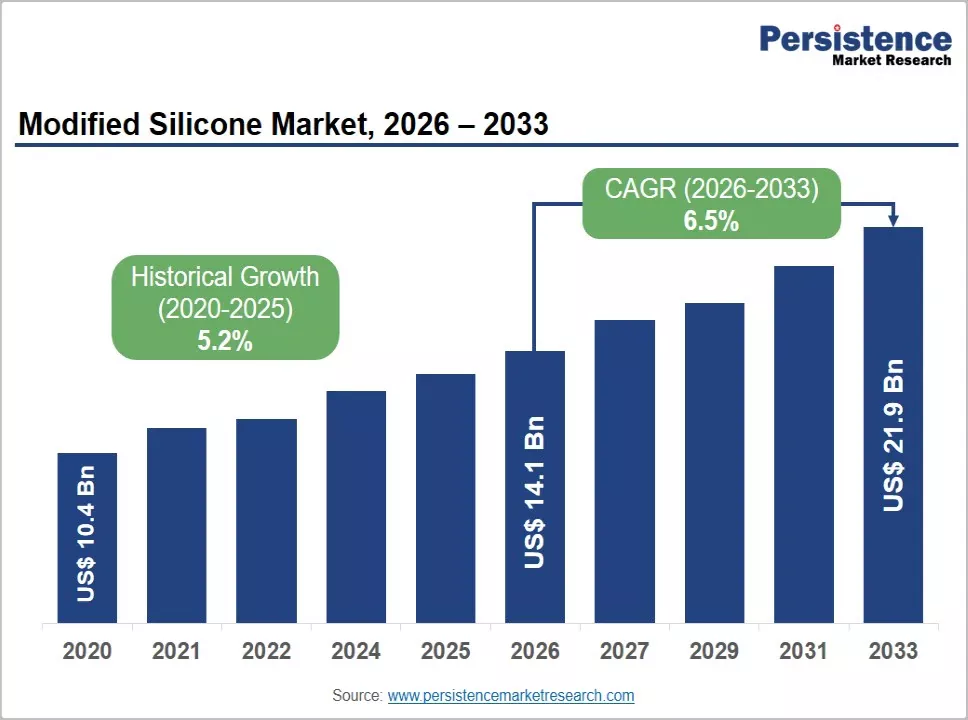
The global modified silicone market size is likely to be valued at US$14.1 billion in 2026 and is projected to reach US$21.9 billion by 2033, growing at a CAGR of 6.5% during the forecast period from 2026 to 2033, driven by rising use of silicone-modified polymers in construction sealants and adhesives, growing demand for high-performance coatings and additives and expanding applications in automotive, aerospace, and consumer care products.
Modified silicones combine the thermal stability, weather resistance, flexibility, and low surface tension of silicone chemistry with the functionality of organic groups, allowing formulators to tailor properties such as adhesion, compatibility, and surface behavior for specific end-uses.
Key Industry Highlights:
- Reactive modified silicones are estimated to remain the leading product type in 2026 with about 58% share, supported by their ability to bond chemically into polymer networks and coatings.
- Performance additives are estimated to account for about 27% of the market by application in 2026, supported by demand for slip, leveling, defoaming, and surface-modifying functions.
- Asia Pacific is estimated to account for a 43% share of the global market in 2026, supported by large-scale construction, electronics, and manufacturing activity.
DRO Analysis
Driver: Demand for high-performance sealants, coatings, and additives
The fundamental growth driver for the modified silicone market is the expanding use of silicone-modified materials in applications requiring durability, weather resistance, and adhesion. In construction, silyl-modified and silicone-modified polymers are used in sealants and adhesives that bond to diverse substrates, tolerate movement and temperature variation, and offer low odor and solvent-free formulations compared with some conventional systems.
In paints and coatings, silicone-modified resins and additives improve heat resistance, gloss retention, water repellency, and leveling, extending product life in architectural, industrial, and protective applications. Growing infrastructure investment, renovation activity, and stricter performance and emissions expectations in coatings are supporting demand for modified silicone chemistries across a broad customer base.
Restraint: Raw material volatility and formulation complexity
A restraint on the modified silicone market is the exposure of producers to raw material and energy price fluctuations. Silicone production depends on silicon metal, methanol, and energy-intensive processes, and periods of supply tightness or capacity changes can produce volatile pricing that is difficult to pass through to downstream customers.
Additionally, modified silicones often carry higher costs than conventional organic alternatives and require careful formulation to ensure compatibility, stability, and desired performance. Regulatory attention to certain cyclic siloxanes in consumer products and the environment can also require reformulation, testing, and compliance investment, which may slow product introductions and limit adoption in cost-sensitive applications.
Opportunity: Electric vehicles, electronics, and sustainable formulations
A significant opportunity lies in the growth of electric vehicles, batteries, and electronics, where modified silicones are used for thermal management, sealing, insulation, and protection against moisture and vibration. Requirements for durable, lightweight, and heat-resistant materials in battery assemblies and power electronics open additional applications for tailored silicone chemistries.
Sustainability trends are also creating opportunity. Formulators are seeking low-VOC, solvent-free, and long-life materials that reduce maintenance and replacement, and modified silicone technologies can support such requirements in sealants, coatings, and textile finishes. Development of bio-based and recyclable modifications, along with fluorine-free water-repellent finishes for textiles, offers scope for producers able to deliver both performance and environmental credentials.
Category-wise analysis
Product type insights
Reactive modified silicones are estimated to be the leading product type, accounting for approximately 58% of the global modified silicone market in 2026. Their ability to chemically bond with resin systems, coatings, adhesives, and sealants gives them a performance advantage in applications requiring durable modification. Hydroxyl, amino, epoxy, carbinol, and vinyl functionalities can improve adhesion, flexibility, heat resistance, and weatherability, supporting broad industrial consumption.
Non-reactive modified silicones are expected to be the fastest-growing product type, supported by expanding demand for surface-control properties across coatings, personal care, cleaning formulations, plastics, and industrial additives. Polyether-, alkyl-, and aryl-modified silicones provide controlled wetting, spreading, leveling, defoaming, and sensory effects without requiring permanent chemical bonding, making them suitable for a growing range of formulated products.
Application insights
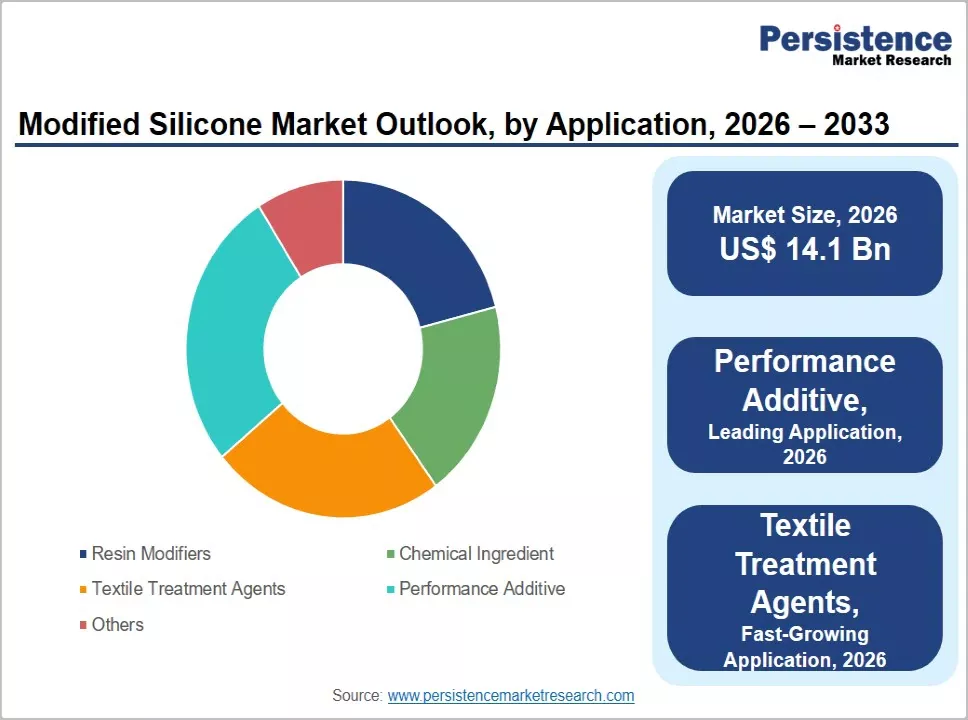
Performance additives are projected to remain the leading application, representing approximately 27% of global modified silicone demand in 2026. Their ability to deliver slip, wetting, leveling, foam control, and surface-modification benefits at relatively low concentrations supports widespread adoption in paints and coatings, inks, plastics, cleaning products, and other formulations. This broad application base gives performance additives a larger consumption footprint than more specialized uses.
Textile treatment agents are expected to be among the fastest-growing applications, driven by demand for softer fabrics, improved smoothness, water repellency, and enhanced fabric handling. Silicone-based finishing agents are increasingly relevant to apparel and technical textiles where manufacturers seek improved fabric performance while adapting formulations to changing environmental and chemical requirements.
Regional Insights
Asia Pacific modified silicone market trends
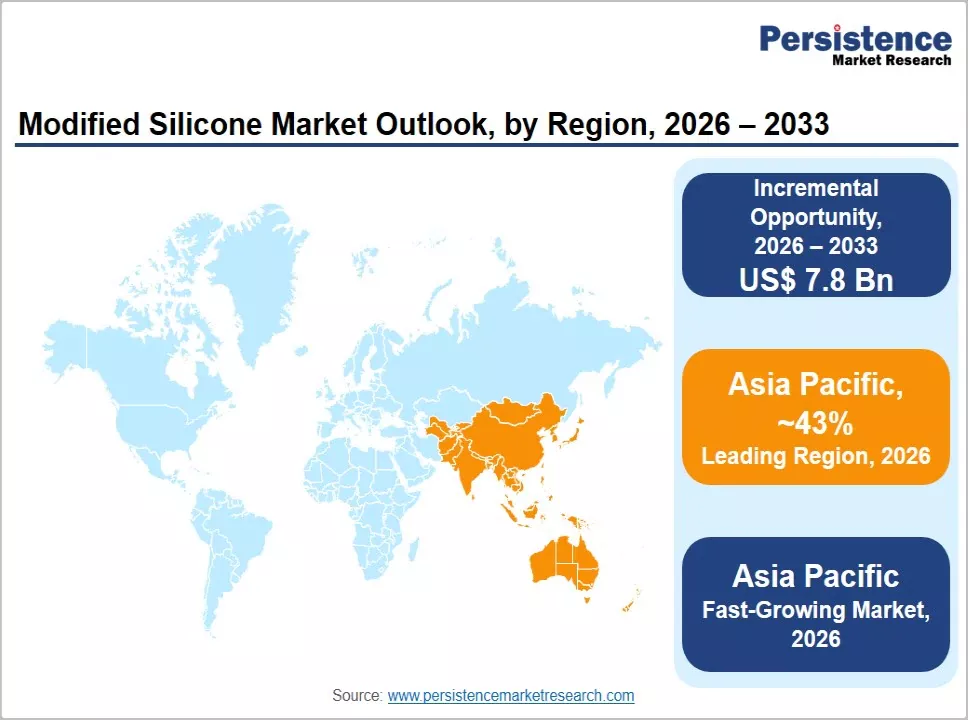
Asia Pacific is expected to remain the largest regional market, accounting for approximately 43% of global modified silicone demand in 2026. A strong manufacturing base, extensive silicone production capacity, and high consumption across construction, electronics, automotive, and textiles underpin regional demand. Integrated supply chains also support cost-efficient production and downstream formulation.
China represents the largest country-level market, supported by substantial silicone manufacturing capacity and broad industrial consumption. Japan and South Korea contribute through advanced specialty chemical technologies and strong electronics and automotive industries, while India and Southeast Asia are expanding as construction, consumer goods, automotive production, and manufacturing activity increase.
Asia Pacific is expected to preserve its leading position through 2033 as infrastructure development, electric vehicle manufacturing, electronics production, and industrial investment continue. The regional mix is also likely to shift gradually toward higher-value modified grades as manufacturers seek improved performance and differentiated silicone solutions.
Europe modified silicone market trends
Europe is estimated to account for approximately 26% of the global modified silicone market in 2026, supported by an established specialty chemicals sector and significant demand from automotive, aerospace, construction, and coatings industries. Environmental standards and performance requirements are also encouraging formulators to develop more efficient and sustainable silicone-based solutions.
Germany represents a key national market due to its chemical manufacturing base and automotive industry, while France, the U.K., Italy, and Spain contribute through construction, aerospace, industrial manufacturing, and consumer applications. Building renovation, energy-efficiency improvements, and demand for durable coatings and sealants provide additional support for specialty silicone consumption.
Through 2033, European demand is expected to increasingly reflect sustainability requirements, building renovation, electric vehicle production, and advanced manufacturing. Specialty grades with enhanced durability, lower environmental impact, and improved formulation efficiency are likely to capture a growing portion of regional value.
North America modified silicone market trends
North America is projected to account for approximately 22% of global demand in 2026, supported by construction activity, aerospace manufacturing, automotive production, and established personal care and consumer goods industries. The region also benefits from a mature ecosystem of silicone producers, specialty chemical suppliers, and downstream formulators.
The U.S. represents the dominant regional market, with infrastructure development, residential and commercial construction, aerospace manufacturing, and industrial maintenance supporting consumption. Canada adds demand through construction, manufacturing, and automotive supply chains, while high-performance coatings and sealants remain important across industrial and infrastructure applications.
North American demand is expected to develop steadily through 2033 as infrastructure investment, electric vehicle manufacturing, and demand for durable construction materials increase. Suppliers are also likely to place greater emphasis on specialty additives, energy-efficient formulations, and silicone technologies that support evolving environmental and performance standards.
Competitive Landscape
The global modified silicone market is moderately consolidated, comprising large global silicone producers alongside specialized additive and specialty chemical manufacturers. Key participants include Dow Inc., Wacker Chemie AG, Shin-Etsu Chemical Co., Ltd., Momentive Performance Materials Inc., Elkem Silicones, Evonik Industries AG, BYK-Chemie GmbH, and Kaneka Corporation. Competition is shaped by product breadth, technical support, raw material integration, application development capability, and global manufacturing reach. Companies continue to invest in specialty and sustainable silicone technologies, capacity expansion, and closer collaboration with formulators in construction, coatings, and automotive segments.
Key Industry Developments:
- In June 2026, Dow announced approximately US$100 million in investments through 2027 to expand specialty silicone manufacturing and innovation capabilities across the U.S., China, and Japan. The projects include liquid silicone rubber and engineered silicone capacity for mobility, electronics, semiconductor packaging, and healthcare applications.
- In April 2026, Shin-Etsu Silicone announced plans to construct a new silicone products plant in Pinghu, China, as part of its broader capacity expansion program. The facility is expected to strengthen regional production capabilities and support growing demand for silicone materials across Asian markets.
Companies Covered in Modified Silicone Market
- Dow Inc.
- Wacker Chemie AG
- Shin-Etsu Chemical Co., Ltd.
- Momentive Performance Materials Inc.
- Elkem Silicones
- Evonik Industries AG
- BYK-Chemie GmbH
- Kaneka Corporation
- KCC Corporation
- Siltech Corporation
Frequently Asked Questions
The global modified silicone market is estimated to reach US$14.1 billion in 2026.
Growth is driven by rising use of silicone-modified sealants and adhesives in construction, demand for high-performance coatings and additives, expansion of automotive and electronics applications, and growing need for durable and weather-resistant materials.
The modified silicone market is projected to grow at a CAGR of 6.5% from 2026 to 2033, reaching approximately US$21.9 billion by 2033.
Growth of electric vehicles and electronics, demand for low-VOC and solvent-free formulations, and development of fluorine-free textile finishes and sustainable silicone technologies create key opportunities for market participants.
Some of the key market players include Dow Inc., Wacker Chemie AG, Shin-Etsu Chemical Co., Ltd., Momentive Performance Materials Inc., Elkem Silicones, Evonik Industries AG, BYK-Chemie GmbH, and Kaneka Corporation.


