


- Executive Summary
- Global Luxury Perfume Market Snapshot 2025 and 2032
- Market Opportunity Assessment, 2025-2032, US$ Bn
- Key Market Trends
- Industry Developments and Key Market Events
- Demand Side and Supply Side Analysis
- PMR Analysis and Recommendations
- Market Overview
- Market Scope and Definitions
- Value Chain Analysis
- Macro-Economic Factors
- Global GDP Outlook
- Global Perfume Industry Overview
- Global Luxury Personal Care Industry Overview
- Global E-commerce Industry Overview
- Forecast Factors – Relevance and Impact
- COVID-19 Impact Assessment
- PESTLE Analysis
- Porter's Five Forces Analysis
- Geopolitical Tensions: Market Impact
- Regulatory and Technology Landscape
- Market Dynamics
- Drivers
- Restraints
- Opportunities
- Trends
- Price Trend Analysis, 2019 – 2032
- Region-wise Price Analysis
- Price by Segments
- Price Impact Factors
- Global Luxury Perfume Market Outlook: Historical (2019 – 2024) and Forecast (2025 – 2032)
- Key Highlights
- Global Luxury Perfume Market Outlook: Type
- Introduction/Key Findings
- Historical Market Size (US$ Bn) and Volume (Units) Analysis by Type, 2019-2024
- Current Market Size (US$ Bn) and Volume (Units) Forecast, by Type, 2025-2032
- Parfum
- Eau de Parfum
- Eau de Toilette
- Eau de Cologne
- Perfume Oil
- Others
- Market Attractiveness Analysis: Type
- Global Luxury Perfume Market Outlook: End User
- Introduction/Key Findings
- Historical Market Size (US$ Bn) and Volume (Units) Analysis by End User, 2019-2024
- Current Market Size (US$ Bn) and Volume (Units) Forecast, by End User, 2025-2032
- Men
- Women
- Market Attractiveness Analysis: End User
- Global Luxury Perfume Market Outlook: Distribution Channel
- Introduction/Key Findings
- Historical Market Size (US$ Bn) and Volume (Units) Analysis by Distribution Channel, 2019-2024
- Current Market Size (US$ Bn) and Volume (Units) Forecast, by Distribution Channel, 2025-2032
- Offline
- Online
- Market Attractiveness Analysis: Distribution Channel
- Global Luxury Perfume Market Outlook: Region
- Key Highlights
- Historical Market Size (US$ Bn) and Volume (Units) Analysis by Region, 2019-2024
- Current Market Size (US$ Bn) and Volume (Units) Forecast, by Region, 2025-2032
- North America
- Europe
- East Asia
- South Asia & Oceania
- Latin America
- Middle East & Africa
- Market Attractiveness Analysis: Region
- North America Luxury Perfume Market Outlook: Historical (2019 – 2024) and Forecast (2025 – 2032)
- Key Highlights
- Pricing Analysis
- North America Market Size (US$ Bn) and Volume (Units) Forecast, by Country, 2025-2032
- U.S.
- Canada
- North America Market Size (US$ Bn) and Volume (Units) Forecast, by Type, 2025-2032
- Parfum
- Eau de Parfum
- Eau de Toilette
- Eau de Cologne
- Perfume Oil
- Others
- North America Market Size (US$ Bn) and Volume (Units) Forecast, by End User, 2025-2032
- Men
- Women
- North America Market Size (US$ Bn) and Volume (Units) Forecast, by Distribution Channel, 2025-2032
- Offline
- Online
- Europe Luxury Perfume Market Outlook: Historical (2019 – 2024) and Forecast (2025 – 2032)
- Key Highlights
- Pricing Analysis
- Europe Market Size (US$ Bn) and Volume (Units) Forecast, by Country, 2025-2032
- Germany
- Italy
- France
- U.K.
- Spain
- Russia
- Rest of Europe
- Europe Market Size (US$ Bn) and Volume (Units) Forecast, by Type, 2025-2032
- Parfum
- Eau de Parfum
- Eau de Toilette
- Eau de Cologne
- Perfume Oil
- Others
- Europe Market Size (US$ Bn) and Volume (Units) Forecast, by End User, 2025-2032
- Men
- Women
- Europe Market Size (US$ Bn) and Volume (Units) Forecast, by Distribution Channel, 2025-2032
- Offline
- Online
- East Asia Luxury Perfume Market Outlook: Historical (2019 – 2024) and Forecast (2025 – 2032)
- Key Highlights
- Pricing Analysis
- East Asia Market Size (US$ Bn) and Volume (Units) Forecast, by Country, 2025-2032
- China
- Japan
- South Korea
- East Asia Market Size (US$ Bn) and Volume (Units) Forecast, by Type, 2025-2032
- Parfum
- Eau de Parfum
- Eau de Toilette
- Eau de Cologne
- Perfume Oil
- Others
- East Asia Market Size (US$ Bn) and Volume (Units) Forecast, by End User, 2025-2032
- Men
- Women
- East Asia Market Size (US$ Bn) and Volume (Units) Forecast, by Distribution Channel, 2025-2032
- Offline
- Online
- South Asia & Oceania Luxury Perfume Market Outlook: Historical (2019 – 2024) and Forecast (2025 – 2032)
- Key Highlights
- Pricing Analysis
- South Asia & Oceania Market Size (US$ Bn) and Volume (Units) Forecast, by Country, 2025-2032
- India
- Southeast Asia
- ANZ
- Rest of SAO
- South Asia & Oceania Market Size (US$ Bn) and Volume (Units) Forecast, by Type, 2025-2032
- Parfum
- Eau de Parfum
- Eau de Toilette
- Eau de Cologne
- Perfume Oil
- Others
- South Asia & Oceania Market Size (US$ Bn) and Volume (Units) Forecast, by End User, 2025-2032
- Men
- Women
- South Asia & Oceania Market Size (US$ Bn) and Volume (Units) Forecast, by Distribution Channel, 2025-2032
- Offline
- Online
- Latin America Luxury Perfume Market Outlook: Historical (2019 – 2024) and Forecast (2025 – 2032)
- Key Highlights
- Pricing Analysis
- Latin America Market Size (US$ Bn) and Volume (Units) Forecast, by Country, 2025-2032
- Brazil
- Mexico
- Rest of LATAM
- Latin America Market Size (US$ Bn) and Volume (Units) Forecast, by Type, 2025-2032
- Parfum
- Eau de Parfum
- Eau de Toilette
- Eau de Cologne
- Perfume Oil
- Others
- Latin America Market Size (US$ Bn) and Volume (Units) Forecast, by End User, 2025-2032
- Men
- Women
- Latin America Market Size (US$ Bn) and Volume (Units) Forecast, by Distribution Channel, 2025-2032
- Offline
- Online
- Middle East & Africa Luxury Perfume Market Outlook: Historical (2019 – 2024) and Forecast (2025 – 2032)
- Key Highlights
- Pricing Analysis
- Middle East & Africa Market Size (US$ Bn) and Volume (Units) Forecast, by Country, 2025-2032
- GCC Countries
- South Africa
- Northern Africa
- Rest of MEA
- Middle East & Africa Market Size (US$ Bn) and Volume (Units) Forecast, by Type, 2025-2032
- Parfum
- Eau de Parfum
- Eau de Toilette
- Eau de Cologne
- Perfume Oil
- Others
- Middle East & Africa Market Size (US$ Bn) and Volume (Units) Forecast, by End User, 2025-2032
- Men
- Women
- Middle East & Africa Market Size (US$ Bn) and Volume (Units) Forecast, by Distribution Channel, 2025-2032
- Offline
- Online
- Competition Landscape
- Market Share Analysis, 2024
- Market Structure
- Competition Intensity Mapping
- Competition Dashboard
- Company Profiles
- Chanel
- Company Overview
- Product Portfolio/Offerings
- Key Financials
- SWOT Analysis
- Company Strategy and Key Developments
- Dior
- Hermès
- Tom Ford
- Yves Saint Laurent (YSL)
- Gucci
- Creed
- Guerlain
- Valentino
- Maison Francis Kurkdjian
- Amouage
- Clive Christian
- Diptyque
- Le Labo
- Byredo
- Chanel
- Appendix
- Research Methodology
- Research Assumptions
- Acronyms and Abbreviations


- Beauty & Personal Care
- Luxury Perfume Market
Luxury Perfume Market Trends, Size, Share, Growth, and Forecasts 2025 - 2032
Luxury Perfume Market by Perfume Type (Parfum, Eau de Parfum, Eau de Toilette, Eau de Cologne, Perfume Oil, and Others), End-user (Men, Women), Distribution Channel (Offline, Online), and Region for 2025 - 2032
Luxury Perfume Market Share and Trends Analysis
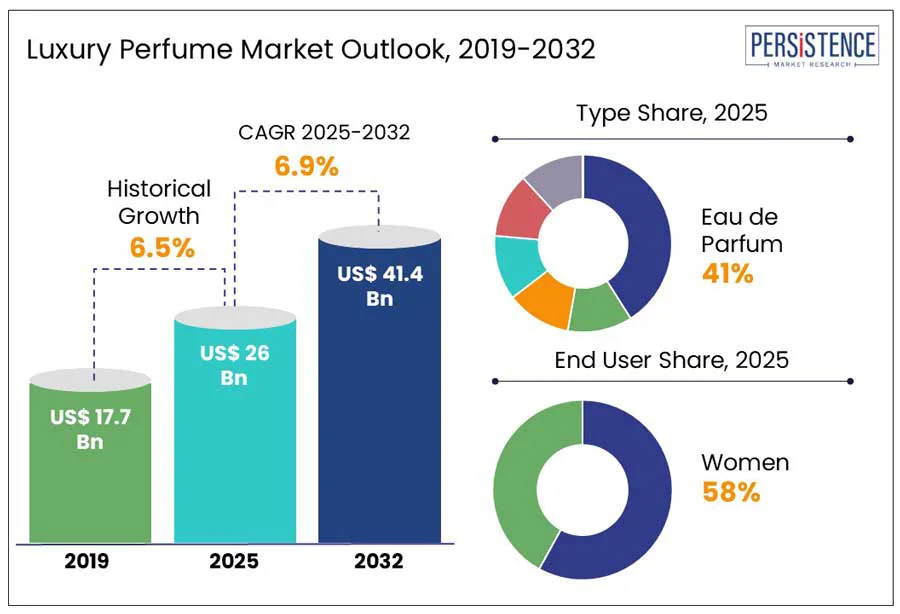
The global luxury perfume market size is anticipated to rise from US$ 26 Bn in 2025 to US$ 41.4 Bn by 2032. It is projected to witness a CAGR of 6.9% from 2025 to 2032. According to the Persistence Market Research report, the industry is captivating consumers with its blend of exclusivity, artistry, and sensory allure. As preferences shift toward personalized, sustainable, and emotion-driven scents, high-end fragrance brands are fast-evolving. This market thrives on storytelling, craftsmanship, and rising global demand for unique olfactory experiences that define personal identity.
Key Industry Highlights:
- Consumers prefer Eau de Parfum for its balance of longevity and intensity, making it the most commonly purchased luxury fragrance type.
- Traditional attars and concentrated oils are seeing renewed interest, especially in regions with a cultural affinity for rich, and lasting scents.
- Female consumers account for a majority of purchases, especially in premium designer and gifting categories.
- In-store experiences, personal consultations, and luxury ambiance keep department stores and boutiques central to high-end perfume sales.
- Europe dominates due to heritage brands and mature markets, while rising affluence and Western lifestyle adoption fuel demand in Asia Pacific.
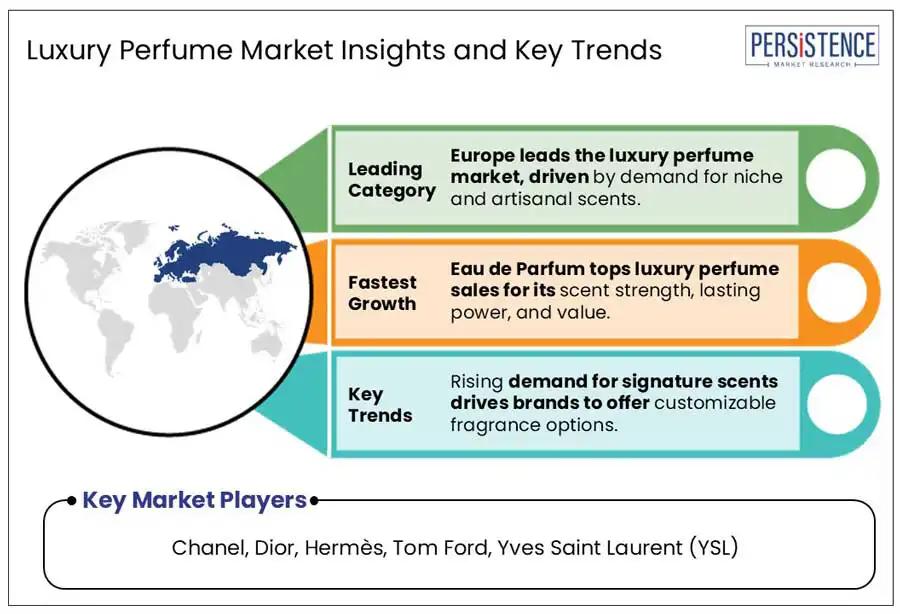
- Consumers increasingly seek bespoke and signature scents, prompting brands to offer customizable fragrance experiences.
|
Global Market Attribute |
Key Insights |
|
Luxury Perfume Market Size (2025E) |
US$ 26 Bn |
|
Market Value Forecast (2032F) |
US$ 41.4 Bn |
|
Projected Growth (CAGR 2025 to 2032) |
6.9% |
|
Historical Market Growth (CAGR 2019 to 2024) |
6.5% |
Market Dynamics
Drivers - Rising disposable incomes and evolving lifestyle aspirations have led to increased consumer demand for the luxury perfume segment
Today’s consumers are redefining the value of luxury perfumes, placing greater emphasis on quality, craftsmanship, and authenticity. They increasingly seek fragrances crafted with rare, natural ingredients and produced through meticulous processes that reflect artistry and heritage. Perfumes are no longer viewed merely as fashion accessories; they have become powerful tools for self-expression and extensions of personal identity. This shift has spurred growing demand for niche, artisanal, and indie fragrance brands that offer distinct, curated, and often customizable scent profiles. Social media platforms such as Instagram and TikTok, along with celebrity endorsements, play a pivotal role in shaping trends and guiding consumer preferences.
- According to a report by Circana, TikTok ranks as the second-most popular platform influencing fragrance purchases across all shoppers, driven notably by Gen Z and Millennials.
- In September 2024, Dior unveiled a new chapter for its iconic J'adore fragrance by appointing Rihanna as the brand's ambassador, succeeding Charlize Theron after her 20-year tenure. The campaign, directed by Steven Klein and set in the opulent Palace of Versailles, features Rihanna embodying the essence of J'adore in a golden corseted gown, symbolizing a fusion of modernity and timeless elegance.
These platforms not only amplify brand visibility but also foster aspirational appeal, particularly among younger consumers seeking status, uniqueness, and immersive olfactory experiences.
Restraints - High product prices and the presence of counterfeit luxury fragrances limit market expansion, particularly in price-sensitive regions
High product prices remain a major barrier to the expansion of the luxury perfume market, especially in price-sensitive regions such as parts of Asia, Africa, and Latin America. Many consumers in these markets are unable or unwilling to spend on premium fragrances due to economic constraints or competing spending priorities. Additionally, the widespread availability of counterfeit luxury perfumes poses a significant challenge. These imitations often sell at a fraction of the cost, attracting budget-conscious buyers and undermining brand value and consumer trust. Combined, these factors restrict broader market penetration and limit growth opportunities for authentic luxury fragrance brands.
Opportunity - A growing opportunity for luxury perfume brands to tap into the rising demand for affordable luxury, particularly in emerging markets
As global consumers increasingly gain purchasing power and exposure to international trends, there is a growing demand for aspirational yet accessible luxury goods. This shift presents a valuable opportunity for luxury perfume brands to launch smaller-sized bottles, travel formats, and entry-level luxury lines that attract younger audiences and first-time buyers. These formats offer affordability without compromising the brand’s exclusivity.
- Guerlain has expanded its iconic La Petite Robe Noire fragrance line by introducing a 20ml version, known as Le Flacon Coeur. This heart-shaped bottle is designed to be refillable, aligning with Guerlain's commitment to sustainability. The smaller size caters to consumers seeking portability and affordability without compromising on luxury.
- Bella Hadid introduced her fragrance brand, Orebella, to the UK market with an exclusive debut at Selfridges in London. The line includes four scents available in travel-sized 10ml bottles priced at £32, making luxury fragrances more accessible to a broader audience.
Tailoring scents to align with diverse cultural preferences and leveraging localized influencer marketing strategies can enhance consumer engagement worldwide. By adapting to evolving global consumer behavior, brands can broaden their reach and solidify their presence in both mature and emerging markets.
Category Wise Analysis
Type Insights
Eau de Parfum (EDP) leads global luxury perfume demand due to its ideal balance of fragrance concentration, longevity, and affordability compared to Parfum. With a concentration typically ranging from 15–20%, EDP offers long-lasting scent without overpowering, making it suitable for daily and special-occasion use. Consumers appreciate its strong yet wearable profile, which provides value for money, especially in mid- to high-tier luxury segments. Its versatility appeals across age groups and genders, and many brands prioritize EDP in their flagship lines. As a result, Eau de Parfum consistently dominates both retail sales and new product launches in the fragrance market.
- In April 2025, Vera Wang introduced "Love" Eau de Parfum, a fragrance celebrating commitment and romance. This scent combines mandarin, pink pepper, blackcurrant, tuberose, jasmine sambac, amber woods, and a unique Queen of the Night floral note.
- Dior collaborated with perfumer Francis Kurkdjian to reinvent the classic Miss Dior fragrance in 2024. This new Eau de Parfum offers a refined floral composition, featuring jasmine essence subtly complemented by hints of mandarin.
End-user Insights
Women continue to represent the dominant end-user segment in the luxury perfume market, driven by both personal use and gift-related purchases. Established luxury brands often center their marketing strategies and product innovations around female consumers, recognizing their strong preference for high-end fragrances as part of self-expression and identity. The tradition of gifting perfumes to women during holidays, birthdays, anniversaries, and other special occasions further strengthens this segment’s dominance. Additionally, women tend to explore diverse scent profiles, from florals to orientals, driving variety and volume in product offerings. This consistent demand ensures women remain a primary focus for luxury fragrance brands.
In April 2025, Jimmy Choo introduced a new fragrance designed to embody luxury and empowerment for the modern woman. This launch reflects the brand's commitment to celebrating femininity and confidence through sophisticated scent profiles, reinforcing its position in the high-end fragrance market.
Regional Insights
North America Luxury Perfume Market Trends
In the North American luxury fragrance market, personalization and limited-edition releases are increasingly influential in shaping consumer preferences and driving brand loyalty. Consumers are seeking fragrances that reflect their individuality, pushing brands to offer bespoke scent options, customized packaging, and curated shopping experiences. Limited-edition launches create urgency and exclusivity, appealing to collectors and fragrance enthusiasts who desire uniqueness.
In December 2024, Dolly Parton launched the Crystal Edition Parfum through her brand, Dolly Beauty. This limited-edition fragrance release was restricted to just 1,946 individually numbered bottles. Each bottle is crafted from solid crystal and adorned with a rhinestone-studded butterfly cap, reflecting the singer's signature style.
These strategies foster deeper emotional connections between consumers and brands, enhancing perceived value. Luxury houses such as Jo Malone and Le Labo have successfully leveraged personalization while brands such as Tom Ford and Maison Margiela frequently release exclusive editions that quickly become cult favorites.
Europe Luxury Perfume Market Trends
Europe poses as a dominant market in the global luxury perfume industry, with growing demand fueled by niche and artisanal fragrance houses. Consumers across the region are increasingly drawn to products that emphasize authenticity, craftsmanship, and heritage. European buyers tend to value sophisticated, story-driven scent compositions over mass-produced alternatives, leading to the rise of small-batch perfumers and heritage brands rooted in traditional techniques.
- Hermès launched Oudh Alezan, a unisex luxury perfume created from eaglewood, infused with rose water and rose oxide. Available in three sizes, this release underscores Hermès' commitment to artisanal craftsmanship.
- Rabanne introduced "La Collection," an eight-piece fine fragrance range, marking its most ambitious move in luxury perfumery. Priced at USD 315 for a 125ml bottle, the collection caters to niche customers seeking exclusivity.
Countries like France and Italy continue to be major influencers, not only for their historical significance in perfumery but also for housing many premium fragrance maisons. This refined consumer taste solidifies Europe’s leadership in the luxury perfume market.
Asia Pacific Luxury Perfume Market Trends
Rapid urbanization and the growing influence of Western lifestyles are significantly propelling the growth of the luxury perfume market across major Asia Pacific economies. As more consumers in countries like China, India, and Southeast Asian nations move to urban centers, they gain increased exposure to global fashion and beauty standards. Western cultural values, including personal grooming and the use of premium fragrances, are becoming aspirational benchmarks.
- In June 2024, Brunello Cucinelli expanded into China’s luxury fragrance market with its first perfume collection, crafted by perfumer Daphné Bugey. This move caters to the rising demand for high-end beauty products in China.
- In April 2024, Baccarose launched "Eternal Journey," a gender-fluid fragrance line created with DJ Pierre Ravan. Inspired by the KaRavan concept, the collection aims to provide transformative olfactory experiences in the Indian luxury market.
This shift, combined with rising disposable incomes and a young, brand-conscious population, is creating fertile ground for luxury perfume brands. The demand is particularly strong for global and niche labels offering prestige, quality, and exclusivity.
Competitive Landscape
The global luxury perfume market is highly competitive, marked by innovation, heritage branding, and growing consumer preference for personalized fragrances. Key players compete on elements such as product exclusivity, quality of ingredients, artisanal craftsmanship, and brand storytelling. Companies are increasingly investing in digital marketing, influencer collaborations, and immersive retail experiences to capture consumer interest.
The rise of niche and indie perfume labels is intensifying competition, especially among younger demographics seeking authenticity. Expansion into emerging markets through localized offerings and smaller packaging formats has become a strategic focus. Sustainability and cruelty-free formulations are also emerging as critical differentiators in this space.
Key Industry Developments
- In May 2025, Maison Francis Kurkdjian introduced "Kurky," which offers a playful blend of peach, raspberry, and vanilla. This fragrance exemplifies the brand's commitment to crafting scents that evoke joyful and vibrant emotions.
- In May 2025, Louis Vuitton launched "eLVes”, which combines floral notes with blackcurrant, peach, coconut milk, and Ambroxan. This fragrance reflects the brand's dedication to creating luxurious and contemporary scents.
- In May 2025, Bottega Veneta released Come With Me, which is a travel-sized perfume featuring notes of Italian bergamot and carrot seed. This launch aligns with the brand's minimalist aesthetic and caters to consumers seeking portable luxury fragrances.
Companies Covered in Luxury Perfume Market
- Chanel
- Dior
- Hermès
- Tom Ford
- Yves Saint Laurent (YSL)
- Gucci
- Creed
- Guerlain
- Valentino
- Maison Francis Kurkdjian
- Amouage
- Clive Christian
- Diptyque
- Le Labo
- Byredo
Frequently Asked Questions
The global luxury perfume market is projected to value at 26 bn in 2025.
The luxury perfume market is driven by rising disposable incomes and evolving lifestyles.
The luxury perfume market is poised to witness a CAGR of 6.9% between 2025 and 2032
Rising demand for affordable luxury, particularly in emerging markets, is the key market opportunity.
Major players in the luxury perfume market include Chanel, Dior, Hermès, Tom Ford, Yves Saint Laurent (YSL), and others.


