Lip Care Products Market Size, Share, Growth, and Regional Forecast for 2025 – 2032

Lip Care Products Market by Product Type (Lip Oil, Lip Gloss, Lip Balm, Lip Scrub, and Others), Ingredient Type (Natural, Synthetic, and Medicated), End-user, Distribution Channel, and Regional Analysis for 2025-2032

ID: PMRREP35360
Calendar

May 2025

190 Pages

Author : Vaishnavi Patil

PreviewSegmentation

Lip Care Products Market Share Analysis

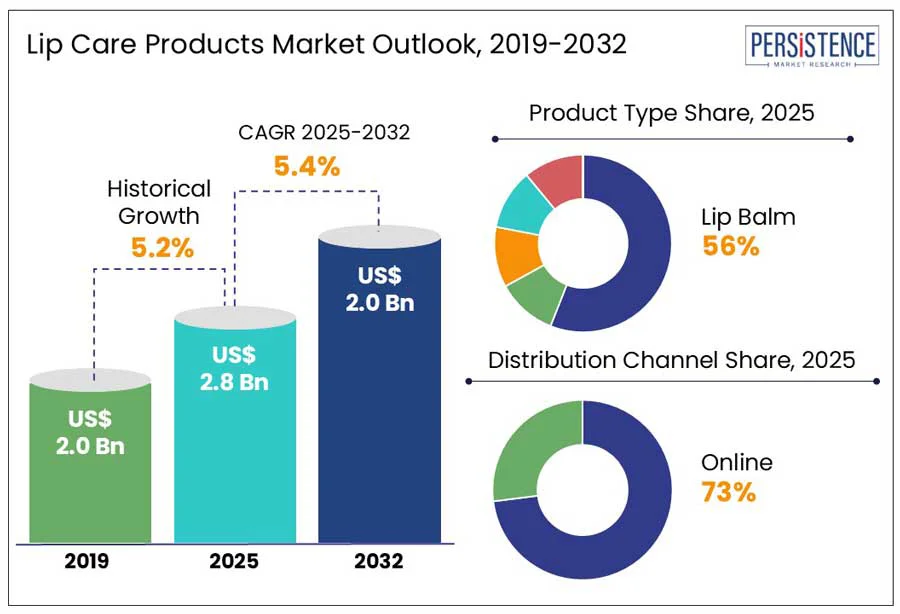
The global lip care products market size is anticipated to rise from US$ 2.8 Bn in 2025 to US$ 4.1 Bn by 2032. It is projected to witness a CAGR of 5.9% from 2025 to 2032. According to the Persistence Market Research report, the industry is booming as consumers seek products that offer hydration, protection, and beauty. With increasing demand for natural, eco-friendly ingredients and multifunctional formulas, lip balms, oils, and glosses are evolving. Innovations in skincare and cosmetic benefits are driving the market's continuous growth and transformation. 

lip care products market outlook, 2019-2032

Key Industry Highlights

  • Consumers are increasingly favoring lip care products with natural and organic ingredients, driven by a preference for eco-friendly and sustainable options.
  • Lip balms remain the dominant product segment, accounting for over 50% of global sales, with a focus on moisturizing and tinted variants.
  • Lip oils have gained significant traction, experiencing popularity, as consumers seek lightweight, hydrating products with a glossy finish.
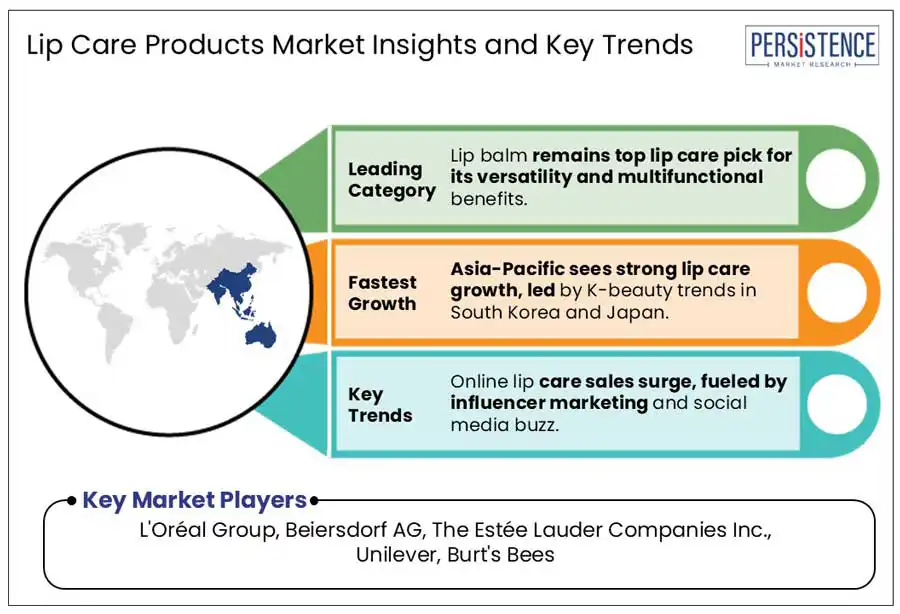
  • Online sales of lip care products have surged, driven by influencer marketing and social media recommendations.
  • Asia Pacific is witnessing significant growth, with the increasing adoption of lip care products, particularly in countries such as South Korea and Japan, driven by the K-beauty trend.

Global Market Attribute

Key Insights

Lip Care Products Market Size (2025E)

US$ 2.8 Bn

Market Value Forecast (2032F)

US$ 4.1 Bn

Projected Growth (CAGR 2025 to 2032)

5.9%

Historical Market Growth (CAGR 2019 to 2024)

5.4%

Market Dynamics

Drivers - Rising awareness of daily lip protection against sun and pollution is driving demand for SPF lip care products

As consumers become aware of the importance of lip protection against UV radiation and environmental pollutants, the demand for SPF-enriched lip care products is increasing. These products, including balms, glosses, and oils, offer dual benefits by providing deep hydration while protecting the lips from sun damage, premature aging, and pigmentation. Exposure to UV rays, coupled with air pollution in urban areas, is driving this trend, prompting consumers to seek lip care solutions that combine beauty and protection. The growing focus on skin health and sun safety is particularly evident in regions such as North America and Asia Pacific, where sun exposure is significant.

In September 2024, Brinton launched the UV Doux Lip Lightening Balm in India. Formulated with almond oil, hydrogenated olive oil, and SPF 40, it reduces pigmentation and protects lips from sun damage. It also includes Vitamin E and grape seed oil for antioxidant protection.

Dot & Key introduced its Barrier Repair Hydrating Lip Balm with SPF 50 in October 2024. This balm offers high sun protection with five essential ceramides, shea butter, and avocado oil. It is available in four fruity variants and is PA+++ rated, ensuring both hydration and UV protection.

Restraint - Synthetic ingredient concerns and allergic reactions are restraining consumer trust in non-organic lip care formulations

Synthetic ingredients in lip care products pose a notable restraint for market growth due to rising consumer concerns about their safety. Many commonly used chemicals, such as parabens, phthalates, and artificial fragrances, are associated with allergic reactions, skin irritation, and sensitivities, particularly on the delicate lip area. Studies reveal that 15-20% of cases of contact allergy are caused due to lipsticks and lip balms, which are the most commonly used lip cosmetics frequently seen in females.

This has led to growing apprehension among consumers, who are increasingly scrutinizing ingredient labels and expressing distrust toward non-organic formulations. Reports of allergic contact cheilitis and adverse skin reactions from synthetic compounds further discourage consumers from purchasing such products, especially those with sensitive skin. This widespread concern continues to challenge the adoption of synthetic lip care products.

Opportunity - Growing demand for gender-neutral and age-inclusive lip care lines offers new branding and formulation opportunities

Modern consumers are increasingly moving away from traditional beauty standards that segment products by gender or age, instead embracing inclusivity in their personal care routines. This evolving mindset has opened up opportunities for brands to develop gender-neutral and age-inclusive lip care lines that resonate with a broader, more diverse audience. Products that focus on universal concerns such as dryness, sun protection, or environmental damage appeal to all demographics regardless of gender or age. This inclusivity trend is especially strong among Gen Z and millennials, who value authenticity, diversity, and social awareness.

The Aesop Protective Lip Balm SPF30 is a recently launched, gender-neutral lip care product designed to protect lips from UV damage. Infused with botanical oils, it provides hydration, nourishment, and a delightful fragrance while offering broad-spectrum UVA/UVB protection.

Category Wise Insights

Product Type Insights

Lip balm continues to be the most widely used lip care product due to its versatility and multifunctional benefits. It serves as a moisturizer, providing essential hydration to dry and chapped lips and acts as a protective barrier against harsh weather conditions and environmental stressors. Additionally, many lip balms now include added features such as SPF protection, anti-aging properties, and soothing ingredients, such as botanical oils and vitamins. With its compact size and ease of use, lip balm appeals to a broad range of consumers, making it an essential part of daily personal care routines.

In 2024, LANEIGE Glaze Craze Tinted Lip Serum launched two new shades, expanding its popular collection. These additions offer enhanced hydration and a glossy finish, catering to diverse preferences. The lip serums are available for purchase online, providing a fresh option for lip care enthusiasts.

Aesop launched the Protective Lip Balm SPF30, designed to protect and hydrate lips. It contains UVA and UVB filters to shield lips from the sun's rays, while botanical oils soften, hydrate, and nourish.

Distribution Channel Insights

Online platforms have become the leading distribution channels for lip care products, largely due to influencer marketing and the convenience they offer consumers. The growing influence of beauty influencers on social media drives consumer interest in niche, organic, and eco-friendly brands.

Australian brand Lano has gained significant popularity through Instagram influencer campaigns. Their lip balms, known for being natural and cruelty-free, are marketed through visually engaging content.

These platforms allow brands to engage with a global audience directly, offering easy access to a variety of products that may not be available in physical stores. As consumers increasingly prioritize convenience and product authenticity, online shopping is the preferred method for purchasing lip care items, especially those with natural or organic ingredients.

lip care products market insights and key trend

Regional Insights

North America Lip Care Products Market Trends

In North America, lip care products relay skincare benefits, such as anti-aging, deep hydration, and barrier repair, have gained traction. Consumers are increasingly seeking multifunctional products that enhance appearance and provide long-term lip health. Brands are responding with formulations containing ingredients such as hyaluronic acid, peptides, and ceramides, which are traditionally used in facial skincare.

In April 2024, Clarins launched the Hydra-Essentiel [HA + Peptide] Moisture Replenishing Lip Balm, a product designed to hydrate, smooth, and visibly plump lips in just 60 seconds. Enriched with hyaluronic acid, plumping peptides, and organic cocoa butter, it provides 24-hour hydration with a single application.

This reflects a broader shift in trend toward holistic beauty routines, where lips are treated with equal care. The demand is particularly strong among aging population and skincare-savvy young consumers looking for preventive care in daily lip products.

Europe Lip Care Products Market Trends

In European markets, rising regulatory scrutiny and consumer demand for ingredient transparency are driving the shift toward certified organic lip care products. With strict EU regulations on cosmetic safety and labeling, consumers are becoming more aware of what goes into their products and are actively seeking certifications such as Cosmos and Ecocert.

In 2023, more than 50% of UK beauty and personal care product launches featured ethical and environmental claims, underscoring a significant shift towards sustainability in the industry.

A.P.C. launched its COSMO M81002 Lip Balm, certified Cosmos Organic by Ecocert. This nourishing lip balm is subtly scented with orange blossom and comes in a 15ml recyclable tube made from recycled materials. It is formulated with 100% natural ingredients and carries a Yuka rating of 93/100, reflecting its commitment to clean beauty standards.

This reflects a broader preference for clean beauty, free from synthetic chemicals, parabens, and artificial fragrances. Brands offering verifiable organic formulations are gaining trust and market traction. As a result, manufacturers are reformulating products and highlighting organic credentials to align with the growing demand for safe, ethical, and sustainable lip care solutions.

Asia Pacific Lip Care Products Market Trends

In Asia Pacific, the lip care products industry is driven by the growing popularity of K-beauty and increasing consumer interest in skincare. Consumers are increasingly integrating specialized lip care steps into their nightly regimens, mirroring Korean skincare practices. Products like hydrating lip sleeping masks enriched with ingredients such as hyaluronic acid, vitamin E, and fruit extracts are witnessing rising adoption.

Laneige's Lip Sleeping Mask, enriched with hyaluronic acid, vitamin C, and antioxidants from fruit extracts, has recently gained significant attention. This nourishing overnight lip mask delivers intense moisture and antioxidants.

In November 2024, Loops Beauty, a renowned K-beauty brand, expanded into the lip care category with the launch of the Dew Cloud Ultra Hydrating Lip Mask. The product is developed in South Korea, designed to provide intense hydration and nourishment, addressing common skin concerns such as dryness and pollution damage.

This trend is particularly strong among younger consumers who value comprehensive, preventative skincare. Additionally, the influence of social media and beauty influencers is accelerating the adoption of new lip care trends and innovation across the region.

Competitive Landscape

The global lip care products market is characterized by high product innovation, intense brand positioning, and increasing focus on natural formulations. Companies are differentiating through multifunctional products, such as tinted balms with SPF and skincare-infused lip treatments. Clean beauty claims, sustainable packaging, and gender-neutral branding have become key competitive factors. Players are also leveraging digital platforms and influencer marketing to engage younger consumers. Entry of niche and indie brands has intensified competition, particularly in the organic and vegan segments. Overall, the market is dynamic, with rapid adaptation to consumer trends and regulations driving brand strategies.

Key Industry Developments

  • In April 2025, LANEIGE expanded its popular Glaze Craze Tinted Lip Serum line by introducing two new shades: Blueberry Jelly and Strawberry Sprinkles. These additions continue the brand's theme of donut-inspired, high-shine lip serums that combine skincare benefits with vibrant color. The serums are formulated with polypeptides, argan ceramides, and polyglutamic acid to provide hydration and a plumping effect.  
  • In February 2025, Guerlain expanded its KissKiss Bee Glow Pearly lip balm collection by introducing six new shades in Japan. These honey-infused balms adapt to the lips' natural color, offering a personalized tint. The addition caters to consumers seeking both skincare benefits and subtle, customized lip color.
  • In April 2024, Aesop introduced its Protective Lip Balm SPF30, a vegan-friendly product designed to hydrate and shield lips from UVA and UVB rays. Formulated with botanical oils such as jojoba and sunflower seed, it offers deep nourishment while providing sun protection. The balm is free from animal-derived ingredients, aligning with clean beauty trends.

Companies Covered in Lip Care Products Market

  • L'Oréal Group
  • Beiersdorf AG
  • The Estée Lauder Companies Inc.
  • Unilever
  • Burt's Bees
  • Procter & Gamble Co. (P&G)
  • EOS (Evolution of Smooth)
  • Blistex Inc.
  • ChapStick
  • Kiehl’s
  • Himalaya Wellness
  • The Body Shop
  • Revlon Inc.
  • Avon Products Inc.
  • Carmex (Carma Laboratories Inc.)
Frequently Asked Questions

The global lip care products market is projected to value at 2.8 bn in 2025.

The lip care products market is driven by the rising awareness of daily lip protection against sun and pollution.

The lip care products market is poised to witness a CAGR of 5.9% between 2025 and 2032

Growing demand for gender-neutral and age-inclusive lip care lines offers key market opportunities.

Major players in the lip care products market include L'Oréal Group, Beiersdorf AG, The Estée Lauder Companies Inc., Unilever, Burt's Bees, and others.

Lip Care Products Market Report Scope

Report Attribute

Details

Historical Data/Actuals

2019 – 2024

Forecast Period

2025 – 2032

Market Analysis Units

Value: US$ Bn/Mn, Volume: As applicable

Geographical Coverage

  • North America
  • Europe
  • East Asia
  • South Asia and Oceania
  • Middle East and Africa
  • Latin America

Segmental Coverage

  • Product Type
  • Ingredient Type
  • Distribution Channel
  • Region

Competitive Analysis

  • L'Oréal Group
  • Beiersdorf AG
  • The Estée Lauder Companies Inc.
  • Unilever
  • Burt's Bees
  • Procter & Gamble Co. (P&G)
  • EOS (Evolution of Smooth)
  • Blistex Inc.
  • ChapStick
  • Kiehl’s
  • Himalaya Wellness
  • The Body Shop
  • Revlon Inc.
  • Avon Products Inc.
  • Carmex (Carma Laboratories Inc.)
  • Amorepacific Corporation

Report Highlights

  • Market Forecast and Trends
  • Competitive Intelligence & Share Analysis
  • Growth Factors and Challenges
  • Strategic Growth Initiatives
  • Pricing Analysis & Technology Roadmap
  • Future Opportunities and Revenue Pockets
  • Market Analysis Tools   

Customization and Pricing

Available upon request

Market Segmentation

By Product Type

  • Lip Oil
  • Lip Gloss
  • Lip Balm
  • Lip Scrub
  • Others

By Ingredient Type

  • Natural
  • Synthetic
  • Medicated

By End-user

  • Male
  • Female
  • Kids

By Distribution Channel

  • Online
  • Offline

By Region

  • North America
  • Europe
  • East Asia
  • South Asia and Oceania
  • Middle East and Africa
  • Latin America

Related Reports

1. Executive Summary

1.1. Global Lip Care Products Market Snapshot 2025 and 2032

1.2. Market Opportunity Assessment, 2025-2032, US$ Bn

1.3. Key Market Trends

1.4. Industry Developments and Key Market Events

1.5. Demand Side and Supply Side Analysis

1.6. PMR Analysis and Recommendations

2. Market Overview

2.1. Market Scope and Definitions

2.2. Value Chain Analysis

2.3. Macro-Economic Factors

2.3.1. Global GDP Outlook

2.3.2. Global Cosmetic Industry Overview

2.3.3. Global E-commerce Industry Overview

2.3.4. Global Skincare Industry Overview

2.4. Forecast Factors – Relevance and Impact

2.5. COVID-19 Impact Assessment

2.6. PESTLE Analysis

2.7. Porter's Five Forces Analysis

2.8. Geopolitical Tensions: Market Impact

2.9. Regulatory and Technology Landscape

3. Market Dynamics

3.1. Drivers

3.2. Restraints

3.3. Opportunities

3.4. Trends

4. Price Trend Analysis, 2019 – 2032

4.1. Region-wise Price Analysis

4.2. Price by Segments

4.3. Price Impact Factors

5. Global Lip Care Products Market Outlook: Historical (2019 – 2024) and Forecast (2025 – 2032)

5.1. Key Highlights

5.2. Global Lip Care Products Market Outlook: Product Type

5.2.1. Introduction/Key Findings

5.2.2. Historical Market Size (US$ Bn) and Volume (Units) Analysis by Product Type, 2019-2024

5.2.3. Current Market Size (US$ Bn) and Volume (Units) Forecast, by Product Type, 2025-2032

5.2.3.1. Lip Oil

5.2.3.2. Lip Gloss

5.2.3.3. Lip Balm

5.2.3.4. Lip Scrub

5.2.3.5. Others

5.2.4. Market Attractiveness Analysis: Product Type

5.3. Global Lip Care Products Market Outlook: Ingredient Type

5.3.1. Introduction/Key Findings

5.3.2. Historical Market Size (US$ Bn) and Volume (Units) Analysis by Ingredient Type, 2019-2024

5.3.3. Current Market Size (US$ Bn) and Volume (Units) Forecast, by Ingredient Type, 2025-2032

5.3.3.1. Natural

5.3.3.2. Synthetic

5.3.3.3. Medicated

5.3.4. Market Attractiveness Analysis: Ingredient Type

5.4. Global Lip Care Products Market Outlook: End User

5.4.1. Introduction/Key Findings

5.4.2. Historical Market Size (US$ Bn) and Volume (Units) Analysis by End User, 2019-2024

5.4.3. Current Market Size (US$ Bn) and Volume (Units) Forecast, by End User, 2025-2032

5.4.3.1. Male

5.4.3.2. Female

5.4.3.3. Kids

5.4.4. Market Attractiveness Analysis: End User

5.5. Global Lip Care Products Market Outlook: Distribution Channel

5.5.1. Introduction/Key Findings

5.5.2. Historical Market Size (US$ Bn) and Volume (Units) Analysis by Distribution Channel, 2019-2024

5.5.3. Current Market Size (US$ Bn) and Volume (Units) Forecast, by Distribution Channel, 2025-2032

5.5.3.1. Online

5.5.3.2. Offline

5.5.4. Market Attractiveness Analysis: Distribution Channel

6. Global Lip Care Products Market Outlook: Region

6.1. Key Highlights

6.2. Historical Market Size (US$ Bn) and Volume (Units) Analysis by Region, 2019-2024

6.3. Current Market Size (US$ Bn) and Volume (Units) Forecast, by Region, 2025-2032

6.3.1. North America

6.3.2. Europe

6.3.3. East Asia

6.3.4. South Asia & Oceania

6.3.5. Latin America

6.3.6. Middle East & Africa

6.4. Market Attractiveness Analysis: Region

7. North America Lip Care Products Market Outlook: Historical (2019 – 2024) and Forecast (2025 – 2032)

7.1. Key Highlights

7.2. Pricing Analysis

7.3. North America Market Size (US$ Bn) and Volume (Units) Forecast, by Country, 2025-2032

7.3.1. U.S.

7.3.2. Canada

7.4. North America Market Size (US$ Bn) and Volume (Units) Forecast, by Product Type, 2025-2032

7.4.1. Lip Oil

7.4.2. Lip Gloss

7.4.3. Lip Balm

7.4.4. Lip Scrub

7.4.5. Others

7.5. North America Market Size (US$ Bn) and Volume (Units) Forecast, by Ingredient Type, 2025-2032

7.5.1. Natural

7.5.2. Synthetic

7.5.3. Medicated

7.6. North America Market Size (US$ Bn) and Volume (Units) Forecast, by End User, 2025-2032

7.6.1. Male

7.6.2. Female

7.6.3. Kids

7.7. North America Market Size (US$ Bn) and Volume (Units) Forecast, by Distribution Channel, 2025-2032

7.7.1. Online

7.7.2. Offline

8. Europe Lip Care Products Market Outlook: Historical (2019 – 2024) and Forecast (2025 – 2032)

8.1. Key Highlights

8.2. Pricing Analysis

8.3. Europe Market Size (US$ Bn) and Volume (Units) Forecast, by Country, 2025-2032

8.3.1. Germany

8.3.2. Italy

8.3.3. France

8.3.4. U.K.

8.3.5. Spain

8.3.6. Russia

8.3.7. Rest of Europe

8.4. Europe Market Size (US$ Bn) and Volume (Units) Forecast, by Product Type, 2025-2032

8.4.1. Lip Oil

8.4.2. Lip Gloss

8.4.3. Lip Balm

8.4.4. Lip Scrub

8.4.5. Others

8.5. Europe Market Size (US$ Bn) and Volume (Units) Forecast, by Ingredient Type, 2025-2032

8.5.1. Natural

8.5.2. Synthetic

8.5.3. Medicated

8.6. Europe Market Size (US$ Bn) and Volume (Units) Forecast, by End User, 2025-2032

8.6.1. Male

8.6.2. Female

8.6.3. Kids

8.7. Europe Market Size (US$ Bn) and Volume (Units) Forecast, by Distribution Channel, 2025-2032

8.7.1. Online

8.7.2. Offline

9. East Asia Lip Care Products Market Outlook: Historical (2019 – 2024) and Forecast (2025 – 2032)

9.1. Key Highlights

9.2. Pricing Analysis

9.3. East Asia Market Size (US$ Bn) and Volume (Units) Forecast, by Country, 2025-2032

9.3.1. China

9.3.2. Japan

9.3.3. South Korea

9.4. East Asia Market Size (US$ Bn) and Volume (Units) Forecast, by Product Type, 2025-2032

9.4.1. Lip Oil

9.4.2. Lip Gloss

9.4.3. Lip Balm

9.4.4. Lip Scrub

9.4.5. Others

9.5. East Asia Market Size (US$ Bn) and Volume (Units) Forecast, by Ingredient Type, 2025-2032

9.5.1. Natural

9.5.2. Synthetic

9.5.3. Medicated

9.6. East Asia Market Size (US$ Bn) and Volume (Units) Forecast, by End User, 2025-2032

9.6.1. Male

9.6.2. Female

9.6.3. Kids

9.7. East Asia Market Size (US$ Bn) and Volume (Units) Forecast, by Distribution Channel, 2025-2032

9.7.1. Online

9.7.2. Offline

10. South Asia & Oceania Lip Care Products Market Outlook: Historical (2019 – 2024) and Forecast (2025 – 2032)

10.1. Key Highlights

10.2. Pricing Analysis

10.3. South Asia & Oceania Market Size (US$ Bn) and Volume (Units) Forecast, by Country, 2025-2032

10.3.1. India

10.3.2. Southeast Asia

10.3.3. ANZ

10.3.4. Rest of SAO

10.4. South Asia & Oceania Market Size (US$ Bn) and Volume (Units) Forecast, by Product Type, 2025-2032

10.4.1. Lip Oil

10.4.2. Lip Gloss

10.4.3. Lip Balm

10.4.4. Lip Scrub

10.4.5. Others

10.5. South Asia & Oceania Market Size (US$ Bn) and Volume (Units) Forecast, by Ingredient Type, 2025-2032

10.5.1. Natural

10.5.2. Synthetic

10.5.3. Medicated

10.6. South Asia & Oceania Market Size (US$ Bn) and Volume (Units) Forecast, by End User, 2025-2032

10.6.1. Male

10.6.2. Female

10.6.3. Kids

10.7. South Asia & Oceania Market Size (US$ Bn) and Volume (Units) Forecast, by Distribution Channel, 2025-2032

10.7.1. Online

10.7.2. Offline

11. Latin America Lip Care Products Market Outlook: Historical (2019 – 2024) and Forecast (2025 – 2032)

11.1. Key Highlights

11.2. Pricing Analysis

11.3. Latin America Market Size (US$ Bn) and Volume (Units) Forecast, by Country, 2025-2032

11.3.1. Brazil

11.3.2. Mexico

11.3.3. Rest of LATAM

11.4. Latin America Market Size (US$ Bn) and Volume (Units) Forecast, by Product Type, 2025-2032

11.4.1. Lip Oil

11.4.2. Lip Gloss

11.4.3. Lip Balm

11.4.4. Lip Scrub

11.4.5. Others

11.5. Latin America Market Size (US$ Bn) and Volume (Units) Forecast, by Ingredient Type, 2025-2032

11.5.1. Natural

11.5.2. Synthetic

11.5.3. Medicated

11.6. Latin America Market Size (US$ Bn) and Volume (Units) Forecast, by End User, 2025-2032

11.6.1. Male

11.6.2. Female

11.6.3. Kids

11.7. Latin America Market Size (US$ Bn) and Volume (Units) Forecast, by Distribution Channel, 2025-2032

11.7.1. Online

11.7.2. Offline

12. Middle East & Africa Lip Care Products Market Outlook: Historical (2019 – 2024) and Forecast (2025 – 2032)

12.1. Key Highlights

12.2. Pricing Analysis

12.3. Middle East & Africa Market Size (US$ Bn) and Volume (Units) Forecast, by Country, 2025-2032

12.3.1. GCC Countries

12.3.2. South Africa

12.3.3. Northern Africa

12.3.4. Rest of MEA

12.4. Middle East & Africa Market Size (US$ Bn) and Volume (Units) Forecast, by Product Type, 2025-2032

12.4.1. Lip Oil

12.4.2. Lip Gloss

12.4.3. Lip Balm

12.4.4. Lip Scrub

12.4.5. Others

12.5. Middle East & Africa Market Size (US$ Bn) and Volume (Units) Forecast, by Ingredient Type, 2025-2032

12.5.1. Natural

12.5.2. Synthetic

12.5.3. Medicated

12.6. Middle East & Africa Market Size (US$ Bn) and Volume (Units) Forecast, by End User, 2025-2032

12.6.1. Male

12.6.2. Female

12.6.3. Kids

12.7. Middle East & Africa Market Size (US$ Bn) and Volume (Units) Forecast, by Distribution Channel, 2025-2032

12.7.1. Online

12.7.2. Offline

13. Competition Landscape

13.1. Market Share Analysis, 2024

13.2. Market Structure

13.2.1. Competition Intensity Mapping

13.2.2. Competition Dashboard

13.3. Company Profiles

13.3.1. L'Oréal Group

13.3.1.1. Company Overview

13.3.1.2. Product Portfolio/Offerings

13.3.1.3. Key Financials

13.3.1.4. SWOT Analysis

13.3.1.5. Company Strategy and Key Developments

13.3.2. Beiersdorf AG

13.3.3. The Estée Lauder Companies Inc.

13.3.4. Unilever

13.3.5. Burt's Bees

13.3.6. Procter & Gamble Co. (P&G)

13.3.7. EOS (Evolution of Smooth)

13.3.8. Blistex Inc.

13.3.9. ChapStick

13.3.10. Kiehl’s

13.3.11. Himalaya Wellness

13.3.12. The Body Shop

13.3.13. Revlon Inc.

13.3.14. Avon Products Inc.

13.3.15. Carmex (Carma Laboratories Inc.)

14. Appendix

14.1. Research Methodology

14.2. Research Assumptions

14.3. Acronyms and Abbreviations

Research Methodology Framework for Market Research Excellence

At Persistence Market Research, we implement a comprehensive, validated, and multi-dimensional approachto market analysis that delivers actionable insights across complex market landscapes. Our methodology combines the analytical rigor of leading consulting firms with innovative research techniques, ensuring robust market assessments that guide strategic decision-making with confidence.

Core Research Philosophy

Our methodology is built on four foundational pillars:

Research Philosophy Image

At Persistence Market Research, our methodology is designed to transcend conventional market studies by combining analytical rigor, multi-source validation, and future-focused insights.

We integrate advanced research frameworks, robust data collection strategies, cutting-edge analytics, and innovative technologies to deliver a 360-degree view of complex markets.

We integrate advanced research frameworks, robust data collection strategies, cutting-edge analytics, and innovative technologies to deliver a 360-degree view of complex markets.

Each stage spanning from strategic scoping and hypothesis-building to competitive intelligence, quality validation, and actionable recommendations is engineered to provide clients with unmatched clarity, precision, and confidence in decision-making.

By embedding innovation and technology at the core, our approach ensures that insights are not only comprehensive but also predictive, empowering businesses to seize opportunities, mitigate risks, and achieve sustainable growth

Research Philosophy Image

Capturing Key Information and Events

During this phase, key research objectives focus on essential information and data points for assessing the market, including:

Research Philosophy Image

TAM-SAM-SOM Framework Implementation

We employ both top-down and bottom-up approaches to ensure accurate market sizing.

Top-Down Market SizingBottom-Up Market Sizing
Universe Definition: Total global/regional market identificationUnit Economics: Average transaction values, purchase frequencies, customer lifecycle
Segmentation Filters: Geographic, demographic, and behavioral constraintsCustomer Segmentation: Detailed buyer persona development and sizing
Market Share Analysis: Competitive landscape assessment and share allocationPenetration Analysis: Market penetration rates by segment and geography
Growth Rate Application: Historical trends and forward-looking growth assumptionsScaling Methodology: Extrapolation techniques with confidence intervals

Validation & Cross-Verification

  • Triangulation: Comparing top-down and bottom-up results for consistency
  • Sensitivity Analysis: Testing key assumptions and parameter variations
  • Peer Benchmarking: Comparison with analogous markets and industry benchmarks
  • Expert Review: External validation through industry specialist consultation

Research Philosophy Image

Forecasting & Projection Modeling

Our proprietary forecasting models incorporate multiple variables and scenarios.

Forecasting Components

  • Historical Trend Analysis: 10-year historical growth patterns and cyclical variations
  • Driver-Based Modeling: Economic indicators, demographic shifts, technology adoption
  • Scenario Planning: Base case, optimistic, and conservative projections
  • Monte Carlo Simulations: Probability-weighted outcomes and risk assessments

Model Validation

  • Back-Testing: Historical accuracy assessment over 3–5-year periods
  • Cross-Validation: Multiple modeling approaches for result comparison
  • External Benchmarking: Comparison with established market forecasts
  • Continuous Calibration: Quarterly model updates based on new data

Comprehensive Data Collection Strategy

Our secondary research phase establishes a robust knowledge base utilizing diverse, credible sources.

Secondary Data Sourcess

  • Industry Publications & Reports
  • Government & Regulatory Data
  • Financial Intelligence (filings & reports)
  • Academic Research & Digital Intelligence

Quality Assurance Protocol

  • Source credibility assessment and publication date validation
  • Data consistency checks across multiple sources
  • Bias identification and neutralization techniques
  • Information gap tracking for primary research prioritization

Research Philosophy Image

Primary Research Excellence

Our primary research methodology employs best-in-class techniques to capture unique market insights.

Quantitative Research Methods

  • Large-Scale Surveys: Statistically representative samples with 95% confidence intervals
  • Survey Methodology: Multi-channel deployment (online, telephone, in-person)
  • Question Architecture and Response Optimization

Qualitative Research Methods

  • Executive Interviews
  • Focus Groups
  • Expert Consultations

Quality Assurance & Validation Framework

Multi-Stage Validation Process

  • Source Verification and Consistency Testing
  • Outlier Detection and Bias Assessment
  • Peer Review Process and External Validation
  • Sensitivity Analysis and Confidence Intervals

Research Philosophy Image

Methodology Validation & Credibility

Our research methodology has been extensively validated through:

  • Academic Partnerships: Collaborations with top-tier business schools and research institutions
  • Client Success Stories: Documented case studies demonstrating research impact and ROI
  • Continuous Benchmarking: Performance comparison with leading global research firms

This comprehensive methodology framework positions Persistence Market Research at the forefront of market intelligence, combining the analytical sophistication of top-tier consulting firms with innovative research techniques. Our approach ensures that every market assessment delivers precise, actionable, and strategically valuable insights that drive business success in competitive market environments.

Ready to unlock your market potential? Contact our research experts to discuss how our validated methodology can transform your strategic decision-making with data-driven market intelligence.

Copyright © 2026 Persistence Market Research. All Rights Reserved

Connect With Us -
Table of Content - Lip Care Products Market Size, Share, Growth, and Regional Forecast for 2025 – 2032