




- Medical Devices
- Intubation Market
Intubation Market Size, Trends, Share, Growth, and Regional Forecast, 2026 to 2033
Intubation Market by Product (Airway Management Tubes, Intubation Accessories), Usage (Reusable, Disposable), End-user, and Regional Analysis from 2026 to 2033

Intubation Market Share and Trends Analysis
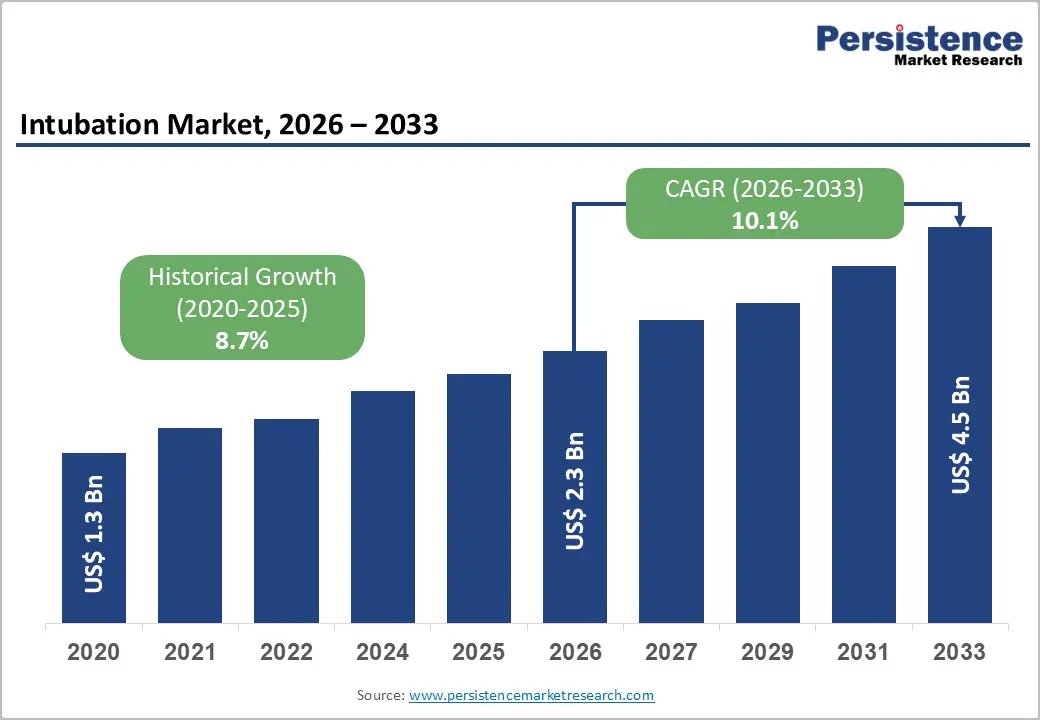
The global intubation market size is likely to be valued at US$2.3 billion in 2026 and projected to reach US$4.5 billion by 2033 growing at a CAGR of 10.1% during the forecast period from 2026 to 2033.
The intubation market forms a critical part of the global airway management landscape, supporting safe breathing during surgeries, emergency care, and intensive care treatment. It includes endotracheal tubes, laryngoscopes, supraglottic airway devices, and related accessories used across hospitals, ambulatory surgical centers, and emergency medical services. Market growth is driven by rising surgical volumes, increasing ICU admissions, trauma cases, and the growing prevalence of respiratory disorders. Technological advances such as video laryngoscopes and single-use devices are improving first-pass success rates and infection control. Emerging economies are witnessing faster adoption due to expanding healthcare infrastructure and improved access to critical care services.
Key Industry Highlights
- The increasing number of elective and emergency surgical procedures globally is a major driver of the intubation market.
- Rising ICU admissions due to respiratory diseases, sepsis, trauma, and post-operative complications continue to fuel intubation device usage.
- Video laryngoscopes are gaining strong traction due to higher first-pass success rates, better visualization, and reduced airway-related complications.
- Leading Product: Airway management tubes hold the highest share as they are essential for every intubation procedure and are used in large volumes across surgeries, ICUs, and emergency care.
- Leading Region: North America is the leading region as it has a large number of well-equipped hospitals, ICUs, and emergency care centers.
| Key Insights | Details |
|---|---|
| Intubation Market Size (2026E) | US$2.3 Bn |
| Market Value Forecast (2033F) | US$4.5 Bn |
| Projected Growth (CAGR 2026 to 2033) | 10.1% |
| Historical Market Growth (CAGR 2020 to 2025) | 8.7% |
Market Dynamics
Driver - Industry Acquisition and Development of Advanced Techniques for Management of Intubation Procedures
The intubation market is witnessing significant growth driven by the industry’s focus on acquisitions and the development of advanced techniques for airway management. Leading players are increasingly investing in mergers, acquisitions, and strategic partnerships to enhance their product portfolios, expand geographic presence, and integrate innovative technologies. Such initiatives enable companies to offer comprehensive airway management solutions, combining endotracheal tubes, video laryngoscopes, supraglottic airway devices, and specialized intubation accessories under a single brand.
Simultaneously, the development of advanced techniques including video-assisted intubation, optical stylets, anti-kink reinforced tubes, and ergonomically designed disposables is transforming procedural efficiency and patient safety. Video laryngoscopes, for instance, are reducing first-pass failure rates and facilitating management of difficult airways, while single-use devices help minimize cross-contamination and hospital-acquired infections. Continuous innovation in cuff technology, tube materials, and integrated monitoring systems is also improving clinical outcomes and procedural success rates across surgical, emergency, and ICU settings.
Furthermore, acquisitions allow companies to gain access to regional expertise, regulatory approvals, and R&D capabilities, accelerating the launch of next-generation airway solutions. By combining strategic growth initiatives with technological advancement, the industry is not only improving the standard of care but also reinforcing recurring revenue streams through consumables and disposable products. Overall, these efforts position the intubation market for sustained expansion globally, addressing both clinical needs and evolving healthcare infrastructure demands.
Restraints - Infection Risk in Reusable Devices
Reusable intubation devices, such as laryngoscope blades, endotracheal tube holders, and other airway accessories, carry a significant risk of hospital-acquired infections (HAIs) if not properly sterilized. These devices come into direct contact with the patient’s airway, saliva, and respiratory secretions, creating an environment conducive to microbial growth. Even with strict cleaning protocols, complex designs and hard-to-reach surfaces on blades or stylets can harbor bacteria, viruses, and fungi. Inadequate sterilization can lead to cross-contamination between patients, increasing the likelihood of respiratory infections, pneumonia, or sepsis, particularly in immunocompromised or critically ill patients. The challenge is further compounded in high-volume hospital settings where devices are reused multiple times daily, leaving little room for thorough sterilization between procedures.
Additionally, variability in sterilization techniques, differences in hospital compliance, and lack of standardized protocols across regions exacerbate the risk. This has prompted many healthcare providers to reconsider single-use or disposable devices as a safer alternative, which significantly reduces infection transmission. Regulatory authorities are increasingly emphasizing stringent disinfection standards, driving hospitals to invest in sterilization infrastructure or transition to disposable airway management solutions, but cost and environmental concerns remain barriers. The infection risk associated with reusable devices continues to be a major restraint on the growth and adoption of conventional intubation equipment.
Opportunity - Telemedicine & Remote Monitoring Integration
Telemedicine & remote monitoring integration presents a significant growth opportunity in the intubation market, driven by the increasing need for expert guidance in ICU, emergency, and remote care settings. Critical airway management often requires rapid, precise action, and not all healthcare facilities, particularly in rural or resource-limited areas, have access to highly trained anesthesiologists or airway specialists. Telemedicine-enabled intubation solutions enable remote clinicians to guide less-experienced staff in real-time, improving procedural success and reducing complications. Integration of cameras, sensors, and AI-assisted visualization can provide live feedback during intubation, ensuring correct tube placement and optimal ventilation. This capability is particularly valuable in pre-hospital care, ambulances, and smaller hospitals where airway expertise may be limited.
Additionally, telemedicine platforms can enable continuous monitoring of intubated patients in ICUs, alerting staff to issues such as tube displacement, airway obstruction, or cuff pressure irregularities, thereby enhancing patient safety. With the growing acceptance of digital health solutions and increasing investments in remote healthcare infrastructure globally, telemedicine-integrated airway management devices are poised to become a key differentiator for manufacturers. This opportunity not only expands market reach to underserved regions but also supports the trend toward safer, more efficient, and technology-driven critical care delivery.
Category-wise Analysis
By Product Insights
Airway Management Tubes account for the highest share in the intubation market due to their critical and non-substitutable role in airway management procedures. These tubes, including endotracheal, tracheostomy, reinforced, and double-lumen variants, are essential for ensuring a secure and patent airway during surgeries, mechanical ventilation, and emergency interventions. Unlike intubation accessories, which serve supportive functions, airway tubes are mandatory for every intubation procedure, resulting in consistent and high-volume usage.
Technological advancements in tube design have further strengthened their market dominance. Features such as improved cuff materials, anti-kink designs, preformed shapes, and anatomically optimized sizing enhance patient safety, reduce complications, and improve clinical efficiency. Additionally, the increasing preference for disposable and single-use tubes to minimize cross-contamination and infection risks has driven higher replacement rates, contributing to recurring demand and revenue generation.
Rising prevalence of respiratory disorders, increasing cases of trauma, and greater demand for surgical and critical care procedures globally further amplify the need for airway management tubes. Their adaptability across different patient populations, including adults, pediatrics, and specialized cases, ensures broad applicability.
Overall, the combination of mandatory usage in all intubations, technological innovation, disposability trends, and high procedural volume makes airway management tubes the largest and most revenue-generating product segment in the global intubation market.
By End-user Insights
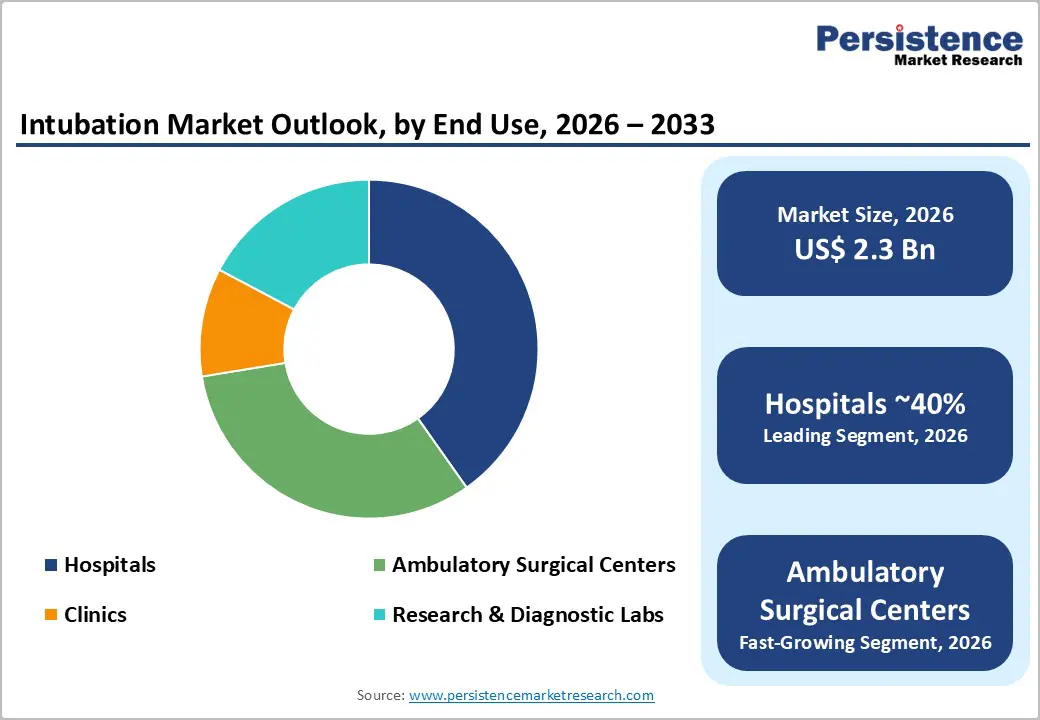
Hospitals account for the highest share in the intubation market among end-users due to their critical role in performing surgeries, managing emergencies, and providing intensive care. Hospitals have multiple departments, including operating rooms, ICUs, emergency units, and trauma centers, all of which require frequent use of airway management devices such as endotracheal tubes, laryngoscopes, and supraglottic airway devices. The sheer volume of procedures performed in hospitals, ranging from elective surgeries to critical emergency interventions, ensures consistent and high demand for intubation products.
Hospitals also employ a large number of trained anesthesiologists, critical care specialists, and respiratory therapists, which supports the use of advanced devices such as video laryngoscopes and specialized airway tubes. Additionally, hospitals are increasingly adopting single-use and disposable devices to minimize infection risk, further increasing product consumption. The integration of new technologies, continuous monitoring, and patient safety protocols in hospital settings drives the preference for high-quality, reliable airway management solutions.
Region-wise Insights
North America Intubation Trends
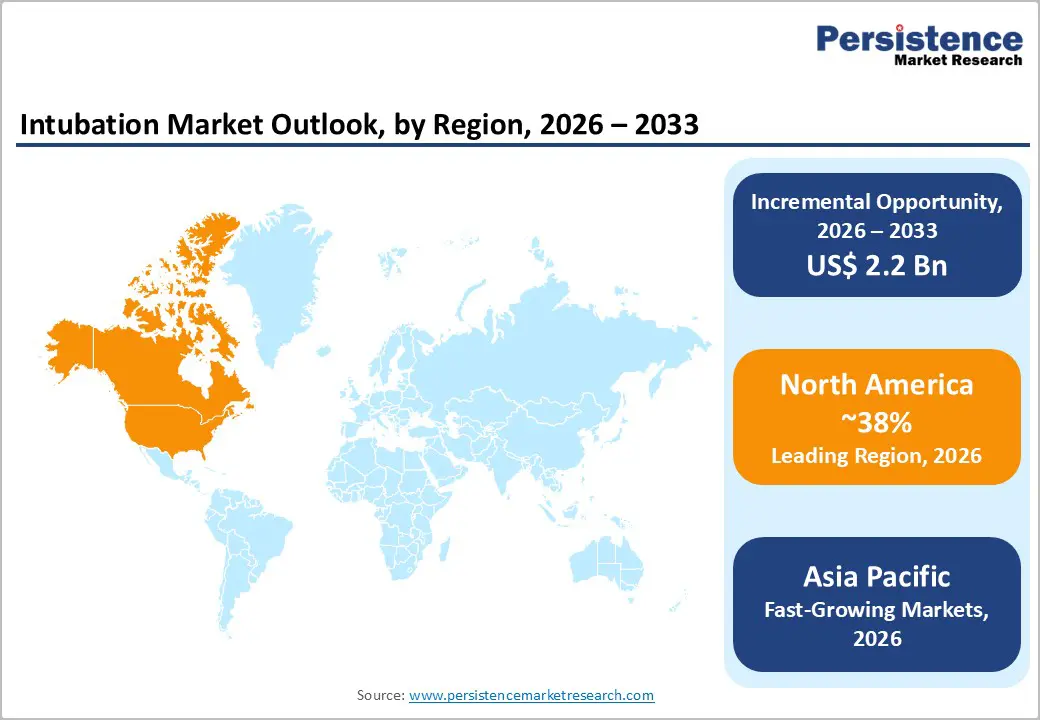
North America leads the global intubation market due to advanced healthcare infrastructure, high surgical volumes, and rapid adoption of innovative airway management technologies. Hospitals, ICUs, and emergency care centers in the region consistently rely on devices such as endotracheal tubes, video laryngoscopes, and supraglottic airway devices, while the shift toward single-use and disposable products is accelerating due to infection control priorities and stringent regulatory standards. Video laryngoscopy is increasingly preferred over traditional direct laryngoscopy, improving first-pass success rates and reducing airway-related complications.
In the U.S., high healthcare spending, favorable reimbursement policies, and strong hospital networks drive consistent demand for technologically advanced devices, including AI-assisted and telemedicine-integrated solutions. Rising ICU admissions, increasing surgical procedures, and a growing prevalence of chronic respiratory diseases further boost usage across both public and private healthcare facilities. The presence of major manufacturers, robust distribution channels, and continuous investment in clinician training and simulation programs support the adoption of cutting-edge airway management devices. Together, these factors ensure that North America, led by the U.S., maintains its leading position in the global intubation market, combining technology-driven innovation with high device utilization and safety-focused care.
Asia Pacific Intubation Market Trends
The Asia Pacific region is emerging as a high-growth market for intubation and airway management, driven by expanding healthcare infrastructure, increasing surgical volumes, and rising awareness of advanced airway care. Rapid urbanization, government initiatives to improve critical care access, and growing investments in hospitals and ICUs are creating strong demand for endotracheal tubes, supraglottic airway devices, and video laryngoscopes. Adoption of disposable and single-use devices is increasing to address infection control concerns, particularly in countries with high patient loads. Technological awareness among clinicians is rising, with hospitals gradually integrating video laryngoscopy and AI-assisted intubation tools to improve patient safety and procedural efficiency. Pre-hospital care and emergency services in urban centers are also contributing to device uptake, as portable airway solutions become more widely available.
Additionally, medical tourism and increasing healthcare expenditure in countries such as India, China, and Southeast Asia are expanding access to modern airway management technologies. The presence of both global manufacturers and emerging local players, along with cost-effective device solutions, further accelerates market growth. Overall, Asia Pacific represents a significant growth opportunity, combining infrastructure expansion, technological adoption, and rising clinical awareness to become a key emerging region in the global intubation market.
Competitive Landscape
The intubation market is moderately consolidated and highly competitive, driven by continuous innovation, product diversification, and technological advancement. Key players focus on expanding their airway management portfolios, launching disposable and single-use devices, and introducing advanced solutions such as video laryngoscopes, AI-assisted tools, and patient-specific tubes. Strategies such as partnerships with hospitals, clinician training programs, and geographic expansion are common to strengthen market presence. Competition is also fueled by the rising demand in emerging markets, where cost-effective and technologically advanced devices are gaining traction. Overall, innovation, product differentiation, and strategic collaborations define the competitive dynamics of the global intubation market.
Key Industry Developments:
- In April 2025, KARL STORZ launched the Slimline C-MAC® S single-use video laryngoscope for airway management. Designed to meet the same high-quality standards as other KARL STORZ products, the Slimline C-MAC S blade delivered clear visibility, enabling confident intubation even in the most challenging airway cases.
- In January 2025, 42 Technology (42T) launched an innovative, video-capable medical device at CES 2025 that was designed to improve the speed and safety of patient intubation during surgical procedures and emergency care.
Companies Covered in Intubation Market
- Medtronic
- Teleflex Incorporated
- Ambu A/S
- Smiths Medical (ICU Medical)
- Karl Storz
- Verathon Inc.
- Olympus Corporation
- Nihon Kohden Corporation
- Flexicare Medical
- Intersurgical Ltd.
- Vyaire Medical
- SunMed
- Henan Tuoren Medical Device
- P3 Medical
- Marshall Airway Products
- Others
Frequently Asked Questions
The global intubation market is projected to be valued at US$2.3 Bn in 2026.
The global intubation market is driven by the rising volume of surgical procedures, increasing ICU admissions, and growing incidence of respiratory disorders worldwide.
The global market is poised to witness a CAGR of 10.1% between 2026 and 2033.
Key market opportunities in the global intubation market include the expanding adoption of video laryngoscopes and advanced airway visualization technologies that improve first-pass success and patient safety.
Medtronic, Teleflex Incorporated, Ambu A/S, Smiths Medical (ICU Medical), and others.


