




- Retail
- Hyperlocal Services Market
Hyperlocal Services Market Size, Share, and Growth Forecast, 2026 - 2033
Hyperlocal Services Market by Service (On-demand Delivery, Pickup and Drop Services, Home Services, Others), Application (Grocery, Food & Beverages, Others), End-user (Individual Consumers, Others), and Regional Analysis for 2026 - 2033

Hyperlocal Services Market Size and Trends Analysis
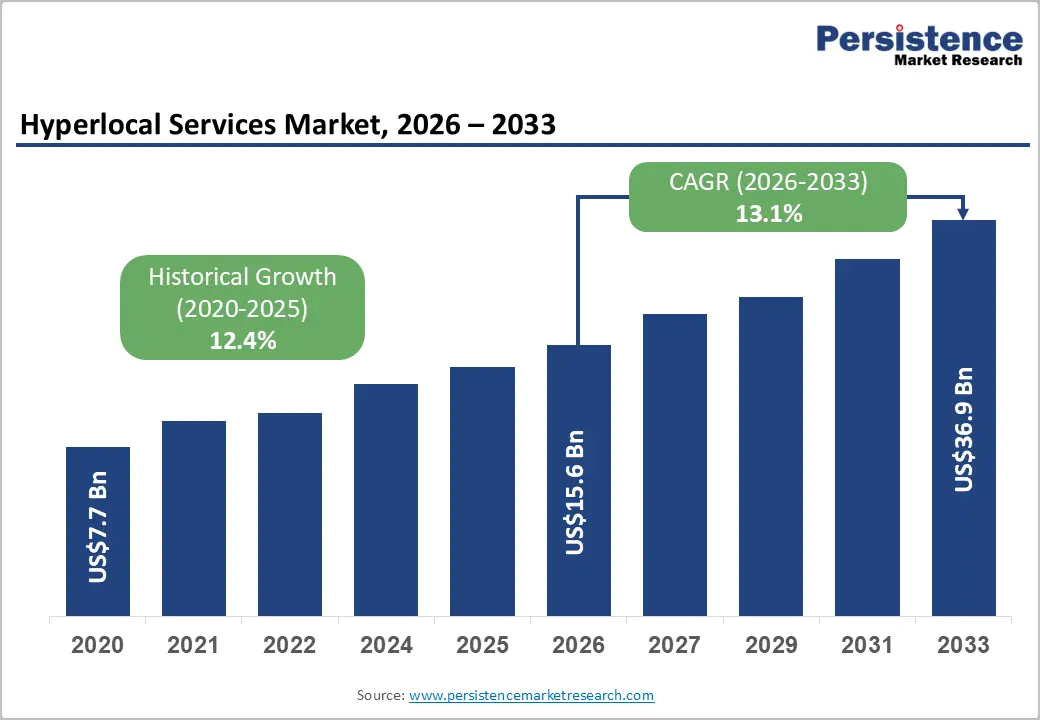
The global hyperlocal services market size is likely to be valued at US$15.6 billion in 2026, and is expected to reach US$36.9 billion by 2033, growing at a CAGR of 13.1% during the forecast period from 2026 to 2033, driven by the increasing adoption of on-demand platforms that connect consumers with nearby service providers and retailers within a defined geographic radius, typically between 1 and 10 kilometers. These platforms utilize real-time geolocation technologies, mobile applications, and efficient last-mile delivery networks to enable rapid fulfillment of goods and services, significantly enhancing convenience, speed, and accessibility for users.
The COVID-19 pandemic acted as a pivotal turning point for the hyperlocal services market, fundamentally reshaping consumer behavior toward proximity-based digital transactions. The widespread adoption of services such as online grocery delivery, food ordering, home-based services, and pharmacy deliveries during lockdowns has transitioned into long-term consumer habits, reflecting a sustained preference for convenience-driven, on-demand solutions rather than temporary reliance.
Key Industry Highlights:
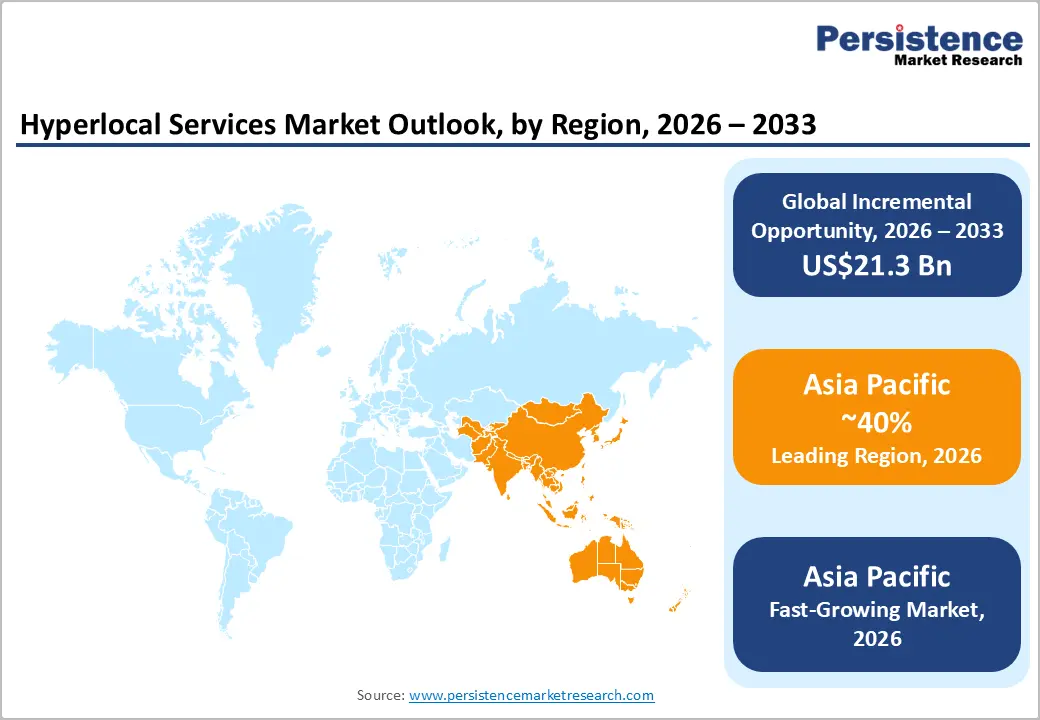
- Leading Region: Asia Pacific, anticipated to account for a 40% market share in 2026, driven by dense urban populations and strong digital adoption in India and China.
- Fastest-growing Region: Asia Pacific, fueled by expanding internet access, a growing middle class, and a rising on-demand economy.
- Dominant Service: On-demand delivery, to hold approximately 48% of the market share, due to the high frequency of grocery and food orders.
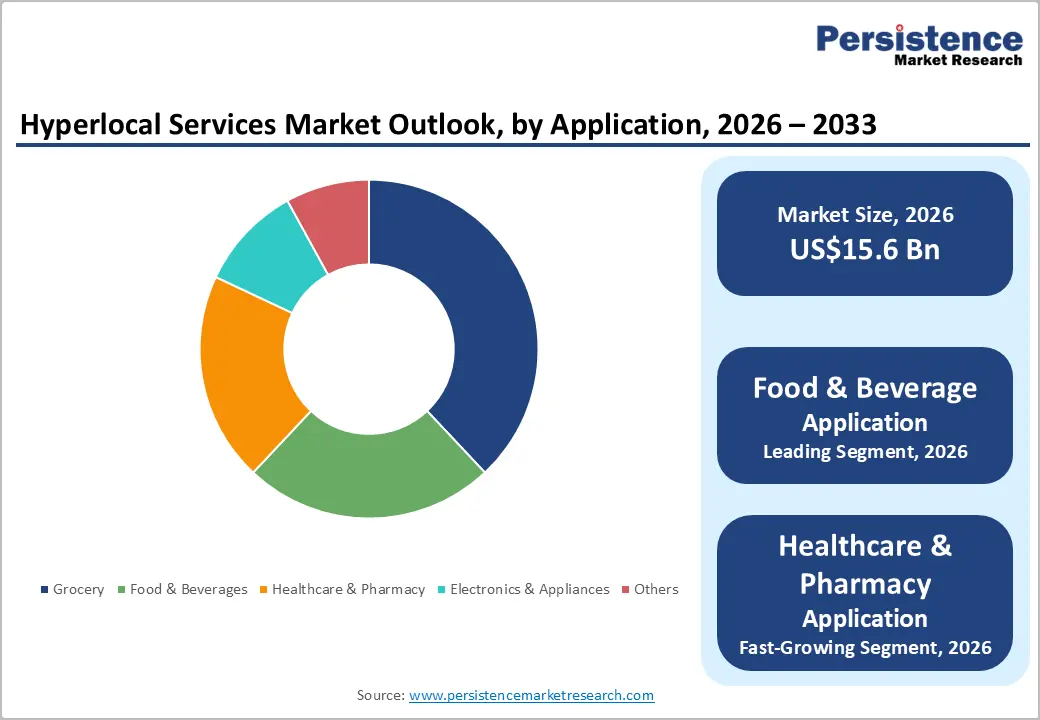
- Leading Application: Food & beverages are projected to dominate, holding the 38% of the share in 2026, fueled by their high order frequency and deeply ingrained consumer habits.
| Key Insights | Details |
|---|---|
|
Hyperlocal Services Market Size (2026E) |
US$15.6 Bn |
|
Market Value Forecast (2033F) |
US$36.9 Bn |
|
Projected Growth CAGR (2026-2033) |
13.1% |
|
Historical Market Growth (2020-2025) |
12.4% |
DRO Analysis
Driver - Smartphone Proliferation, Urban Density, and the Convenience Economy
The foundational infrastructure of the hyperlocal services market, smartphone penetration, and high-speed mobile internet have reached critical mass globally, creating an enormous addressable consumer base for on-demand platforms.
According to the International Telecommunication Union (ITU), global smartphone subscriptions exceeded 6 billion in 2024, while mobile internet penetration in urban areas across key emerging markets such as India, Indonesia, Brazil, and Nigeria has surpassed 74%. This widespread digital connectivity provides a strong foundation for the large-scale adoption of hyperlocal service platforms.
Urban population density is a direct accelerant of hyperlocal service economics. The United Nations Department of Economic and Social Affairs projects that 68% of the global population will reside in urban areas by 2050, up from 56% in 2021.
High-density urban environments compress delivery distances, improve logistics efficiency, and expand the viable addressable radius of hyperlocal platforms, directly enhancing unit economics. Cities with populations exceeding 1 million are experiencing the highest rates of hyperlocal platform adoption, as the proximity of supply (local restaurants, pharmacies, supermarkets) and demand (urban consumers) enables sub-30-minute delivery windows that redefine service standards.
Expanding Gig Economy and Technological Advancement in Last-Mile Logistics
The rapid expansion of the gig economy has enabled hyperlocal service platforms to build a scalable, asset-light delivery workforce that can be dynamically scaled with demand fluctuations. The International Labor Organization (ILO) estimates that gig workers constitute approximately 15% of the total workforce in advanced economies and an even higher proportion in emerging markets such as India (where gig workers exceed 7.7 million according to NITI Aayog projections for 2030). This abundant, flexible labor supply enables platforms to offer consistent service levels without the capital intensity of maintaining a fixed delivery workforce.
Concurrently, technological advances in last-mile logistics, including AI-powered route optimization, predictive demand forecasting, dark store micro-fulfillment networks, and drone-assisted delivery pilots, are compressing delivery times and reducing per-order logistics costs. Companies such as Zomato, Swiggy, and Instacart are deploying machine learning algorithms that predict demand at a hyperlocal pin-code level, enabling the prepositioning of inventory and delivery personnel that reduce average delivery times by 20–35%.
Uber Technologies' integration of its ride-hailing network with Uber Eats delivery creates a uniquely dense logistics fabric that competitors find difficult to replicate. These technological improvements simultaneously enhance consumer satisfaction and improve platform profitability, creating a virtuous cycle that sustains investment and competitive intensity in the sector.
Restraint - Thin Unit Economics, Profitability Challenges, and Regulatory Pressure on Gig Workers
Despite impressive topline growth, profitability remains an elusive goal for most hyperlocal service platforms. The business model is structurally characterized by high customer acquisition costs, heavy discounting, and promotional spending to drive adoption, and thin per-order margins that require enormous transaction volumes to generate positive operating leverage.
A significant proportion of leading hyperlocal platforms, including Swiggy and Zomato, reported operating losses for multiple consecutive years before achieving tentative profitability milestones, reflecting the intense competitive and cost pressures inherent in the model.
Regulatory scrutiny on gig worker classification and labor rights is intensifying globally. The European Union's Platform Work Directive, adopted in 2024, establishes a legal presumption of employment for platform workers, which, if broadly implemented, would significantly increase labor costs for delivery platforms operating across the EU. Similar legislative developments are emerging in the U.K., California, and multiple Indian states. These regulatory shifts threaten to structurally increase variable delivery costs, compressing margins and challenging the low-price positioning that drives consumer adoption.
Intense Market Fragmentation and Customer Loyalty Deficit
The hyperlocal services market is characterized by intense multi-player competition across service verticals, with low switching costs and minimal brand loyalty among price-sensitive consumer segments. Consumers routinely switch between platforms based on promotional offers, delivery fee structures, and real-time availability, creating a perpetual customer acquisition arms race that inflates marketing expenditures industry-wide.
In mature markets such as the U.S. and Western Europe, dominant platforms including Uber Eats, DoorDash, and Deliveroo compete for the same customer base with near-identical value propositions, leading to margin dilution and the commoditization of the delivery experience.
Market fragmentation is also pronounced across geographies, with local and regional players (Dunzo in India, housekeep in the U.K.) competing effectively against global platforms by offering superior local knowledge, language capabilities, and community trust attributes that global platforms struggle to replicate at hyperlocal granularity.
Opportunity - Quick Commerce (Q-Commerce) and 10-Minute Delivery Infrastructure
The emergence of quick commerce, characterized by delivery windows of 10 to 20 minutes, represents a transformational opportunity within the broader Hyperlocal Services Market. Q-commerce platforms are establishing dense networks of micro-fulfillment dark stores positioned within two to three kilometers of high-density residential areas, enabling ultra-fast delivery of everyday essentials. Platforms including Zepto (India), Getir (Turkey/Europe), and Blinkit (Zomato-owned, India) have pioneered this model and attracted significant venture capital investment exceeding US$3 billion globally between 2021 and 2024.
The Total Addressable Market (TAM) for Q-commerce within the Hyperlocal Services ecosystem is substantial. The global grocery market exceeds US$12 trillion annually, and even a 3–5% shift of impulse and top-up grocery purchases to Q-commerce platforms would represent a multi-hundred-billion-dollar incremental opportunity. As dark-store economics improve with scale and AI-driven inventory optimization, Q-commerce is poised to become the highest-growth subsegment of the hyperlocal services market.
Hyperlocal Services Expansion into Tier-2 and Tier-3 Cities in Emerging Markets
While hyperlocal platforms have achieved significant penetration in Tier-1 metropolitan markets, Tier-2 and Tier-3 cities in India, Indonesia, Vietnam, Nigeria, and Brazil represent a largely untapped and rapidly urbanizing consumer base. According to India's Ministry of Statistics, over 300 million internet users reside outside India's eight largest metropolitan areas, a consumer population with rising disposable incomes, improving digital literacy, and historically underserved access to organized retail and services.
Platforms that successfully adapt their operational models for lower-density, price-sensitive Tier-2/3 markets through localized pricing, regional language interfaces, cash-on-delivery payment options, and partnerships with local kirana (mom-and-pop) stores stand to capture enormous incremental market share. Swiggy and BigBasket have already initiated Tier-2 city expansion programs in India, while Delivery Hero SE is executing similar strategies across secondary cities in the Middle East and Southeast Asia.
Category-wise Analysis
Service Insights
On-demand delivery is anticipated to dominate with over 48% of the share in 2026. This segment encompasses food delivery, grocery delivery, express courier, and medicine delivery, all characterized by high transaction frequency, recurring consumer demand, and well-established platform ecosystems.
The dominance of on-demand delivery is reinforced by the network effects inherent in mature food delivery platforms: as Swiggy, Zomato, Grubhub, and Uber Eats accumulate restaurant and consumer density in urban markets, their delivery logistics become progressively more efficient, creating widening competitive moats. Zomato demonstrates strong network effects in the on-demand delivery segment. In major Indian cities such as Mumbai, Delhi, and Bangalore, Zomato has onboarded a vast number of restaurants, creating high supply density. This attracts a large and active user base due to greater choice and convenience.
Home services are likely to be the fastest-growing segment, driven by rising dual-income household penetration and increasing consumer willingness to outsource domestic tasks to vetted professional platforms such as Urban Company and Housekeep. Urban Company illustrates how home services are among the fastest-growing on-demand segments. Its instant home services vertical, InstaHelp, crossed 1 million monthly bookings in March 2026, highlighting rapid adoption for everyday household tasks such as cleaning, dishwashing, and laundry.
Application Insights
Food & beverages are projected to dominate, holding the 38% of share in 2026, fueled by their high order frequency and deeply ingrained consumer habits. Platforms such as Zomato and Swiggy benefit from daily or weekly usage patterns, as consumers increasingly rely on food delivery for convenience, time savings, and variety. The rise of cloud kitchens, quick commerce, and subscription models further strengthens engagement.
Zomato and Swiggy clearly demonstrate why food & beverages dominate the hyperlocal market, driven by high order frequency and strong consumer habits. In India, a large share of urban consumers order food once or twice a week, indicating habitual and recurring demand.
Healthcare & pharmacy is the fastest-growing application, supported by the critical need for timely access to medicines. Platforms such as Tata 1mg and PharmEasy enable doorstep delivery of prescription drugs, often within hours, addressing urgent and recurring medical needs. Rising prevalence of chronic diseases, increasing digital adoption, and post-pandemic preference for contactless services are accelerating demand. Tata 1mg demonstrates rapid growth in the healthcare & pharmacy segment, driven by demand for timely medicine delivery.
The platform offers same-day and next-day delivery of prescription medicines, diagnostics, and health products across major Indian cities. During and after the COVID-19 pandemic, online pharmacy adoption accelerated significantly as consumers prioritized convenience, reliability, and quick access to essential medicines.
Regional Insights
North America Hyperlocal Services Market Trends
The North America Hyperlocal Services market is experiencing dynamic growth, driven by increasing smartphone penetration, widespread internet connectivity, and rising consumer demand for instant, location-specific services delivered within minimal turnaround times. The U.S. leads regional market activity, supported by dense urban populations, advanced digital payment infrastructure, and a highly competitive on-demand service ecosystem.
Hyperlocal services encompass a broad spectrum of offerings including food and grocery delivery, home services, healthcare consultations, courier logistics, and local retail fulfillment, all operating within tightly defined geographic boundaries. The rapid proliferation of GPS-enabled mobile applications and real-time tracking technologies has fundamentally transformed consumer expectations, establishing speed, convenience, and personalization as primary service differentiators.
The COVID-19 pandemic served as a significant accelerator, permanently shifting consumer behavior toward local on-demand service consumption and compelling businesses to develop robust hyperlocal fulfillment capabilities. Artificial intelligence and machine learning integration is enabling sophisticated demand forecasting, dynamic pricing models, and optimized last-mile delivery routing across hyperlocal platforms. Key challenges including thin profit margins, high operational costs, driver retention, and intense platform competition continue to shape market dynamics.
Europe Hyperlocal Services Market Trends
Europe's hyperlocal market is characterized by high regulatory complexity, strong consumer protection frameworks, and significant variation in adoption maturity across member states, with Northwestern Europe (U.K., Netherlands, Germany, and France) significantly more advanced than Central and Eastern European markets.
Germany is the leading Continental European market for Hyperlocal Services, driven by its large urban population, high digital commerce adoption, and the strong presence of Delivery Hero SE, one of the world's largest food delivery and hyperlocal platforms, headquartered in Berlin. Delivery Hero's network spans 70+ countries, and its German-market operations through its Foodpanda and Foodora brands provide unparalleled regional coverage. Germany's manufacturing heartland is also driving B2B hyperlocal service demand, with SMEs in industrial cities deploying on-demand procurement and logistics platforms to manage supply chain agility.
France is the second-largest European hyperlocal market, where Deliveroo and Uber Eats compete alongside domestic players, and where the rapid expansion of Q-commerce platforms, particularly in Paris, has created one of Europe's most advanced ultra-fast delivery ecosystems. The Netherlands emerges as a key innovation hub, having birthed Picnic (rapid grocery delivery) and serving as a European headquarters for multiple global platforms. Spain and Italy are experiencing accelerating adoption, particularly in food delivery and mobile payments.
Asia Pacific Hyperlocal Services Market Trends
Asia Pacific is projected to be the dominating and fastest-growing regional market for hyperlocal services, accounting for over 40% of global revenues in 2026. The region's dominance reflects a unique convergence of favorable structural factors: massive urban populations, a young and digitally native consumer base, a deep and cost-competitive gig workforce, and rapidly expanding smartphone and 4G/5G connectivity.
India's hyperlocal services market is anchored by Swiggy and Zomato, two homegrown unicorns that have collectively transformed urban India's food delivery, grocery delivery (Swiggy Instamart, Blinkit), and home services ecosystems. Zomato's acquisition of Blinkit in 2022 for approximately US$478 million exemplifies the sector's consolidation trajectory toward integrated hyperlocal super-apps. BigBasket, majority-owned by Tata Digital, dominates online grocery with hyperlocal fulfillment from a network of dark stores across 30+ Indian cities. Dunzo pioneered the hyperlocal delivery model in India before pivoting toward a Q-commerce focus supported by a strategic partnership with Reliance Retail.
China maintains the world's largest absolute hyperlocal services market in terms of revenue, led by Meituan (food and grocery delivery), Eleme (Alibaba's food delivery platform), and JD Daojia (on-demand retail delivery). Japan and South Korea represent premium-tier hyperlocal markets characterized by high average order values, sophisticated logistics infrastructure, and growing demand for home services among aging urban populations.
Competitive Landscape
The global hyperlocal services market operates as a dynamic, multi-tier competitive environment shaped by a combination of global platform leaders, regional champions, and vertically specialized operators. Unlike traditional software markets, competitive advantage in hyperlocal services is built on operational excellence, delivery speed, logistics density, supplier network depth, and consumer experience consistency in addition to technology and brand investment.
The competitive landscape is undergoing active consolidation as leading platforms acquire adjacent capabilities, absorb struggling competitors, and build toward integrated super-app models that span multiple hyperlocal service verticals. Barriers to entry in established urban markets are rising as dominant platforms deepen restaurant, retail, and service provider exclusivity partnerships, increasing switching costs for both supply-side and demand-side participants.
Leading hyperlocal service platforms are converging on a super-app strategy, the integration of multiple service verticals (food, grocery, pharmacy, home services, mobility) within a single consumer application to maximize customer lifetime value, reduce per-customer acquisition costs, and establish platform stickiness.
The expansion of Swiggy and Zomato beyond food delivery into Q-commerce grocery, restaurant discovery, and event ticketing highlights this strategic evolution in the Indian market. Similarly, Grab and GoTo are advancing comparable super-app consolidation strategies across Southeast Asia.
Key Industry Developments:
- In June 2025, BigBasket announced plans to launch a 10-minute food delivery service across India by March 2026. It piloted the service in Bengaluru and expanded its dark store network to enable rapid deliveries. The company focused on curated offerings from Tata brands and aimed to compete with existing food delivery platforms.
- In May 2025, Swiggy launched its 10-minute delivery service, Bolt, nationwide, expanding to 500+ cities. The company onboarded 45,000+ restaurant brands and drove over 10% of its total orders through Bolt. It optimized deliveries within a 2 km radius, focusing on quick-serve items. Bolt also improved customer retention, with higher repeat usage from new users.
Companies Covered in Hyperlocal Services Market
- Swiggy
- Zomato
- Delivery Hero SE
- Grubhub Inc.
- Instacart
- Dunzo
- Urban Company
- Housekeep
- Big Basket
- Uber Technologies, Inc.
Frequently Asked Questions
The global hyperlocal services market is projected to reach US$15.6 billion in 2026.
The hyperlocal services market is primarily driven by widespread smartphone penetration, rising urban consumer demand for convenience and speed, rapid expansion of the gig economy workforce, and technological advances in last-mile logistics, including AI-powered route optimization and dark store micro-fulfillment networks.
The hyperlocal services market is poised to witness a CAGR of 13.1% from 2026 to 2033.
The most significant opportunities include the rapid growth of Q-commerce (10-minute delivery) powered by dark store infrastructure, geographic expansion into Tier-2 and Tier-3 cities in India, Southeast Asia, and Latin America, and the Healthcare & Pharmacy delivery segment projected as the fastest-growing application. Advertising monetization by leading platforms represents a high-margin incremental revenue opportunity.
The leading players in the hyperlocal services market include Swiggy, Zomato, Delivery Hero SE, Grubhub Inc., Instacart, Dunzo, Urban Company, Housekeep, BigBasket, and Uber Technologies, Inc.


