




- Specialty & Fine Chemicals
- Hexylene Glycol Market
Hexylene Glycol Market Size, Share, and Growth Forecast, 2026 – 2033
Hexylene Glycol Market by Grade (Industrial Grade, Pharmaceutical Grade, Cosmetic Grade), Application (Plasticizers, Solvents, Cosmetics, Personal Care Products, Pharmaceuticals), End-User (Automotive, Construction, Electronics, Packaging, Healthcare), and Regional Analysis for 2026-2033

Hexylene Glycol Market Share and Trends Analysis
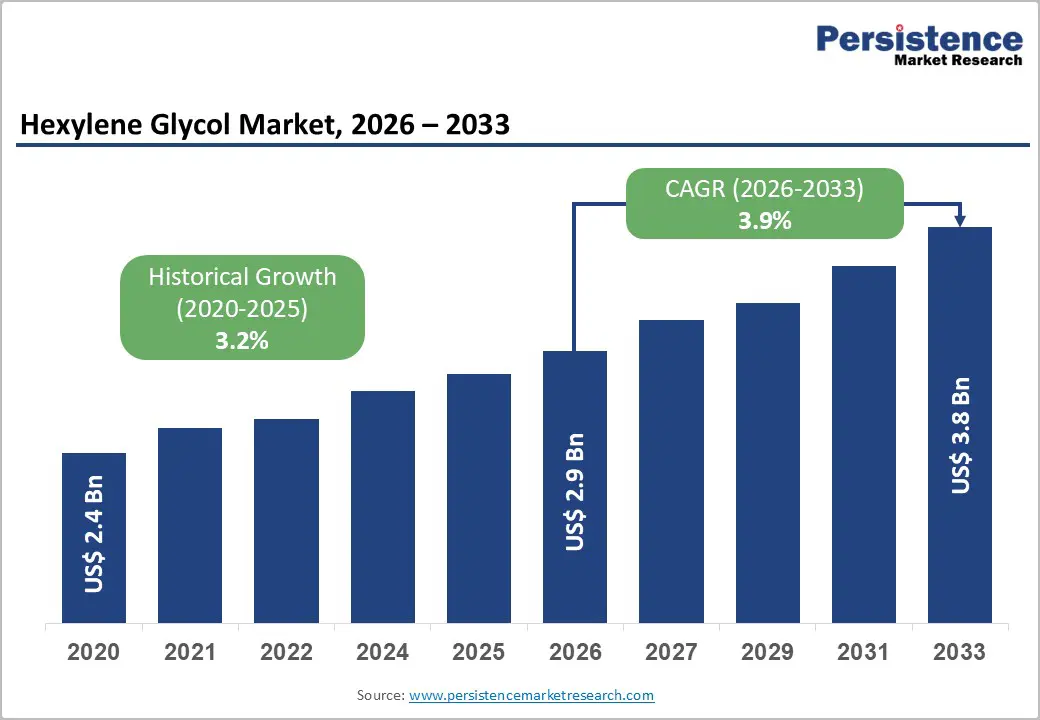
The global hexylene glycol market size is likely to be valued at US$ 2.9 billion in 2026, and is projected to reach US$ 3.8 billion by 2033, growing at a CAGR of 3.9% during the forecast period 2026−2033. Consistent demand across industrial, pharmaceutical, and personal-care value chains establishes a stable growth trajectory. Expansion of urban populations increases consumption of coatings, adhesives, and cosmetic formulations that utilize multifunctional solvents, leading to rising baseline demand. Greater clinical awareness of formulation stability requirements supports adoption within dermatological and topical therapeutic products.
Treatment adoption trends favor excipients that enhance solubility and preservation performance, strengthening utilization in pharmaceutical manufacturing. Technological integration across specialty chemical synthesis improves process efficiency and purity consistency, enabling scalable supply for regulated industries. Healthcare infrastructure expansion across developing economies increases production of topical medications and hygiene formulations, reinforcing demand for solvent systems with established toxicological profiles.
Key Industry Highlights
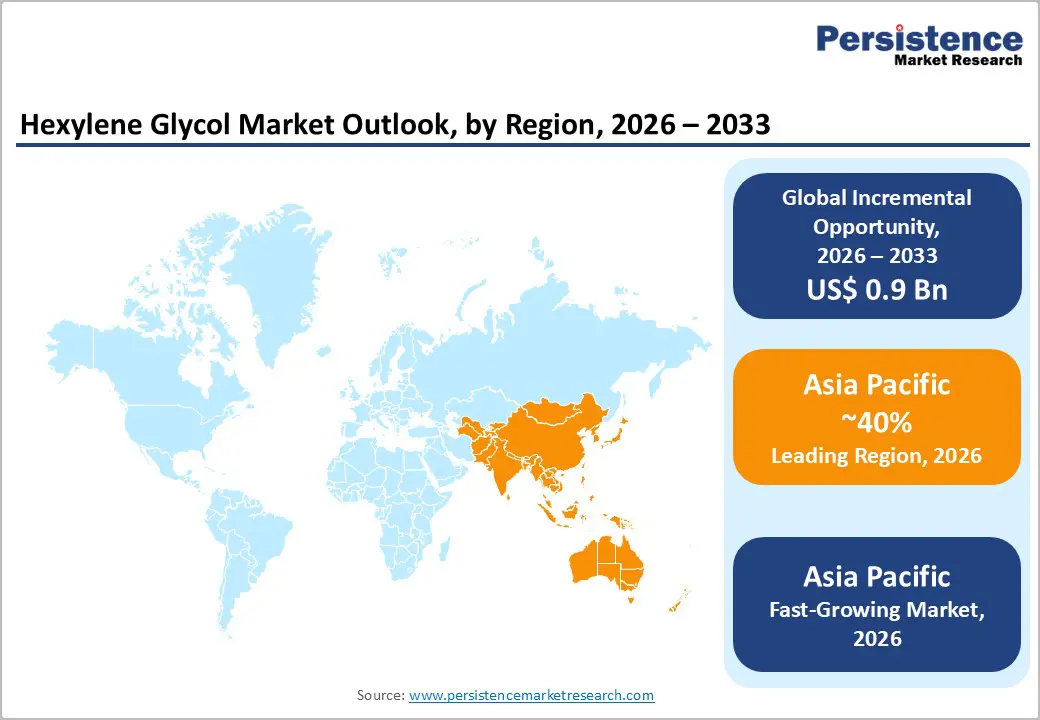
- Dominant Region: Asia Pacific is slated to dominate with about 40% market share in 2026 due to integrated production hubs, feedstock access, and cost-efficient infrastructure.
- Fastest-growing Market: Asia Pacific is projected to be the fastest-growing market through 2033, driven by specialty chemical demand across Indonesia, China, India, and South Korea.
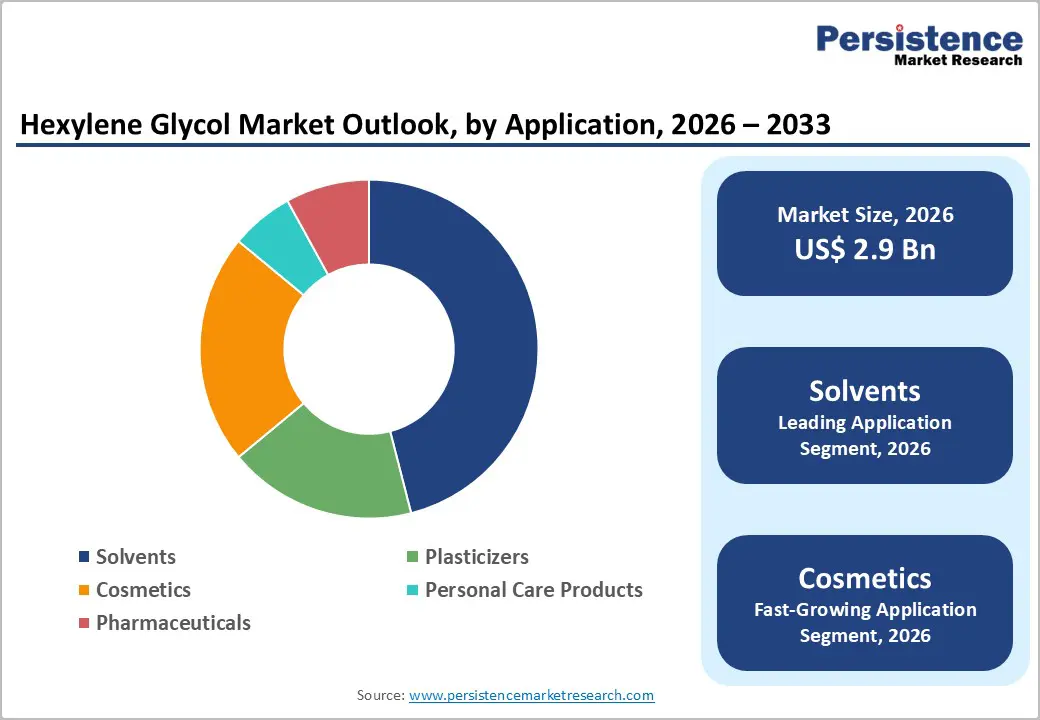
- Leading Application: Solvents are likely to lead with about 46% revenue share in 2026, fueled by their widespread use in coatings, inks, cleaners, and industrial formulations.
- Fastest-growing Application: Cosmetics are anticipated to grow the fastest from 2026 to 2033, propelled by rising demand for hydration, texture, and stability in personal-care formulations.
| Key Insights | Details |
|---|---|
| Hexylene Glycol Market Size (2026E) | US$ 2.9 Bn |
| Market Value Forecast (2033F) | US$ 3.8 Bn |
| Projected Growth (CAGR 2026 to 2033) | 3.9% |
| Historical Market Growth (CAGR 2020 to 2025) | 3.2% |
Market Factors – Growth, Barriers, and Opportunity Analysis
Rising Demand from Cosmetics and Personal Care Industries for Specialty Chemicals
Product development activity across beauty and hygiene manufacturing stimulates steady procurement of multifunctional formulation inputs that support texture optimization, solubility balance, and ingredient compatibility. Research laboratories prioritize compounds that maintain clarity, stabilize emulsions, and improve sensory characteristics across creams, serums, sprays, and color products. Portfolio diversification strategies in retail channels encourage frequent reformulation cycles, which raise consumption intensity of specialty chemical components within contract production networks. Brand differentiation strategies tied to performance claims and sensory appeal promote continuous ingredient sourcing aligned with formulation standards and regulatory safety benchmarks.
Official regulatory frameworks highlight industry scale and structural demand momentum. A March 2025 policy factsheet drawing on data from the U.S. Department of Commerce and Bureau of Labor Statistics reports US$ 308.7 billion contribution to national GDP from the cosmetics and personal care products sector, demonstrating substantial manufacturing and supply-chain activity that supports high raw-material utilization levels. Production expansion across multiple product categories increases reliance on functional solvents that ensure formulation uniformity and stability across large-batch processing environments. Compliance requirements emphasizing ingredient documentation, toxicological validation, and traceability further reinforce preference for established formulation agents widely accepted across product classes.
Expanding Paints and Coatings Sector Supports Usage
Industrial demand for coating formulations rises in parallel with construction, automotive, and infrastructure activity, creating strong consumption patterns for formulation solvents and viscosity-control agents. Paint manufacturers rely on this chemical for flow improvement, pigment dispersion, and drying balance, which supports coating uniformity across architectural and industrial surfaces. Public investment programs accelerate project pipelines that require protective and decorative coatings for steel, concrete, and composite materials. According to the Union Budget 2025, infrastructure spending reached INR 11.2 lakh crore, reflecting sustained government commitment to asset creation and surface protection requirements. Stable procurement cycles from large contractors and original equipment manufacturer (OEM) production lines sustain volume offtake, reinforcing supply agreements with chemical distributors and specialty ingredient suppliers.
Performance expectations within modern coating systems emphasize durability, gloss retention, corrosion resistance, and application stability under varied environmental conditions. Formulators select multifunctional solvents that maintain resin solubility, regulate evaporation rate, and improve film formation consistency. This compound meets such technical criteria, enabling optimization of formulation cost structures while maintaining regulatory compliance for volatile organic compound thresholds. Competitive differentiation among coating producers centers on performance additives that enhance storage stability and application efficiency, leading procurement teams to prioritize raw materials with proven compatibility across acrylic, alkyd, and epoxy systems.
Strict Chemical Regulations Increase Compliance Burden
Stringent regulatory frameworks across chemical, cosmetic, and pharmaceutical industries impose extensive approval, testing, and documentation requirements on hexylene glycol producers. Regulatory scrutiny intensity continues to rise across developed and emerging economies. Compliance protocols involve toxicology assessments, environmental impact analysis, labeling standards, and worker safety certifications, which extend product development timelines and raise administrative expenditure. Regional authorities such as European Chemicals Agency (ECHA)’s REACH framework and U.S. Environmental Protection Agency (EPA) standards demand detailed data submission, periodic audits, and formulation traceability. Small and mid-scale manufacturers face resource strain due to laboratory validation costs and consultant fees linked with certification processes. Market entry barriers rise when suppliers must align with multiple jurisdictional rules, limiting expansion speed and discouraging new participants.
Operational structures within chemical manufacturing require continuous monitoring systems, record maintenance, and employee training programs aligned with safety directives. Production units often modify processes to meet emission thresholds, waste disposal norms, and storage regulations, leading to capital allocation toward compliance infrastructure rather than capacity expansion. Supply contracts with downstream industries such as cosmetics or pharmaceuticals often mandate regulatory declarations and certification proof, creating documentation cycles that slow transaction timelines. Compliance teams coordinate with legal and technical departments to interpret evolving statutes. Frequent policy revisions across regions force firms to update formulations, packaging information, and transport classifications, generating recurring validation expenses.
Safety and Handling Requirements Add Operational Expenses
Regulatory frameworks governing industrial chemicals such as hexylene glycol impose strict standards for storage, transport, labeling, and workplace exposure control. Compliance demands investment in specialized containment systems, fire-resistant storage infrastructure, ventilation equipment, and certified packaging solutions designed to meet occupational safety and hazardous material transport codes. Workforce training programs, protective gear procurement, and periodic safety audits increase administrative and operational overhead across manufacturing and distribution networks. Insurance premiums often rise for facilities managing chemical solvents, reflecting risk classification tied to flammability and exposure concerns. Quality assurance protocols require batch testing, documentation, and traceability systems aligned with international chemical safety regulations, raising fixed operational expenditure across production cycles.
Industrial buyers evaluate total cost of ownership rather than unit price alone, leading procurement teams to factor compliance, storage, and handling expenses into sourcing decisions. Substitute solvents with lower regulatory burden or simpler storage profiles gain preference when cost optimization strategies dominate purchasing criteria. Logistics partners impose surcharges for hazardous material transport, influencing supply chain economics and reducing margin flexibility for producers and distributors. Capital allocation toward safety infrastructure limits funds available for capacity expansion, research initiatives, or market development programs.
Bio-based Product Development to Broaden Application Scope
Sustainable feedstock innovation creates strong commercial potential across coatings, cosmetics, pharmaceuticals, and specialty chemicals. Regulatory bodies across regions promote low-carbon raw materials, encouraging manufacturers to shift toward renewable intermediates such as bio-derived glycols. Corporate procurement strategies increasingly prioritize environmental compliance, lifecycle assessment performance, and green certification alignment. Bio-based variants support these targets while maintaining functional parity with petrochemical grades, enabling seamless substitution across existing formulations. Market participants view such materials as strategic tools for portfolio diversification, brand positioning, and long-term supply security. Growing investor focus on environmental, social, and governance performance strengthens capital flow toward producers offering renewable chemistry solutions.
Application range expands as formulators explore plant-derived solvent systems suited for sensitive formulations, including dermal products, medical preparations, and food-contact materials. Toxicological perception plays a major role in purchasing decisions within consumer-facing sectors, where renewable origin signals safety, traceability, and environmental responsibility. Research initiatives within industrial biotechnology improve yield efficiency and purity levels, supporting scalability for commercial volumes. Collaboration between chemical producers and biotechnology firms accelerates development of tailored grades designed for sector-specific requirements. Market differentiation emerges through certification labels, sustainability metrics, and reduced emission profiles, strengthening competitive positioning in regulated supply chains.
Increasing Research Investments to Enhance Innovation Efforts
Rising allocation of capital toward research and development creates strong commercial potential for hexylene glycol across specialty chemical, pharmaceutical, and formulation industries. Laboratory programs focus on purity enhancement, multifunctional performance, and compatibility with complex ingredient systems, leading to higher-value grades suited for premium applications. Innovation initiatives support discovery of novel synthesis pathways that improve yield efficiency and reduce production waste, strengthening margin structure for manufacturers. Investment activity from chemical producers, contract research organizations, and academic laboratories stimulates patent generation, formulation testing, and pilot-scale validation, accelerating transition from concept stage to industrial adoption. Expanding technical knowledge base strengthens product differentiation and supports entry into performance-driven sectors such as advanced coatings, electronics processing fluids, and biomedical formulations.
Strategic funding directed toward material science platforms encourages development of sustainable variants aligned with regulatory and environmental standards, creating pathways for market penetration in regions with strict chemical policies. Research partnerships between suppliers and end-use companies enable customized grades tailored for viscosity control, solubility optimization, and stability enhancement in complex formulations. Continuous experimentation broadens functional profile, positioning hexylene glycol as a versatile ingredient within evolving industrial specifications. Capital inflow into innovation ecosystems strengthens competitive positioning through proprietary technologies, process intensification methods, and scalable production models.
Category-wise Analysis
Grade Insights
Industrial grade is poised to lead with a forecasted 52% share in 2026, owing to widespread utilization across coatings, adhesives, cleaning agents, and plastic processing formulations. Industrial manufacturers prioritize solvent systems that provide viscosity control and compatibility with diverse chemical matrices. Established performance history supports procurement confidence among formulators. Supply availability through bulk distribution channels enhances accessibility for large-scale operations. Industrial chemists value consistency in evaporation rate and solvency characteristics, which supports repeatable production quality. Innovation in blending technologies allows integration into customized solvent packages tailored for sector-specific requirements. Cost-efficiency relative to specialty grades supports adoption across high-volume applications. Strong distribution networks operated by chemical suppliers ensure steady availability for industrial buyers.
Pharmaceutical grade is anticipated to be the fastest-growing segment between 2026 and 2033, fueled by rising demand for excipients used in topical treatments, dermatological preparations, and antiseptic formulations. Clinical acceptance of multifunctional solvents with established toxicological data supports utilization within regulated manufacturing environments. Treatment effectiveness improves when formulations maintain stable dispersion of active compounds. Provider preference for ingredients documented in pharmacopeial references strengthens adoption. Accessibility increases through global pharmaceutical ingredient supply networks. Innovation in purification technologies enhances quality assurance and traceability. Adherence to formulation standards improves product reliability, reinforcing demand among pharmaceutical producers.
Application Insights
Solvents are likely to command a projected 46% of the hexylene glycol market revenue share in 2026, due to extensive use in coatings, inks, cleaning fluids, and industrial processing solutions. Consumer trust in finished goods depends on formulation stability, which relies on solvent compatibility. Cultural acceptance of packaged goods and treated materials increases reliance on performance-optimized chemical formulations. Retail penetration of consumer products containing formulated materials indirectly sustains demand. Preventive healthcare adoption promotes use of disinfectants and hygiene products that require stable solvent systems. Digital commerce expansion supports distribution of formulated goods, increasing production volumes and solvent consumption.
Cosmetics expected to witness the fastest growth between 2026 and 2033, powered by rising global interest in skin hydration, texture enhancement, and preservation stability within personal-care formulations. Consumer perception of product quality links closely to sensory performance and shelf life, both influenced by solvent selection. Cultural acceptance of daily skincare routines expands addressable consumer base. Retail channels including online platforms broaden access to cosmetic products, increasing production demand. Preventive skincare adoption strengthens demand for formulation ingredients capable of maintaining uniform dispersion of active components. Continuous innovation in cosmetic science encourages incorporation of multifunctional glycols into advanced formulations.
Regional Insights
North America Hexylene Glycol Market Trends
North America maintains a mature yet strategically significant position in the hexylene glycol market landscape, supported by advanced chemical processing infrastructure and strong integration between raw material suppliers and downstream formulation industries. Production networks across United States and Canada emphasize high-purity grades tailored for pharmaceuticals, specialty coatings, and performance cosmetics, enabling premium pricing structures. Pharmaceutical solvent systems and dermatological gel formulations require strict impurity thresholds, while aerospace coating producers specify high-stability solvents for corrosion-resistant finishes. Regulatory frameworks promote consistent quality benchmarks and traceability, strengthening procurement confidence among multinational buyers. Investment concentration targets emission-controlled synthesis units, automated quality monitoring platforms, and catalytic efficiency upgrades that sustain output reliability under compliance-intensive environments.
Industrial expansion across Mexico supports additional momentum through rising production of automotive coatings, construction sealants, and maintenance fluids requiring stabilizing solvents. Demand streams include OEM refinish coatings, industrial degreasers, and oilfield chemical blends that rely on controlled evaporation characteristics. Market activity reflects preference for technologically differentiated formulations rather than commodity-grade output, encouraging suppliers to prioritize performance innovation and application testing programs. Collaboration between specialty chemical laboratories and formulation companies advances solubility optimization, viscosity control, and compatibility with bio-derived ingredients.
Europe Hexylene Glycol Market Trends
Europe maintains a mature yet strategically influential position in the market for hexylene glycol, aided by advanced chemical engineering standards, strict product quality frameworks, and strong integration between specialty chemical producers and downstream manufacturing sectors. Industrial economies such as Germany, France, and Italy operate highly optimized production systems that emphasize purity control, process efficiency, and regulatory alignment. Demand originates from high-value applications including performance coatings, pharmaceutical intermediates, and precision cleaning formulations used in electronics manufacturing. Environmental compliance policies encourage adoption of solvents with favorable toxicological and volatility profiles, strengthening commercial relevance of hexylene glycol within regulated industrial supply chains. Established distribution infrastructure and cross-border trade agreements enable consistent material flow across manufacturing clusters, sustaining stable consumption levels.
Industrial expansion across pharmaceutical innovation hubs, sustainable coatings development programs, and specialty formulation laboratories supports steady growth momentum. Research institutions and chemical technology centers collaborate with manufacturers to refine synthesis routes, improve recyclability, and enhance functional versatility for advanced formulations. Investment focus on green chemistry platforms promotes transition toward lower-emission production processes, aligning material selection with climate neutrality targets. High technical expertise within workforce segments enables rapid scale-up of pilot formulations into commercial production, reducing time-to-market for new applications.
Asia Pacific Hexylene Glycol Market Trends
Asia Pacific is expected to dominate with an estimated 40% of the hexylene glycol market share in 2026, reflecting concentration of integrated chemical production hubs, feedstock accessibility, and cost-efficient refining infrastructure across economies such as China, India, Japan, and South Korea. Large petrochemical complexes support continuous output of intermediates required for glycol synthesis, ensuring stable supply conditions for downstream processors. Strong presence of formulators in coatings, inks, personal care, and industrial fluids sustains high consumption intensity per manufacturing cluster. Trade corridor expansion and port modernization improve export competitiveness, enabling suppliers to serve global buyers with reduced logistics expenditure. Government-supported industrial corridors and tax-linked manufacturing incentives strengthen capital inflow into specialty chemical capacity, reinforcing leadership position across production networks.
Asia Pacific is forecasted to be the fastest-growing regional market for hexylene glycol between 2026 and 2033, propelled by rapid scale-up of domestic formulation industries and rising specialty material demand across Indonesia, China, India, and South Korea. Urban infrastructure programs stimulate coatings and construction chemical usage, while pharmaceutical and electronics production pipelines elevate requirement for high-purity solvents. Multinational producers establish joint ventures with local firms to secure distribution access and technical adaptation for climate and regulatory conditions. Expanding skilled technical workforce and competitive operating expenditure enable accelerated plant commissioning cycles, supporting swift volume expansion across multiple end-use sectors.
Competitive Landscape
The global hexylene glycol market demonstrates moderate fragmentation, with multinational chemical corporations such as BASF SE, Arkema Group, and LANXESS holding notable revenue shares alongside regional specialty manufacturers including FINAR Limited and Praasol Chemicals. Leading participants collectively control a considerable portion of global supply through integrated production facilities, proprietary processing technologies, and established distribution frameworks. Competitive positioning depends on production scale, purity-grade portfolio diversity, logistics capability, and compliance alignment with chemical safety standards across pharmaceutical, cosmetic, and industrial applications.
Barriers to entry remain significant due to capital-intensive manufacturing infrastructure, strict regulatory certification requirements, and necessity for long-term procurement agreements with end-use industries. Firms such as Solvay and Lonza Group maintain competitive advantage through advanced formulation expertise and high-specification product offerings tailored for regulated sectors. Market competition therefore centers on technological differentiation, supply reliability, and application-specific customization rather than price-driven strategies, sustaining structured rivalry among established suppliers while limiting rapid penetration by new entrants.
Key Industry Developments
In December 2025, LG Chem submitted a petrochemical restructuring plan to the South Korean government targeting up to 25% reduction in naphtha-cracking capacity as part of an industry-wide efficiency and oversupply correction initiative.
Companies Covered in Hexylene Glycol Market
- Arkema Group
- BASF SE
- DowDuPont
- FINAR Limited
- LANXESS
- Lonza Group
- Monument Chemicals, Inc.
- Novaphene Specialities Pvt. Ltd
- Praasol Chemicals Ltd.
- SOLVAY S.A.
- Solventis Ltd.
Frequently Asked Questions
The global hexylene glycol market is projected to reach US$ 2.9 billion in 2026.
Demand growth from cosmetics, pharmaceuticals, coatings, and specialty chemical formulations is driving the market.
The market is poised to witness a CAGR of 3.9% from 2026 to 2033.
Development of high-purity grades and innovation in specialty applications are generating high-value market opportunities.
Some of the key market players include Arkema Group, BASF SE, DowDuPont, FINAR Limited, LANXESS, Lonza Group, and Monument Chemicals, Inc.


