




- Beauty & Personal Care
- Hands-Free Shoes Market
Hands-Free Shoes Market Size, Share and Growth Forecast, 2026-2033
Hands-Free Shoes by End-user (Children & School-Age Users, Adults (18–45), Elderly Population (65+), Others), Application (Everyday Casual Wear, Athletic & Performance Use, Others), and Regional Analysis for 2026-2033

Hands-Free Shoes Market Size and Trends Analysis
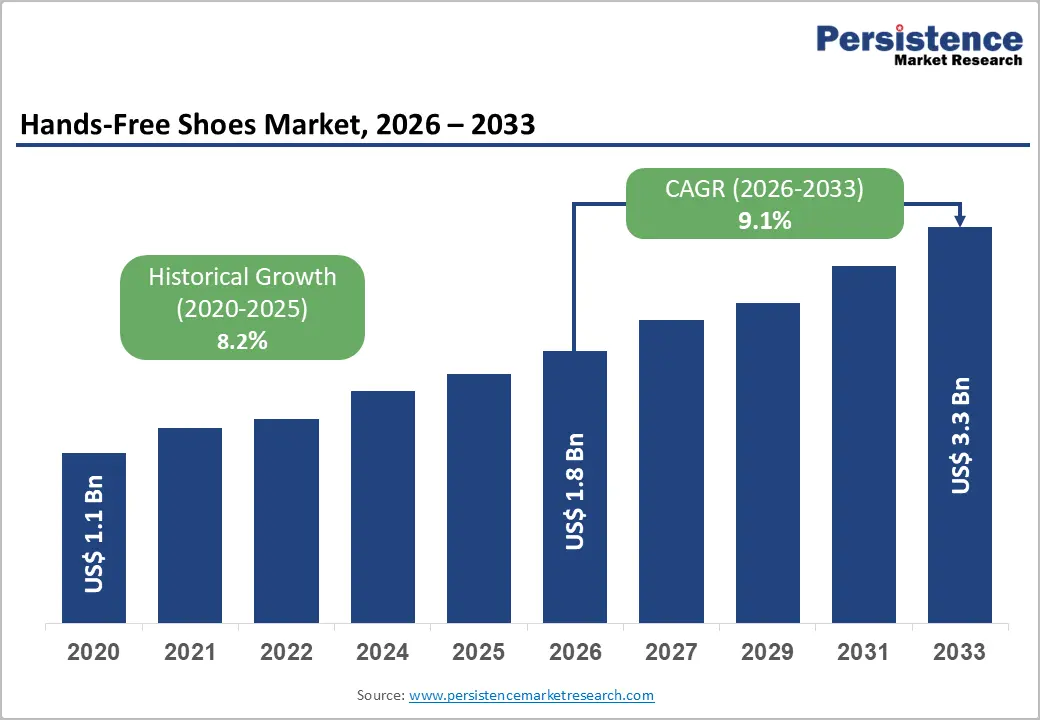
The global hands-free shoes market size is likely to be valued at US$1.8 billion in 2026 and is projected to reach US$3.3 billion by 2033, growing at a CAGR of 9.1% during the forecast period from 2026 to 2033, driven by rising demand for truly effortless hands-free footwear solutions, especially among elderly and mobility-challenged users, along with a clear shift toward everyday slip-on footwear systems that eliminate hassle without compromising style or comfort.
Rapid advances in ergonomic and adaptive shoe design are driving adoption across lifestyle, sports, and clinical applications. Aging populations, growing rehabilitation needs, and active lifestyles are boosting demand, while innovations such as elastic locking systems, hands-free entry designs, and orthopedic comfort features enable quick, effortless wear without bending or tying.
Key Industry Highlights:
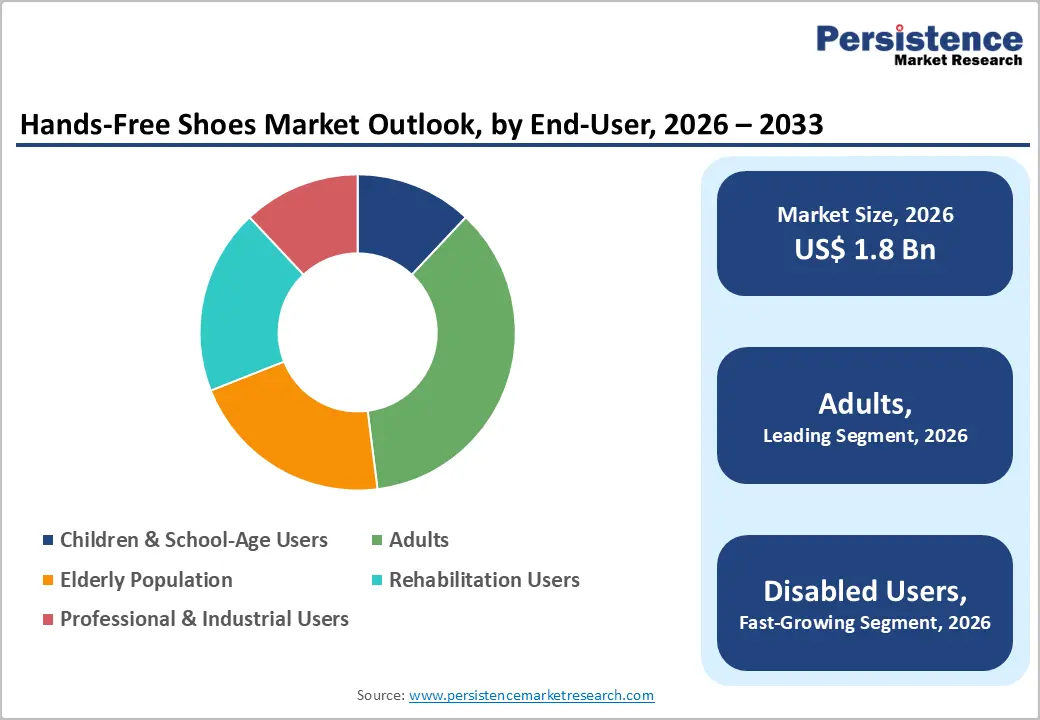
- End-user Leadership: Adults are expected to dominate the hands-free shoes market with a 35% share in 2026, driven by strong lifestyle-led adoption of slip-on footwear systems, while healthcare & rehabilitation users are projected to grow fastest at 10% CAGR through 2033, supported by rising mobility assistance demand.
- Application Trend: Everyday casual wear will remain the leading application in 2026, while healthcare & clinical settings are expected to record the fastest growth, driven by increasing use of adaptive footwear solutions in recovery and elderly care.
- Regional Outlook: Asia Pacific is set to be the fastest-growing region, led by China, India, and Japan, while North America is expected to continue to lead in innovation across adaptive and smart footwear integration.
- Core Growth Drivers: Rising elderly population, expanding rehabilitation needs, and increasing demand for hands-free footwear solutions remain the key structural drivers of market expansion.
- Usage Trend: Growing adoption of slip-on footwear systems across casual, sports, and travel segments is accelerating mass-market penetration due to convenience and comfort benefits.
DRO Analysis
Driver - Rising Geriatric Population and Mobility-Impairment Incidence
The expansion of the elderly population is a critical driver for the hands-free shoes market. According to the United Nations Department of Economic and Social Affairs (UN DESA), the global population aged 65+ is expected to nearly double between 2020 and 2050, reaching over 1.5 billion. Mobility limitations such as arthritis and reduced hand dexterity significantly increase demand for adaptive footwear solutions.
The World Health Organization (WHO) reports that over 1.71 billion people live with musculoskeletal conditions globally, many requiring ergonomic footwear. This demographic shift is directly influencing demand in healthcare and rehabilitation settings. Manufacturers are responding with step-in, no-lace systems and orthopedic cushioning technologies. As a result, hands-free shoe adoption in elderly care segments is emerging as a structurally sustained growth driver across developed and aging economies such as Japan, Germany, and the U.S.
Restraint - High Product Cost and Limited Mass-Market Penetration
Despite strong innovation momentum, the hands-free shoes market faces a key restraint in the form of elevated product pricing compared to traditional footwear. Advanced mechanisms such as elastic heel structures, carbon-fiber support systems, and adaptive midsoles increase production costs by an estimated 20–35% according to footwear manufacturing benchmarks from industry associations such as FDRA (Footwear Distributors and Retailers of America). This cost premium limits adoption in price-sensitive markets, particularly in developing economies.
Limited awareness outside urban centers also restricts penetration. Supply chain complexities involving specialized materials and precision manufacturing further elevate cost structures. Retail price sensitivity remains a challenge for mass adoption, particularly in the everyday casual slip-on footwear segment, slowing down volume growth despite rising consumer interest in convenience-driven footwear formats.
Opportunity - Expansion of Smart and Adaptive Footwear Ecosystem
A major opportunity lies in the integration of smart footwear technologies with hands-free designs. The global wearable technology ecosystem, valued at over US$90 billion, is increasingly converging with footwear innovation. This creates opportunities for embedded sensors, pressure-mapping insoles, and AI-driven gait correction systems within hands-free shoes.
Demand is particularly strong in sports rehabilitation, elderly care, and occupational safety segments. Companies investing in modular, connected footwear platforms are expected to gain a competitive advantage. Government healthcare programs promoting mobility assistance devices further support adoption. This convergence of footwear and digital health represents a transformative opportunity for long-term market expansion.
Category-wise Analysis
End-user Insights
The adults (18–45) segment is estimated to lead the hands-free shoes market, accounting for approximately 35% share in 2026. This dominance is likely driven by a strong preference for convenience-oriented slip-on footwear systems, particularly across urban lifestyles, travel, and fitness usage. Rising sneaker culture and expanding hands-free product lines from brands such as Skechers and Nike are estimated to be accelerating mainstream adoption. FDRA industry insights suggest continued strength in casual footwear over formal categories, supporting sustained demand. E-commerce expansion and trend-led purchasing behavior are also expected to reinforce this segment’s leadership in key metropolitan markets.
The disabled users segment is estimated to be the fastest-growing, projected at a CAGR of 10% through 2033, supported by rising demand for adaptive footwear solutions in healthcare and recovery applications. The WHO estimates suggest that over 1.7 billion people globally are affected by musculoskeletal conditions, which is likely to drive long-term need for mobility-support footwear. Increasing post-surgical rehabilitation cases and age-related mobility limitations are expected to support adoption in clinical environments. In aging societies such as Japan, where around 29% of the population is aged 65+, healthcare systems are increasingly integrating easy-wear footwear into elder care programs, reinforcing structural demand growth.
Application Insights
The everyday casual wear segment is estimated to dominate application demand with around 40% share in 2026, driven by strong global preference for comfort-focused slip-on footwear systems. The ongoing casualization of fashion is likely to sustain this dominance, with sneakers estimated to account for over 50% of global athletic footwear sales. This shift is encouraging widespread integration of hands-free designs into everyday footwear collections. Urban commuting needs, travel convenience, and hybrid work patterns are also expected to support steady usage. As a result, this segment is likely to remain the core revenue contributor in the hands-free shoes market.
The healthcare & clinical settings segment is estimated to be the fastest-growing, projected to expand at a CAGR of 11% globally, driven by increasing adoption of orthopedic and rehabilitation footwear solutions. The WHO estimates indicate over 300 million surgical procedures annually, which is expected to sustain demand for post-operative mobility support products. Hospitals and physiotherapy centers are increasingly adopting step-in footwear to enhance patient independence and recovery outcomes. Growth is further fueled by aging populations and ongoing healthcare infrastructure advancements across Europe and Asia, positioning the segment as a key growth area within the hands-free shoes market.
Regional Analysis
North America Hands-Free Shoes Market Trends
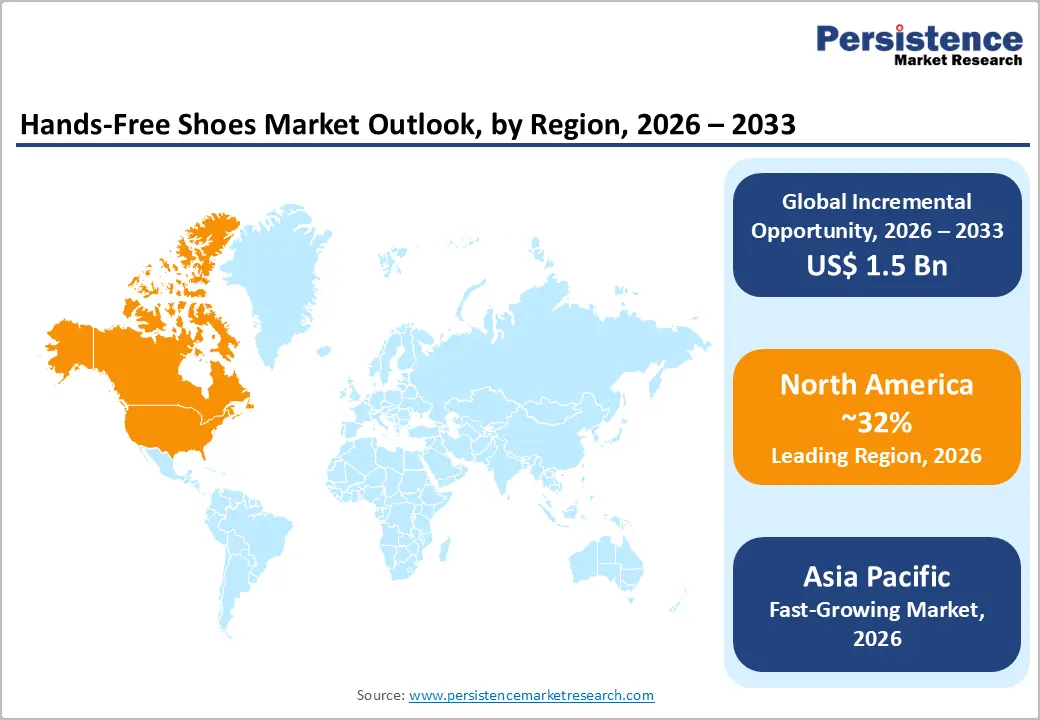
North America is estimated to account for a 32% share of the global hands-free shoes market in 2026, supported by early and sustained adoption of slip-on footwear systems across lifestyle and healthcare segments. Consumer behavior is estimated to be strongly convenience-driven, with over 40% of footwear buyers in the U.S. likely prioritizing no-lace or easy-entry designs. The region is also expected to benefit from high digital retail penetration, where online channels are estimated to contribute 60%+ of sales in comfort and casual footwear categories, improving accessibility for hands-free innovations. The growing overlap between athletic, casual, and adaptive footwear is likely to further reinforce market expansion.
The U.S. is estimated to contribute around 82% of regional demand in 2026, driven by a strong preference for comfort-led sneakers and rapid acceptance of step-in footwear formats in everyday wear. Adoption is likely to be further supported by increasing use of hands-free designs in rehabilitation and assisted living environments, particularly for elderly users and post-surgery recovery cases. Canada is estimated to account for around 18% of the regional market, with demand expected to grow steadily in urban centers where practical and weather-adaptive footwear is preferred. Increasing awareness of mobility-support footwear in healthcare and wellness settings is also likely to support gradual expansion.
Europe Hands-Free Shoes Market Trends
Europe is estimated to hold a 25% share of the global hands-free shoes market in 2026, driven by strong structural demand from aging populations and rising preference for ergonomic slip-on footwear systems. With nearly 20%+ of the population estimated to be aged 65 or above, demand for mobility-support and adaptive footwear solutions is likely to remain structurally strong. The region is also expected to see dual adoption trends, where hands-free footwear is increasingly used in both healthcare applications and premium lifestyle segments, supported by sustainability-led consumption patterns and demand for long-lasting comfort products.
Germany is estimated to represent around 28–30% of the Europe market, driven by strong healthcare integration and high adoption of orthopedic and rehabilitation footwear. Usage of hands-free footwear in physiotherapy and elder care programs is expected to increase steadily as mobility-support solutions gain importance in clinical settings. The U.K. is estimated to account for around 18–20% of the regional demand, with adoption likely driven by urban consumers prioritizing convenience in daily wear. The increasing normalization of step-in sneaker formats in mainstream retail channels is expected to further support growth in casual footwear categories.
Asia Pacific Hands-Free Shoes Market Trends
Asia Pacific is estimated to account for 28% of the global hands-free shoes market in 2026 and is expected to remain the fastest-growing region due to rapid urbanization and rising acceptance of slip-on footwear systems. Growth is likely to be driven by expanding middle-class consumption, strong influence of sneaker culture, and increasing penetration of online footwear retail, which is estimated to contribute a significant and rising share of total footwear sales across major economies. Adoption of adaptive footwear solutions is also expected to increase gradually in healthcare and elderly care applications.
China is estimated to contribute around 40% of the Asia Pacific demand, supported by strong manufacturing capacity and fast adoption of comfort-led footwear in urban markets. Demand for hands-free sneakers is expected to grow steadily as convenience and lifestyle alignment become key purchase factors among younger consumers.
Japan is estimated to hold around 20% of Asia Pacific demand, driven by a structurally aging population, where over 29% of citizens are aged 65+ (estimated). This demographic trend is expected to significantly accelerate adoption of adaptive footwear solutions, particularly in rehabilitation, elderly care, and clinical mobility support applications. Hands-free designs are increasingly being integrated into healthcare and assisted living environments, where ease of wear and reduced strain during movement are critical priorities.
Competitive Landscape
The global hands-free shoes market is moderately consolidated, with leading players such as Nike, Adidas, Skechers, Puma, and New Balance estimated to collectively hold a significant share of global revenues. These companies are expected to sustain dominance through strong brand equity, extensive global distribution networks, and continuous innovation in slip-on footwear systems and comfort-led design platforms. Competitive strength is further reinforced by investments in ergonomic engineering, lightweight materials, and step-in sneaker technologies aimed at improving ease-of-wear, performance, and lifestyle adoption across consumer segments.
Regional and niche players are expected to focus on orthopedic, elderly care, and rehabilitation footwear solutions, targeting high-growth medical and comfort-driven segments. Collaboration between comfort-tech specialists and global footwear brands is increasing to integrate hands-free mechanisms into mainstream product portfolios. Competition is expected to intensify over the forecast period, with growing emphasis on sustainable materials, hybrid lifestyle-performance designs, strategic partnerships, and selective acquisitions, while digital-first brands expand through e-commerce-led positioning and differentiated comfort innovation.
Key Industry Developments:
- In October 2025, Nike unveiled the “Project Amplify” powered footwear concept, an early-stage robotic assistance system designed to enhance walking efficiency and reduce physical fatigue in long-distance movement.
- In August 2025, Skechers entered a US$9 billion acquisition agreement with 3G Capital, which received full regulatory approvals and is expected to reshape its global operating strategy under private ownership, strengthening its focus on comfort-led and slip-in footwear systems.
Companies Covered in Hands-Free Shoes Market
- Nike Inc.
- Adidas AG
- Skechers USA Inc.
- Puma SE
- New Balance Athletics Inc.
- Under Armour Inc.
- ASICS Corporation
- Li-Ning Company Limited
- ANTA Sports Products Limited
- Deckers Brands
- Wolverine World Wide Inc.
- Clarks
- Bata Corporation
- Decathlon
- OrthoLite
Frequently Asked Questions
The global hands-free shoes market is projected to reach US$1.8 billion in 2026.
Rising demand for convenience footwear, aging populations, and growth of slip-on footwear systems drive the market.
The hands-free shoes market is expected to grow at a CAGR of 9.1% from 2026 to 2033.
Opportunities lie in healthcare footwear adoption, sportswear integration, and expansion of adaptive footwear solutions in emerging markets.
Key players include Nike, Adidas, Skechers, Puma, and New Balance.


