




- Industrial Goods & Service
- Green Roof Market
Green Roof Market Size, Share, and Growth Forecast 2026 - 2033
Green Roof Market by Roof Type (Extensive, Intensive, Others), Application (Residential, Commercial, Industrial), and Regional Analysis for 2026 - 2033

Green Roof Market Size and Trend Analysis
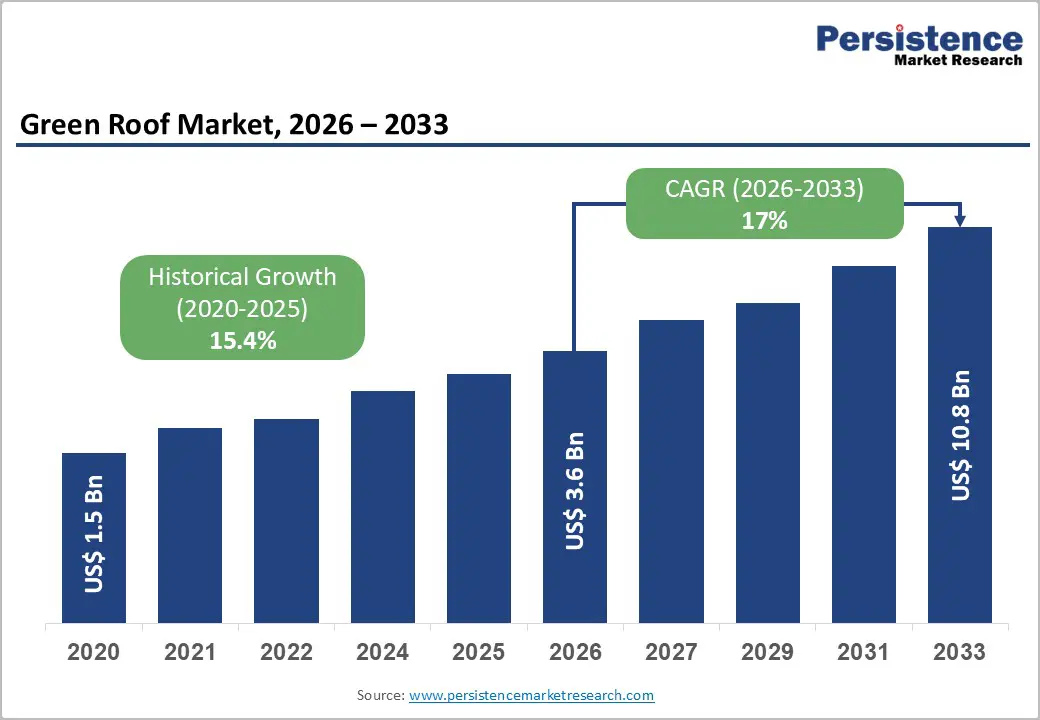
The global green roof market is valued at US$ 3.6 billion in 2026 and is projected to reach US$ 10.8 billion, growing at a CAGR of 17% between 2026 and 2033. This exceptional growth trajectory is primarily driven by accelerating urbanization, intensifying climate-resilience mandates from municipal governments, and growing integration of green infrastructure into sustainable building codes.
Rising awareness of urban heat island mitigation, stormwater management benefits, and biodiversity enhancement, reinforced by incentive programs across North America, Europe, and the Asia Pacific, compels building owners and urban planners to adopt green roof systems at scale.
Key Industry Highlights:
- Leading Region: North America leads the global green roof market with approximately 36% revenue share in 2026, supported by robust stormwater regulatory incentives, LEED-driven commercial adoption, and strong industry advocacy through the Green Roofs for Healthy Cities (GRHC) association.
- Fast-Growing Market: Asia Pacific is the fast-growing market with a CAGR exceeding 20%, driven by China's Sponge City program, Singapore's LUSH 3.0 mandate, and rapid urbanization creating urgent demand for green infrastructure across densely populated metropolitan centres.
- Dominant Roof Type: Extensive green roofs dominate the roof type category with approximately 58% market share, favoured for their lower cost, lightweight design, and minimal maintenance requirements that make them accessible for large-scale commercial and industrial retrofits globally.
- Fast-Growing Application: The Biosolar (Green Roof + PV) system is the fastest-growing application trend within the Commercial segment, as developers seek to simultaneously fulfil green building, stormwater, and renewable energy mandates in a single rooftop investment with measurable ROI.
- Key Opportunity: Technology-integrated smart green roofs incorporating IoT sensors, automated irrigation, and BMS-connected performance monitoring represent a high-margin growth opportunity, enabling operators to optimize lifecycle costs and meet increasingly data-driven sustainability reporting requirements.
DRO Analysis
Drivers - Rise in Urban Heat Island Effect and Climate-Resilience Policies
Cities worldwide are increasingly turning to green roofs as a frontline urban climate adaptation tool. The Intergovernmental Panel on Climate Change (IPCC) has documented that urban areas experience temperatures 1-3°C higher than surrounding rural zones, intensifying energy demand and public health risks. Green roofs reduce surface temperatures through evapotranspiration and thermal insulation, directly addressing the urban heat island effect.
Municipal governments in countries such as Germany, France, and Singapore have enacted green roof mandates or incentive schemes to accelerate adoption. The European Union's Nature Restoration Law, passed in 2024, further obliges member states to enhance urban biodiversity and green coverage, positioning green roofs as a key compliance mechanism and a powerful demand catalyst across European building projects.
Stringent Stormwater Management Regulations Driving Adoption
Regulatory requirements for stormwater retention and runoff reduction are a significant structural driver for green roof adoption globally. The U.S. Environmental Protection Agency (EPA) has recognized green roofs as a Low Impact Development (LID) best management practice, and many U.S. cities offer stormwater fee credits to buildings that install them.
For instance, Washington D.C.'s Stormwater Retention Credit (SRC) program and Philadelphia's Green City, Clean Waters plan have created direct financial incentives for green roof installation on commercial and municipal buildings. Studies published in the Journal of Hydrology confirm that extensive green roofs can retain 50% of rainfall in a single storm event, making them a compelling compliance tool for property developers and municipalities managing combined sewer overflow risks.
Restraints - High Installation and Structural Modification Costs
The upfront capital cost of green roof installation remains a significant adoption barrier, particularly for retrofit projects on existing buildings. According to data published by the Green Roofs for Healthy Cities (GRHC) association, installed costs for intensive green roofs can range from USD 150 to 500 per square meter, compared to conventional roofing at USD 30-80 per square meter.
Many older buildings also require structural reinforcement to support the additional load of growing media, waterproofing layers, and vegetation, further inflating project costs. While lifecycle cost analyses often demonstrate net savings through energy efficiency and roof membrane longevity, the substantial payback period, typically 10-15 years, discourages uptake among smaller building owners and markets with limited green building financing mechanisms.
Limited Technical Expertise and Maintenance Challenges
Green roof systems require specialized horticultural, waterproofing, and drainage engineering expertise that is unevenly distributed across geographies. In developing regions across South Asia, Latin America, and Africa, the scarcity of certified green roof installers and maintenance professionals constrains market penetration. Ongoing maintenance, including irrigation management, weed control, and plant replacement, demands consistent investment and skilled labour.
The World Green Building Council (WorldGBC) notes that the lack of awareness and training programs in emerging markets creates a human capital bottleneck. Poorly maintained green roofs risk vegetation die-off, waterproofing membrane damage, and drainage blockages, undermining performance and deterring adoption among risk-averse commercial building managers.
Opportunities - Integration with Solar Photovoltaic Systems: The Biosolar Green Roof Opportunity
The convergence of green roofs and rooftop solar photovoltaic (PV) systems, commonly referred to as biosolar roofs, represents a high-growth opportunity for market participants. Research published by Wageningen University & Research demonstrates that vegetation on biosolar roofs can lower panel operating temperatures by 2-8°C, increasing PV energy output by up to 6%. Simultaneously, PV panels provide partial shade that reduces plant water stress, improving vegetation performance.
As governments worldwide accelerate rooftop solar mandates, including the EU Solar Rooftop Initiative targeting 30 GW of new solar capacity annually, biosolar roof solutions offer a compelling value proposition for new commercial and residential construction, enabling developers to simultaneously meet green building, biodiversity, and renewable energy compliance targets.
Smart and Technology-Integrated Green Roofs for Urban Infrastructure
The integration of sensor networks, automated irrigation, and real-time monitoring technology into green roof systems is emerging as a key differentiating opportunity for solution providers. Smart green roofs equipped with soil moisture sensors, weather-adaptive irrigation controllers, and IoT-connected performance dashboards enable optimized water usage and predictive maintenance, directly addressing operational cost concerns.
Pilot programs by Singapore's National Parks Board (NParks) and smart city initiatives in Amsterdam and Toronto have demonstrated the feasibility of technology-integrated urban greening at scale. As the global smart building market expands, the ability to embed green roof performance data into building management systems (BMS) and sustainability reporting frameworks creates meaningful additional value for commercial property owners and institutional investors.
Category-wise Analysis
Roof Type Insights
The extensive green roof segment leads the roof type category, accounting for approximately 58% of total revenue in 2026. Extensive systems characterized by shallow growing media depths of 60-200 mm and lightweight vegetation such as sedums and mosses are dominant due to their lower installed cost, minimal structural loading requirements, and suitability for large-scale commercial and industrial roof retrofits.
Data from the German Landscape Research, Development and Construction Society (FLL), the global reference body for green roof guidelines, confirms extensive systems as the most widely specified type in new commercial construction. Their low maintenance requirements and compatibility with standard structural specifications make them the preferred choice for cost-conscious developers, municipal infrastructure projects, and industrial warehouse green roof programs.
Application Insights
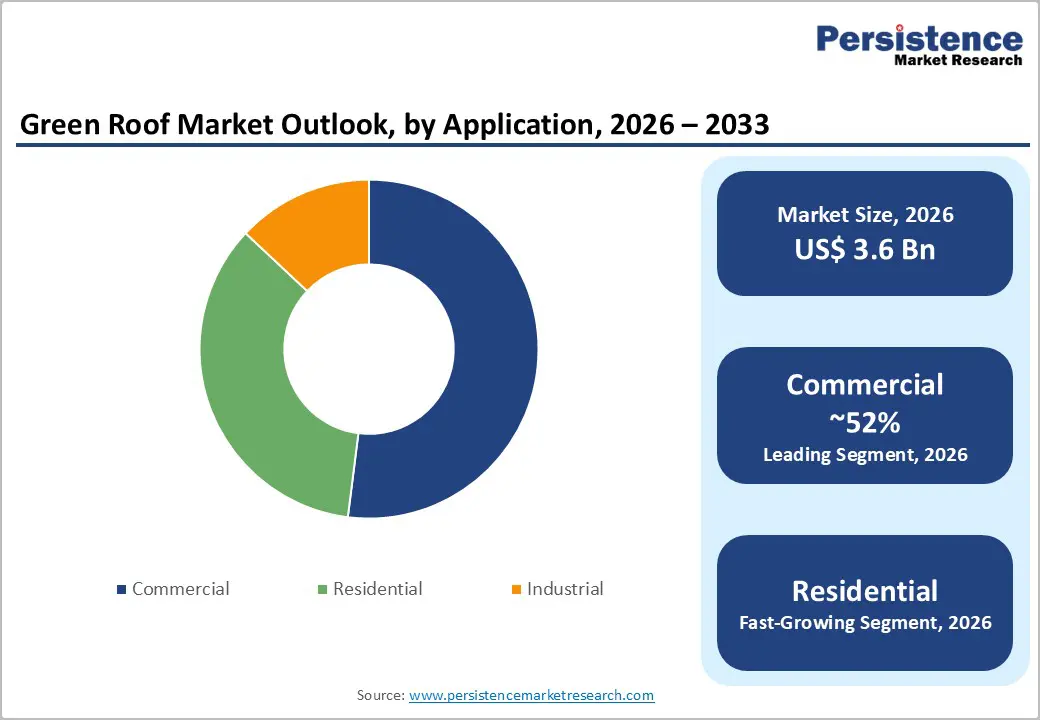
The commercial application segment holds the largest share, representing approximately 52% of the green roof market. Commercial buildings encompassing office complexes, retail centres, hospitality facilities, and institutional structures are the primary adopters of green roof technology, driven by green building certification requirements (LEED, BREEAM, WELL), corporate sustainability mandates, and the tangible commercial benefits of reduced energy costs and enhanced tenant attraction.
The U.S. Green Building Council (USGBC) reports that LEED-certified buildings command rental premiums and higher occupancy rates, incentivizing commercial developers to invest in green infrastructure, including green roofs. The segment also benefits disproportionately from stormwater credit programs administered in major North American and European cities.
Regional Analysis
North America Green Roof Market Trends & Analysis
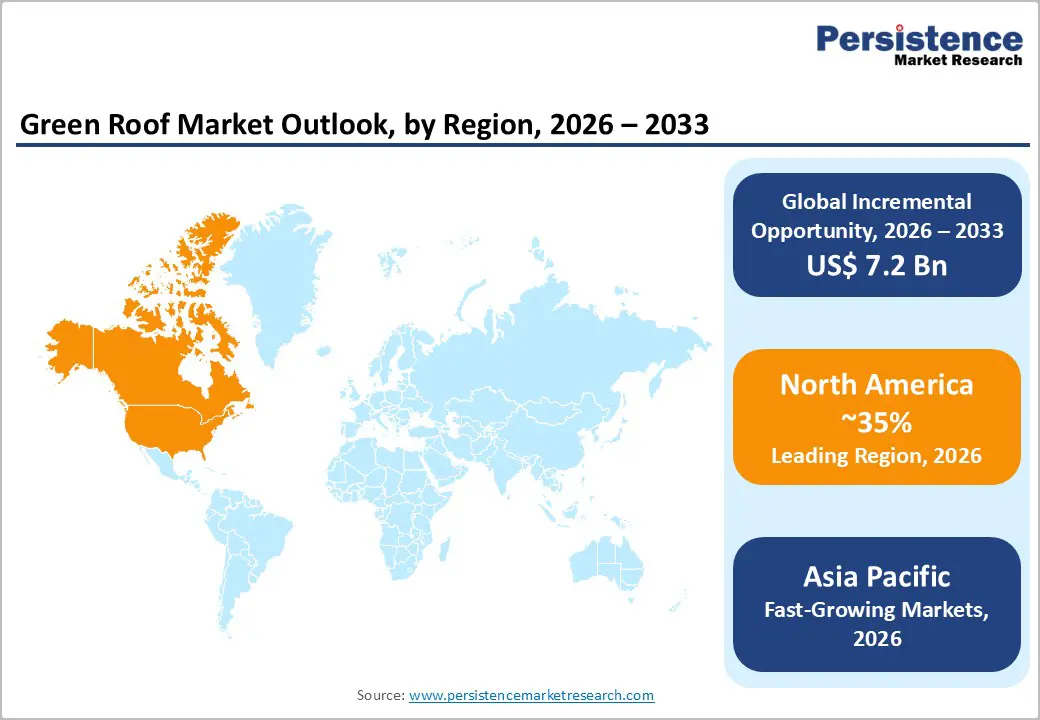
North America is the leading regional market for green roofs, accounting for approximately 36% of global revenue in 2026. The United States and Canada benefit from a well-developed regulatory and incentive framework, with over 25 major U.S. cities offering stormwater fee credits or direct subsidies for green roof installation.
Federal support through the U.S. EPA's green infrastructure programs and state-level sustainable building incentives further underpin demand. The region is also home to the Green Roofs for Healthy Cities (GRHC) association, which has driven industry standardization and professional accreditation.
U.S. Green Roof Market Size
The United States represents approximately 30% of the global green roof market revenue in 2026, establishing it as the world's single largest national market. Chicago, New York, and Washington D.C. remain the primary metropolitan markets, driven by robust stormwater ordinances and green building certification activity.
Europe Green Roof Market Trends, Drivers, & Insights
Europe is the second largest and most mature green roof market, with Germany historically leading global green roof coverage per capita. The region benefits from binding green infrastructure legislation, with Germany's federal building code encouraging green roof installation since the 1980s.
The EU Nature Restoration Law (2024) mandates member states to restore 20% of degraded ecosystems by 2030, with urban greening identified as a core restoration tool. Geopolitical disruptions from the Russia-Ukraine conflict have accelerated Europe's focus on energy independence, indirectly benefiting green roofs through their role in reducing building heating and cooling loads.
Germany Green Roof Market Size
Germany commands approximately 11% of the global green roof market revenue, reflecting decades of policy support and deep industry expertise. The FLL guidelines, originating in Germany, are applied globally as the technical standard for green roof design. German manufacturers such as ZinCo GmbH and Optigrün international AG are internationally recognized green roof system providers with extensive European and export market presence.
U.K. Green Roof Market Size
The United Kingdom holds approximately 6% of global market revenue. The Greater London Authority's London Plan mandates the integration of urban greening factors in new developments, with green roofs a key qualifying measure. Post-Brexit, the U.K. has maintained ambitious biodiversity net gain requirements under the Environment Act 2021, which is driving the adoption of biodiverse and brown roofs, an emerging green roof subtype across new residential and commercial developments.
France Green Roof Market Size
France accounts for a leading share in regional revenue. France's Grenelle II Law and more recently the LOM framework mandate green or solar roofs on new commercial buildings over 1,000 m². Paris's ambitious urban greening strategy targets 100 hectares of new green infrastructure across the city, including extensive green roofs on public buildings.
Asia Pacific Green Roof Market Drivers & Analysis
Asia Pacific is the fast-growing regional market, expanding at an estimated CAGR of 20%+ through the forecast period. Rapid urbanization, with the United Nations projecting that 68% of Asia's population will be urban by 2050, combined with worsening air quality, urban heat, and flooding events, is creating urgent demand for green infrastructure solutions.
China's 'Sponge City' initiative, which targets 80% of urban areas to absorb and reuse 70% of rainfall by 2030, is a transformative policy driver. Singapore's Landscaping for Urban Spaces and High-Rises (LUSH) 3.0 program mandates skyrise greening for new developments, with green roofs a primary qualifying element.
China Green Roof Market Size
China represents approximately 14% of the global green roof market and is the fastest-growing large national market. The Ministry of Housing and Urban-Rural Development (MOHURD) has integrated green roofs into China's Green Building Standards (GB/T 50378), and the Sponge City program has designated over 30 pilot cities for urban water resilience investment, including green roof deployment.
India Green Roof Market Size
India accounts for approximately 4% of global market revenue and is experiencing accelerating momentum. The Indian Green Building Council (IGBC) and Bureau of Energy Efficiency (BEE) are actively promoting green roof adoption as part of India's Smart Cities Mission and National Action Plan on Climate Change (NAPCC).
Japan Green Roof Market Size
Japan holds approximately 5% of global green roof market revenue. Tokyo Metropolitan Government's Rooftop Greening Ordinance which has mandated greening of 20% of rooftop area for new buildings over 1,000 m² since 2001has established Japan as a mature urban greening market.
Competitive Landscape
The global green roof market is highly fragmented, with the top five players collectively holding less than 25% of global revenue. The market comprises specialized system manufacturers (supplying growing media, drainage layers, and membranes), general construction contractors with green roof capability, and horticultural specialists.
Key differentiators among market leaders include proprietary modular system design, depth of technical expertise certified by FLL or GRHC, and multi-regional project execution capacity. Emerging trends include platform-based procurement models, digital design-and-build services, and strategic alliances between green roof system suppliers and solar PV installers.
Key Developments:
- In January 2025, Sempergreen showcased its latest advancements in green roof systems and living walls at the BAU Munich 2025 trade fair.
- In October 2024, Azizi Developments announced their partnership with Soprema Inc. to provide better and more advanced waterproofing solutions.
Companies Covered in Green Roof Market
- ZinCo GmbH
- Bauder Limited
- Optigrün international AG
- American Hydrotech, Inc.
- Tremco CPG (TremcoRoofing & Building Maintenance)
- Sempergreen
- LiveRoof, LLC
- GreenGrid Roofs (Weston Solutions)
- Vegetal i.D.
- Soprema Group
- IKO Industries Ltd.
- Sika AG
- Xero Flor International
- Urbanscape (Knauf Insulation)
- Green Roof Outfitters
Frequently Asked Questions
The global Green Roof market is valued at US$ 3.6 Bn in 2026 and is projected to reach US$ 10.8 Bn by 2033, recording a robust CAGR of 17.0% over the forecast period.
The primary demand drivers are escalating urban heat island mitigation policies reinforced by the IPCC's documented temperature differentials in urban zones and stringent stormwater management regulations from bodies such as the U.S. EPA.
Extensive Green Roofs represent the leading segment with approximately 58% market share. Their dominance is driven by lower installed costs, lightweight profiles suitable for standard structural specifications, and minimal ongoing maintenance, making them the preferred choice for large-scale commercial and industrial retrofits globally.
North America leads the global green roof market with approximately 36% of revenue in 2026, underpinned by comprehensive stormwater credit programs in major U.S. cities, federal EPA green infrastructure support, and strong industry standards promoted by the Green Roofs for Healthy Cities (GRHC) association.
Leading companies in the global green roof market include ZinCo GmbH (Germany), Bauder Limited (U.K.), Optigrün international AG (Germany), American Hydrotech Inc., Sempergreen, Soprema Group, Sika AG, Xero Flor International, Urbanscape (Knauf Insulation), and LiveRoof LLC, among others.


