




- Medical Devices
- Fetal Monitoring Workstation Market
Fetal Monitoring Workstation Market Size, Share, and Growth Forecast, 2026 – 2033
Display Configuration (Single Monitor Workstation, Others), Application (Antepartum Monitoring, Others), End-user (Hospitals, Clinics, Birthing Centers, Ambulatory Care Centers, Telehealth Service Providers), and Regional Analysis for 2026-2033

Fetal Monitoring Workstation Market Size and Trends Analysis
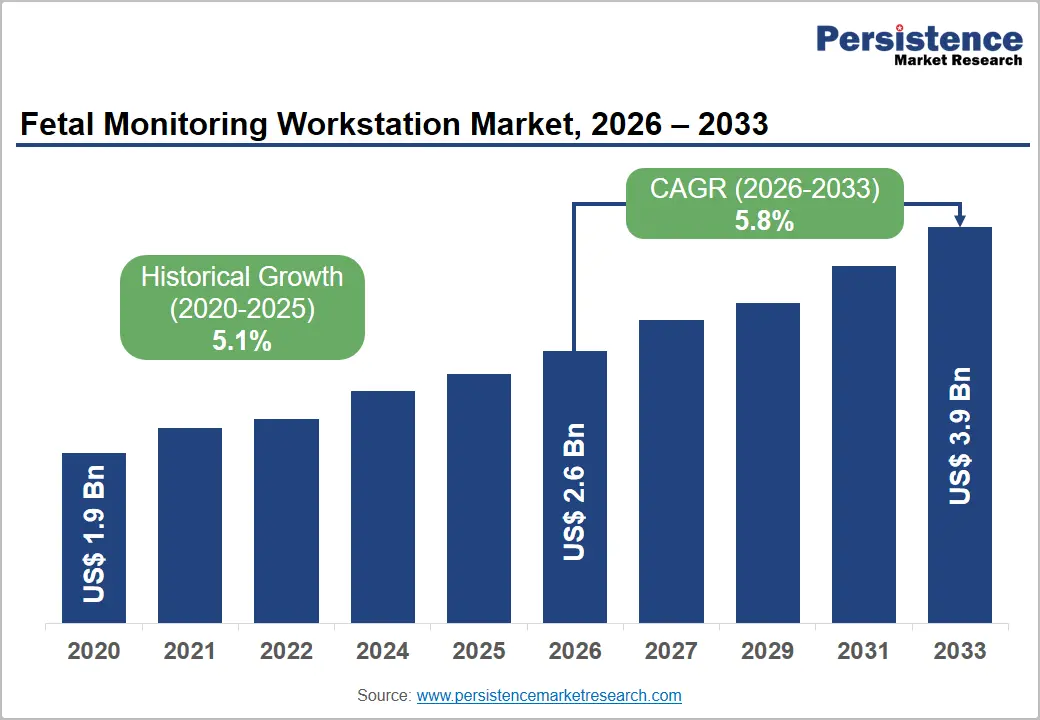
The global fetal monitoring workstation market size is likely to be valued at US$2.6 billion in 2026 and is projected to reach US$3.9 billion by 2033, growing at a CAGR of 5.8% during the forecast period from 2026 to 2033, driven by the increasing global birth volumes requiring advanced maternal-fetal surveillance, rising prevalence of high-risk pregnancies, and greater adoption of digital healthcare technologies across obstetric care settings. Growing investments in maternal health infrastructure, integration of electronic medical records (EMR), and increasing demand for real-time fetal assessment are strengthening the demand for advanced fetal monitoring systems. Healthcare providers are prioritizing clinical workflow optimization and early identification of fetal distress, supporting long-term adoption of fetal monitoring workstations across hospitals, clinics, and emerging telehealth platforms.
Key Industry Highlights:
- Dominant Display Configuration: Single monitor workstations are set to account for approximately 46% of market revenue in 2026, while multi-screen workstations are expected to be the fastest-growing segment through 2033, driven by centralized monitoring and advanced visualization requirements.
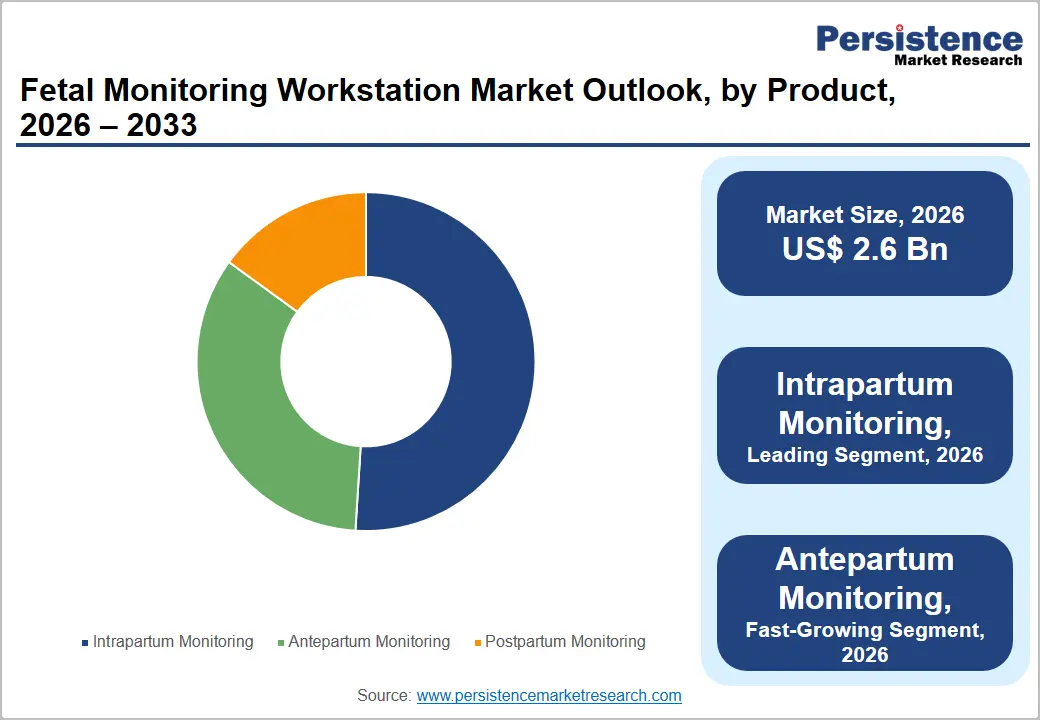
- Leading Application: Intrapartum monitoring is anticipated to lead with about 51% market share in 2026, while antepartum monitoring is likely to register the fastest growth during 2026–2033 due to rising high-risk pregnancy surveillance.
- Dominant End-user: Hospitals are projected to command nearly 61% of revenue in 2026, whereas telehealth service providers are expected to be the fastest-growing end-user segment through 2033, supported by expanding remote maternal care adoption.
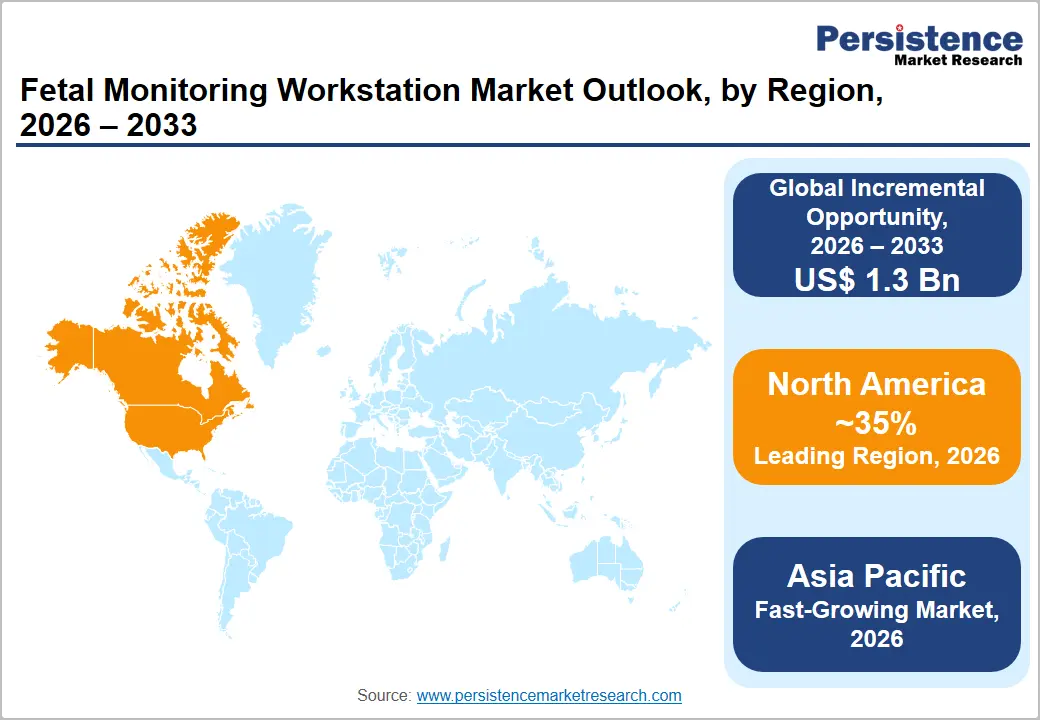
- Regional Leadership: North America is poised to dominate with an estimated 35% share in 2026, while Asia Pacific is expected to record the fastest growth through 2033, driven by healthcare infrastructure investments and increasing institutional births.
- Competitive Environment: Market competition is characterized by AI-enabled monitoring innovations, telehealth integration, cloud-based platforms, and strategic expansion into high-growth emerging markets.
DRO Analysis
Driver - Rising High-Risk Pregnancies and Maternal Health Surveillance Requirements
One of the primary growth drivers for the fetal monitoring workstation market is the increasing prevalence of high-risk pregnancies worldwide. According to the World Health Organization (WHO), approximately 295,000 women die annually from pregnancy-related complications, while millions experience severe maternal and neonatal complications. Simultaneously, advanced maternal age pregnancies continue to increase globally. Data from the U.S. Centers for Disease Control and Prevention (CDC) indicates a steady rise in births among women aged 35 years and above, a demographic associated with higher risks of fetal complications requiring continuous monitoring.
Healthcare systems are therefore investing in advanced fetal monitoring equipment capable of delivering real-time fetal heart rate analysis, uterine contraction tracking, and integrated clinical decision support. The growing emphasis on reducing neonatal mortality and improving obstetric outcomes has made continuous monitoring a standard clinical requirement in many developed healthcare systems, directly supporting workstation demand.
Restraint - High Capital Investment and Integration Complexity
Adoption of advanced fetal monitoring workstations remains constrained by significant upfront investment requirements. Beyond hardware procurement, healthcare providers must fund software licensing, interoperability upgrades, cybersecurity measures, staff training, and ongoing maintenance. These costs create barriers for smaller hospitals and clinics, particularly in developing economies where healthcare budgets remain limited. According to the World Bank, many low- and middle-income countries continue to face healthcare funding gaps that restrict investments in advanced digital healthcare infrastructure.
Integration complexity further limits adoption. Modern workstations must connect with electronic health records (EHRs), hospital information systems, and centralized monitoring networks while meeting stringent data security and regulatory requirements. The World Bank's Digital-in-Health assessment identifies interoperability challenges as a major obstacle to healthcare digitalization globally. As a result, many healthcare facilities delay modernization projects and extend the operational life of legacy monitoring systems, slowing the penetration of next-generation fetal monitoring technologies.
Opportunity – Expansion of Telehealth-Based Maternal Monitoring and Connected Care Models
The rapid expansion of telehealth and remote patient monitoring is creating a substantial growth opportunity for the fetal monitoring workstation market. According to the World Health Organization (WHO), over 120 countries have incorporated digital health initiatives into their national healthcare strategies, with maternal and reproductive health among the priority application areas. Increasing demand for prenatal care accessibility, particularly in rural and underserved regions, is encouraging healthcare providers to adopt connected monitoring platforms that enable remote assessment of fetal well-being and maternal health indicators.
Advancements in cloud computing, AI-enabled analytics, and secure data transmission are accelerating the development of integrated fetal monitoring solutions capable of supporting virtual care models. The International Telecommunication Union (ITU) estimates that global internet usage exceeded 5.5 billion people in 2024, expanding the potential patient base for digital maternal healthcare services. Furthermore, governments across Asia Pacific, North America, and Europe continue investing in healthcare digitalization programs, creating favorable conditions for telehealth-enabled fetal monitoring systems. As healthcare providers seek to improve access, reduce unnecessary hospital visits, and enhance pregnancy outcomes, connected maternal monitoring platforms are expected to become a major source of market expansion through 2033.
Category-wise Analysis
Display Configuration Insights
Single monitor workstations are expected to account for approximately 46% of market revenue in 2026, making them the leading display configuration segment. Their strong position is supported by widespread adoption across community hospitals and maternity clinics, where affordability and operational simplicity remain key procurement criteria. According to the WHO, nearly 80% of global births occur in healthcare facilities, creating sustained demand for standardized monitoring systems capable of supporting routine fetal assessment without requiring extensive infrastructure investments.
Multi-Screen workstations are projected to be the fastest-growing segment, advancing at an estimated 6.8% CAGR through 2033. Growth is being fueled by increasing investments in smart hospitals and centralized patient monitoring environments. In recent years, major healthcare systems across the U.S., Germany, and Japan have accelerated digital maternity ward modernization projects, incorporating multi-patient surveillance stations that enable clinicians to monitor multiple labor rooms simultaneously, improving operational efficiency and response times.
Application Insights
Intrapartum monitoring is anticipated to hold around 51% of the market share in 2026, maintaining its leadership position. The segment benefits from widespread clinical adoption of continuous fetal monitoring during labor, particularly for high-risk deliveries. According to the U.S. CDC, nearly 32% of births in the U.S. are delivered via cesarean section, highlighting the importance of continuous fetal surveillance to support timely clinical intervention and informed delivery management decisions.
Antepartum monitoring is expected to register the fastest growth, at an estimated 6.5% CAGR during 2026–2033. The segment is gaining momentum as pregnancy-related complications become increasingly common worldwide. Data from the International Diabetes Federation indicates that more than 20 million live births annually are affected by hyperglycemia during pregnancy, increasing demand for prenatal fetal assessment and proactive monitoring strategies aimed at reducing adverse maternal and neonatal outcomes.
End-user Insights
Hospitals are projected to dominate, accounting for approximately 61% of global revenue in 2026. Ongoing investments in maternal and neonatal care infrastructure reinforce their leadership. For example, numerous healthcare systems across Europe and North America have expanded specialized maternity and neonatal intensive care units (NICUs) over the past few years, increasing demand for integrated fetal monitoring workstations capable of supporting complex obstetric cases and centralized clinical oversight.
Telehealth service providers are expected to be the fastest-growing end-user segment, advancing at an estimated 7.2% CAGR through 2033. The segment is benefiting from broader adoption of remote patient monitoring technologies, a market that continues to attract substantial healthcare investment globally. Government-backed digital health programs in countries such as the U.S., U.K., Australia, and India are increasingly incorporating maternal health services into virtual care frameworks, enabling specialists to review fetal monitoring data remotely. These developments are expanding access to prenatal care while creating new deployment opportunities for connected fetal monitoring workstations.
Regional Insights
North America Fetal Monitoring Workstation Market Trends
North America is estimated to account for approximately 35% of global market revenue in 2026, supported by advanced healthcare infrastructure, increasing adoption of digital healthcare technologies, and growing investment in maternal-fetal care. The region is anticipated to witness continued deployment of AI-enabled clinical monitoring platforms, interoperable healthcare systems, and cloud-based patient management solutions. Rising focus on improving maternal outcomes and managing high-risk pregnancies is expected to sustain demand for advanced fetal monitoring workstations.
U.S. Fetal Monitoring Workstation Market Trends
The U.S. is projected to contribute approximately 84% of regional revenue in 2026, driven by ongoing hospital digitization efforts and increasing adoption of connected healthcare technologies. The growing implementation of AI-assisted monitoring tools, remote patient monitoring programs, and integrated EHR platforms is expected to support workstation demand. Continued investments in maternity care modernization and data-driven clinical workflows are likely to strengthen market growth over the forecast period.
Canada Fetal Monitoring Workstation Market Trends
Canada is estimated to account for nearly 16% of regional revenue in 2026, supported by expanding digital health initiatives and increasing adoption of virtual care services. Provincial healthcare systems are expected to continue investing in interoperable monitoring infrastructure and remote maternal care programs. These developments are likely to create favorable conditions for cloud-connected fetal monitoring solutions, particularly in geographically dispersed healthcare networks.
Europe Fetal Monitoring Workstation Market Trends
Europe is projected to represent approximately 28% of global market revenue in 2026, supported by established healthcare systems, strong maternal care standards, and ongoing healthcare digitalization efforts. The region is expected to witness increasing adoption of integrated monitoring ecosystems, centralized patient management platforms, and predictive clinical analytics tools. Regulatory alignment under MDR is likely to continue encouraging the deployment of advanced fetal monitoring technologies across healthcare facilities.
Germany Fetal Monitoring Workstation Market Trends
Germany is estimated to contribute approximately 22% of regional revenue in 2026, supported by continued investments in hospital digitization and healthcare technology modernization. Government-backed digital infrastructure programs are expected to accelerate adoption of centralized patient monitoring systems and connected clinical workflows. Growing implementation of smart hospital technologies is likely to strengthen demand for advanced fetal monitoring workstations throughout the forecast period.
U.K. Fetal Monitoring Workstation Market Trends
The U.K. is projected to account for approximately 18% of regional revenue in 2026, supported by ongoing maternity care transformation initiatives and digital healthcare investments. Expansion of electronic patient record systems, connected maternity services, and virtual care programs is expected to improve monitoring capabilities across obstetric departments. These developments are likely to support steady adoption of integrated fetal monitoring solutions.
Asia Pacific Fetal Monitoring Workstation Market Trends
Asia Pacific is estimated to account for approximately 25% of global market revenue in 2026 and is expected to register the fastest regional growth through 2033. Market expansion is likely to be supported by increasing institutional delivery rates, healthcare infrastructure development, growing maternal health investments, and accelerating adoption of digital healthcare platforms. Rising deployment of smart hospital technologies and connected healthcare solutions is also expected to create significant growth opportunities.
China Fetal Monitoring Workstation Market Trends
China is projected to contribute approximately 38% of regional revenue in 2026, supported by ongoing hospital modernization initiatives and continued implementation of the Healthy China 2030 strategy. Increasing adoption of AI-enabled healthcare solutions, cloud-based clinical platforms, and smart hospital technologies is expected to enhance demand for advanced fetal monitoring systems. Expansion of connected maternal healthcare services is also likely to support long-term market growth.
India Fetal Monitoring Workstation Market Trends
India is estimated to account for approximately 19% of regional revenue in 2026, supported by expanding maternal healthcare programs and ongoing healthcare digitalization efforts. Initiatives such as Pradhan Mantri Surakshit Matritva Abhiyan (PMSMA) and the Ayushman Bharat Digital Mission (ABDM) are expected to improve prenatal care accessibility and strengthen digital health infrastructure. Additionally, increasing investments by private hospital networks in telehealth and advanced obstetric monitoring technologies are likely to drive future market demand.
Competitive Landscape
The global fetal monitoring workstation market is estimated to be moderately consolidated, with leading players such as GE HealthCare, Philips Healthcare, Siemens Healthineers, and Huntleigh Healthcare collectively accounting for an estimated 50–55% of global revenue. These companies are expected to leverage their established hospital networks, regulatory expertise, and integrated monitoring platforms while continuing to invest in AI-enabled analytics, interoperability, and connected maternal care technologies.
Regional manufacturers such as Mindray, Edan Instruments, and Comen Medical are anticipated to expand through cost-competitive offerings and strong regional distribution capabilities. Barriers, including regulatory compliance, clinical validation requirements, and hospital IT integration, continue to limit new entrants; however, increasing adoption of cloud-based monitoring, telehealth platforms, and AI-supported clinical workflows is expected to create opportunities for software-focused healthcare technology providers. Market consolidation is likely to increase gradually through strategic acquisitions, technology partnerships, and digital health collaborations.
Key Industry Developments
- In February 2026, GE HealthCare partnered with Diagnoly to integrate the Fetoly AI solution into its Voluson women's health ultrasound platform, enhancing AI-assisted fetal cardiac and brain assessment capabilities and strengthening prenatal diagnostic accuracy.
- In January 2026, Nuvo Group reported the development of an AI-ready maternal-fetal dataset comprising more than 350,000 monitoring minutes across over 25,000 pregnancy sessions, creating one of the largest real-world physiological databases to support future AI-driven pregnancy monitoring innovations.
Companies Covered in Fetal Monitoring Workstation Market
- GE HealthCare
- Philips Healthcare
- Siemens Healthineers
- Natus Medical Incorporated
- Huntleigh Healthcare
- FUJIFILM Sonosite
- Medtronic plc
- Drägerwerk AG
- Edan Instruments
- Bionet Co., Ltd.
- Shenzhen Comen Medical Instruments
- Mindray Medical International
- Analogic Corporation
- CooperSurgical
- Mediana Co., Ltd.
Frequently Asked Questions
The global fetal monitoring workstation market is projected to reach US$2.6 billion in 2026.
Rising high-risk pregnancies, expanding healthcare digitalization, and increasing demand for continuous maternal-fetal monitoring drive market growth.
The fetal monitoring workstation market is expected to grow at a CAGR of 5.8% from 2026 to 2033.
Telehealth-enabled maternal monitoring, AI-integrated monitoring platforms, and healthcare infrastructure expansion create significant growth opportunities.
GE HealthCare, Philips Healthcare, Siemens Healthineers, Huntleigh Healthcare, and Natus Medical are among the leading market participants.


