




- Technology
- Fall Detection System Market
Fall Detection System Market Size, Share, and Growth Forecast 2026 - 2033
Fall Detection System Market by Product Type (Automatic Fall Detection Systems, Manual Fall Detection Systems), Sensing Method (Wearable (Watches, Necklaces, Clip-to-Garments), Non-Wearable (Floor Sensors, Wall Sensors)), Technology (GPS-based, Mobile Phone-based, Sensor-based), End-User (Home Care Settings, Assisted Living Facilities), and Regional Analysis, 2026-2033

Fall Detection System Market Size and Trend Analysis
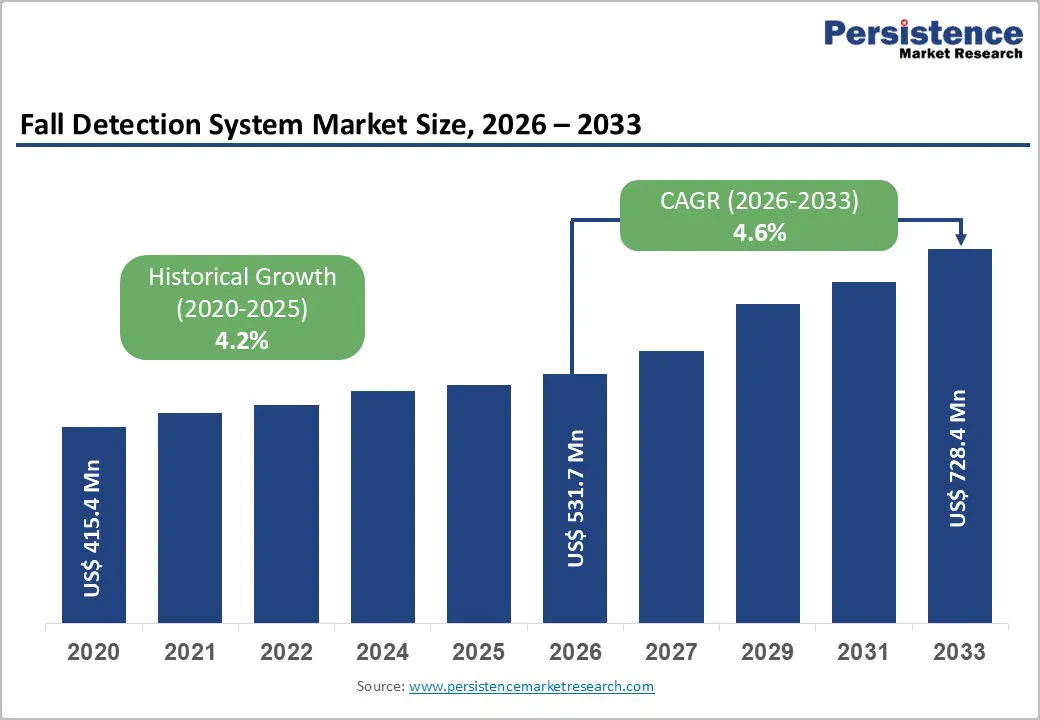
The global fall detection system market size is expected to be valued at US$ 531.7 million in 2026 and projected to reach US$ 728.4 million by 2033, growing at a CAGR of 4.6% between 2026 and 2033.
Rise in geriatric population drives this growth as falls remain a leading cause of injury in this group. According to the World Health Organization, falls result in over 37 million severe injuries annually, with nearly 30% of individuals aged 65 and above experiencing at least one fall each year. Data from the Centers for Disease Control and Prevention further highlights the benefits of early detection technologies in reducing hospital admissions and improving emergency response outcomes.
Key Highlights:
- Leading Region - North America dominates the Fall Detection System market with a 38% share in 2025, supported by advanced healthcare infrastructure and a high incidence of elderly falls.
- Fastest Growing Region - Asia Pacific, holding 32% share in 2025, is the fastest-growing region driven by rapid aging populations across Japan, China, and India.
- Leading Product Category - Automatic Fall Detection Systems lead with a 62% share in 2025 due to hands-free reliability and higher adoption in home care settings.
- Leading Sensing Method - Wearable devices command a 70% share in 2025, supported by portability, continuous monitoring, and smart device integration.
- Key Opportunity - Smart home integration presents significant growth potential as connected ecosystems enhance real-time monitoring and aging-in-place solutions.
| Key Insights | Details |
|---|---|
| Fall Detection System Size (2026E) | US$ 531.7 million |
| Market Value Forecast (2033F) | US$ 728.4 million |
| Projected Growth CAGR (2026 - 2033) | 4.6% |
| Historical Market Growth (2020 - 2025) | 4.2% |
Market Dynamics
Drivers - Rising Geriatric Population Increasing Fall Risks and Demand for Safety Solutions
The global rise in the elderly population is significantly increasing fall-related health risks, driving demand for advanced detection systems. According to the United Nations, the population aged 60+ is projected to reach 2.1 billion by 2050. The Centers for Disease Control and Prevention reports that one in four older adults in the U.S. experiences a fall annually, resulting in nearly three million emergency visits.
Falls often lead to severe complications such as hip fractures, affecting nearly 300,000 seniors each year in the U.S., increasing hospitalization and long-term care costs. Fall detection systems provide immediate alerts to caregivers, reducing response times and mitigating injury severity. Growing preference for aging-in-place and smart home integration further strengthens adoption across home care and assisted living settings.
Advancements in Wearable and IoT Technologies Enhancing Detection Accuracy
Technological innovation in wearable devices and IoT ecosystems is accelerating market growth by improving fall detection precision and connectivity. With global connected devices expected to surpass 25 billion by 2025, wearable sensors such as accelerometers and gyroscopes now achieve up to 95% detection accuracy, according to studies by the National Institutes of Health. These advancements enhance real-time monitoring and emergency communication.
Modern systems integrate with mobile applications and cloud platforms, reducing false alarms by nearly 40% while ensuring continuous tracking. Policy support, including digital health initiatives from the European Commission, promotes adoption of connected healthcare technologies. Rising healthcare expenditures and demand for proactive monitoring solutions continue to drive widespread implementation globally.
Restraints - High Costs and Limited Accessibility Restrict Widespread Adoption
The relatively high upfront cost of fall detection systems remains a key barrier, particularly in price-sensitive markets. Premium devices typically range between US$ 200-500 per unit, excluding installation and monitoring subscriptions that can add 20-30% to total expenses. The World Health Organization estimates that nearly one billion people globally lack access to essential assistive technologies, underscoring affordability challenges.
In developing economies, limited reimbursement frameworks and uneven insurance coverage further constrain adoption. Although evidence from the National Institute for Health and Care Excellence highlights the effectiveness of such systems in reducing fall-related injuries, cost sensitivity among households and care facilities continues to slow large-scale market penetration.
Privacy Concerns and False Positives Undermining User Confidence
Data privacy and security concerns present significant restraints in the fall detection system market. Regulations such as the European Commission’s GDPR framework impose strict compliance requirements on connected health devices, affecting IoT-enabled monitoring solutions. Cybersecurity reports indicate that privacy-related concerns influence adoption decisions across a considerable share of digital health products.
Additionally, biomedical studies show false positive alerts occurring in approximately 10-20% of cases, leading to alert fatigue among caregivers and users. Repeated false alarms reduce trust in system reliability, particularly in non-wearable sensor-based models. These performance and compliance challenges continue to limit broader consumer confidence and institutional deployment.
Opportunity - Smart Home Ecosystem Integration Creating Next-Generation Care Opportunities
Integration of fall detection systems with smart home platforms presents strong growth potential as connected home adoption accelerates globally. Smart home users are projected to reach hundreds of millions by the late 2020s, creating a robust digital infrastructure for connected health devices. Collaborations with platforms such as Amazon Alexa and Google Nest enable seamless emergency alerts and voice-enabled assistance, improving response efficiency.
Pilot programs demonstrate significantly faster emergency interventions when systems are integrated into home automation ecosystems. Support from the Administration for Community Living further promotes aging-in-place initiatives. Companies leveraging AI-driven predictive analytics can enhance preventive monitoring, expanding long-term revenue opportunities in elderly home care.
Emerging Markets Offering Growth Through Affordable and Scalable Solutions
Emerging economies present substantial opportunities as aging demographics expand rapidly across Asia Pacific. In Japan, nearly 29% of the population is aged 65 and above, increasing demand for elderly monitoring technologies. Government-backed healthcare initiatives such as Ayushman Bharat improve affordability and access to digital health solutions.
Low-cost, sensor-based and non-wearable systems are gaining traction in cost-sensitive markets, particularly in assisted living facilities. Engineering studies indicate that floor-based sensor technologies can achieve high detection accuracy while remaining economical. Expanding local manufacturing hubs and supportive healthcare policies enable scalable production, positioning emerging regions as high-growth markets for accessible fall detection solutions.
Category-wise Analysis
Product Type Insights
Automatic fall detection systems account for 62% share in 2025 due to their hands-free functionality and suitability for elderly users, particularly those with cognitive impairments. Regulatory clearances from the U.S. Food and Drug Administration reinforce product reliability, while clinical trials demonstrate nearly 85% sensitivity in real-world fall detection scenarios. Growing preference for non-intrusive, real-time monitoring systems further strengthens adoption, especially in home care settings where maintaining independence is a priority.
Manual fall detection systems are witnessing steady growth as cost-effective alternatives, particularly in price-sensitive and emerging markets. These systems appeal to users seeking greater control over emergency alerts and minimal automation. Improvements in ergonomic wearable buttons and enhanced connectivity features are expanding their relevance in assisted living environments and community-based elderly care programs.
Sensing Method Insights
Wearable sensing methods account for a 70% share in 2025, driven by portability and continuous 24/7 monitoring capabilities. Devices such as the Apple Watch incorporate advanced accelerometers and gyroscopes, with medical validations indicating up to 97% post-fall detection accuracy. Lightweight, discreet designs and integration with mobile applications enhance user compliance, making wearables highly suitable for active seniors and independent living scenarios.
Non-wearable sensing systems are emerging rapidly as smart home adoption increases. Floor and wall-mounted sensors provide passive monitoring without requiring users to wear devices, addressing compliance concerns. Advancements in radar, infrared, and pressure-sensing technologies are improving environmental detection accuracy, making these systems attractive for assisted living facilities and institutional care environments.
Technology Insights
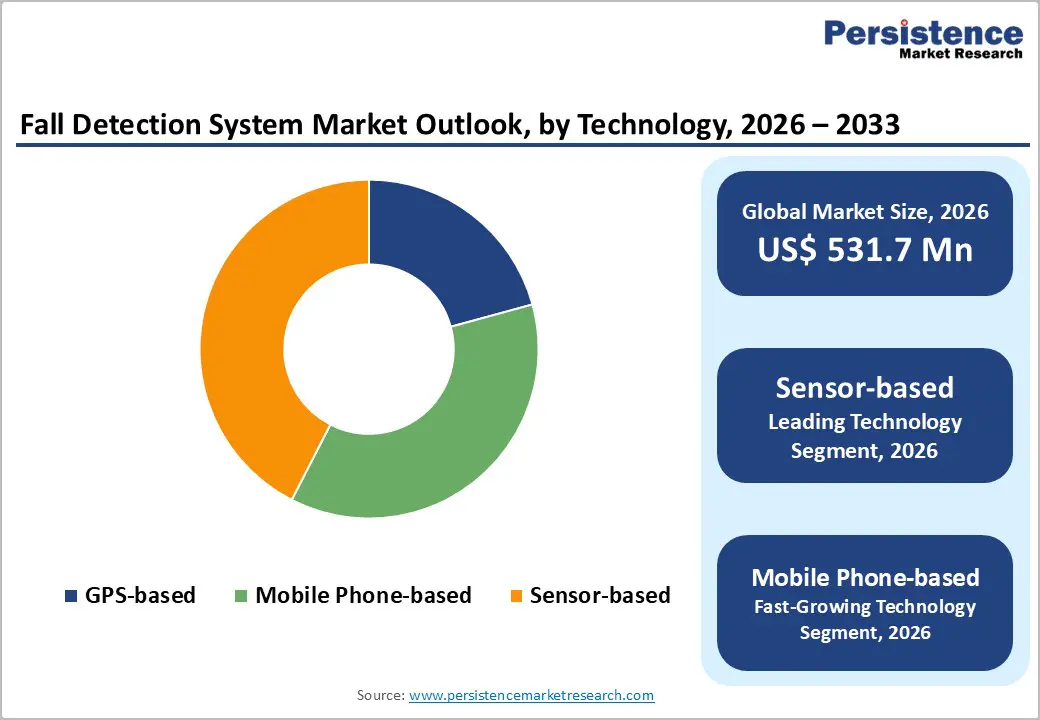
Sensor-based technology leads the market with a 55% share in 2025, owing to high precision enabled by accelerometers, gyroscopes, and machine learning algorithms. Research studies indicate approximately 92% accuracy in distinguishing actual falls from routine activities, outperforming GPS-based systems in indoor environments. Integration with IoT platforms and cost-effective hardware components further strengthens adoption across home and facility-based monitoring solutions.
Mobile phone-based technology is emerging as the fastest-growing segment, supported by widespread smartphone penetration and app-based health monitoring. Built-in motion sensors allow fall detection without additional hardware, lowering entry barriers for consumers. Continuous software updates, AI-driven improvements, and seamless emergency communication features are accelerating uptake, particularly among tech-savvy elderly populations.
End-user Insights
Home care settings with a 68% share in 2025, reflecting strong aging-in-place preferences. Surveys show that nearly 77% of seniors prefer to remain in their own homes, fueling demand for reliable fall detection solutions. Home-based systems contribute to reduced hospitalizations by around 15%, supporting cost savings and easing pressure on healthcare infrastructure amid caregiver shortages.
Assisted living facilities represent the fastest-growing end-user segment as institutions increasingly adopt centralized monitoring systems. Integration with digital health records and facility-wide alert dashboards enhances response coordination. Rising occupancy in senior living communities and growing emphasis on resident safety standards are further driving adoption across professional care environments.
Regional Insights
North America Fall Detection System Market Trends
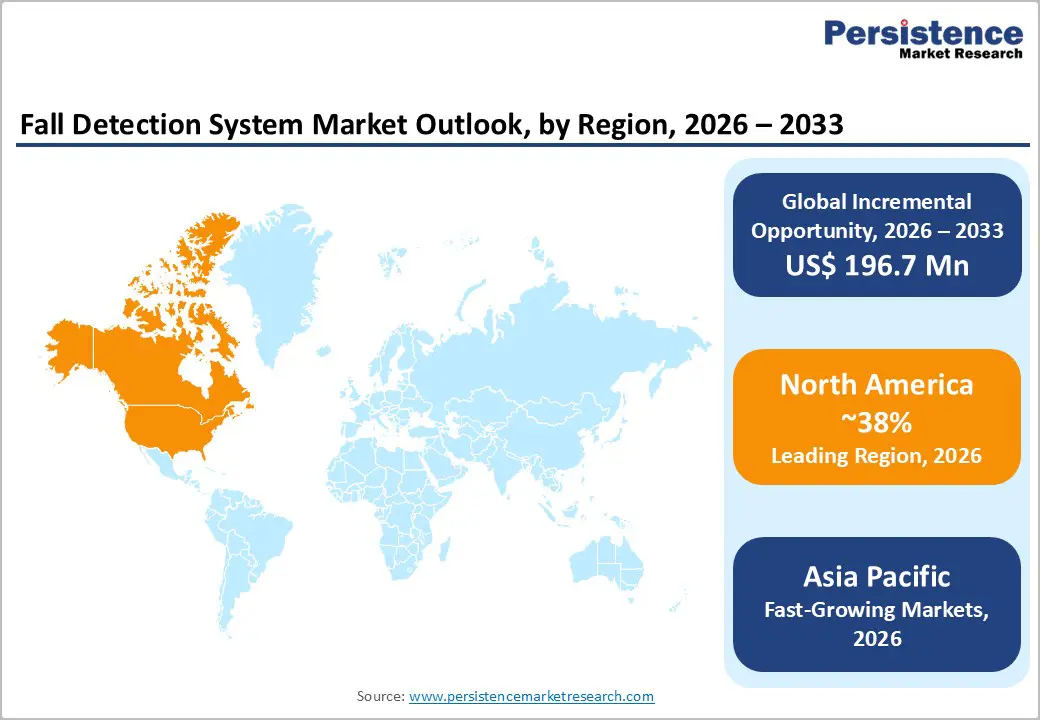
North America leads the global market with a 38% share in 2025, supported by advanced healthcare infrastructure and strong reimbursement frameworks. The Centers for Disease Control and Prevention reports approximately 36 million senior falls annually in the United States, reinforcing the need for preventive monitoring solutions. Regulatory clearances from the U.S. Food and Drug Administration further strengthen consumer confidence in wearable and sensor-based devices.
Innovation hubs such as Silicon Valley accelerate AI-driven enhancements and connected health ecosystems. Public programs, including Medicare coverage for high-risk seniors, expand accessibility. Growing integration with telehealth platforms and smart home systems continues to reinforce regional dominance in both home care and assisted living environments.
Europe Fall Detection System Market Trends
Europe demonstrates steady expansion and is projected to achieve a CAGR of 4.2% between 2026 and 2033, driven by aging demographics and strong public healthcare systems. Countries such as Germany and United Kingdom are at the forefront, where pilot programs under the National Health Service have reduced accident and emergency visits through early intervention initiatives. Policy coordination under European digital health frameworks promotes standardized device approvals and interoperability. According to Eurostat, the share of individuals aged over 65 is expected to rise significantly by 2050, reinforcing long-term demand. Strict data protection regulations also encourage GDPR-compliant device development, strengthening consumer trust across the region.
Asia Pacific Fall Detection System Market Trends
Asia Pacific accounts for a 32% share in 2025 and represents the fastest-growing regional market due to rapid demographic transitions. In Japan, nearly 29% of the population is aged 65 and above, supporting widespread adoption of home-based monitoring systems. Government-backed subsidies encourage integration of fall detection technologies within elderly housing and community healthcare programs. In China, smart sensor deployment in senior living communities is expanding, while India and ASEAN economies benefit from growing manufacturing capabilities and cost-effective production. Projections from the United Nations indicate a sharp rise in the elderly population by 2050, sustaining long-term regional demand.
Competitive Landscape
The fall detection system market is moderately consolidated, with leading players strengthening their positions through continuous investment in AI-enabled sensor technologies and advanced analytics. Companies focus on improving detection accuracy, minimizing false positives, and enhancing battery efficiency to differentiate their offerings. Strategic mergers, acquisitions, and technology partnerships are commonly used to expand product portfolios, geographic presence, and integration capabilities within digital health ecosystems.
At the same time, emerging participants are reshaping competition through subscription-based monitoring models and service-oriented offerings. Collaborations with home care providers, assisted living operators, and telehealth platforms are expanding B2B opportunities. Emphasis on cloud connectivity, remote monitoring dashboards, and predictive analytics is further intensifying innovation-driven competition.
Key Developments:
- In January 2025, Apple upgraded the Apple Watch with advanced AI-powered fall detection capabilities, enhancing real-time accuracy and expanding availability across multiple international markets to strengthen its position in connected health and elderly safety solutions.
- In June 2024, Google integrated fall detection alerts into Google Nest devices and partnered with insurance providers to offer premium discounts, promoting adoption of smart home-based elderly monitoring solutions.
- In October 2023, Philips introduced its Lifeline auto-alert system, receiving clearance from the U.S. Food and Drug Administration with reported 95% detection accuracy to enhance emergency response reliability.
Companies Covered in Fall Detection System Market
- Koninklijke Philips N.V.
- Tunstall Healthcare
- ADT Inc.
- Medical Guardian LLC
- Bay Alarm Medical
- MobileHelp
- MariCare Oy
- KamiVision
- Empatica Inc.
- CarePredict
- Apple Inc.
- Samsung Electronics
- Garmin Ltd.
- Vayyar Imaging
- VitalConnect
Frequently Asked Questions
The Fall Detection System market is projected to reach US$ 531.7 million in 2026, supported by strong adoption in Home Care Settings, which hold a 68% share in 2025.
A major demand driver is the rising geriatric population, with the World Health Organization reporting 37 million annual severe fall injuries, accelerating the adoption of Automatic Systems that hold a 62% share in 2025.
North America leads the market with a 38% share in 2025, driven by strong healthcare infrastructure, innovation ecosystems, and regulatory support in the United States.
Smart home integration presents a major opportunity, particularly in the Asia Pacific, which accounts for 32% share in 2025, as connected ecosystems enhance wearable and sensor-based monitoring adoption.
Key players include Philips, Apple, Google, and BioSensics, competing through AI-enabled sensor-based technologies.


