Expectorant Drugs Market Size, Share, and Growth Forecast for 2025 - 2032

Market Study on Expectorant Drugs: PMR Predicts a Host of Opportunities on the Horizon, Analysing the Demand for Oral Drugs, Rising Prevalence of Respiratory Conditions, and the Growing Awareness About the Importance of Mucus Clearance

ID: PMRREP33736
Calendar

February 2025

178 Pages

Author : Abhijeet Surwase

Expectorant Drugs Market

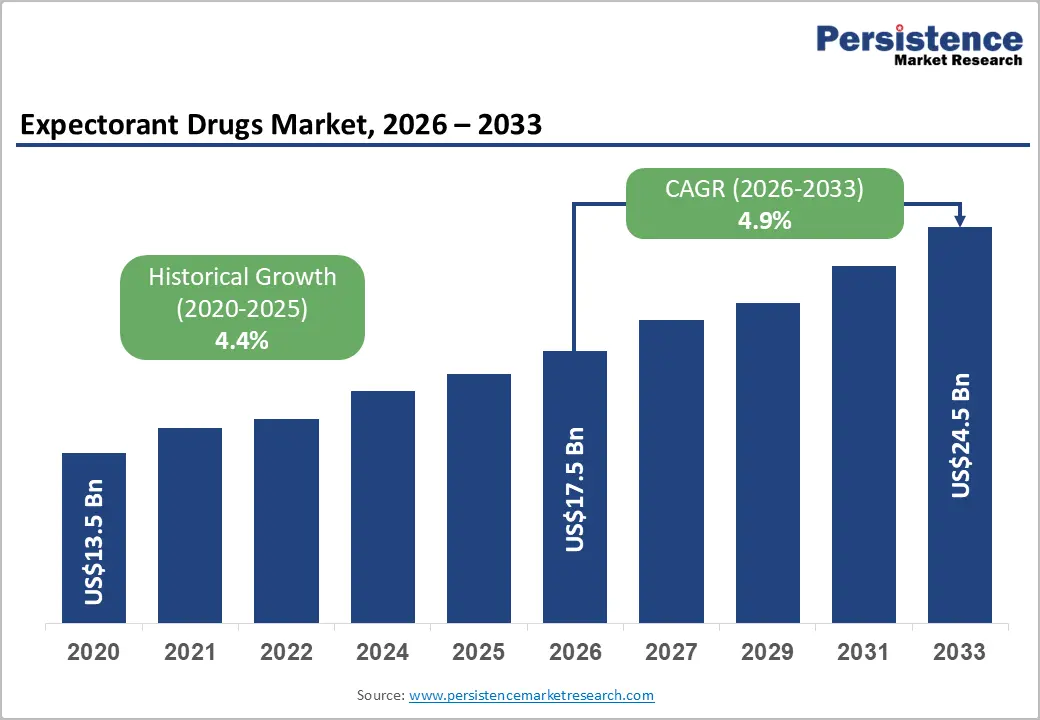
The global expectorant drugs market is forecast to expand at a CAGR of 4.9% and thereby increase from a value of US$ 16.7 Bn in 2025, to US$ 23.4 Bn by the end of 2032.

Attributes

Key Insights

Expectorant Drugs Market Size (2025E)

US$ 16.7 Bn

Projected Market Value (2032F)

US$ 23.4 Bn

Global Market Growth Rate (CAGR 2025 to 2032)

4.9%

Historical Market Growth Rate (CAGR 2019 to 2024)

3.8%

Market Introduction and Definition

Expectorant drugs play a pivotal role in respiratory healthcare, aiming to alleviate symptoms associated with respiratory conditions such as coughs and congestion. These medications are designed to facilitate the removal of mucus and phlegm from the respiratory tract, promoting easier breathing and providing relief to individuals experiencing respiratory distress. The primary aim is to enhance the efficiency of the cough reflex and reduce the viscosity of mucus, making it easier for individuals to clear their airways. By fostering the expulsion of mucus, expectorant drugs contribute to a more comfortable and effective management of respiratory ailments, ensuring a smoother recovery for patients dealing with conditions ranging from the common cold to chronic respiratory disorders.

The expectorant drugs market is propelled by several key drivers that underscore the significance of respiratory health. The increasing prevalence of respiratory disorders, including chronic obstructive pulmonary disease (COPD) and asthma, fuels the demand for expectorant drugs. Additionally, the heightened awareness among both healthcare professionals and patients regarding the importance of early intervention and effective symptom management further stimulates market growth. Opportunities in the market lie in the development of innovative formulations, combination therapies, and the expansion of product portfolios by pharmaceutical companies.

Market Growth Drivers

Increasing Incidence of Respiratory Disorders

One of the primary drivers propelling the higher market growth of expectorant drugs is the escalating prevalence of respiratory disorders worldwide. Conditions such as chronic bronchitis, asthma, and chronic obstructive pulmonary disease (COPD) continue to affect a substantial portion of the global population. This increasing burden of respiratory ailments necessitates effective pharmaceutical interventions, driving the demand for expectorant drugs. As the incidence of respiratory disorders rises, pharmaceutical companies are compelled to invest in research and development, innovating new formulations and expanding product portfolios to meet the evolving needs of patients.

In addition, the emphasis on early symptom management in respiratory healthcare serves as another key factor fuelling the growth of the expectorant drugs market. Healthcare professionals and patients alike are recognizing the importance of proactive intervention to alleviate symptoms like cough and congestion before they escalate. This preventive approach not only improves the quality of life for individuals with respiratory conditions but also contributes to reducing healthcare costs associated with more severe stages of respiratory diseases. The shift towards early intervention aligns with a broader trend in healthcare, fostering a conducive environment for expectorant drugs to witness higher market growth by addressing respiratory symptoms promptly and efficiently.

Market Restraints

Stringent Regulations

One critical factor that might affect the market performance of expectorant drugs pertains to regulatory stringency. Evolving regulations and stringent approval processes set by health authorities can significantly impact the development, manufacturing, and commercialization timelines for expectorant medications. Stringent regulatory measures aim to ensure the safety and efficacy of pharmaceutical products but can potentially lead to prolonged market entry timelines. The demanding regulatory landscape may pose challenges for market players, necessitating robust compliance strategies and extensive clinical evidence. Navigating these regulatory hurdles effectively will be crucial for companies aiming to maintain dominance in the expectorant drugs market, ensuring timely product launches and market accessibility amid evolving regulatory requirements.

Complexities in Regulatory Compliance

One substantial challenge that the expectorant drugs market may encounter revolves around regulatory compliance complexities. Meeting stringent regulatory requirements, including safety assessments and efficacy validations, can pose significant hurdles for market players. The evolving regulatory landscape necessitates continuous adaptation to changing standards, potentially leading to delays in product approvals and market entry. Balancing innovation with regulatory compliance becomes a delicate task, requiring substantial investments in research, development, and robust quality assurance measures. Successfully overcoming these regulatory challenges will be crucial for sustaining market competitiveness and ensuring the availability of safe and effective expectorant medications to meet the evolving needs of patients.

Opportunities

Innovative Formulations, and Combination Therapies

A significant revenue opportunity lies in the exploration and development of innovative formulations and combination therapies within the expectorant drugs market. Pharmaceutical companies can capitalize on advancements in drug delivery systems, such as extended-release formulations or novel administration routes, to enhance the efficacy and patient adherence of expectorant medications. Moreover, combining expectorants with complementary agents, such as bronchodilators or anti-inflammatory drugs, presents a promising avenue for creating comprehensive treatment regimens. This strategic approach not only addresses multiple aspects of respiratory conditions but also provides a unique selling proposition, fostering increased market penetration and revenue generation.

Moreover, expanding product portfolios to address a spectrum of respiratory challenges offers another active opportunity for revenue growth in the expectorant drugs market. Pharmaceutical companies can focus on developing expectorant formulations tailored to specific respiratory disorders, such as paediatric coughs, geriatric respiratory ailments, or conditions with unique mucolytic requirements. By catering to diverse patient demographics and their distinct healthcare needs, companies can establish themselves as comprehensive respiratory care providers. This approach not only broadens market reach but also positions companies to capture a larger share of the expectorant drugs market by offering specialized solutions for various respiratory challenges, contributing to sustained revenue growth.

Analyst’s Viewpoint

The evolving landscape of the expectorant drugs market reflects a compelling narrative shaped by rising respiratory concerns globally. With an increased understanding of respiratory wellness, pharmaceutical advancements, and lifestyle-induced ailments, the market stands at a pivotal juncture. The subheading reflects a comprehensive analysis of key market drivers, such as the growing burden of respiratory disorders, advancements in medical research, and a heightened emphasis on preventive healthcare. Exploring the pharmaceutical industry's response to respiratory health challenges, the analysis delves into the competitive landscape, regulatory influences, and emerging opportunities. In an era of heightened health consciousness, the expectorant drugs market serves as a vital component in addressing the complexities of respiratory health, paving the way for innovative solutions and improved patient outcomes.

Supply-side Dynamics

The supply-side dynamics in the expectorant drugs market are influenced by a multifaceted interplay of factors. Pharmaceutical companies and manufacturers play a pivotal role in ensuring a steady supply of expectorant drugs to meet the escalating demand. Robust research and development efforts to formulate effective expectorant medications, adherence to stringent quality standards, and strategic partnerships for sourcing raw materials contribute to a resilient supply chain. Furthermore, technological advancements in manufacturing processes enhance production efficiency, ensuring a consistent and reliable supply of expectorant drugs to healthcare providers and end-users. The evolving regulatory landscape also shapes supply-side dynamics, with manufacturers navigating compliance requirements to maintain product quality and safety.

China stands as a cornerstone in the global supply chain for expectorant drugs, playing a pivotal role in meeting the escalating demand. As a major supplier, China benefits from its robust pharmaceutical manufacturing infrastructure, skilled workforce, and cost-effective production capabilities. The country's pharmaceutical sector has witnessed substantial growth, bolstered by investments in research and development, fostering innovation in drug formulations. Chinese pharmaceutical companies contribute significantly to the global supply of expectorant drugs, meeting both domestic and international needs.

Top Regional Markets

Europe Holds the Strongest Foothold

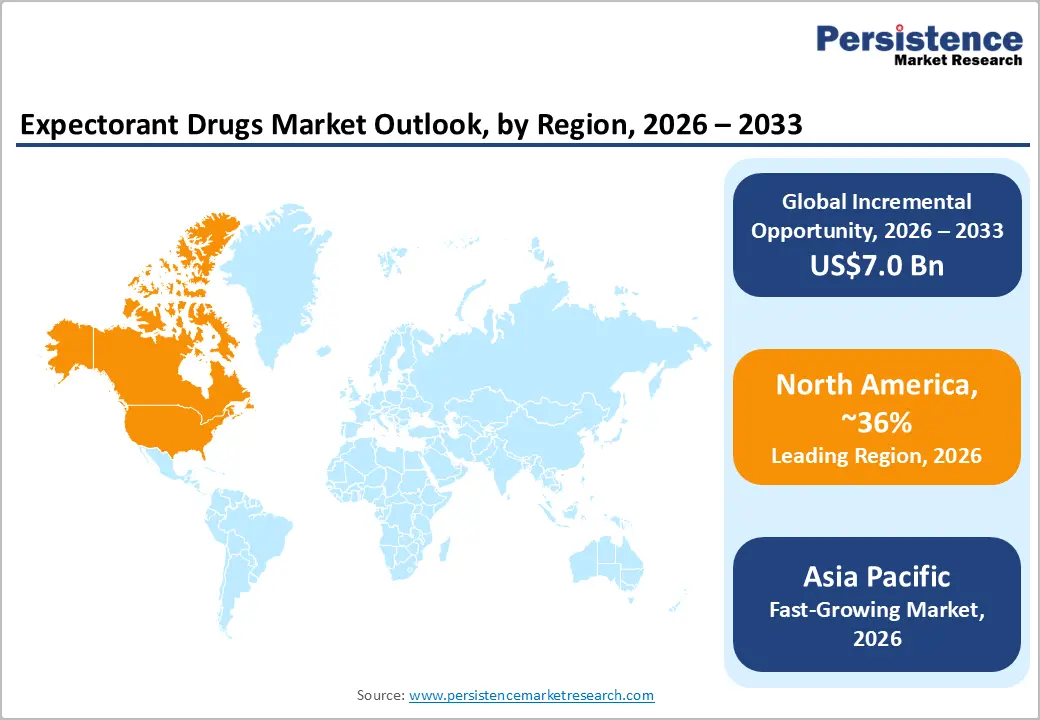
Europe is emerging as the dominating region in the expectorant drugs market due to its robust healthcare infrastructure and the persistent challenges posed by respiratory conditions. The region boasts well-established healthcare systems with advanced medical facilities and a strong network of pharmacies. Additionally, the prevalence of respiratory disorders, including chronic obstructive pulmonary disease (COPD) and asthma, remains significant in Europe. The region's proactive approach in managing respiratory health, coupled with a high awareness of expectorant medications, positions it at the forefront. Europe's dominance is further propelled by the continuous efforts to address respiratory health issues, emphasizing the significance of expectorant drugs in combating respiratory ailments effectively.

South Asia, and the Pacific Slated to Witness Exceptional Growth

South Asia, and the Pacific emerges as the fastest-growing region in the expectorant drugs market, driven by rapid urbanization and a surge in respiratory ailments. The region's dynamic urban landscape, marked by expanding cities and changing lifestyles, contributes to an increased prevalence of respiratory issues. Factors such as air pollution, environmental changes, and lifestyle choices elevate the demand for expectorant drugs. Moreover, a growing awareness of respiratory health and improved healthcare infrastructure in the region further fuels the market's rapid expansion. South Asia, and the Pacific's proactive response to addressing respiratory challenges positions it as a key player in the global expectorant drugs market, with sustained growth anticipated in the foreseeable future.

Competitive Intelligence and Business Strategy

Prominent organizations, including Abbott Laboratories, Acella Pharmaceuticals LLC, Astrazeneca Plc., Cipla Limited, Dabur India Ltd, and G lenmark Pharmaceuticals Limited are at the vanguard of this sector. Competitive intelligence in the expectorant drugs market involves a systematic and ethical gathering of information about market rivals to gain insights into their strategies, strengths, weaknesses, and market positioning. Pharmaceutical companies engaged in manufacturing expectorant drugs closely monitor competitors' product portfolios, pricing strategies, and regulatory compliance. Analysing competitors' clinical trial activities and research initiatives helps in benchmarking and staying ahead in terms of innovation. This intelligence empowers companies to make informed decisions, anticipate market trends, and devise strategies for sustainable growth. A dynamic competitive intelligence framework is crucial for navigating the evolving landscape of the expectorant drugs market and adapting to changing consumer preferences and regulatory environments.

Successful business strategy in the expectorant drugs market requires a comprehensive approach that aligns with market dynamics, regulatory requirements, and patient needs. Companies focus on developing innovative formulations, ensuring product efficacy, and differentiating themselves through unique selling propositions. Strategic partnerships with healthcare providers, distributors, and pharmacies facilitate market penetration and enhance the availability of expectorant drugs.

Key Recent Developments

New Product Launch

In October 2023, Efficient Laboratories, a Puerto Rican firm that distributes its brands of healthcare products, launched a new product, ROMPR PECHITO, an OTC medicine for children to relieve cold symptoms.

Market Impact: The introduction of this new product added to the range of available options for consumers seeking effective and child-friendly solutions for cold relief, potentially influencing market dynamics and meeting the demand for pediatric cough and cold medications.

In September 2023, Genexa announced new clean over-the-counter (OTC) kids' medicines, further strengthening its leading role in bringing consumers clean, safe, and effective medications.

Market Impact: The introduction of new clean over-the-counter (OTC) kids' medicines by Genexa in September 2023 has significantly impacted the Expectorant Drugs Market. Genexa's commitment to providing clean, safe, and effective medications reinforces its position as a leader in the industry, influencing consumer preferences towards healthier and cleaner alternatives in the Expectorant Drugs Market.

Expectorant Drugs Market Research Segmentation

By Drug Type:

  • Secretion Enhancer
    • Potassium Citrate
    • Potassium Iodide
    • Sodium Citrate
    • Guaiphenesin
    • Ammonium Chloride
    • Others
  • Mucolytics
    • Bromhexine
    • Ambroxol
    • Acetyl Cysteine
    • Carbocisteineurine

By Dosage Form:

  • Oral Solid
  • Oral Liquid
  • Inhalant

By Product Type:

  • Over-The-Counter (OTC)
  • Prescription Drug

By Distribution Channel:

  • Hospital Pharmacies
  • Retail Store
  • Drug Store
  • Online Pharmacies

By Region:

  • North America
  • Europe
  • East Asia
  • South Asia & Oceania
  • Latin America
  • Middle East & Africa

Companies Covered in Expectorant Drugs Market

  • Abbott Laboratories
  • Acella Pharmaceuticals LLC
  • Astrazeneca Plc.
  • Cipla Limited
  • Dabur India Ltd
  • Glenmark Pharmaceuticals Limited
  • Johnson and Johnson
  • Merck KGaA
  • Novartis International AG
  • Pfizer Inc.
  • Proctor and Gamble Co
Frequently Asked Questions

The market is anticipated to grow at a CAGR of 4.9% during the projected period.

The expectorant drugs market will be valued at USD 16.7 billion in 2025.

The US will hold the largest market share in 2025.

The prominent players in the market are Abbott Laboratories,Acella Pharmaceuticals LLC, Astrazeneca Plc., Cipla Limited, Dabur India Ltd, and Glenmark Pharmaceuticals Limited.

The prescription drug segment is expected to grow at the fastest CAGR during the forecast period.

Market Segmentation

Which Category of Drugs Leads Revenue Generation?

Sales of Respiratory Relief Products Maximum

Secretion enhancers emerge as the dominant category in the expectorant drugs market due to their pivotal role in fostering effective respiratory relief. These medications work by stimulating and optimizing the natural processes of mucous secretion in the respiratory tract, aiding in the expulsion of accumulated mucus. Mucolytics establish dominance in the expectorant drugs market by offering a distinctive therapeutic advantage in facilitating the breakdown of mucus. These medications work by altering the properties of respiratory secretions, making them less viscous and easier to mobilize. The ability of mucolytics to enhance the fluidity of mucus promotes efficient clearance from the airways, providing relief from respiratory symptoms.

Which Dosage Form Represents the Largest Segment Globally?

Oral Solid Forms Dominate with their Optimal Delivery for Patient Convenience

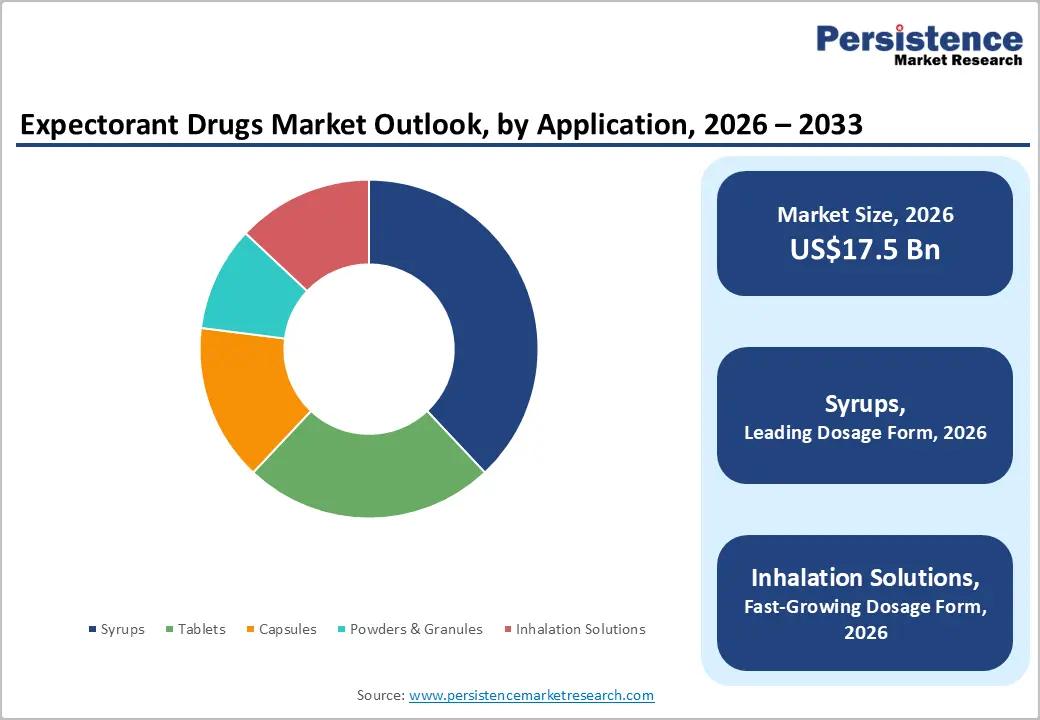
The oral solid dosage form asserts dominance in the expectorant drugs market, primarily due to its optimal delivery mechanism that ensures patient convenience and adherence. Tablets and capsules within this category offer precise dosing, ease of administration, and accurate control over the release of expectorant medications. Furthermore, the oral liquid dosage form emerges as the fastest category in the expectorant drugs market, offering fast and versatile respiratory relief. Liquid expectorant formulations are favoured for their rapid onset of action, enabling quick absorption and efficacy in addressing symptoms such as cough and congestion.

What is the Prominent Product Type Category?

OTC Segment to be at the Forefront

The over-the-counter (OTC) category establishes dominance in the expectorant drugs market, driven by its accessibility and the empowerment it provides to consumers. OTC expectorant drugs, available without a prescription, offer individuals the flexibility to self-diagnose and self-administer for common respiratory symptoms. This accessibility contributes to timely intervention, enabling consumers to address coughs and congestion promptly. Furthermore, the prescription drug category maintains dominance in the expectorant drugs market, attributed to the tailored therapeutic approaches and clinical oversight it affords. Prescription expectorant medications are often recommended for more complex respiratory conditions or cases requiring a nuanced treatment strategy.

Which is the Leading Distribution Channel?

Hospital Pharmacies Contribute the Highest Sales, Prospects Look Promising for Online Pharmacies

Hospital pharmacies secure dominance in the expectorant drugs market, leveraging their expertise and comprehensive healthcare integration. These pharmacies operate within the institutional setting of hospitals, where healthcare professionals can provide specialized guidance on expectorant medications. The close proximity to healthcare professionals ensures that patients receive personalized advice and can promptly address any concerns related to respiratory conditions.

Online pharmacies emerge as the fastest-growing category in the expectorant drugs market, driven by digital convenience and expanded accessibility. The increasing prevalence of online platforms allows consumers to access a wide range of expectorant medications from the comfort of their homes.

Expectorant Drugs Market Report Scope

Attribute

Details

Forecast Period

2025 to 2032

Historical Data Available for

2019 to 2024

Market Analysis Units Value: US$ Bn/Mn, Volume: As applicable

Key Regions Covered

  • North America
  • Latin America
  • Europe
  • South Asia & Pacific
  • East Asia
  • The Middle East & Africa  

Key Countries Covered

  • United States
  • Canada
  • Germany
  • United Kingdom
  • France
  • Italy
  • Spain
  • Russia
  • China
  • Japan
  • South Korea
  • India
  • Thailand
  • Malaysia
  • Indonesia
  • Australia
  • New Zealand
  • GCC Countries
  • South Africa  

Key Market Segments Covered

  • Drug Type
  • Dosage Form
  • Product Type
  • Distribution Channel
  • Region

Key Companies Profiled

  • Abbott Laboratories
  • Acella Pharmaceuticals LLC
  • Astrazeneca Plc.
  • Cipla Limited
  • Dabur India Ltd
  • Glenmark Pharmaceuticals Limited
  • Johnson and Johnson
  • Merck KGaA
  • Novartis International AG
  • Pfizer Inc.
  • Proctor and Gamble Co
Report Highlights
  • Market Forecast and Trends
  • Competitive Intelligence & Share Analysis
  • Growth Factors and Challenges
  • Strategic Growth Initiatives
  • Pricing Analysis & Technology Roadmap
  • Future Opportunities and Revenue Pockets
  • Industry Market Analysis Tools

Customization & Pricing

Available upon request

Related Reports

1. Executive Summary

    1.1. Global Expectorant Drugs Market Snapshot, 2024 and 2032

    1.2. Market Opportunity Assessment, 2024 - 2032, US$ Mn

    1.3. Key Market Trends

    1.4. Future Market Projections

    1.5. Premium Market Insights

    1.6. Industry Developments and Key Market Events   

    1.7. PMR Analysis and Recommendations

2. Market Overview

    2.1. Market Scope and Definition

    2.2. Market Dynamics

        2.2.1. Drivers

        2.2.2. Restraints

        2.2.3. Opportunity

        2.2.4. Challenges

        2.2.5. Key Trends

    2.3. Drug Type Lifecycle Analysis

    2.4. Expectorant Drugs Market: Value Chain

        2.4.1. List of Raw Material Supplier

        2.4.2. List of Manufacturers

        2.4.3. List of Distributors

        2.4.4. List of Applications

        2.4.5. Profitability Analysis

    2.5. Porter Five Force's Analysis

    2.6. Geopolitical Tensions: Market Impact   

    2.7. Macro-Economic Factors

        2.7.1. Global Sectorial Outlook

        2.7.2. Global GDP Growth Outlook

        2.7.3. Global Parent Market Overview

    2.8. Forecast Factors - Relevance and Impact

    2.9. Regulatory and Technology Landscape

3. Global Expectorant Drugs Market Outlook, 2019 - 2032

    3.1. Key Highlights

        3.1.1. Market Volume (Units) Projections

        3.1.2. Market Size and Y-o-Y Growth

        3.1.3. Absolute $ Opportunity

    3.2. Market Size (US$ Mn) Analysis and Forecast

        3.2.1. Historical Market Size Analysis, 2019-2023

        3.2.2. Current Market Size Forecast, 2024-2032

    3.3. Global Expectorant Drugs Market Outlook: Drug Type

        3.3.1. Introduction / Key Findings

        3.3.2. Historical Market Size (US$ Mn) and Volume (Units) Analysis By Drug Type, 2019-2023

        3.3.3. Current Market Size (US$ Mn) and Volume (Units) Forecast By Drug Type, 2024-2032

            3.3.3.1. Secretion Enhancer

                3.3.3.1.1. Potassium Citrate

                3.3.3.1.2. Potassium Iodide

                3.3.3.1.3. Sodium Citrate

                3.3.3.1.4. Guaiphenesin

                3.3.3.1.5. Ammonium Chloride

                3.3.3.1.6. Others

            3.3.3.2. Mucolytics

                3.3.3.2.1. Bromhexine

                3.3.3.2.2. Ambroxol

                3.3.3.2.3. Acetyl Cysteine

                3.3.3.2.4. Carbocisteineurine

    3.4. Market Attractiveness Analysis: Drug Type

    3.5. Global Expectorant Drugs Market Outlook: Dosage Form

        3.5.1. Introduction / Key Findings

        3.5.2. Historical Market Size (US$ Mn) and Volume (Units) Analysis By Dosage Form, 2019-2023

        3.5.3. Current Market Size (US$ Mn) and Volume (Units) Forecast By Dosage Form, 2024-2032

            3.5.3.1. Oral Solid

            3.5.3.2. Oral Liquid

            3.5.3.3. Inhalant

    3.6. Market Attractiveness Analysis: Dosage Form

    3.7. Global Expectorant Drugs Market Outlook: Product Type

        3.7.1. Introduction / Key Findings

        3.7.2. Historical Market Size (US$ Mn) and Volume (Units) Analysis By Product Type, 2019-2023

        3.7.3. Current Market Size (US$ Mn) and Volume (Units) Forecast By Product Type, 2024-2032

            3.7.3.1. Over-The-Counter (OTC)

            3.7.3.2. Prescription Drug

    3.8. Market Attractiveness Analysis: Product Type

    3.9. Global Expectorant Drugs Market Outlook: Distribution Channel

        3.9.1. Introduction / Key Findings

        3.9.2. Historical Market Size (US$ Mn) and Volume (Units) Analysis By Distribution Channel, 2019-2023

        3.9.3. Current Market Size (US$ Mn) and Volume (Units) Forecast By Distribution Channel, 2024-2032

            3.9.3.1. Hospital Pharmacies

            3.9.3.2. Retail store

            3.9.3.3. Drug store

            3.9.3.4. Online Pharmacies

    3.10. Market Attractiveness Analysis: Distribution Channel

4. Global Expectorant Drugs Market Outlook: Region

    4.1. Key Highlights

    4.2. Historical Market Size (US$ Mn) and Volume (Units) Analysis By Region, 2019-2023

    4.3. Current Market Size (US$ Mn) and Volume (Units) Forecast By Region, 2024-2032

        4.3.1. North America

        4.3.2. Europe

        4.3.3. East Asia

        4.3.4. South Asia & Pacific

        4.3.5. Latin America

        4.3.6. Middle East & Africa (MEA)

    4.4. Market Attractiveness Analysis: Region

5. North America Expectorant Drugs Market Outlook, 2019 - 2032 

    5.1. Key Highlights

    5.2. Pricing Analysis

    5.3. Historical Market Size (US$ Mn) and Volume (Units) Analysis By Market, 2019-2023

        5.3.1. By Country

        5.3.2. By Drug Type

        5.3.3. By Dosage Form

        5.3.4. By Product Type 

        5.3.5. By Distribution Channel

    5.4. Current Market Size (US$ Mn) and Volume (Units) Forecast By Country, 2024-2032

        5.4.1. U.S.

        5.4.2. Canada

    5.5. Current Market Size (US$ Mn) and Volume (Units) Forecast By Drug Type, 2024-2032

        5.5.1. Secretion Enhancer

            5.5.1.1. Potassium Citrate

            5.5.1.2. Potassium Iodide

            5.5.1.3. Sodium Citrate

            5.5.1.4. Guaiphenesin

            5.5.1.5. Ammonium Chloride

            5.5.1.6. Others

        5.5.2. Mucolytics

            5.5.2.1. Bromhexine

            5.5.2.2. Ambroxol

            5.5.2.3. Acetyl Cysteine

            5.5.2.4. Carbocisteineurine

    5.6. Current Market Size (US$ Mn) and Volume (Units) Forecast By Dosage Form, 2024-2032

        5.6.1. Oral Solid

        5.6.2. Oral Liquid

        5.6.3. Inhalant

    5.7. Current Market Size (US$ Mn) and Volume (Units) Forecast By Product Type, 2024-2032

        5.7.1. Over-The-Counter (OTC)

        5.7.2. Prescription Drug

    5.8. Current Market Size (US$ Mn) and Volume (Units) Forecast By Distribution Channel, 2024-2032

        5.8.1. Hospital Pharmacies

        5.8.2. Retail store

        5.8.3. Drug store 

        5.8.4. Online Pharmacies

    5.9. Market Attractiveness Analysis

6. Europe Expectorant Drugs Market Outlook, 2019 - 2032

    6.1. Key Highlights

    6.2. Pricing Analysis

    6.3. Historical Market Size (US$ Mn) and Volume (Units) Analysis By Market, 2019-2023

        6.3.1. By Country

        6.3.2. By Drug Type

        6.3.3. By Dosage Form

        6.3.4. By Product Type 

        6.3.5. By Distribution Channel

    6.4. Current Market Size (US$ Mn) and Volume (Units) Forecast By Country, 2024-2032

        6.4.1. Germany

        6.4.2. France

        6.4.3. U.K.

        6.4.4. Italy

        6.4.5. Spain

        6.4.6. Russia

        6.4.7. Turkey

        6.4.8. Rest of Europe

    6.5. Current Market Size (US$ Mn) and Volume (Units) Forecast By Drug Type, 2024-2032

        6.5.1. Secretion Enhancer

            6.5.1.1. Potassium Citrate

            6.5.1.2. Potassium Iodide

            6.5.1.3. Sodium Citrate

            6.5.1.4. Guaiphenesin

            6.5.1.5. Ammonium Chloride

            6.5.1.6. Others

        6.5.2. Mucolytics

            6.5.2.1. Bromhexine

            6.5.2.2. Ambroxol

            6.5.2.3. Acetyl Cysteine

            6.5.2.4. Carbocisteineurine

    6.6. Current Market Size (US$ Mn) and Volume (Units) Forecast By Dosage Form, 2024-2032

        6.6.1. Oral Solid

        6.6.2. Oral Liquid

        6.6.3. Inhalant

    6.7. Current Market Size (US$ Mn) and Volume (Units) Forecast By Product Type, 2024-2032

        6.7.1. Over-The-Counter (OTC)

        6.7.2. Prescription Drug

    6.8. Current Market Size (US$ Mn) and Volume (Units) Forecast By Distribution Channel, 2024-2032

        6.8.1. Hospital Pharmacies

        6.8.2. Retail store

        6.8.3. Drug store 

        6.8.4. Online Pharmacies

    6.9. Market Attractiveness Analysis

7. East Asia Expectorant Drugs Market Outlook, 2019 - 2032

    7.1. Key Highlights

    7.2. Pricing Analysis

    7.3. Historical Market Size (US$ Mn) and Volume (Units) Analysis By Market, 2019-2023

        7.3.1. By Country

        7.3.2. By Drug Type

        7.3.3. By Dosage Form

        7.3.4. By Product Type 

        7.3.5. By Distribution Channel

    7.4. Current Market Size (US$ Mn) and Volume (Units) Forecast By Country, 2024-2032

        7.4.1. China

        7.4.2. Japan

        7.4.3. South Korea

    7.5. Current Market Size (US$ Mn) and Volume (Units) Forecast By Drug Type, 2024-2032

        7.5.1. Secretion Enhancer

            7.5.1.1. Potassium Citrate

            7.5.1.2. Potassium Iodide

            7.5.1.3. Sodium Citrate

            7.5.1.4. Guaiphenesin

            7.5.1.5. Ammonium Chloride

            7.5.1.6. Others

        7.5.2. Mucolytics

            7.5.2.1. Bromhexine

            7.5.2.2. Ambroxol

            7.5.2.3. Acetyl Cysteine

            7.5.2.4. Carbocisteineurine

    7.6. Current Market Size (US$ Mn) and Volume (Units) Forecast By Dosage Form, 2024-2032

        7.6.1. Oral Solid

        7.6.2. Oral Liquid

        7.6.3. Inhalant

    7.7. Current Market Size (US$ Mn) and Volume (Units) Forecast By Product Type, 2024-2032

        7.7.1. Over-The-Counter (OTC)

        7.7.2. Prescription Drug

    7.8. Size (US$ Mn) and Volume (Units) Forecast By Distribution Channel, 2024-2032

        7.8.1. Hospital Pharmacies

        7.8.2. Retail store

        7.8.3. Drug store

        7.8.4. Online Pharmacies

    7.9. Market Attractiveness Analysis

8. South Asia & Oceania Expectorant Drugs Market Outlook, 2019 - 2032

    8.1. Key Highlights

    8.2. Pricing Analysis

    8.3. Historical Market Size (US$ Mn) and Volume (Units) Analysis By Market, 2019-2023

        8.3.1. By Country

        8.3.2. By Drug Type

        8.3.3. By Dosage Form

        8.3.4. By Product Type 

        8.3.5. By Distribution Channel

    8.4. Current Market Size (US$ Mn) and Volume (Units) Forecast By Country, 2024-2032

        8.4.1. India

        8.4.2. Southeast Asia

        8.4.3. ANZ

        8.4.4. Rest of South Asia & Oceania

    8.5. Current Market Size (US$ Mn) and Volume (Units) Forecast By Drug Type, 2024-2032

        8.5.1. Secretion Enhancer

            8.5.1.1. Potassium Citrate

            8.5.1.2. Potassium Iodide

            8.5.1.3. Sodium Citrate

            8.5.1.4. Guaiphenesin

            8.5.1.5. Ammonium Chloride

            8.5.1.6. Others

        8.5.2. Mucolytics

            8.5.2.1. Bromhexine

            8.5.2.2. Ambroxol

            8.5.2.3. Acetyl Cysteine

            8.5.2.4. Carbocisteineurine

    8.6. Current Market Size (US$ Mn) and Volume (Units) Forecast By Dosage Form, 2024-2032

        8.6.1. Oral Solid

        8.6.2. Oral Liquid

        8.6.3. Inhalant

    8.7. Current Market Size (US$ Mn) and Volume (Units) Forecast By Product Type, 2024-2032

        8.7.1. Over-The-Counter (OTC)

        8.7.2. Prescription Drug

    8.8. Current Market Size (US$ Mn) and Volume (Units) Forecast By Distribution Channel, 2024-2032

        8.8.1. Hospital Pharmacies

        8.8.2. Retail store

        8.8.3. Drug store 

        8.8.4. Online Pharmacies

    8.9. Market Attractiveness Analysis

9. Latin America Expectorant Drugs Market Outlook, 2019 - 2032

    9.1. Key Highlights

    9.2. Pricing Analysis

    9.3. Historical Market Size (US$ Mn) and Volume (Units) Analysis By Market, 2019-2023

        9.3.1. By Country

        9.3.2. By Drug Type

        9.3.3. By Dosage Form

        9.3.4. By Product Type 

        9.3.5. By Distribution Channel

    9.4. Current Market Size (US$ Mn) and Volume (Units) Forecast By Country, 2024-2032

        9.4.1. Brazil

        9.4.2. Mexico

        9.4.3. Rest of Latin America

    9.5. Current Market Size (US$ Mn) and Volume (Units) Forecast By Drug Type, 2024-2032

        9.5.1. Secretion Enhancer

            9.5.1.1. Potassium Citrate

            9.5.1.2. Potassium Iodide

            9.5.1.3. Sodium Citrate

            9.5.1.4. Guaiphenesin

            9.5.1.5. Ammonium Chloride

            9.5.1.6. Others

        9.5.2. Mucolytics

            9.5.2.1. Bromhexine

            9.5.2.2. Ambroxol

            9.5.2.3. Acetyl Cysteine

            9.5.2.4. Carbocisteineurine

    9.6. Current Market Size (US$ Mn) and Volume (Units) Forecast By Dosage Form, 2024-2032

        9.6.1. Oral Solid

        9.6.2. Oral Liquid

        9.6.3. Inhalant

    9.7. Current Market Size (US$ Mn) and Volume (Units) Forecast By Product Type, 2024-2032

        9.7.1. Over-The-Counter (OTC)

        9.7.2. Prescription Drug

    9.8. Current Market Size (US$ Mn) and Volume (Units) Forecast By Distribution Channel, 2024-2032

        9.8.1. Hospital Pharmacies

        9.8.2. Retail store

        9.8.3. Drug store

        9.8.4. Online Pharmacies

    9.9. Market Attractiveness Analysis

10. Middle East & Africa Expectorant Drugs Market Outlook, 2019 - 2032

    10.1. Key Highlights

    10.2. Pricing Analysis

    10.3. Historical Market Size (US$ Mn) and Volume (Units) Analysis By Market, 2019-2023

        10.3.1. By Country

        10.3.2. By Drug Type

        10.3.3. By Dosage Form

        10.3.4. By Product Type 

        10.3.5. By Distribution Channel

    10.4. Current Market Size (US$ Mn) and Volume (Units) Forecast By Country, 2024-2032

        10.4.1. GCC

        10.4.2. Egypt

        10.4.3. South Africa

        10.4.4. Northern Africa

        10.4.5. Rest of Middle East & Africa

    10.5. Current Market Size (US$ Mn) and Volume (Units) Forecast By Drug Type, 2024-2032

        10.5.1. Secretion Enhancer

            10.5.1.1. Potassium Citrate

            10.5.1.2. Potassium Iodide

            10.5.1.3. Sodium Citrate

            10.5.1.4. Guaiphenesin

            10.5.1.5. Ammonium Chloride

            10.5.1.6. Others

        10.5.2. Mucolytics

            10.5.2.1. Bromhexine

            10.5.2.2. Ambroxol

            10.5.2.3. Acetyl Cysteine

            10.5.2.4. Carbocisteineurine

    10.6. Current Market Size (US$ Mn) and Volume (Units) Forecast By Dosage Form, 2024-2032

        10.6.1. Oral Solid

        10.6.2. Oral Liquid

        10.6.3. Inhalant

    10.7. Current Market Size (US$ Mn) and Volume (Units) Forecast By Product Type, 2024-2032

        10.7.1. Over-The-Counter (OTC)

        10.7.2. Prescription Drug

    10.8. Current Market Size (US$ Mn) and Volume (Units) Forecast By Distribution Channel, 2024-2032

        10.8.1. Hospital Pharmacies

        10.8.2. Retail store

        10.8.3. Drug store

        10.8.4. Online Pharmacies

    10.9. Market Attractiveness Analysis

11. Competition Landscape

    11.1. Market Share Analysis, 2024

    11.2. Market Structure

        11.2.1. Competition Intensity Mapping By Market  

        11.2.2. Competition Potassium Citrate

        11.2.3. Apparent Product Capacity

    11.3. Company Profiles (Details - Overview, Financials, Strategy, Recent Developments)

        11.3.1. Abbott Laboratories

            11.3.1.1. Overview

            11.3.1.2. Segments and Product

            11.3.1.3. Key Financials

            11.3.1.4. Market Developments

            11.3.1.5. Market Strategy

        11.3.2. Acella Pharmaceuticals LLC

            11.3.2.1. Overview

            11.3.2.2. Segments and Product

            11.3.2.3. Key Financials

            11.3.2.4. Market Developments

            11.3.2.5. Market Strategy

        11.3.3. Astrazeneca Plc.

            11.3.3.1. Overview

            11.3.3.2. Segments and Product

            11.3.3.3. Key Financials

            11.3.3.4. Market Developments

            11.3.3.5. Market Strategy

        11.3.4. Cipla Limited

            11.3.4.1. Overview

            11.3.4.2. Segments and Product

            11.3.4.3. Key Financials

            11.3.4.4. Market Developments

            11.3.4.5. Market Strategy

        11.3.5. Dabur India Ltd

            11.3.5.1. Overview

            11.3.5.2. Segments and Product

            11.3.5.3. Key Financials

            11.3.5.4. Market Developments

            11.3.5.5. Market Strategy

        11.3.6. Glenmark Pharmaceuticals Limited

            11.3.6.1. Overview

            11.3.6.2. Segments and Product

            11.3.6.3. Key Financials

            11.3.6.4. Market Developments

            11.3.6.5. Market Strategy

        11.3.7. Johnson and Johnson

            11.3.7.1. Overview

            11.3.7.2. Segments and Product

            11.3.7.3. Key Financials

            11.3.7.4. Market Developments

            11.3.7.5. Market Strategy

        11.3.8. Merck KGaA

            11.3.8.1. Overview

            11.3.8.2. Segments and Product

            11.3.8.3. Key Financials

            11.3.8.4. Market Developments

            11.3.8.5. Market Strategy

        11.3.9. Novartis International AG

            11.3.9.1. Overview

            11.3.9.2. Segments and Product

            11.3.9.3. Key Financials

            11.3.9.4. Market Developments

            11.3.9.5. Market Strategy

        11.3.10. Pfizer Inc.

            11.3.10.1. Overview

            11.3.10.2. Segments and Product

            11.3.10.3. Key Financials

            11.3.10.4. Market Developments

            11.3.10.5. Market Strategy

        11.3.11. Proctor and Gamble Co

12. Appendix

    12.1. Research Methodology

    12.2. Research Assumptions

    12.3. Acronyms and Abbreviations

Research Methodology Framework for Market Research Excellence

At Persistence Market Research, we implement a comprehensive, validated, and multi-dimensional approachto market analysis that delivers actionable insights across complex market landscapes. Our methodology combines the analytical rigor of leading consulting firms with innovative research techniques, ensuring robust market assessments that guide strategic decision-making with confidence.

Core Research Philosophy

Our methodology is built on four foundational pillars:

Research Philosophy Image

At Persistence Market Research, our methodology is designed to transcend conventional market studies by combining analytical rigor, multi-source validation, and future-focused insights.

We integrate advanced research frameworks, robust data collection strategies, cutting-edge analytics, and innovative technologies to deliver a 360-degree view of complex markets.

We integrate advanced research frameworks, robust data collection strategies, cutting-edge analytics, and innovative technologies to deliver a 360-degree view of complex markets.

Each stage spanning from strategic scoping and hypothesis-building to competitive intelligence, quality validation, and actionable recommendations is engineered to provide clients with unmatched clarity, precision, and confidence in decision-making.

By embedding innovation and technology at the core, our approach ensures that insights are not only comprehensive but also predictive, empowering businesses to seize opportunities, mitigate risks, and achieve sustainable growth

Research Philosophy Image

Capturing Key Information and Events

During this phase, key research objectives focus on essential information and data points for assessing the market, including:

Research Philosophy Image

TAM-SAM-SOM Framework Implementation

We employ both top-down and bottom-up approaches to ensure accurate market sizing.

Top-Down Market SizingBottom-Up Market Sizing
Universe Definition: Total global/regional market identificationUnit Economics: Average transaction values, purchase frequencies, customer lifecycle
Segmentation Filters: Geographic, demographic, and behavioral constraintsCustomer Segmentation: Detailed buyer persona development and sizing
Market Share Analysis: Competitive landscape assessment and share allocationPenetration Analysis: Market penetration rates by segment and geography
Growth Rate Application: Historical trends and forward-looking growth assumptionsScaling Methodology: Extrapolation techniques with confidence intervals

Validation & Cross-Verification

  • Triangulation: Comparing top-down and bottom-up results for consistency
  • Sensitivity Analysis: Testing key assumptions and parameter variations
  • Peer Benchmarking: Comparison with analogous markets and industry benchmarks
  • Expert Review: External validation through industry specialist consultation

Research Philosophy Image

Forecasting & Projection Modeling

Our proprietary forecasting models incorporate multiple variables and scenarios.

Forecasting Components

  • Historical Trend Analysis: 10-year historical growth patterns and cyclical variations
  • Driver-Based Modeling: Economic indicators, demographic shifts, technology adoption
  • Scenario Planning: Base case, optimistic, and conservative projections
  • Monte Carlo Simulations: Probability-weighted outcomes and risk assessments

Model Validation

  • Back-Testing: Historical accuracy assessment over 3–5-year periods
  • Cross-Validation: Multiple modeling approaches for result comparison
  • External Benchmarking: Comparison with established market forecasts
  • Continuous Calibration: Quarterly model updates based on new data

Comprehensive Data Collection Strategy

Our secondary research phase establishes a robust knowledge base utilizing diverse, credible sources.

Secondary Data Sourcess

  • Industry Publications & Reports
  • Government & Regulatory Data
  • Financial Intelligence (filings & reports)
  • Academic Research & Digital Intelligence

Quality Assurance Protocol

  • Source credibility assessment and publication date validation
  • Data consistency checks across multiple sources
  • Bias identification and neutralization techniques
  • Information gap tracking for primary research prioritization

Research Philosophy Image

Primary Research Excellence

Our primary research methodology employs best-in-class techniques to capture unique market insights.

Quantitative Research Methods

  • Large-Scale Surveys: Statistically representative samples with 95% confidence intervals
  • Survey Methodology: Multi-channel deployment (online, telephone, in-person)
  • Question Architecture and Response Optimization

Qualitative Research Methods

  • Executive Interviews
  • Focus Groups
  • Expert Consultations

Quality Assurance & Validation Framework

Multi-Stage Validation Process

  • Source Verification and Consistency Testing
  • Outlier Detection and Bias Assessment
  • Peer Review Process and External Validation
  • Sensitivity Analysis and Confidence Intervals

Research Philosophy Image

Methodology Validation & Credibility

Our research methodology has been extensively validated through:

  • Academic Partnerships: Collaborations with top-tier business schools and research institutions
  • Client Success Stories: Documented case studies demonstrating research impact and ROI
  • Continuous Benchmarking: Performance comparison with leading global research firms

This comprehensive methodology framework positions Persistence Market Research at the forefront of market intelligence, combining the analytical sophistication of top-tier consulting firms with innovative research techniques. Our approach ensures that every market assessment delivers precise, actionable, and strategically valuable insights that drive business success in competitive market environments.

Ready to unlock your market potential? Contact our research experts to discuss how our validated methodology can transform your strategic decision-making with data-driven market intelligence.

Copyright © 2026 Persistence Market Research. All Rights Reserved

Connect With Us -